JOHN & PAT WEBBER OF SIXBELLS
WIN YET ANOTHER NATIONAL
1st Welsh South Road National Flying Club Bergerac 2014 - Only Bird on the Day into Wales
by Gareth Watkins
The 2014 Welsh National Flying Club race from Bergerac convoyed and liberated with the CSCFC proved to be a "stern test" of the pigeons entered. At the end of the first day there were only two birds recorded. The first at Portsmouth and the second clocked in atrocious conditions of driving drizzle and virtually nil visibility to the Welsh partnership of John and Pat Webber of Sixbells, a small village a short distance from the former Welsh mining town of Abertillery. The Webber's pigeon was clocked at 21.30 in the evening and proved to be the only bird recorded on the day into Wales, having flown a 100 or so miles further north west than the Portsmouth timer, against the westerly wind and driving rain. The following is a long overdue report on the ultra successful Webbers, which features their latest champion racer, Solo 13, a gallant little blue hen.
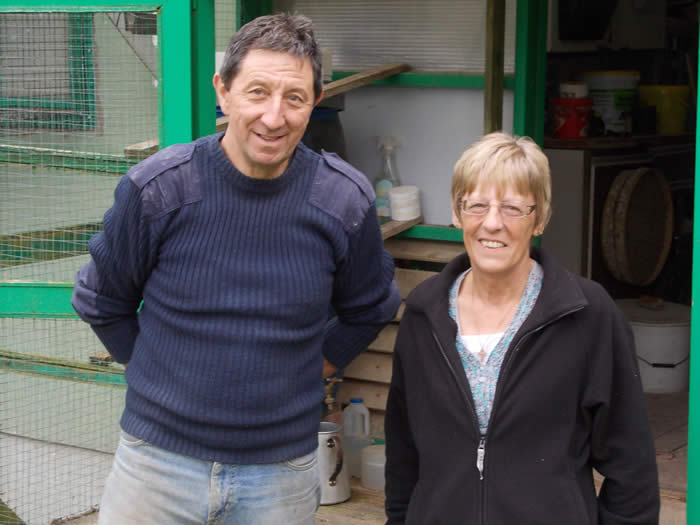
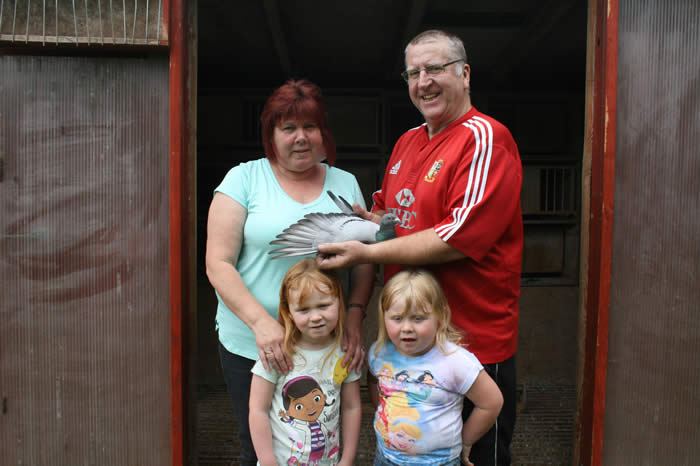
John and Pat Webber, 1st Open WSRNFC Bergerac only bird on the day.
IN THE BEGINNING
John first became interested in pigeons when he was about 10 years old. When John was 12 years old one of his relatives married an American pilot who John visited on several occasions at the Air Force base in Ipswich. Much to his delight one day an American refrigerator arrived at his home in a big wooden crate. The crate was swiftly requisitioned by John and placed on 6ft stilts in the garden and this housed the first pigeons. These consisted of unwanted birds off local fanciers and strays. A second loft was later built on a plot on the hillside above the village and measured approximately 3 meters x 1½ meters and was the first loft to which John raced pigeons.

A view from the Webber loft (on a sunny day!) over the village of Sixbells
THE PRESENT LOFT SET UP
The lofts have been at the present location since 1968 and are situated high on the hillside in a recess in the hillside, with lovely views across the valley and over the village. The lofts overlook the site of the former Six Bells colliery where John worked for 20 years. The colliery site is now landscaped and green with a massive monument of a miner named "The Guardian" constructed in memory of the 45 miners who died in a massive explosion underground on 28th June 1960. Pat's father, Frederick Rees, being one of those poor souls who perished there. Both Pat and John remember how it devastated the community for years.
The present racing loft was built in the early 1990s. The loft was constructed on a base of concrete blocks and is a two storey structure, the lower level being the garage/workshop area and the upper containing the race birds. This loft is designed in sections to enable the partners to race the birds on natural, widowhood or on the roundabout system. There are five sections to the main loft with plenty of room as the floor area covers 50 square yards and is 30ft x 15ft. The loft is designed to attain maximum ventilation with the windows and doors opening into aviaries and unless the weather is really bad they are open 24/7. Skylights are fitted into the roof so that the interior is extremely light and airy. Vents have also been fitted at floor level in the rear of the loft in order to allow an air flow through to all sections.
A second loft situated at right angles to the main loft and facing down the valley in a southerly direction, houses the young birds. This loft is 18 ft x 6 ft with a 12 ft x 4 ft aviary to the front.
The stock birds are housed in a 18 ft x 6 ft loft to the rear of the race loft. This also has a large aviary on the front with 15 natural boxes each measuring 2 ft square designed with a shelf to allow the bird’s access to two nest pans.
All lofts were spotlessly clean with a light dressing of sand on the floors which is sieved twice daily. Another loft which proved to be the original stock loft can accommodate a further 9 pairs of stock birds if needed. The normal practice is for the partners to have around 15 pairs of stock birds and 20 pairs of racers from which they usually rear a team of 50 young birds. However, due to heavy losses over the past few seasons while training, the 2014 young bird team amounted to 80 youngsters.
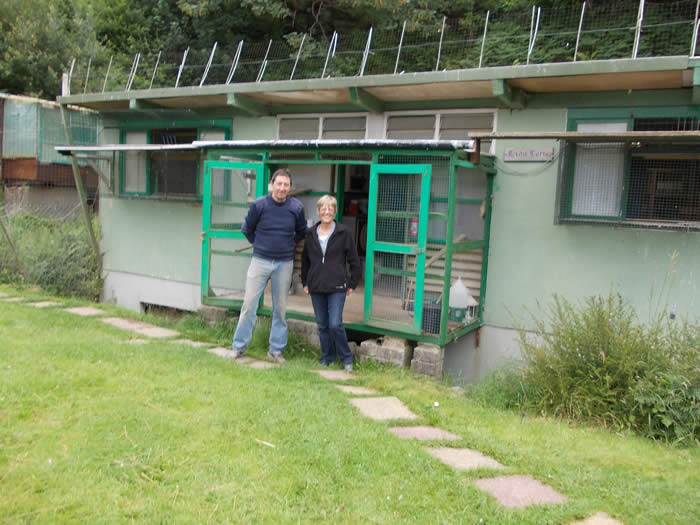
The old bird loft
MANAGEMENT
All the birds are mated on the closest weekend to Valentine’s Day. This enables the first round eggs from the stock birds to be floated under the race team. The racers are allowed to rear one pair then trained whilst sitting their second pair of eggs. The racers are then flown separated on a form of round about until repairing for their target races later in the season.
The race birds are exercised for one hour twice a day with the flags up with a day of rest on the day after the race. The cocks and hens then have an open loft and access to a bath for half a day each when separated - cocks in the morning, hens in the afternoon. When paired they have an open loft between exercise sessions.
Training is kept to a minimum due to the explosion of the raptor population in and around the South Wales valleys and any training undertaken is limited to 15 miles.
When separated the birds are allowed to see their mates for a short time prior to basketing.
Both Young and old birds are raced every week until the last race. The partners never start training until two weeks before the first race and the weather dictates how many times they go - which is every day if possible till the first race.
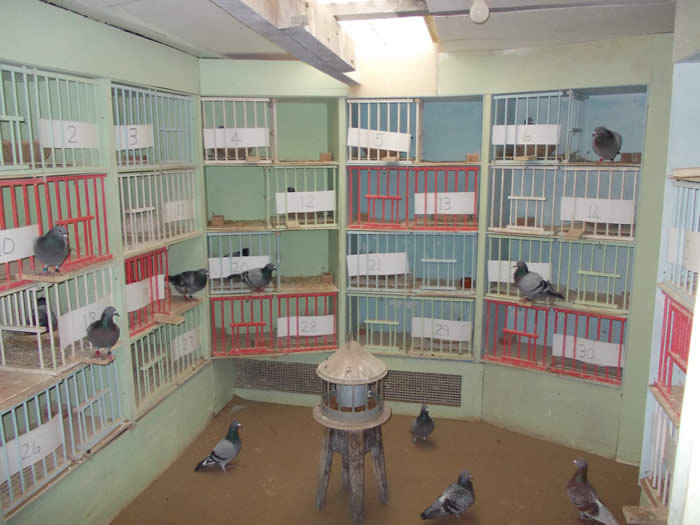
One of the old bird sections in the Webber loft
FEEDING
Old birds are fed in their boxes twice a day with corn purchased straight from the farm. A light feed in the morning and a heavier mix in the night. John and Pat are not too fussy as to what type of food is used as long as it is in proportion with the amount of work the birds are doing. This follows what John learnt from his past mentor Mr Dobbins who always said “keep in mind - cereals are for breakfast, potatoes are for tea”.
Once the 250 mile race stage is reached the birds are fed in the normal way i.e. in their boxes but with the addition of a hopper of beans made available at all times These hoppers are placed on top of a stool 2 ft off the floor so there is never any waste and no one pigeon can dominate the feed area. If John and Pat want the birds to eat more beans in their daily intake than they simply feed less in the boxes.
Young birds are fed by hand exactly the same mixture as the old birds and beans are added to the mix as the distance increases if need be. After the first three races young birds are fed to appetite.
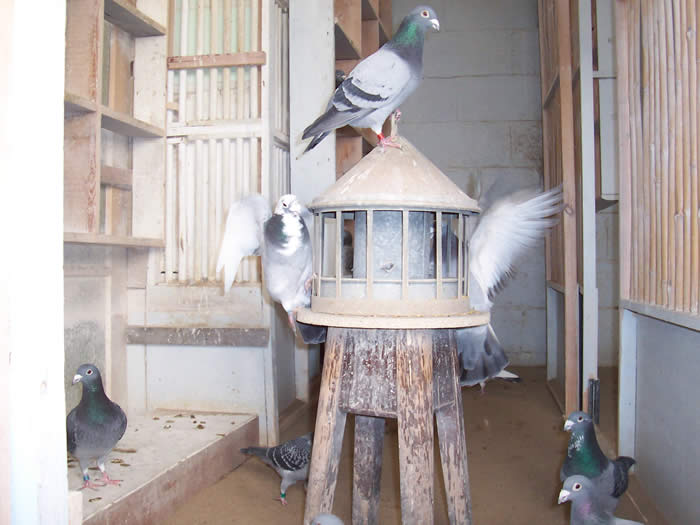
The hopper of beans positioned on a stool to ensure no waste and no pigeon can dominate
BREEDING POLICY
The usual practice is to cross breed for racing but always on the principle of winner to winner when possible. Sometimes they inbreed from some of the best lines and then do a 1st cross from different winning lines. This isn’t always "written in stone" and winner to winner has always worked well for them in the past.
"Pat's Pet" the winner of 1st National New Pitsligo 407ml was the dam of "Mr Softee" the winner of 1st National Oudenaarde 297 mls. "Solo 13" the winner of 1st National Bergerac in 2014 only bird on the day in Wales 15 1/2 hours on the wing, will be paired to her sire next season and the offspring kept for stock.
At the moment the Van Loon pigeons, which were purchased whilst on a visit to Louis Van Loon in 2005, cross well with the birds from good friend Ray Lambert of Abergavenny and are referred to as the "Lambert family". John and Pat regularly swap pigeons with Ray to the benefit of both lofts.
In 2003 the partners visited Andre Roodhooft and purchased two young birds and the hen of the pair, a Hofkens Janssen, has proved to be a prolific breeder especially when crossed with the Lambert line producing birds to win many Fed positions plus a 1st Combine from Lillers.
Another fantastic family housed is the "mouse family".
"Mouse" won 1st National Crieff 323ml in 2001 and is a small Blue Pied hen of Van Den Bosche x Verheye breeding. After winning 1st National she was then put to stock and paired with a cock from Cary Grother bred direct from J L N Houben pigeons. This pairing proved to be a goldmine, breeding Fed and National winners. "Mouse" and her previously mentioned partner went on to breed "Midge" a chequer hen who won 1st National, 1st Combine 8,078 birds Lillers in 2008 and 13th National, 15th Combine from Brussels in the same year.
And so to the main reason for this article - the Bergerac winner "Solo 13" who is the daughter of the aforementioned "Midge" when Midge was mated to a cock purchased from George Carteus whilst John and Pat were on a visit four years ago. This makes "Solo 13" a third generation National winner on Webber's side of the pedigree. During my visit I handles Solo 13 and she conformed perfectly with the partners' ideal type of pigeon being small to medium sized, well balanced and always in top condition.
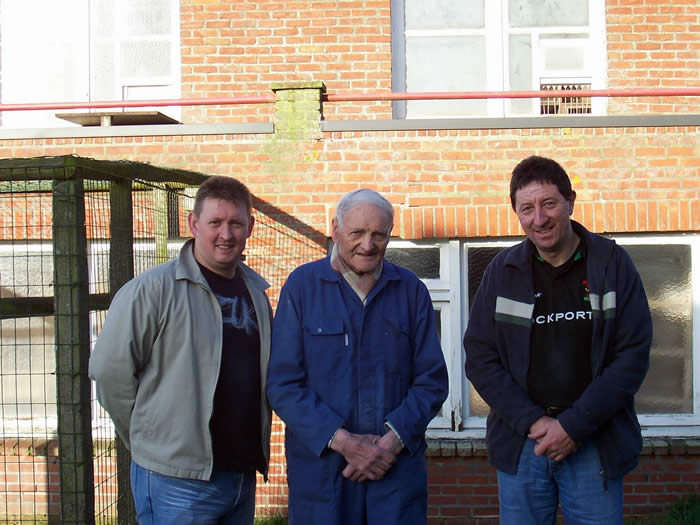
John Webber (r) with Craig Davies and Louis Van Loon
PERFORMANCES
A brief description of some of the partners' more memorable birds and moments:
1987: Kirkpatrick cock Captain Kirk 1st Combine, 1st North Road Open New Pitsligo 407ml 6,300birds.
1990s: "Rolly" - A gift from a recently deceased great friend Keith Jones (Stonker) of Pontypool. "Rolly" achieved many top positions including 2nd Open Newton Grange 286ml (found in the loft), 1st Newpitsligo 407ml & 1st Ripon 180mls.
2000: The partners took 10 of the first 11 positions in the Fed from Ripon young birds (1,928birds).
2008: The Webbers were the only loft in the history of the mighty Welsh North Road Fed to top the Fed four weeks in succession.
2012: Won Welsh South Road Fed individual points, 92 points clear of their nearest competitors.
John and Pat stated that all their National wins were very special in their own right.
"Basher" winning 1st National Thurso 475ml in 2001, 14hr 6 min on the wing timed in semi darkness and the only bird in Wales on the night. "Basher" was bred by John and Pat's late friend the incomparable Dennis Ford from Blaenavon and presented to a Fed sale and on the recommendations from another good friend, John Smale, he was duly purchased by the Webbers. "Basher’s" breeding was a mixture of 75% Wim Muller, Janssen x 25% Cattrysse.
His national win was made all the more special because it was thought that his racing career was finished following a hawk attack when he was ripped to pieces. However after some TLC, a full 12months off he seemed to return to his former self and was duly prepared for Thurso. Basher then went on to win:
1997: 1st club, 10th NNRF, Hexham 227mls. 1st club, 10th fed, 20th sect, 28th open WGNFC Thurso 475 mls.
1998: 1st club, 9th fed, 10th sect, 14th open WGNFC Thurso.
2001: 4th club, 18th fed, 26th WGNFC Crieff 323 mls, 1st club, 1st fed, 1st sect, 1st open WGNFC Thurso.
Winner of WHU QUEEN'S CUP and WGNFC MERITORIOUS AWARD and NNR FED BIRD OF THE YEAR 2001.
The Bergerac win this year is also memorable for a number of reasons but mainly because, unbelievably, this was the partners' first win in a race of more than 500 miles and also their 1st National win on the south road following a number of "near misses".
I won't bore readers with a very long list of the Webbers' many wins but will list here their National prizes in the top ten Open over the years.
9 x 1st National.
6 x 2nd National.
9 x 3rd National plus a further 17 top ten finishes at National level when competing against 1,000s of entries.
I should also point out that John and Pat bred the sire of possibly one of the greatest pigeons ever to grace a Welsh loft - none other than Scammell & Peploe's great "Nearly Cock" - a winner of 3 x 2nd National against thousands of entries and sire , grand sire etc of scores of 1st prize winners UK wide.
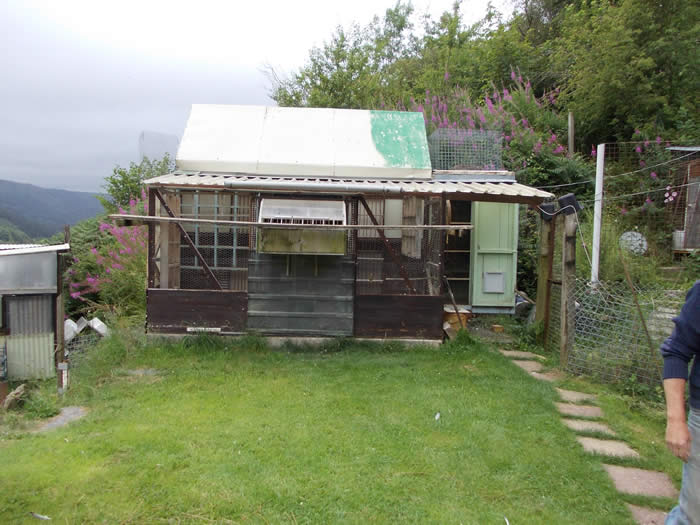
The YB loft
THE BERGERAC NATIONAL 2014
As mentioned in the opening paragraph, the Bergerac National was flown in conjunction with the CSCFC. I'll let John and Pat describe events on that momentous day:-
"The Bergerac race turned out to be such a challenge with the birds having to face a head wind and rain from start to finish with heavy drizzle and thick mist on the home end which lasted all afternoon and evening so much so that we had closed the main doors of the loft. The light was rapidly fading as were our hopes of any day birds. We were walking back and forth looking out across the valley through the glass louvers above the main doors when our little blue hen now named Solo 13 appeared out of the thick mist and was duly clocked at 9.32pm 15½ hours on the wing. The only ones who looked ruffled on the night were ourselves! The lights had to be switched on to enable the hen to eat some seed and have a drink. She then settled on her eggs as if she’d been out for an hour’s exercise, whereas we were over the moon. What a fantastic feeling after thinking 10 minutes previously that there probably wouldn’t be any birds that night. The Bergerac birds were convoyed and liberated with the CSCFC and there was only one bird on the day with that organization also, at Portsmouth 100 miles to the South East of our loft.
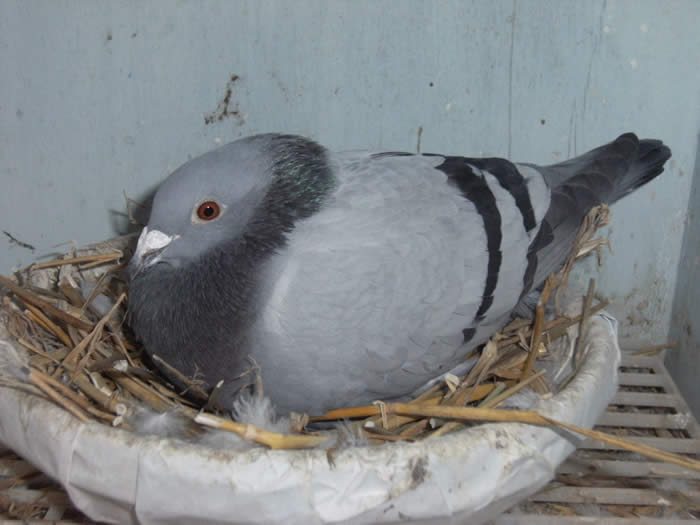
Solo13 the Bergerac National winner on the nest
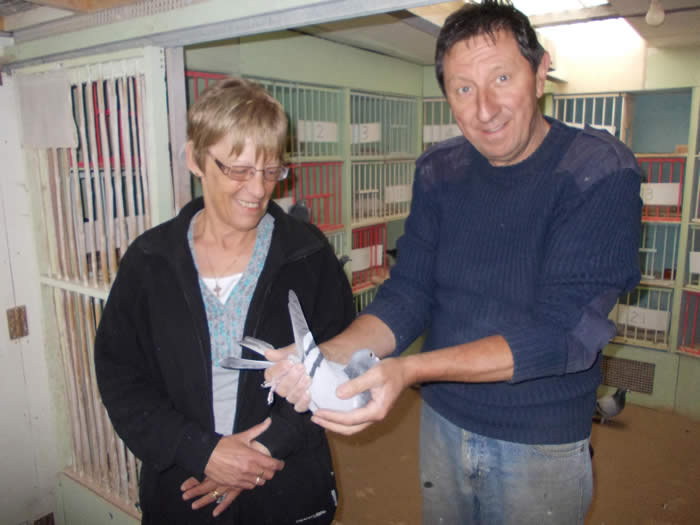
Pat and John with Solo 13
MEDICATION
The birds are always treated annually for canker, cocci and worms and swabs are sent off for testing to a well known vet in Colchester.
Vitamins are used twice a week along with honey. Garlic bulbs are submerged in the water butt 24/7 and this natural product is one that is valued highly. However, clean water is a must as often as possible.
John and Pat don’t feel that you can make a pigeon into a long distance winner by trying to feed extra amounts the week before its designated race and so they alter the amounts as the season progresses.
Such has been the Webbers' success in Welsh pigeon racing over more than twenty years, that a number of years ago I offered to write an article on the partners only to be told by John: "You're welcome to come over IF we win another National". It was a pleasure to take up that offer and I didn't have to wait too long for the pleasure. Congratulations John and Pat on a terrific record of wins at all levels of competition.
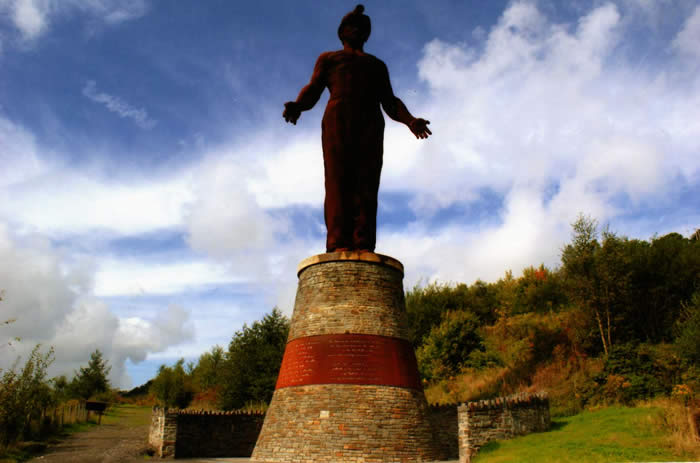
The memorial to the miners who lost their lives in the Sixbells mining disaster of 1960
---
Elimar - September 2014