The Art of Breeding, Conditioning and Racing Pigeons for Success in National and International Races
by Gareth Watkins
In a slight diversion from the long distance series I thought it might be of interest to readers, if in this article, I outlined the pigeons, methods and breeding programmes of three lofts that have gained consistent success at National, and in two cases, International level, in races up to 600 miles.
BRIAN SHEPPARD of Trowbridge
To win a National race is every fancier’s ultimate aim. Many outstanding fanciers have achieved this aim whilst other top-class fanciers have come close on numerous occasions but never achieved their ambition. On the other hand, others of less ability sometimes get lucky by having a good pigeon “good” on the day and carry off the top award, rarely to be heard of again.
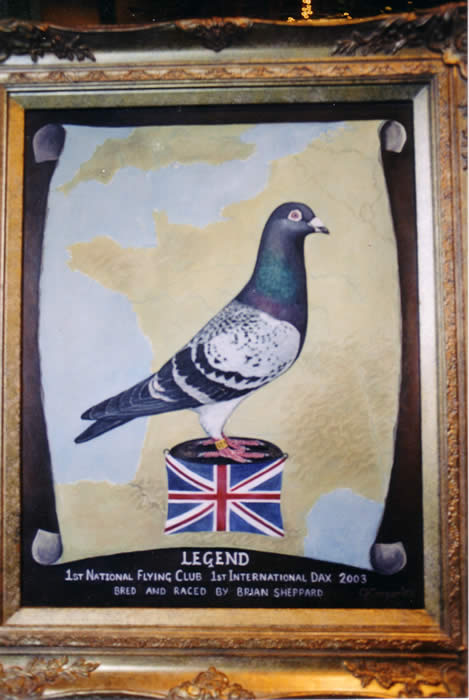
Brian Sheppard falls firmly into the second category, as he has a record at Classic and National level equal to the very best in the U.K. and after so many top ten finishes must have thought that fate had dealt him a “duff hand” in so far as he might never attain his goal of 1st Open in a National race. However, on that wonderful, fateful day in early July 2003, Brian Sheppard’s two year old widowhood cock put the record straight by not only winning 1st National but also by becoming the first pigeon from these shores to win 1st Open in an International race.
e
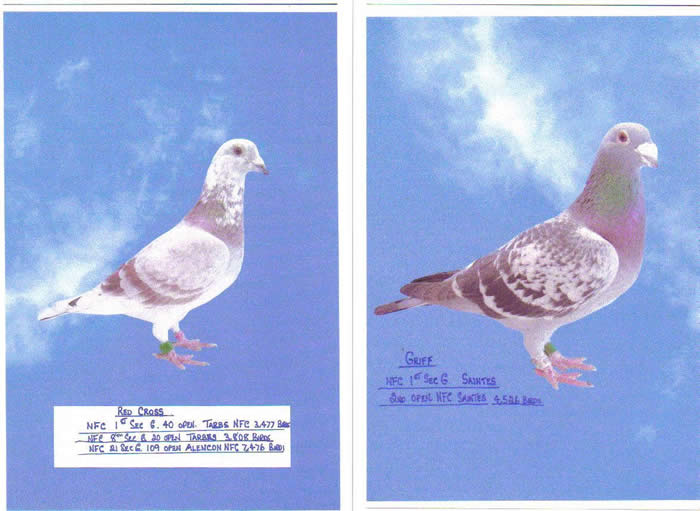
Liberated along with a convoy of 19,400 other pigeons from all over Europe, at 6.0 a.m. on July 12th in the town of Dax in the far south west of France, the “Legend” as he was to become known, set off on his 507 mile journey to his Wiltshire home. Temperatures that day were in the 90s Fahrenheit and the wind was blowing steadily from the north-east so it was obvious from the “off” that it was going to be a hard slog. It can be safely assumed from his winning margin of 44ypm, that “Legend” soon broke away from the bulk of the convoy and raced the greater part of the journey alone. In view of the strength and direction of the head wind, it also seems safe to assume that Legend would have raced up the west coast of France passing over Avcachon to the south west of Bordeaux, La Rochelle, Nantes and Rennes before hitting the northern coast of France at St Malo in the early afternoon some 8 hours after liberation. Without a moment’s hesitation, this courageous bird must then have forged on alone to face the treacherous English Channel at its widest point , close to 200 miles of sea with nowhere to hide from the unrelenting heat and no possibility of rest, before making landfall to the west of Bournemouth on the English coast. Once over the coastline, he would have turned slightly to the east before forging on northwards towards Wiltshire on the final leg of his epic, history-making journey. At 7.00 pm, after 13 hours of non stop effort in sweltering heat, Legend was welcomed home by a startled group of fanciers. All those present on his arrival that evening sensed that he was a good ‘un but none could have possibly imagined at that time just how good this little English-bred hero was – he had just beaten a field of 19,400 of Europe’s top pigeons entered by Europe’s top fanciers and he had done it with ease. I handled Legend four days after his triumph and can state that he was in absolutely superb condition – this therefore begs the question - How good was he when he was basketed for the race? Earlier in the season – 13 days earlier in fact, Legend had demonstrated that he was “on the boil” with a 6th Open finish in the NFC race from Saintes against a field of 4,526 birds. Add to this a 47th Open Saintes NFC against 3,887 birds and 34th Open CSCFC from Cholet with 3,800+ birds competing, both as a yearling, and you can see that the Legend had already put down significant markers as regards his racing ability.
There you have a brief introduction to a record breaking pigeon bred, prepared and raced by a top class fancier and before going any further perhaps this would be an opportune time to give some background information on Brian.
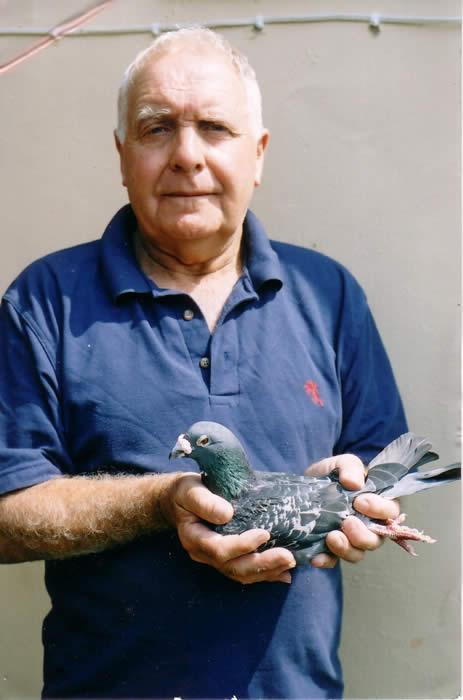
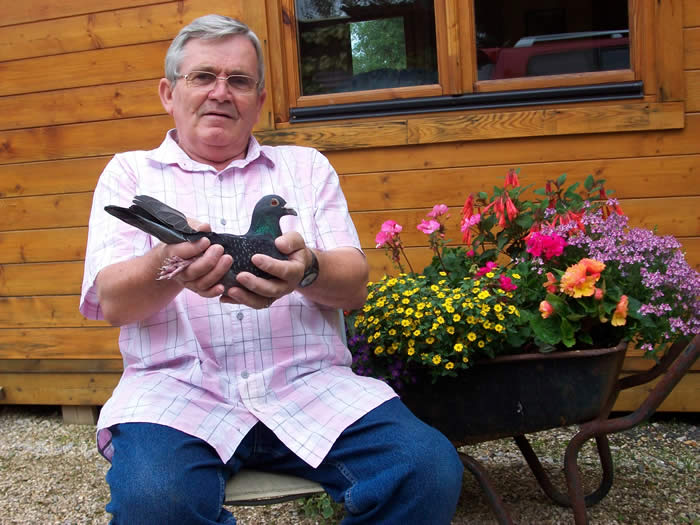
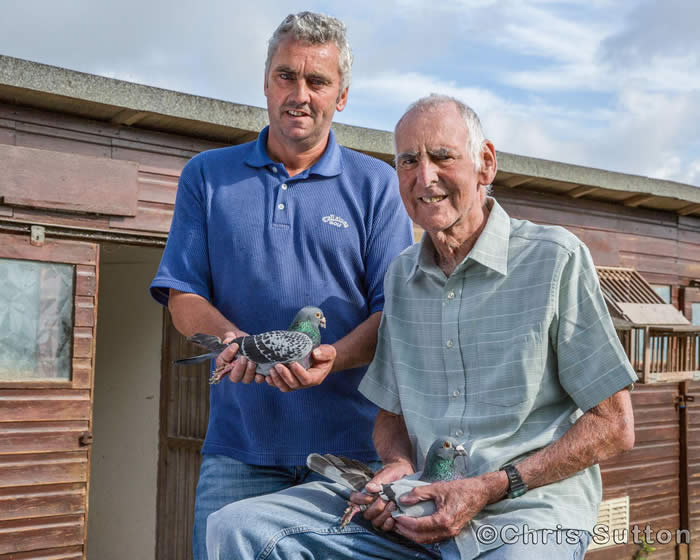
Brian Sheppard and Jingles
Brian Sheppard is now 75 years old and retired for some years, having worked for 24 years in the local Avon tyre manufacturing plant before moving on to become underground safety officer at a local stone quarry for a further 15 years prior to retirement. He has lived at his present address for more than 30 years and has been involved with pigeons for most of the past 60 or so years. Brian is not only a top-class fancier but also puts a lot back into the sport having served on committees for the various classic organisations.
I first visited the Sheppard set up in Trowbridge in the spring of 1997 having studied his consistently excellent National and Classic race results for some time previous. I was immediately impressed with his down to earth amiability and as time drew on and we “talked pigeons” it became increasingly obvious that here was a man who was a pigeon fancier through to his very bone marrow. The pigeons in 1997 were equally as impressive as the man himself and on my visit to celebrate Legend’s success, armed with a bottle of Champagne, nothing had changed to alter my initial impression of Brian or his pigeons.
This is not a huge set up and does not include a range of expensive lofts, but it is a very professional outfit as the birds are housed in a series of lofts designed to maintain super health. The widowhood hens are kept in a small converted garden shed with attached aviary. The hens spend most of the daylight hours in the aviary only being confined to the loft whilst the cocks are at exercise. At night they are ushered into a small section measuring 6ft x2ft x 3ft raised three feet off the floor which has a false grid floor that allows the droppings to fall through. Because of this enforced night time confinement in a small space the hens rarely become amorous towards each other, in fact the opposite occurs as they constantly bicker with one another over space.
The sire of the dam of Legend
A small team of stock birds is maintained and once again these are housed in a converted garden shed with attached aviary. A deep litter of dried droppings and rough sawdust is used on the floor and this is cork dry with no smell of pigeons or notable build up of droppings in any specific area, demonstrating that it is a working litter and as such offers no threat to the birds health.
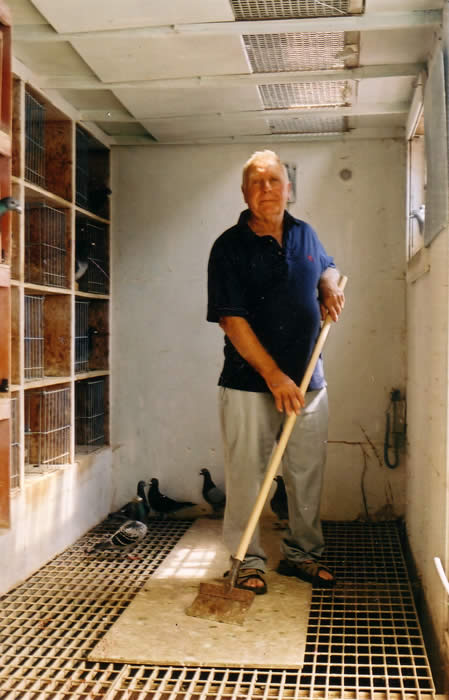
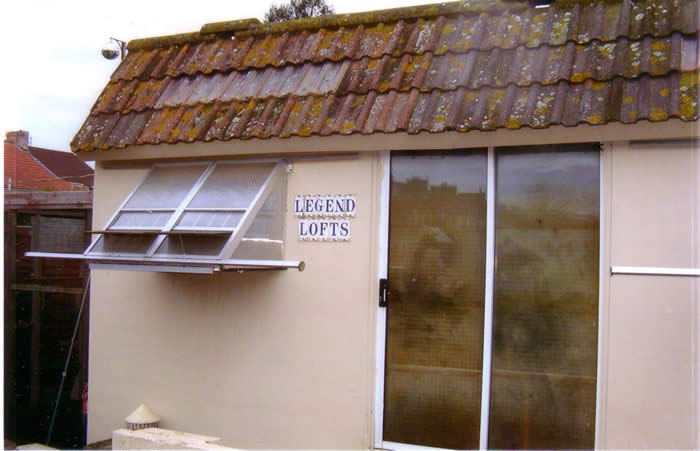
The race team of 25 or so widowers share accommodation in a block built 20ft x 6ft x 6ft loft. This has a pan tiled apex roof with clear Perspex tiles set in a row along the front section. The birds enter via two double-glazed glass sliding doors measuring 6ft x 5ft so the interior of the loft is very light as the loft front faces south. The floor is constructed from heavy metal grids, which are set on rafters above a 3ft deep pit. The droppings fall through into the pit and are cleaned away once annually thus saving valuable time cleaning.
Finally we come to the young bird loft, which is situated in the roof space above Brian’s garage. This is divided into two sections so that the youngsters can be separated if so desired.
The birds are a mixture of the tried and tested “Old English” strains obtained many years ago from top West Country long distance fanciers Reg and Myrtle Venner of Street and R. Trueman–Dicken. To this sound and reliable long distance base birds have been added from various sources but always with the proviso that they are closely related to top class performers. These bloodlines have all been tried and tested in long distance races on both north and south roads and the blend makes up the majority of the present day team.
On a visit to Trowbridge in January 2000 Brian told me that he had just introduced some birds from Jos Thone, via Ian Stafford. Jos Thone as most fanciers will no doubt be aware, is one of the top fanciers on the continent. In his down to earth West Country manner Brian said, “I hope they’m do some winning ‘cos they cost me a bloody fortune !” Well they certainly have done some winning as one of the original Jos Thone imports is the sire of Legend. Brian certainly knows how to pick them.
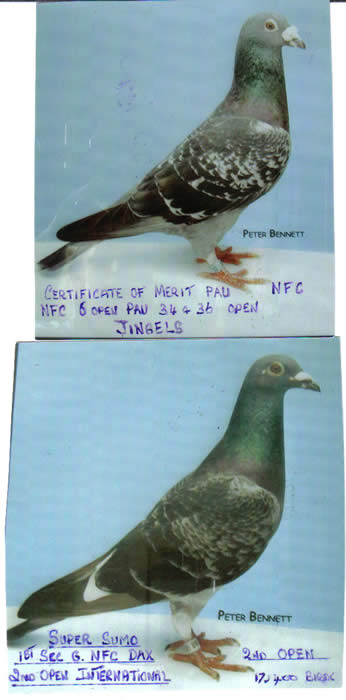
I should also point out that these Thone pigeons have produced a number of other good racers including a late-bred brother to Legend which was lightly trained as a baby and then won 1st from 700+ birds in its first ever race as a yearling – from Picauville in France. This cock later went on to win 2nd Open NFC and 2nd Open International against a field of more than 17,000 pigeons in the 2004 Dax International won by fellow countryman Mark Gilbert of Windsor. Incidentally, in this same Dax International, Dave Posey also won 1st Hens International making it a red letter day for English fanciers.
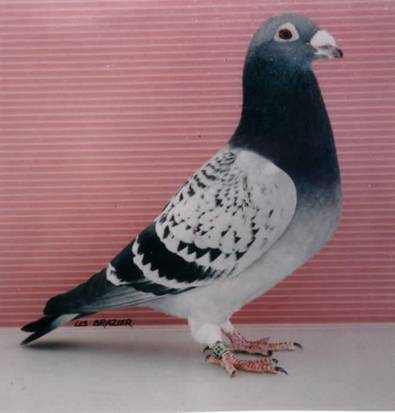
The type of bird developed by Brian over many years of testing over the channel is generally speaking small to medium sized and shallow keeled. They are mostly chequers and dark chequers with the occasional blue and pied. Some grizzles have now become apparent, no doubt due to the increasing influence of the Jos Thone bloodlines. Legend is typical of the old family as he is just on medium sized with a good width across the shoulders and good muscle development giving the impression of great buoyancy in the hand. He also sports a gravel/pearl eye and was sent to the Dax race with his first flight half grown. As mentioned earlier, his sire is a direct Jos Thone cock whilst his mother contains all the very best of Brian’s old family as she was bred from the same mother as “Jingles” when mated to the full brother to the sire of “Jingles”. “Jingles” by the way being Brian’s Certificate of Merit winner with the NFC winning 6th, 34th and 35th Open National from Pau.
The usual practice is to mate the team of widowers at Christmas and the widowers are allowed to rear a pair of youngsters in the first nest before going down on eggs for the second time and being allowed to sit for 6 days. The team is then separated and the cocks do not see their hens again until they are re-mated in late April. Whilst sitting this third nest of eggs the widowers are trained to the south coast at Portland and Thorness on the Isle of Wight. Following this early season training they are once more placed on widowhood, only seeing their hens for a short while before basketting for the channel races and on their return. During the 2003 old bird season, the Sheppard team of widowers underwent, in successive weeks, an exhaustive, but obviously not exhausting, series of channel races which reads as follows:- Picauville (139 mls), Picauville, Nantes [282mls] (BBC), Nantes (NFC), Picauville once more and then onto Saintes where they excelled with 2nd & 6th Open NFC 4,526 birds. In the two weeks between Saintes and Dax the birds were kept on their toes with twice daily forced exercise periods of one hour duration and did not see the basket again until the night of shipping to Dax.
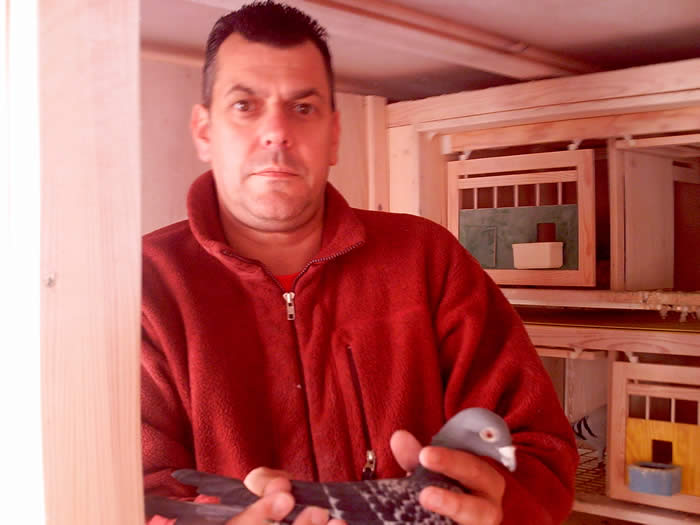
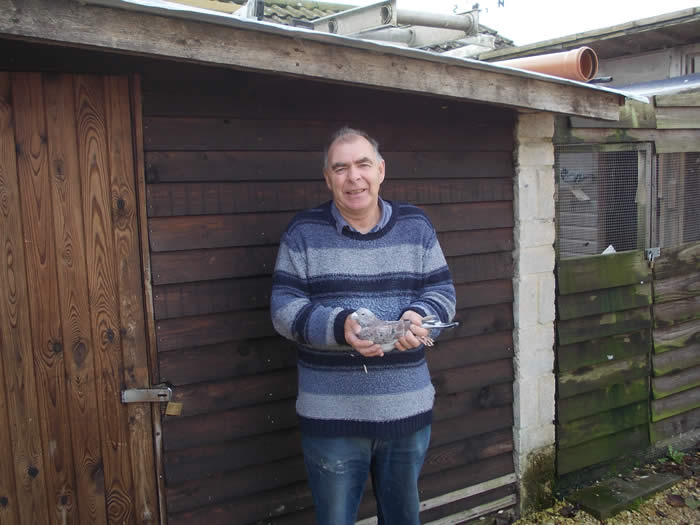
Brian in the loft
The widowers are fed twice daily, in their boxes with a measured amount of corn. This is a proprietary Belgian widowhood mix with a low protein content and a correspondingly high carbohydrate content. Over the years Brian has experimented with various mixtures and is not afraid to alter his methods if he thinks that the birds’ performances will benefit from the change. At the beginning of the racing season the widowers are allowed to do as they like during their twice-daily exercise periods. However as the classic races approach they are forced to put in a one hour shift on each occasion.
For a number of years Brian was not a member of a local club and so his birds were not raced weekly but prepared for Classic and National races by competing with the Wiltshire Continental Club which catered only for channel races. All of Legend’s early channel races from Picauville were undertaken with this well organised association.
Every one of the Sheppard young bird team is expected to fly the channel in their first year, with the hens going to every channel race if fit and well. As yearlings Brian expects the novice widowers to compete from Saintes 393 miles and as two year olds upwards they go to Pau, Bordeaux or Bergerac - or sometimes all three.
Reggie, winner of 1st NW Section, 6th Open CSCFC Pau
For a number of years now Brian has mated his stock birds in late November to breed a round of early babies. These early-bred youngsters are not put on the darkness system as the time of year that they are bred makes this unnecessary. However, the second round from the stock birds, and the widowers first round babies are put on darkness up to the beginning of June and Brian has not experienced any ill effects with them in their subsequent racing careers as old birds. The birds, both young and old, are trained privately to the south coast at Poole and Weymouth and gain their early season experience of channel racing via the previously mentioned Wiltshire Continental Club. Brian has now joined the Bath South Road club in an effort to lighten his work load with regard to the amount of private training he needs to do. Only when Brian feels they are fit enough are they engaged in Classic and National races. In order to get birds fit they must initially be healthy and so all birds are treated for cocci, canker, worms, salmonella and respiratory disease to ensure that they are in A1 health before any training takes place.
Jingles and Super Sumo
I won’t bore readers with a long list of the Sheppard team’s past performances but can state that the performances of pigeons like “Reggie” and “Jingles” are fairly typical of a long line of top-class winning pigeons over more than two decades. Highlighted below are some of Brian’s recent successes in top class competition. Readers can therefore judge for themselves just how successful these methods have proved for him. At one stage he won 5 x 1sts section plus a 2nd Section in a run of seven National and Classic races in which he competed. In the Saintes/Pau National of 2003, flown two weeks after the Dax triumph, Brian entered just two widowers with yet another incredible result of 1st & 4th section 45th & 106th Open NFC .The Langstone Gold Cup, awarded by the NFC to the fancier with the best average velocity in the 3 original National races flown each season has also found its way into the Sheppard trophy cabinet in the recent past along with 6 RPRA awards. Brian has also been the winner of the G A Baker Trophy with the NFC on six occasions. In the 2010 season Brian has continued his phenomenal run of success with 2 x 1sts section wins in classic competition.
Home of Champions
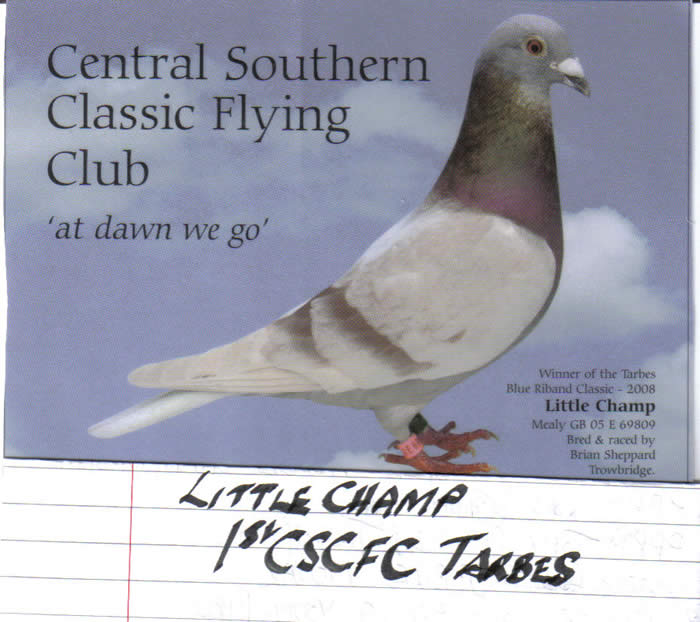
To summarise Brian Sheppards performances I can tell you that since turning to south road racing in 1989 Brian’s birds have won 19 x 1st Section G with the NFC; 8 x 1st NW section with the CSCFC and 3 x 1st section with the BBC. Add to these a 2nd Open NFC Saintes, 3rd Open NFC Nantes 2nd Open NFC Dax; 1st NFC Dax and 1st CSCFC Tarbes plus of course his record breaking 1st Open International Dax and it is not being too controversial to state that this man is an absolute genius at racing pigeons to win in top class competition. Not bad going for a small back garden set up!
I hope the reader has enjoyed this article on the first British pigeon fancier to win an International race. I can assure you that it has been a personal pleasure for me, as in 37 years of reporting on the sport, I have never met a fancier who was more deserving of the highest accolade or a more decent man than the HISTORY MAKER, Brian Sheppard of Trowbridge. Unfortunately I have to finish this section on a sad note, as in August 2010, Jean, Brian’s wife of many years sadly passed away after a short illness. I’m sure that all those who were fortunate enough to meet Jean, a truly lovely lady, will join me in wishing Brian all the very best in the coming months and years ahead after his great loss.
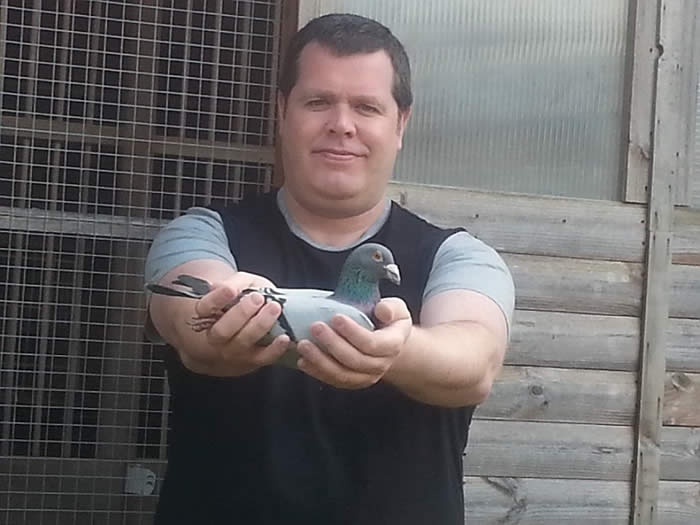
MARK GILBERT of Windsor
When a fifteen year old boy witnessed his single entry to the Pau National dropping towards its home loft, after completing its 560 mile journey from Southern France, to eventually finish 233rd Open NFC, two things happened. The first saw the lad burst into tears with emotion, and the second was his everlasting love affair with long distance classic racing.
The fifteen year old in question was none other than Mark Gilbert of Winkfield near Windsor in Berkshire and in the 30 years that have passed since that memorable Pau race Mark’s passion for long distance pigeon racing has, if anything, grown rather than diminished. In the intervening years many more races have been won by this likeable forty five year old businessman, but none can surpass the pride and joy that Mark felt on that evening many years ago.
Until the year 2003 many great British fanciers had attempted to win an International race competing against the cream of European fanciers, but to no avail. However in that year, the great West Country pigeon fancier, Brian Sheppard of Trowbridge, featured in the first part of this article, achieved what was previously thought to be the impossible when he clocked his two year old widower on the day at 501 miles in the Dax International to win 1st NFC and 1st International Dax with 19,400 pigeons competing. A brilliant, never to be repeated performance most thought. The very next year up comes Mark Gilbert to win 1st NFC and 1st International Dax, with once again more than 17,000 pigeons competing in a race which saw Brian Sheppard close behind at 2nd Open NFC and International with a half brother to the previous year’s International winner. Also in this 2004 Dax International race, Dave Posey of Oxfordshire clocked his great Dordin hen to win 1st Hens International, making it a clean sweep for British fanciers.
As I mentioned earlier, Mark Gilbert has been fortunate enough to win many races since his initial success and amongst these classic wins are 1st NFC Pau / Saintes; 1st BICC Pau; 1st BICC Pau; 1st BBC Messac, 1st London & South East Classic Bergerac and 1st Classic Guernsey. Add to these performances, scores of club, Federation and Open race wins, and you have the CV of one of the most successful fanciers in England at the present time. Most of the aforementioned performances have been achieved in the seven years that Mark and his family have been at their present address in Winkfield.
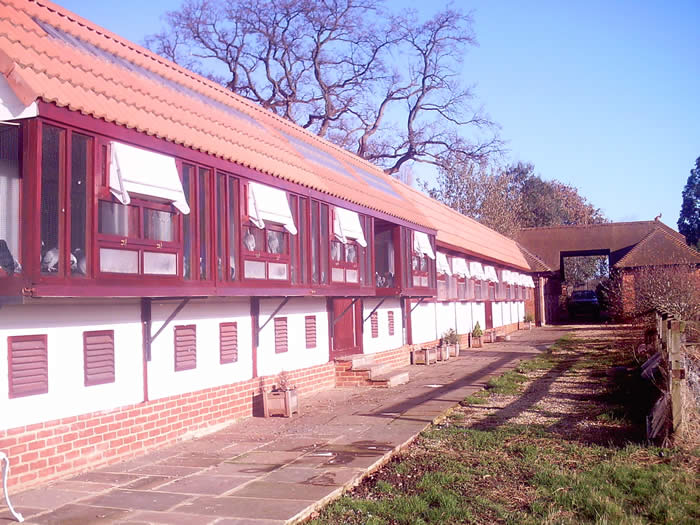
The grass is certainly not allowed to grow under the feet of this man as the range of lofts that have developed in this short time are nothing short of spectacular. Facing south east and measuring in total 140ft in length, with an additional 33ft brick built stock loft, they are a far cry from Mark’s original boyhood loft which was a 6ft x 6ft builder’s shed. The photographs that accompany this article will, I hope show, how impressive these Petron built lofts are. Each loft is 10 ft wide and has a 4ft wide corridor along the front allowing access to each section. The 72ft widowhood loft has eight sections that house the 86 strong team of widowers in six sections with a further two sections to house the widowers’ hens. The young bird loft, which stands immediately adjacent to the widowhood loft, measures 40 ft x 10 ft and has four sections which houses the 160 strong young bird team. The 2010 season saw 32 hens raced on roundabout system for the first time and these are housed in a 27ft loft with two sections plus a central corn store. All lofts have grid flooring and automatically cleaned nest boxes so the time spent on day to day loft management is reduced considerably, which must be a godsend to Mark’s father Geoff, who comes around daily to see that the birds’ every needs are catered for.
Mark’s father, Geoff, is a successful fancier in his own right and, along with Geoff Cooper of Peasedown St John near Bath, has been one of the major influences on Mark’s development as a top class pigeon fancier.
Management at the Southfield lofts is kept as simple as possible with very little frills attached. Once the moult is completed the birds are gradually brought up in readiness for mating. This takes place in early December for the stock birds with the widowhood cocks mated in early February. All the racers, whether they are sprint, middle distance or long distance are mated at the same time. Once their domestic duties have been completed the widowers are gradually eased into their daily home exercise regime and when Mark thinks that they are ready they are then given just two 15 mile training tosses prior to the first race which is usually at 80 – 100 miles. On each of these training tosses, the hens are in the boxes awaiting the returning widowers. The training basket is rarely used thereafter as the widowers are kept up to the mark with two one hour exercise sessions each day. The cocks are locked out of the loft during these periods and exercise freely as Mark rarely has to resort to the flag. Nothing much changes for the remainder of the old bird programme, except that Mark likes the widowers destined for the long distance classics to have two weeks rest from racing in the build up to their target race. Once the channel races arrive the birds are raced on alternate weeks.
The widowers and young birds are fed the same mixture when racing, this is Versele Laga Superstar Plus with 10% barley added. They are communally fed to appetite after each exercise period and the feeding stops once the birds start to leave the barley. The widowers are fed peanuts and seeds in addition to their normal mixture, in the final days of preparation for the long distance races.
The young bird team is raced on the darkness system and are extensively trained in preparation for the young bird programme. Once racing begins they usually get two tosses each week from 35 – 40 miles in addition to their twice daily exercise. On talking to Mark I had the impression that he is hard but fair with his youngsters and if fit and well they are expected to complete the programme including a number of sorties across the channel from Northern France.
The medication programme employed here is minimal. Stock birds and racers are treated for canker before mating and the racers get a further three day treatment for canker before going to their designated long distance race. Mark does not favour the use of supplements but has in the past used multivitamins. However he now feels that if the corn fed is of top quality it should contain sufficient vitamins to satisfy the birds’ needs.
This pragmatic approach is mirrored in Mark’s attitude to the handling characteristics of pigeons. As he said, he would rather have a winner that handled badly than a bad pigeon that handled like a dream! Having written this I can state that some of Mark’s best pigeons were on the large side of massive with some of the hens on the other hand being quite small and petite. This was particularly apparent in the Deweerdt family that he has raced with great success, both inland and overseas through to Pau and Tarbes. The cock birds in this family tended to be generally on the large side, mostly chequers, dark chequers with a few reds. They had excellent feather quality and good strong eye colouration. Mark went direct to the fountainhead to purchase these Deweerdts and has children of all the family’s best performers in International races through to 650 miles in the stock loft. These include children of Emiel, Ted, Iban etc and all are producing the goods at Southfield.
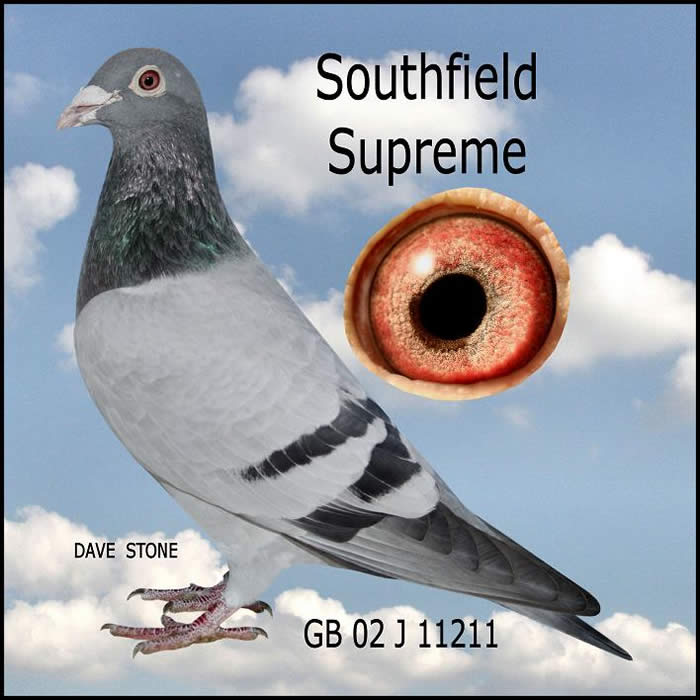
A second family introduced by Mark are the Va nElsakers and these are the pigeons that excel in the sprint and middle distance races. They were mainly blues and beautifully balanced pigeons with pronounced pectoral muscles and predominantly pearl eyes. It was a Van Elsaker widower, “Southfield Supreme”, that was to win 1st International Dax for Mark, proving that they can stay the course as well as sprint. Incidentally, Southfield Supreme since being retired to stock is proving to be a top class stock cock as he is already sire of 3rd, 4th, 8th, 11th, & 16th Open NFC as well as being grand sire to 9th & 10th Open plus 30th & 32nd Open NFC Tarbes this in 2010.Add to these top National prize winners 3 x 1st BBO Fed winners and you have the makings of a super stud sire.
The above two families make up the bulk of the Gilbert stock with a number of additions, such as some terrific descendents of “ Invincible Spirit” which are producing excellent all round racers when crossed with the Deweerdts .
Nevertheless, Mark is always on the look out for something exceptional that will give his racing performances an extra boost, and with his growing interest in International racing in mind, he has recently imported a number of late breds from German multi International winner Hans Peter Brockamp. These are all direct children of the Brockamp International winners and were very young but still old enough to show their class. I believe that they will be a useful addition to the Gilbert team both pure and when crossed with the ever dependable Deweerdts. This assessment has been borne out in the 2010 old bird season as Mark entered some 2009 late bred Brockamps in the Tarbes race and clocked two hens on the NFC result.
Mark’s breeding policy is to outcross for racing and inbreed to strengthen the family bloodlines for the stock loft. This breeding plan is based on the fact that only birds from proven National or International performers have been introduced over the past years irrespective of their family or loft of origin. The only thing that counts at Southfield lofts is PERFORMANCE.
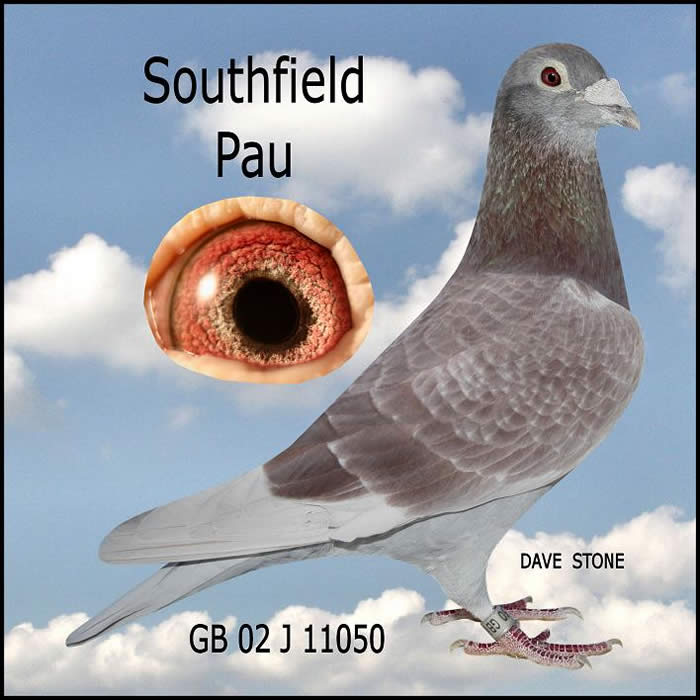
To illustrate this point I give you the case of one of Mark’s best Deweerdt stock cocks, bought from the Deweerdt family as a six year old. In two season’s breeding at Southfield he sired Red Cock “Southfield Pau” 1st BICC Pau; “Southfield Nightflight” 1st NFC Pau/ Saintes and “Southfield Darkie” winner of amongst other top prizes 1st BBC Messac in 2009 and 1st BICC Pau in 2010, and as Mark said he was one of the most non descript weedy little things you could imagine. He was however, apart from being a super stud cock, a full brother to the Deweerdt’s “Raldo” winner of 4th International Perpignan. He was mated to an Eric Cannon hen, a daughter of “Culmer Bess” to breed Southfield Pau and Southfield Nightflight. When mated to a daughter of “Emiel”, a winner of 1st International for the Deweerdts he sired Southfield Darkie.
I cannot close this report without mentioning another top performer at Southfield – Chequer cock “Southfield Treble” who won when racing the following prizes in long distance classic races:-21st BICC Pau; 34th NFC Dax and 5th BICC Perpignan International all in the same season! The next year Treble went on to win 8th London & SE Classic Bergerac 1st Greater Distance Club and 12th Open BBC Palamos.
There you have it then, Mark Gilbert an internationally reknowned fancier and all round good guy. Keep up the good work Mark.
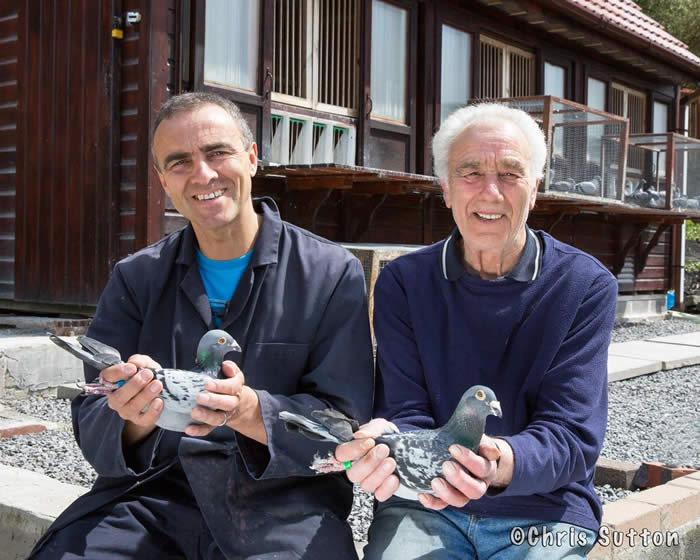
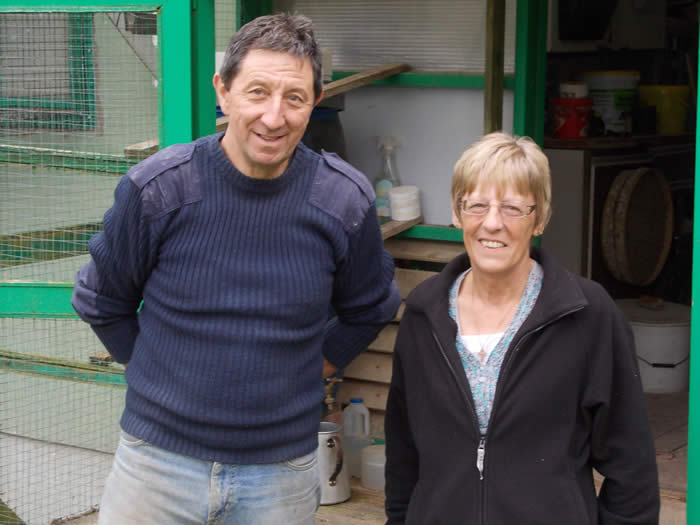
PREECE BROTHERS & SONS of Cwmtillery
The above partnership consists of brothers Colin and Henry Preece and Colin’s two sons, John and Leigh. To describe their results over the past 30 or so years as outstanding would be a massive understatement - something akin to describing Pele or the late Bobby Moore as “good” footballers. The partners have been fanciers out of the top drawer for more than four decades. I can remember visiting the partners in the late 1980’s following their great Lerwick National win of 1986 clocked on the day at 596 miles. Since that time they have wracked up something like 13 x1sts; 13 x 2nd Open and 12 x 3rds in National races, and their occasional forays into cross border classic racing has seen the name of Preece Bros & Sons feature prominently in the results.
The partners joined the Gwent Greater Distance club in the winter of 2007/8 with the intention of taking up the challenge of International racing with the BICC. Their results in 2008 old bird racing read as follows:- 11th sect 18th Open BICC Falaise 2 4,298 birds; 1st GGDC, 1st section 62nd Open BICC Saran; 2nd GGDC 3rd section 61st Open BICC Tours; 3rd GGDC 3rd section 37th Open BICC Alencon. Add to these positions a top ten finish in the Welsh SRNFC Tarbes race at 600 + miles; 1st Open Welsh SRNFC Bergerac 500+ miles [8th NW sect 52nd Open CSCFC] and one week later 1st &11th Open Welsh SENFC Giessen 520+ miles in an absolute disaster of a race with not much more than twenty or so birds clocked in race time from a convoy of close on 1,300, all flying over 500 miles. This constitutes an outstanding season’s racing in anyone’s estimation. The performance of the partners two year old hen in the Giessen race earned them the Queen’s Cup, a trophy awarded each season to the pigeon with the best performance or series of performances in races over 300 miles and flown under WHPU rules.
Old bird loft
All the above performances have been achieved racing a moderate sized team of pigeons to a relatively small back garden loft a fact that must give great encouragement to other back garden fanciers. As long as you have birds of the right calibre and the skill to get the best out of the best of these, then you have nothing to fear from the big team boys.
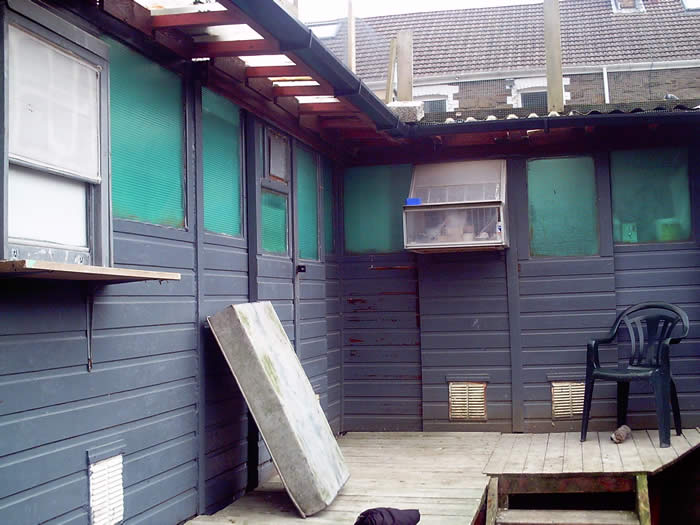
The loft is a 32 ft x 8ft L-shaped structure. Three sections with nest boxes house the racing cocks, whilst the hens occupy the remaining section that has an aviary attached. A 10 ft x 8ft stock loft also has an aviary and this houses 16 pairs of stock birds, whilst the 64 youngsters reared annually are housed in a separate 12 ft x 8 ft section. Once the stock birds have finished rearing they are separated for the year and the youngsters have access to their section in addition to their own 12 ft x 8 ft section, so there’s certainly no overcrowding here.
The race team, which amounts to 30 pairs, are mated in mid February and are allowed to rear a youngster and sit their second round eggs for 8 days, at which time the birds are separated and race the remainder of the season on round about. Twelve pairs are raced on the south road with the GGDC and BICC with the other 18 pairs competing on the east / west route. The old birds get something like five training tosses before racing starts and are then kept fit by twice daily home exercise until the build up to specific target races, at which time individual birds are trained specifically for those races, usually from around 50 miles. The race cocks are fed individually in their boxes and are allowed to eat their fill at each meal time following their twice daily exercise periods. There is always corn still in the pots when it comes to each feed. The hens however are controlled more strictly and are allowed access to the same food mix as the cocks but only for 10 minutes, after which time all remaining food is removed. The racers are never fed break down mixtures – they are fed a mixture made up from two sport mixes at all times and each night they get a special treat plus a pinch of Hormoform.
The usual routine is for the cocks to be airborne by 5.30 am each morning. They are allowed to do as they please for 90 minutes before being called in for their early morning feed. The hens are then released for their morning exercise and fed in after one hour. In the evenings, all birds are forced to fly for 1 hour, until the build up to the National races, when the hen’s get just one 1 hour exercise session per day but are trained every other day from around 50 miles.
The partners’ Bergerac National winner is quite some pigeon. This 5 year old cock, named “Benoni” has won the following positions in classic competition:-
7th sect 7th Open National Saintes as a yearling[12 hrs on the wing];49th sect 67th Open National Cholet as a two year old before being hawked and retired for the season. As a 3 year old 3rd sect 5th Open National Bergerac[ 9th sect 13th Open CSCFC] over 15 hours on the wing .The 2007 season saw him take a week to negotiate the 600 mile trip from Pau and this leads on to the 2008 season where he was clocked to win 3rd Section 37th Open BICC Alencon and 33rd section BICC Saran in the build up to the Bergerac National. His race preparation entailed two short in land races on the east/west route, the aforementioned BICC channel races, followed by four weeks rest and just one short 50 mile race and four private training tosses of approximately 40 miles. Once again, we see in the breeding of this long distance National winner, the influence of the great Dutch long distance families. His sire is a Jan Aarden containing the bloodlines of Smaraagd 2 and Dolle 2, whilst his dam was gifted to the Preeces by Tony Haynes of Ponderosa UK at Weymouth and contains the bloodlines of the Wim Muller Aardens. This medium sized dark chequer pied cock handled like silk and had one of the best full dark circles of eyesign I’ve ever seen.
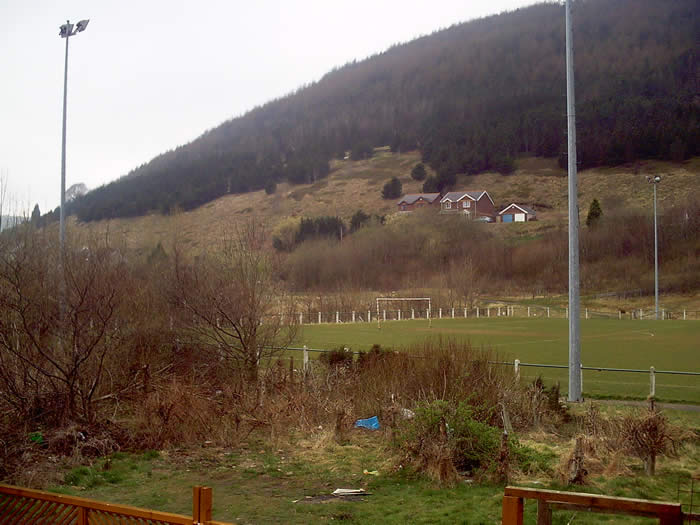
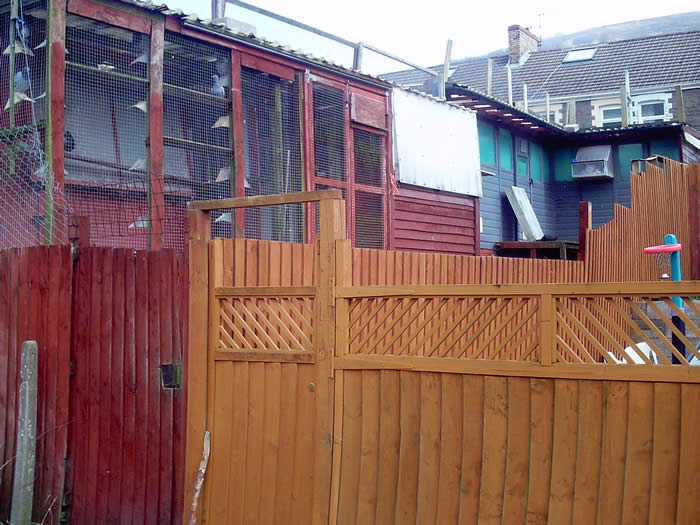
View from the loft
Next, we move on to the Welsh SENFC winner from Giessen. This 2 year old hen was sent sitting 10 day eggs as she had started to show an interest in some of the other round about hens. She contains the very best of the old Lee and Cooper Lefebre Dhaenen x Verheyes via Bob Lee, crossed with Van Loons from Richie Ryder and Lefebre Dhaenen courtesy of Jeff Davies. Her preparation for Giessen included four short races through to Maidstone [160 miles] followed by three channel races with the GGDC and BICC in one of which she was 7th Section BICC. Following these she was re mated and received 2 x 50 mile tosses and a couple at 40 miles which should have taken her 1hrs flying time. Unfortunately [or fortunately] she took 4 hours as the hens were well split up and some took all day to return home, due no doubt to a hawk attack. This Queen’s Cup winning hen was small to medium in the hand with short stubby legs and a strong thick neck, typical of the old Planet Brothers Van Loons.
Also handled was a magnificent blue cock winner of 10 x 1sts whilst racing plus a 2nd Open National and five other top twenty finishes in National races. This cock’s half brother also won third and fourth Open in National races, returning to win 3rd National with all the secondaries ripped out of one wing! Both these top class cocks were bred from the phenomenal “Ryder Hen” bred by Richie Ryder from the very best of the original Planet Brothers Van Loons. She is dam, grand dam etc of a host of top class performers up to and including National level.
During my short visit to the partners’ lofts I also handled the “Saintes Cock” winner of 8th National Saintes and 1st Open National Herstal among many other top performances. He was slightly deeper keeled than the other birds handled and yet he is now the number one stock cock being responsible for scores of winning pigeons at all levels of competition, especially when mated to an old grizzle hen which contains the bloodlines of Burgham Brothers and the old Morgan & Cook Atwells.
The 2009 season was another one full of top class performances at classic level with 3 x 1st National wins including 1st National Tarbes, plus 2 x 2nd National and 3 x 3rd National. The partners’ were also awarded their second successive Queen’s Cup. As I mentioned earlier in this article, the Preece partnership has now won THIRTEEN Nationals, a record that is unlikely to be surpassed, although Dennis Ford of Blaenavon might have something to say about that!
So we move on to the 2010 old bird campaign and the success story continued. In the Tours National race at 350+ miles the partners clocked a yearling round about cock a Richie Ryder Van Loon x Ponderosa Troye Janssen for 1st section 2nd Open National. This performance was followed by 1st section 4th Open National Reims and 2nd section 11th Open National Metz, both performances achieved by the same pigeon, a two year old round about cock, a grand son of 1st National Herstal and the champion stock cock “One Leg”. Next we move on to the Tarbes National and the 2009 Tarbes National winning cock was clocked once again to win 4th section 4th Open. This great long distance racer was also entered simultaneously in the CSCFC race where he won 5th section 21st Open.
Complete loft set up
The BICC Saran race was flown in very difficult conditions and the Welsh entry had to contend with a 30 mph North westerly wind for the whole of the course. Nevertheless, the Preeces clocked three birds on the day. The first in the clock proved to be good enough to win 1st GGDC; 100th North section [competing against fanciers in Essex, Suffolk and Norfolk] and 191st Open - a truly excellent performance given the conditions. This one was a half brother to Benoni the winner of 1st National Bergerac, and contains the Ponderosa Wim Muller lines crossed with the partners’ old grizzle family. In the Poitiers race flown in conjunction with the GGDC and the BICC the partners put up yet another outstanding performance when they clocked their yearling Ponderosa Muller x Lefebre Dhaenen round about cock to win 1st GGDC 3rd section 12th Open BICC, once again flying into a strong westerly wind. The Welsh SRNFC race for Carentan with young birds saw the partners clock another cracker to win 1st National yet again in a difficult race.
In this report I have featured two of the best exponents of National and International pigeon racing in England in addition to possibly the most successful National winning partnerships ever to ply their trade here in Wales. All three use “modern” methods i.e. widowhood/ roundabout or a combination of both to maintain an incredible level of success in races up to 600 miles. In the case of the Preeces and Brian Sheppard use has also been made of reliable old local bloodlines – pigeons that have been winning well into their locality for generations. These have then been crossed with more modern but equally successful “foreign” bloodlines to achieve even greater success. All three fanciers adopt a strict exercise regime in order to obtain supreme fitness in readiness for the tests at 200 – 600 miles.