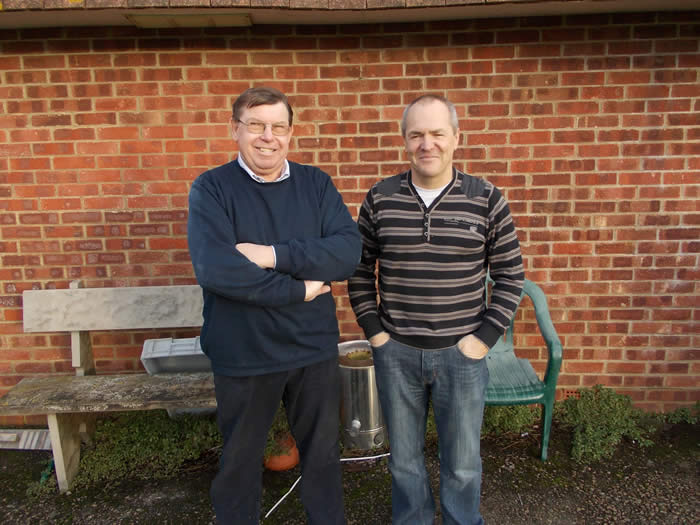
VISITS TO SOME OF THE LONG DISTANCE ACES OF LONDON & ESSEX
PART 2
MARK BULLED
by Gareth Watkins
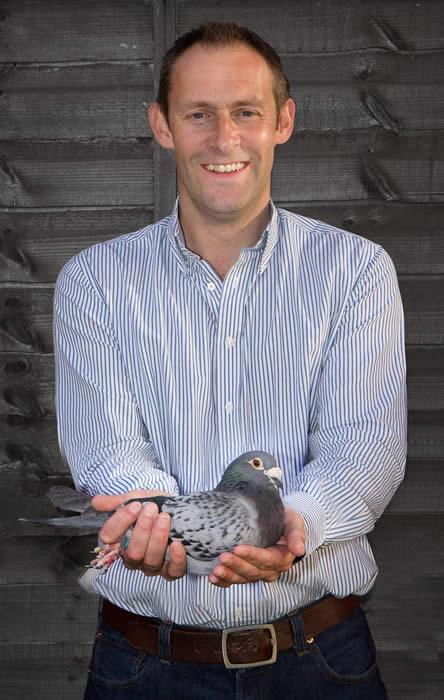
Mark Bulled with 1st Open NFC Tarbes 2012
In the first article in this short series I featured the loft of London North Road Combine Lerwick Ace Pat O'Sullivan of Enfield. In this the second in the series I will highlight the loft and pigeons of King's Cup winner and all round good guy Mark Bulled of Harlow. So here goes.
After leaving Pat and Angela after enjoying a lovely meal in their company we headed north east to the old village of Harlow [Old Town] and arrived at our base for the remainder of the weekend, The Green Man. A quick wash and brush up and we were soon in the bar sampling the selection of real ales on offer ready to await the arrival of Mark Bulled who had said he would join us for a libatory session and a good old chin wag.
Mark arrived around 8 pm and we had a long and enjoyable discussion until midnight when Mark called his cab and made his way home after arranging for us to visit the following morning.
Saturday morning dawned dull and overcast but thankfully dry and after a lovely breakfast we were soon on our way to Mark's home.
As many will know, Mark is a King's Cup winner from Tarbes with the NFC in 2012 and prior to that fabulous win had enjoyed great success on the north road through to Thurso and Lerwick with the London North Road Combine. These successes came when flying in partnership with his late Dad, Cecil and latterly alone. In addition to these great long distance successes Mark has also enjoyed great success in sprint and middle distance racing albeit with a different family of pigeons to his long established long distance family of racers.
As mentioned in an earlier paragraph, in the early years most of the racing was carried out on the north road through to Lerwick and Thurso where the family of hard day Westcott-Brutons thrived. Latterly the emphasis has changed as the competition on the south road scene has increased. This has seen Mark take on the National and International racing competition in races through to Tarbes at close on 600 miles with great success.
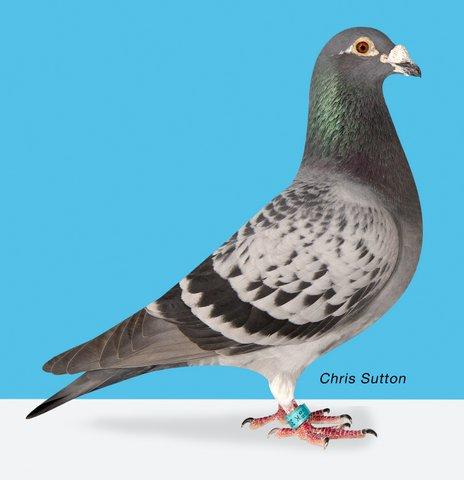
Legacy. 1st Section E 1st Open NFC Tarbes 2012
THE BEGINNING
Pigeons have always been an important part of Mark’s life as both his father and grandfather on his mother’s side were good pigeon men and there were always pigeons “at the bottom of the garden” so to speak as Mark was growing up. His father Cecil was, without doubt, the most knowledgeable and best fancier he has ever met. Cecil had a very sensible and simple approach to pigeon racing. He treated pigeons hard but fair and expected results. Cecil taught Mark not to mollycoddle the birds and not to worry about the ones that couldn’t make the grade advice that he noted well. Another piece of advice that Mark has heeded came from his Cecil’s good friend, Bill Bailey of Harlow, himself a double LNRC winner “Pigeon racing is the continual process of elimination”.
In the last old bird season that they raced together in partnership Mark and Cecil won 9th LNRC Stonehaven, 3rd LNRC Thurso and 1st LNRC Lerwick winning the coveted Tommy Long Trophy for the best average in the three longest LNRC races. In 1996, aged 25 Mark bought his own home and started racing in his own right.
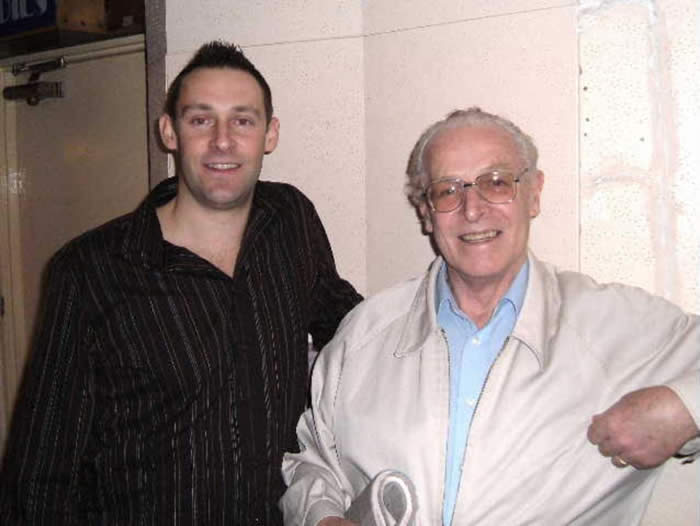
Mark with Dad Cecil
THE LOFTS
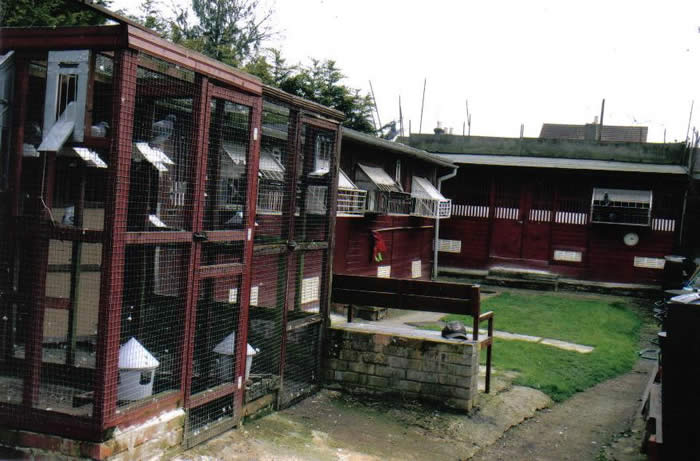
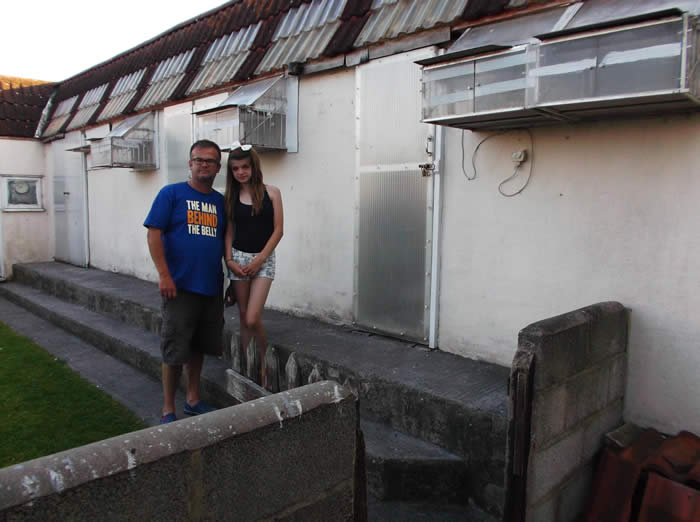
Mark still races to the same loft that he started with in 1996 after his move to his present home. It is a basic Blake’s Lofts construction, L-shaped to fit into his small garden. No tiled roof, no corridor. There are two five foot sections with 8 boxes, one 10 foot section with 16 boxes and a third 10 foot section for storage and widowhood hens. This loft faces south and east. In addition Mark has a new young bird loft and has recently moved the stock birds into what was the young bird loft. That is the sum total of the Bulled set up.
On his move Cecil bred Mark a team of babies which were supplemented with youngsters from friends, and raced under the methods that Mark and his Dad had put together during their successful partnership era. The Fed YB average was won in the first year, and Mark ended up top flyer in the North London Fed the following season a star was born. Not long after moving to his own home Mark also won the LNRC Lerwick and LNRC Berwick.
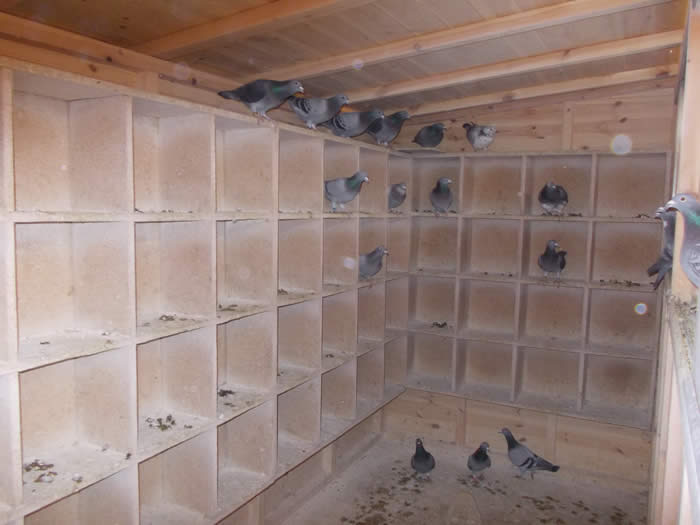
Interior view of Mark's YB loft
MANAGEMENT
The lofts are cleaned daily in the summer and the nest boxes have plastic grills fitted to reduce the workload slightly. During the winter the lofts are cleaned when time allows but always at least once weekly at the weekend. Young birds are kept on deep litter from weaning until July when they too are cleaned daily.
Mark’s race team consists of 24 widowhood cocks plus 8 cocks paired to 16 hens. Mark mates 8 younger hens to 8 yearling cocks, leaving his older hens celibate. Once the first round young birds are reared, both the yearling cocks and younger hens are raced widowhood in the early part of the season.
The 8 older hens are raced celibate for the first races but are introduced to the yearling cocks before and after the race. They are then paired to the yearling cocks for their selected long distance race. This gives Mark a maximum of 48 old bird racers.
At present Mark has 14 pairs of stock but this can vary if he decides to make some new introductions to trial. A team of 60-70 young birds are bred annually from the stock birds and the best of the tried and tested old bird race team. The old birds are mated at different times but usually around late January/earlyebruary each year. All birds are mated at the same time with the exception of the hens that Mark has earmarked for the long distance races in June and July.

RACE PREPARATION
Mark likes his pigeons to maintain a certain level of fitness throughout the year and he is fortunate that he doesn’t have a major hawk problem although he has lost the odd pigeon including his 2nd Open BBC winner off the loft in recent times. The pigeons fly out every weekend during the winter so they can bath and Mark can then give the loft a thorough weekly clean. Once the birds are through the moult a high percentage of farm barley is introduced to the daily feed. All cocks rear a nest, and get as much exercise as possible once young birds are feathered. The young birds are weaned with the hens before they lay again and daily exercise will then commence. Once going with a swing the cocks get at least 6 tosses before the first race.
When at exercise the cocks are locked out for an hour to do as they please. They don’t always fly the hour but they are always on the move. Hens don’t fly well at all so Mark resorts to gentle persuasion by throwing a ball at them if they land too early!
Because of time restrictions the racers only go out once per day with the hens out at 6am before work in the morning and the cocks out for an hour (or longer if they are flying well) after Mark returns from work in the evening. The young birds go out after the cocks have finished their exercise stint in the evening.
Once their pre-season training has been completed Mark never trains the widowhood cocks after the first race. Hens will not get any routine training but if he is going anywhere he will take them with him in order to keep their minds on the job in hand. This training does not usually extend beyond 20 40 miles but it is usually against the prevailing wind ensuring that the birds have to work hard to get home.
There is no specific preparation for National race candidates as Mark is content to ensure that the birds have had plenty of good food the last few days before and that they are basketed calm and quiet. As far as widowhood cocks are concerned Mark always shows the hen no matter what distance to be flown. He has tried not showing the hen but has found that he always has more success when the hens are introduced to the cocks for a short time before basketing.
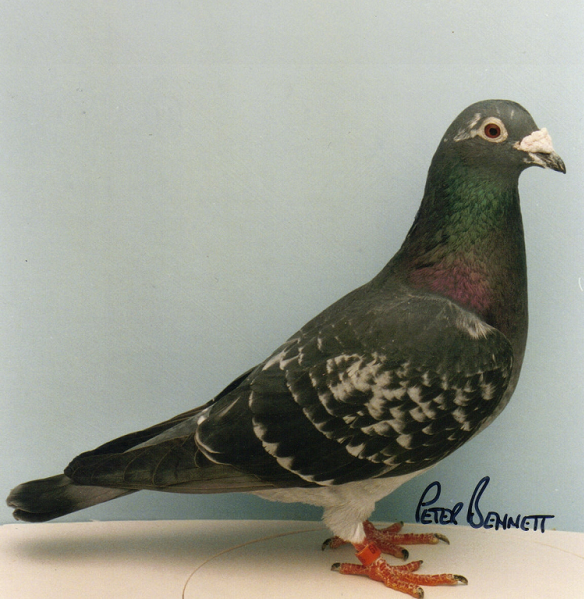
Day Return
YOUNG BIRDS
The Bulled young bird team is extensively schooled in their year of birth, something that Mark believes to be essential. Before the first race he likes to train them up to 30 miles north, south, east and west. They may get 20 tosses before the first race. Training around the clock like this can prove very difficult with losses, but Mark is convinced that it’s a very important part of their education. They will then go to every race in the programme, but not necessarily over the water as young birds. Mark makes a note of everything in his “little black book” so that he has a ready made dossier on every pigeon. Most of his good channel pigeons were well raced as babies but only inland.
The young birds are raced on the natural system and Mark allows them to pair if they wish thus ensuring that they hold better feather. He has also enjoyed a fair degree of success with young birds feeding babies. However, Mark does not attach much significance to young bird racing as he firmly believes that the winners of the young bird races are generally the fanciers who have their young birds on the darkness system and who train the most.
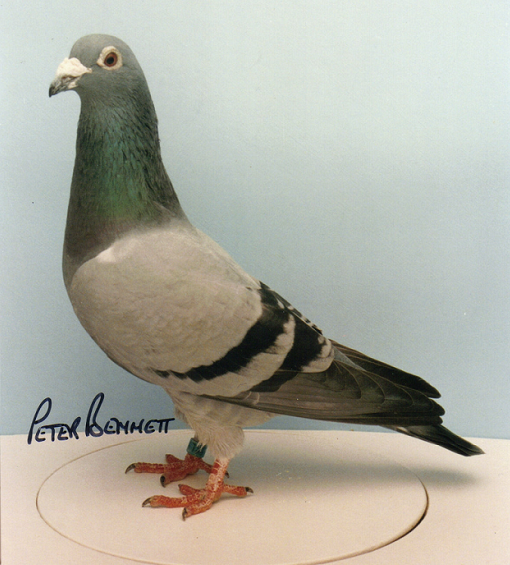
The Ugly Hen
FEEDING
The race team are fed by hand although Mark doesn’t measure the food, but feeds purely by instinct. They are all fed twice daily in their boxes with no corn left overnight. The sprint and distance birds are fed very similarly as Mark makes up three mixtures for his race needs and feeds according to his instincts, as such the feed may vary from day to day during the week.
Young birds are fed in trays generally as much as they can eat on a GEM Cowood mixture with at least 20% barley included. Feeding stops once they leave the barley.
Stock pigeons are hopper fed on a good solid breeding mix. All corn is bought in bulk from Gem Supplements and this usually lasts most of the year. Mark has found through trial and error that this is the best quality and most economical corn on the market. He usually buys the breeding mixture which he uses all year round for general purpose, plus the Cowood mixture for young bird racing. He also buys a few bags of Versele Laga Super Widowhood and Superstar plus, maize and peanuts which are also added to the base mix at various times during racing season.
The maize and peanuts are added to the racers’ feed once the race distance goes beyond 200 miles. Good quality farm barley and tic beans are also used in the mix during the winter months.

Die Hard, the father of the loft.
BLOODLINES
Mark has developed two very different families for racing.
The origins of his distance family can be traced back to the 1950s and originate mainly from the original Westcotts and Jock Reid’s, Stenhousemuir, famous “Big Hen” lines. The Westcotts came from Mark’s Dad’s best friend Bill Bailey, who bred Cecil’s first London North Road Combine Thurso winner, “The Owl” the only bird on the day from 5700 birds.
The Owl’s four Grandparents were:-
NU58CC 469 Bred by W Westcott
NU60WA934 a Granddaughter of Keeble’s King’s Cup winner (Keeble was Westcott’s loft manager I believe?)
SURP62NW1666 A daughter of Jock Reid, Stenhousemuir, Big Hen
NU60WA934. As above, granddaughter of Keeble’s King’s Cup winner.
The current distance team originate from this line and this family have produced 500 mile winners in every generation. Over the years Mark has experimented with the odd pigeons from top distance pigeons to cross into them and has found that the best cross was the old Busschaerts that his Dad bought in 1980. In more recent years a couple of very good pigeons have come from Roy Fox (Fox & Justice, Harrow) and more recently some good birds have been introduced from Darran McFadden, Cranleigh.
However the main bloodline is still predominately The Owl, Westcott/Bruton blood, which Mark refers to as “the old family” or a “Bulled Pigeon”. It was particularly gratifying for Mark, having always wanted to win Pau [now Tarbes], to win the Grand National from Tarbes with a “Pure Bulled”.

The Owl. 1st Open LNRC Thurso 1975 only bird on the day.
During my visit I handled many representatives of the old "Bulled Family" and it took me back 45 years to when my father and I raced the old Wally Grantham Westcotts, as they were absolute "spitting images" of our old family of Westcotts. Medium sized, long cast, bold headed cocks and small to medium sized shallow keeled hens. Fine boned and buoyant with surprisingly big wings in proportion to their body size. The only difference being the eyesign on the "Bulled family" which was uniformly outstanding.
These pigeons certainly don't need a petrol bowser and a new set of tyres to keep them fit.
The second family of sprint pigeons are mainly based on Soontjens which Mark introduced from Frank Sheader in 1992. These immediately won the Fed out of turn and Mark has subsequently introduced top individual pigeons into this Soontjen base and in particular a fantastic Red Busschaert from John Taylor, plus Janssen x Van Loons from Robbie Wilton and a Staf Van Reet hen from Mark Sands. These pigeons of mainly Soontjen bloodlines have won consistently in the sprint/middle distance races for Mark making him a true “all rounder” in pigeon racing terms. We handled winner after winner from this sprint family, some with 7 x 1sts Fed to their credit as well as good turns in middle distance classic races.
In order to develop his present day all distance families Mark has employed both inbreeding and line breeding with line breeding proving the most successful. If Mark introduces a cross into either of his two breeding lines he immediately goes back to his original line, resulting in 75% Bulled sprint or long distance blood in the progeny.

The loft set up with the new YB loft on the right
MEDICATION & SUPPLEMENTS
Mark confesses to having a very limited knowledge of medication and as a result tries to keep medication to a minimum as when he has tried the common route of medicating more often, he found that the birds’ performances dipped. He prefers his Dad’s theory of looking to remove the worse pigeon in the loft at all times.
Mark takes the pragmatic approach that if you think of how many fit, healthy, well bred pigeons we all have that rarely win - what chance does a poorly young bird have? Very little.
His basic programme would be to vaccinate the whole loft against PMV after the moult, then simply a canker treatment before breeding and a worm treatment before racing. During racing, if he feels that something was wrong or performances were poor he would get the droppings analysed and treat accordingly. He doesn’t treat for Paratyphoid or respiratory ailments.
Readers should not think that Mark is averse to treating if things are wrong, but he fails to see the need of routine treatment of pigeons that are in good health. Of course, most fanciers have problems from time to time with their young bird teams and if this arises in the Bulled set up then the worse ones are immediately removed. However, Mark does keep a general antibiotic to hand which can be used in emergencies.
Mark is not convinced on the use of supplements and believes that we as fanciers only use them so that we believe we are doing the best that we can by our birds. He keeps to a very basic programme of honey on return from a race, Naturaline on Saturday/Sunday, and Johnson’s Tonic/multi vitamin alternatively on a Wednesday.
During the winter or with young birds prior to racing he will give either cider vinegar, garlic or an oregano supplement from time to time, which he believes is probably more for the maker’s benefit rather than the good it does for the pigeons. Mark feels that two supplements that cost nothing and would be his number one and two are sunshine and fresh air!
PERFORMANCES
Some of the highlights of Mark’s career in the sport are listed here:-
1st NFC Tarbes & King’s Cup
1st LSECC Tarbes
1st and 2nd BBC Fougeres
1st LNRC Lerwick
1st LNRC Berwick Yearling
LNRC Tommy Long Winner
2 x LSECC Flyer of the Year.
Awarded London Region Top South Road loft.
Mark is unaware of any other fancier who has won London Region Top Loft (overall) on the north and south routes i.e. Lerwick in the LNRC and Tarbes LSECC, these being the longest races organised by London organisations on north and south routes plus the Tommy Long/LSECC Flyer of the year the Main Award organised by the London Organisations (north and south). If anyone has then it’s a terrific feat and deserves full recognition.
Twice London Region Top North Road Loft
Three times North London Flyer of the Year
Over 40 Federation sprint winners.
A total of 7x 1sts LNRC plus 1st LSRC Bergerac were won on the north road when racing with his dad and also when racing alone to his present set up. The LSECC has been won on two occasions, once from Thurso when channel racing was suspended, and in 2012, in addition to winning the King’s Cup from Tarbes with the NFC, Mark also won 1st & 2nd Open in the BBC Fougeres Charity Race competing against more than 1,700 pigeons.
However, the performance that has given Mark most pleasure was probably winning the LSECC Tarbes race with “Sargeant Cecil”, his first major classic win on the south road. “Sargeant Cecil” had already been a top pigeon and Mark worked out a programme for her to enable her to win Tarbes. This programme was carried out with the help of Mark’s wife Hana who was at home on maternity leave after giving birth to a beautiful baby girl, Abbie. Hana was able to let the birds out for exercise in the late afternoon so that they were ready to come in when Mark got home from work. It worked perfectly and “Sargeant Cecil” won the race by a very long margin. Nevertheless, Mark feels sure that he will be remembered more for his Tarbes National win in 2012.
TOP PIGEONS
Mark considers a pigeon named “Die Hard” as the best pigeon he has ever owned. As a racer Die Hard won a LNRC Hall of Fame award for winning 3rd, 3rd and 45th LNRC Thurso, which included twice first Fed Thurso.
As a breeder he has produced 1st NFC Tarbes and 1st LNRC Berwick. He is also grandsire to 1st LSECC Tarbes and 1st Scottish National Niort. He is 16 years old now and just recently reared another healthy young bird, highlighting the constitution of the old family.
In sprint racing terms the best one seems to be “The Red” which has also been something special. Not only a winner of 3 times first Fed himself, he is also the sire/grandsire of well over 10 Fed winners.
Some of Mark's other top long distance performers are:-
Day Return Dark Cock LNRC Hall of Fame Award winner taking 11th, 55th & 80th LNRC Thurso. In 7 full years racing, he only ever had one night out. He was a great grandson of The Owl, and was Mark's father's favourite pigeon. He was sire of many top distance performers and breeders.
The Ugly Hen (Blue) LNRC Hall of Fame Award winner taking 4th, 43rd, 55th & 97th LNRC Thurso. She was also dam of 3rd, 3rd, 4th, 18th & 26th LNRC, 5th &7th LSECC.
The above pair are parents of Die Hard another LNRC Hall of Fame Award winner mentioned above who is also sire of Legacy 1st NFC Tarbes.
Legacy Chequer Cock 1st NFC Tarbes winning the King's Cup.
Sergeant Cecil Chequer Hen 1st LSECC Tarbes, 19th LSECC Bergerac, 48th LSECC Tours, 52nd LSECC Tarbes, 88th LSECC Alencon.
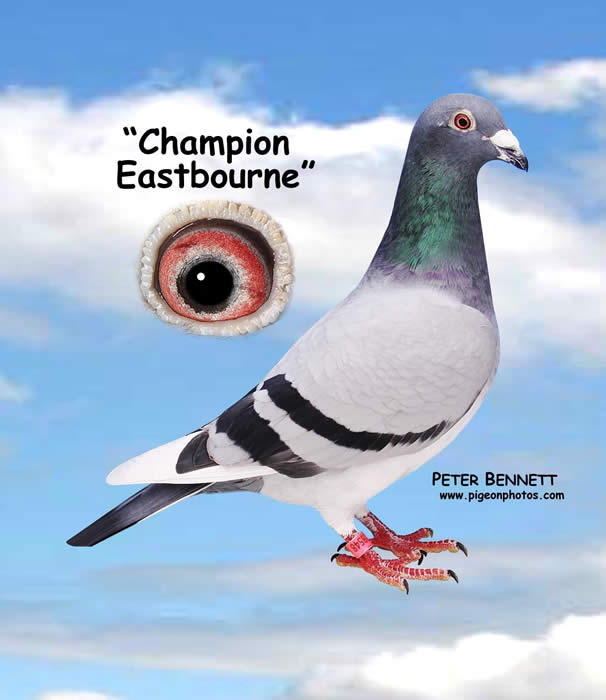
Eastbourne 1st BBC Fougeres
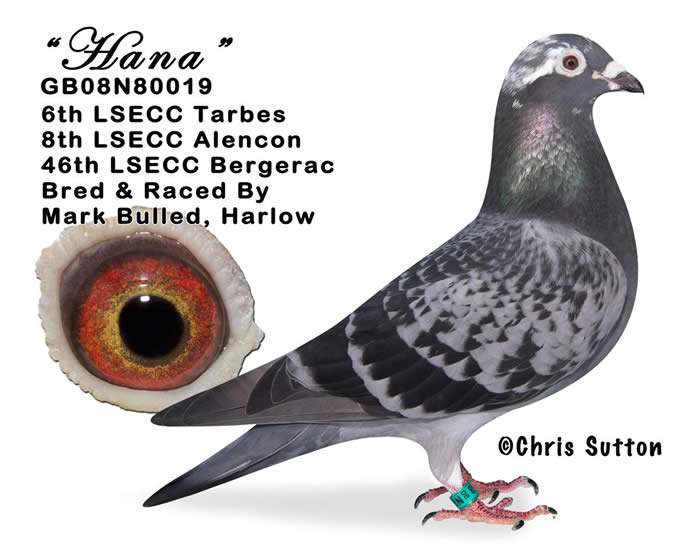
Hana 6th LSECC Tarbes, 8th LSECC Alencon, 48th LSECC Bergerac.
Pied Hen 11th LSECC Tarbes (only bird in section on day), 16th LSECC Tours, 29th LSECC Tarbes.
Some of the current race team handled during our time at Mark's were:-
"Bump" 18th BICC Alencon, 29th BBC Bordeaux, 73rd NFC Cholet.
"Old Slate" 10th BICC Marseille, 17th LSECC Tarbes, 59th 80th LSECC Bergerac, 86th BICC Pau, Flown Perpignan.
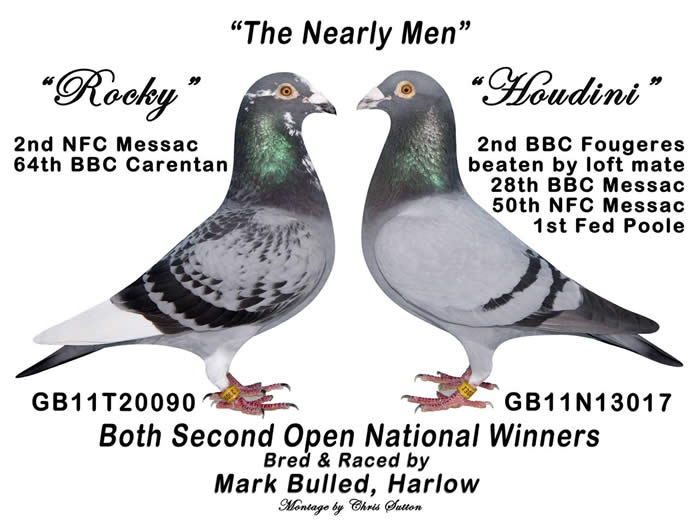
"Houdini" 2nd BBC Fougeres (arrived with winner), 28th BBC Messac, 50th NFC Messac, 81st BICC Le Mans.
"Rocky" 2nd NFC Messac, 64th BBC Carentan in his only two Channel races thus far.
LIKES & DISLIKES
Mark doesn’t like big pigeons full stop and there are none in his loft. He believes that racing pigeons should be well balanced and have good feather. His distance pigeons are very lightly framed, carry no weight, and are long cast with good wings and rich hazel eyes. The sprint pigeons on the other hand are apple bodied, small but powerfully built and sit in the hand with perfect balance.
He does like eyesign but has seen many champion pigeons with what would be considered poor eyes and as a result feels that fanciers should tread very carefully when using eyesign for stock selection.
IN CONCLUSION
Mark believes the most important thing to be successful at the distance is to have the right bloodlines. His father instilled in him at a very early age to work pigeons hard and not to worry about the ones that fall by the wayside. They just weren’t good enough. Then get them in the best condition you can and never be afraid to send your best to the big races.
The stock loft is very important. You must have the right bloodlines in the “bank”.
There you have it then, the story of how a relatively young man steeped in the history and traditions of the sport from a very young age and tutored by an outstanding fancier in the shape of his father Cecil, has achieved long lasting success at the highest level of the sport on both north and south routes.
Both Ieuan and I enjoyed our time with one of the UK's top fanciers of the younger generation. When you consider what this relatively young man has achieved in the sport at such a young age then you begin to wonder what more he can achieve in the years to come? Good luck Mark, your success is well deserved.
---
Elimar - February 2014