THE ART OF BREEDING, CONDITIONING AND RACING PIGEONS AT THE EXTREME DISTANCE – PART 5
by Gareth Watkins
In this, the fifth article in the series, I hope to outline the methods and pigeons of three top-class long distance enthusiasts. Both Derek Reid and Dave Impett are still actively involved in the sport. Unfortunately the third fancier profiled, John McLaren, has now retired and as far as I am aware now lives in South Africa. Both Dave Impett with his team of long distance Jan Aardens and John McLaren advocate a simple common sense approach to the sport. Read on and see if you can pick out some “nuggets” from three top long distance fanciers.
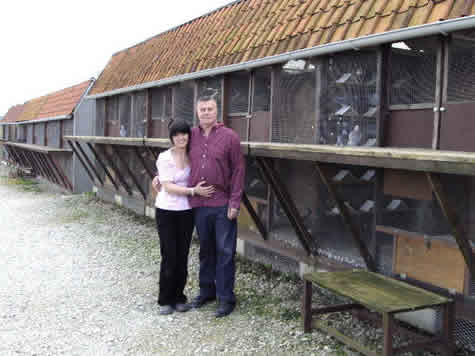
DEREK REID of Weybridge
Derek Reid, the subject of this loft report, is a retired businessman who did not enter the sport until he was in his late forties. Derek’s introduction came as the result of a chance encounter with a pigeon fancier named Tommy Mist, who was a regular customer at Derek’s business premises. One day Tommy asked permission to liberate some pigeons in the company’s car park – and the rest…
Derek’s interest was spurred and he soon set about building a small loft “for his son” and immediately began stocking it with introductions from Louella Lofts. The year after his inaugural season in the sport, Derek ordered a brand new Kidby loft and it was obvious by this time that the pigeon bug had bitten deep. Membership of the National Flying Club followed and Derek immediately won 30th Open in the young bird National with 8,512 birds competing. By 1989 the Reid team was well established with consistent winning performances at club, Fed and National level. However, in this year disaster struck in pigeon terms, as Derek was promoted to a senior position in the company and his new post entailed extensive travel across the globe. This left very little time for pigeons, nevertheless, the pigeons were kept on and managed in his absence, by Derek’s lovely wife Elaine.
In 1993, although they didn’t realise it at the time, the Reids were to make an introduction that would change their whole outlook on the fancy. This sea change took the form of some Wim Muller pigeons obtained from Ponderosa U.K. at Weymouth. More about these top class long distance pigeons later.
The 1998 season saw Derek join the British Barcelona Club and it was at this time that his love affair with long distance racing really began. The 1999 season saw the Reid loft win 2nd sect 3rd Open Nantes, 1st sect 4th Open Palamos and 1st sect 13th Open Bordeaux plus 7th sect 96th Open Lamballe in the young bird National, all with the BBC, amassing 11 trophies in this highly prestigious club. It was at this time that Derek began to appreciate the ability of his original Wim Muller pigeons as he had, as he admitted to me “wasted six years by not really breeding from them”. This initial omission has certainly been made up for since as the Reid loft is now based predominantly on the aforementioned Muller pigeons.
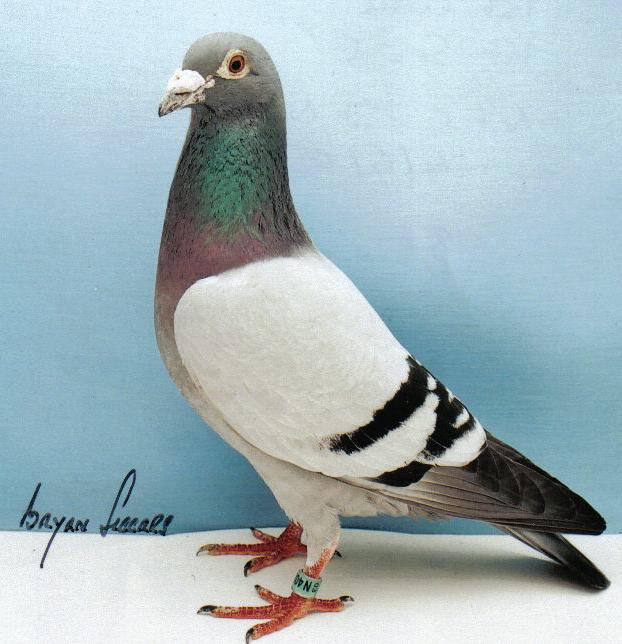
Between 1999 and 2005 the loft was consistently successful, on many occasions finishing the season as highest prize winner in the local club. It was in the 2005 season that Derek finally retired and what a season this proved to be. The first four club races saw three red cards and a number of other prizes taken by the Reid team of widowers. At St Nazaire with the BBC Derek clocked “Ryan’s Express” a Janssen widower for 3rd sect 19th Open and in the very next race, again from St Nazaire, but this time with the NFC, “Ryan’s Express” was clocked once again to win 1st sect 1st Open from more than 8,600 entries. Not a bad start to retirement! This National winner is bred from a Brian Clayburn Smits Van Winkel cock which was purchased as a young bird and was thought to be a hen. He certainly proved everyone wrong as he has since sired more than 25 x 1st prize winners and is rightly regarded as the sire of the loft in sprint terms. The National winner’s grand dam is a Janssen hen obtained from none other than the great loft of Planet Bros.
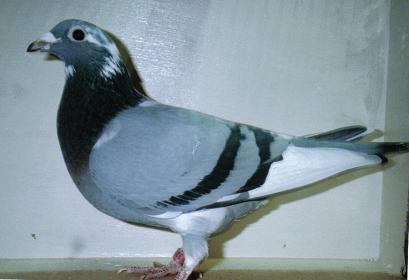
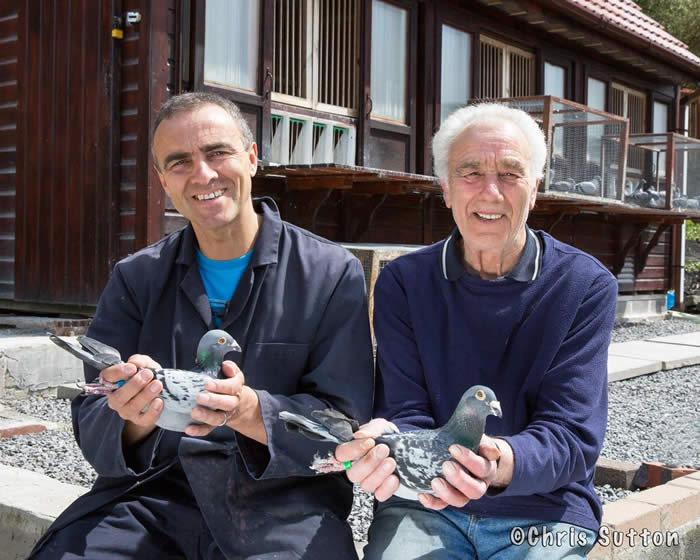
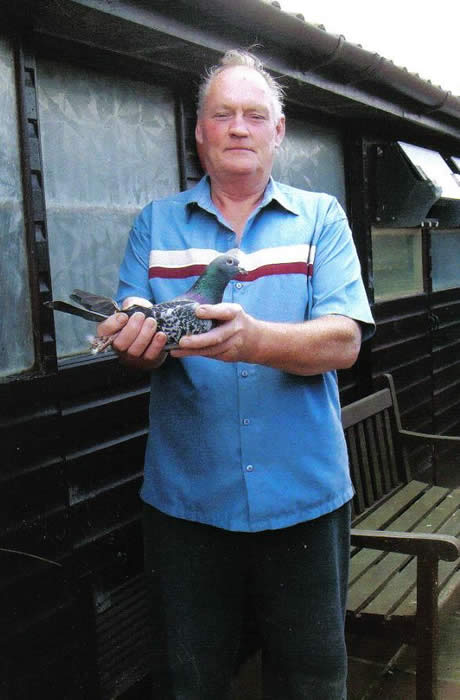
Derek Reid's National winner
More success was soon to follow, as in the BBC’s most prestigious race, from Palamos, at a distance of 675 miles, a dark chequer Wim Muller widowhood cock was clocked on the second day to win 1st sect & 1st Open to top a truly remarkable season. Incidentally, the grand dam of the NFC winner and the grand dam of the Palamos National winner are one and the same Planet Bros Janssen hen!
The success story continued throughout the old bird season as at San Sebastian [560 miles] the Reid loft again featured well up in the result with two crackers for 1st & 6th sect 10th & 47th Open. The Bordeaux National saw another top widowhood performance with Derek’s first in the clock winning 2nd sect & 18th Open at 447 miles. I’m sure you’ll agree, not a bad seasons work.
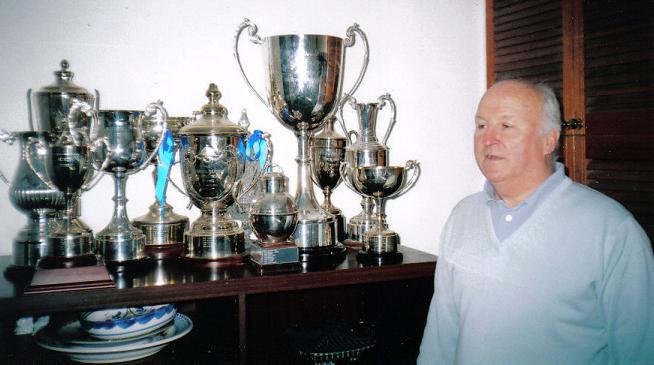
Derek Reid and trophies won in classic long distance races
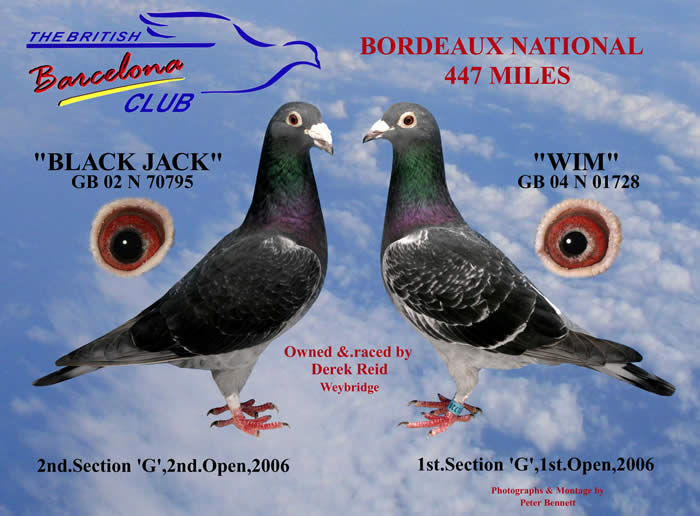
The 2006 campaign proved to be another milestone season. The season began with the first classic race with the BBC from Ingleton, a distance of just 210 miles. The Reid loft won 1st sect 28th Open in this sprint dash. The ban on continental racing that had been imposed by DEFRA at the beginning of the season was then lifted and in the Bordeaux National at a distance of 447 miles, two Wim Muller widowers were clocked to win 1st & 2nd Sect 1st & 2nd Open. The winner was a two year old dark chequer bred from a son of 4th Open Palamos when paired to a g.dtr of Invincible Spirit. His dam is a direct daughter of the original Wim Muller Foundation Pair.
The second cock clocked in this race deserves special mention as does Derek’s wife Elaine. The 2nd Open winner returned from an early season race in a terrible state as he was cut open and was given very little chance of survival. This is where Elaine’s dogged determination, skill and compassion was most clearly demonstrated. Twice a day, every day for two weeks Elaine tended to the injured widower, applying Savlon to his wounds and not a little TLC. Slowly but surely he recovered and within weeks was well enough to exercise with the rest of the team. He soon regained full racing fitness and was well enough to be entered in the Messac race where he returned fourth to the loft. So fit and well was he on his return that he was immediately earmarked for the Bordeaux National. A previous winner of 6th sect 47th Open San Sebastian, this 4 year old widower proved the old adage that “blood will tell” as his sire is a direct son of the Foundation Pair of Ponderosa Wim Mullers whilst his dam is a grand daughter of Black Giant again via Ponderosa. The final race of the BBC calendar was a young bird event from Sennen Cove a distance of 246 miles to Derek’s Weybridge loft. The team once again came well with the first in the clock winning 1st sect 8th Open.
The 2007 season saw a continuation of the Reid success story and I quote here only classic prizes won:- BBC 1st & 2nd section 4th & 5th Open Messac; 15th section 106th Open Palamos. NFC 11th section 23rd Open Alencon.
I won’t detail any more of Derek’s classic performances here, as after a while, some readers will switch off and lose interest. I can however assure you that there are very many more top class performances in the Reid C.V.
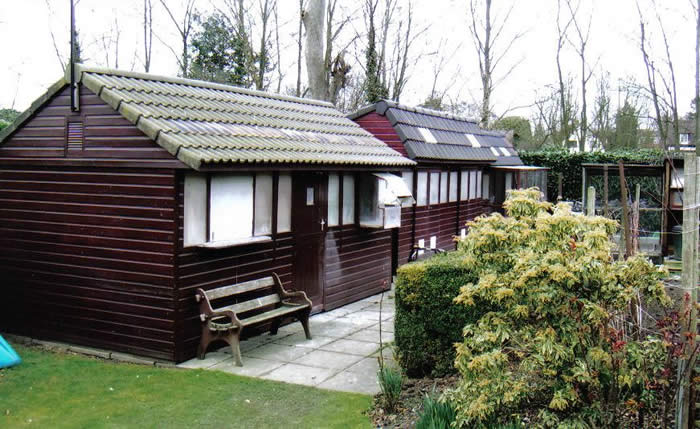
Reid lofts
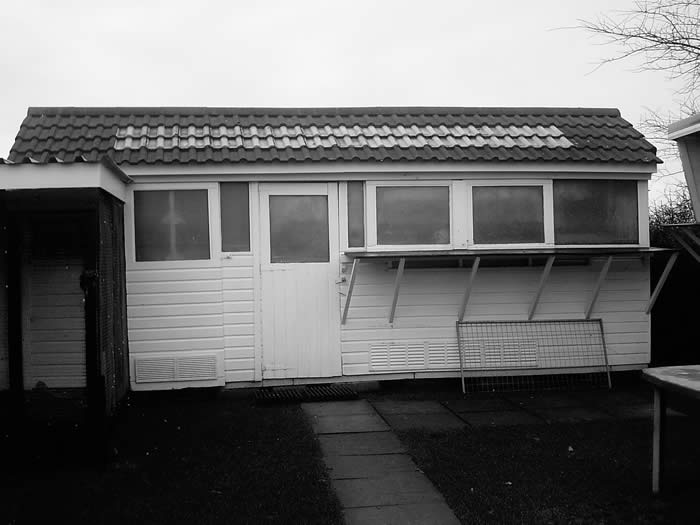
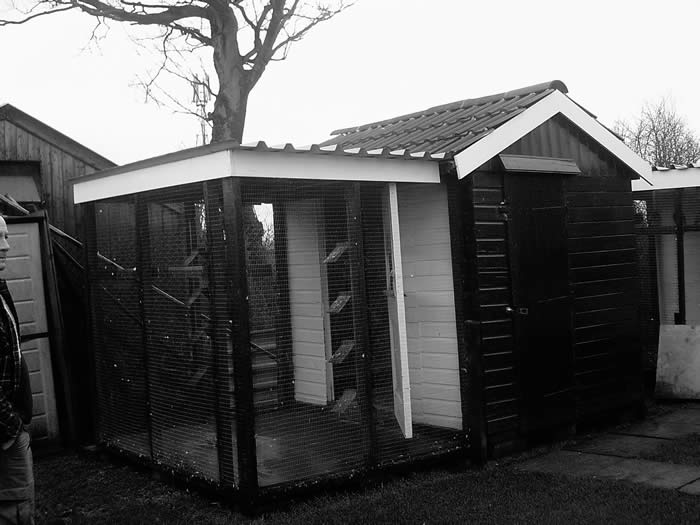
Since the initial small back garden loft was built for Derek and Elaine’s son in the mid 80s, the range of lofts at the Reid’s lovely detached Weybridge home has expanded considerably. A team of 28 widowers earmarked for classic long distance races are housed in a 16ft x 8ft loft whilst the 24 widowers that are expected to compete in sprint / middle distance races are housed in a similar sized two sectioned loft with tiled roof. The 16 pair stock team are comfortably housed in yet another loft, with aviary attached and, like the widowers lofts, this faces southeast.
The young bird team enjoy spacious accommodation in a further range of lofts that face south west. These lofts have now been replaced by a new custom built structure that came into use for the first time in spring 2008.
The sprint widowers and stock birds are mated in late January whilst the long distance widowers are held until mid to late February/early March before being paired. All widowers are allowed to rear a youngster, not necessarily their own, and are then placed on the widowhood system. The cocks get a few training spins before the season begins and in 2006 this amounted to just three tosses at 20 miles. The sprinters are usually expected to race weekly in the inland programme whilst the long distance cocks enjoy a couple of “pipe openers” before being selectively prepared for their target races. The widowers are exercised around home for one hour twice per day. During these exercise periods they are locked out of the loft but are not forced to fly. They are simply allowed to do their own thing.
All birds both young and old are fed exclusively on Versele Laga mixtures and Gem supplements. The young birds receive their first toss at 20 miles and the youngsters are kept at this distance with regular tosses up to the first race and throughout the season. Elaine is responsible for the training and is quite capable of covering any of Derek’s duties in his absence. The Wim Muller young birds in the young bird team are normally only trained to the coast in their first season whilst the rest of the team usually complete the programme. As yearlings the Mullers are once again raced lightly out to 250- 300 miles but as 2 year olds they are expected to do the business out to 500 miles.
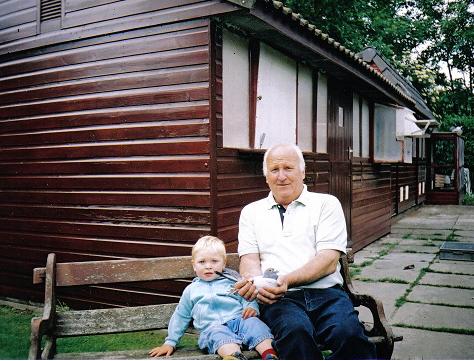
Derek and grandson
Derek has developed two distinct families of pigeons for two distinct types of races. The sprint team are mostly blues and chequers and are strong and robust in the hand with excellent pectoral muscle development. The Mullers on the other hand are small to medium sized dark chequers and dark chequer w/fs, some of which are rather “wirey” in the hand and they certainly don’t like to be handled as they are constantly struggling to get free. For what it’s worth, all birds exhibited excellent eyesign with the Mullers in particular showing extremely strong iris colouration.
To sum up I can only say that I was extremely impressed with the families the Reids have developed and would expect their high level of performance to continue for some years to come.
In early 2007 Derek and Elaine’s son Nicholas, was badly injured in a road accident in the USA and had to undergo major surgery in America and the UK. I’m glad to be able to report that Nicholas has now made a full recovery.
Congratulations Derek and Elaine on your marvellous results.
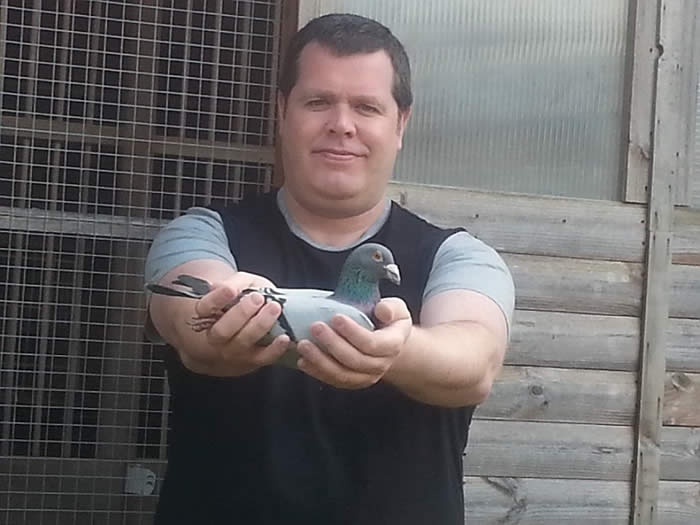
DAVE IMPETT of Blackpool
Dave Impett has been a fancier for close on 50 years, having started in the sport at his father’s side. Following on from this initial introduction Dave completed his pigeon apprenticeship under the guidance of one of the North West’s greatest exponents of long distance pigeon racing – none other than the great Roy Mundy, who bred and raced numerous top class long distance performers including the great “Rossall King”. With this background it is little wonder that Dave’s ultimate goal in pigeon racing was to be successful at the extreme distance and in this case this meant success at Pau or Tarbes at 748 miles.
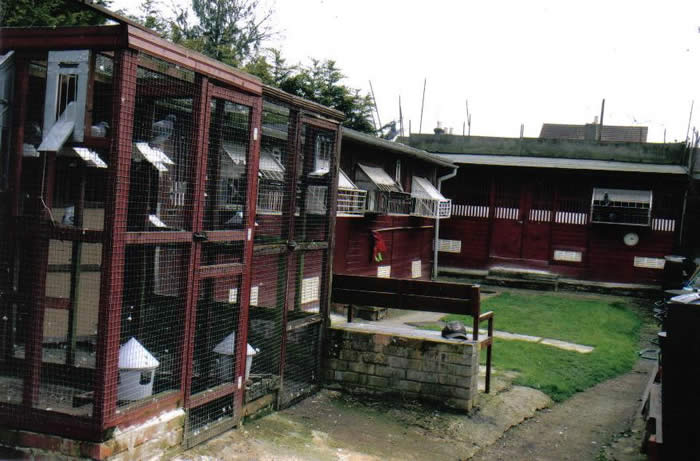
Dave's yb loft
When you set your stall out to compete at this sort of distance you must be prepared to play the waiting game and also be ready to suffer some bad knocks, as this sort of racing is not for the faint hearted!! However, in Dave’s case success has been achieved almost immediately. This is down to a combination of Dave’s previous experience in the field of long distance pigeon racing and his meticulous research in sourcing his foundation stock.
The background to Dave’s pigeon apprenticeship has been outlined in the previous paragraphs, so what is the source of today’s long distance pathfinders? Before setting out on his present course in long distance racing Dave studied the Barcelona International results for the previous ten years. One loft stood out as gaining the most consistent results in the whole of Europe and that was the Jan Aarden based family of the Brugemann Brothers of Assendelft in the far north west of Holland. Another important deciding factor in Dave’s choice was the fact that the brothers pigeons flew almost exactly the same distance from Barcelona to Assendelft as Dave’s birds would have to fly from Pau to Blackpool – close on 750 miles. Arrangements for a visit were made and Dave was soon on his way to the Netherlands to view the pigeons, and just as importantly, to assess the Brugemanns. Needless to say he was not to be disappointed on either account and immediately made his first purchases.
Stock loft and aviary
These initial purchases, made around the turn of the millennium, started breeding “the goods” from the off with the result that Dave has returned to the brothers each year to strengthen his base bloodlines, concentrating on the lines of “Orhan” and “Myra” two top performers from Barcelona for the Brugemanns. The amazing thing about these Brugemann pigeons is the fact that all the brothers top long distance performers were sold in the mid 1990’s and the brothers carried on with latebreds reared from the top birds before they were sold. Two of these latebreds made an immediate impact on the Barcelona International result as two year olds when they appeared in the top 50 of the International result with more than 20,000 pigeons competing. So, as you can see, these Brugemann pigeons start winning at the distance at the first time of asking.
This characteristic has been repeated in the Impett loft in Blackpool – witness the performance of “Katie’s Star” winning 1st Sect L 12thOpen NFC Tarbes 748 miles, as a 3year old late bred. This game hen was not raced as a young bird, received a couple of races as a yearling and flew Saintes 570 miles, on the winning day as a two year old. As a three year old she was given a couple of preparatory races culminating in a trip to St Nazaire with the NFC before being set up for Tarbes sitting 12 day eggs. “Katie’s” haul of trophies in this race included The Roy Mundy Memorial Trophy; H.J.Langdon Trophy; Burton Trophy; Allwood Baird Trophy; J.O.Shone Trophy and The Lancashire Rose Trophy.
North Star
Another fine example of this early maturity is the superb “North Star” a beautiful blue pied hen that flew the young bird National on the day as a baby at 400 miles to win 168th Open with more than 8,000 birds competing. As Dave does not practice the darkness system the hen was sent with only half a tail. Where would she have finished in the result if she had been prepared on the darkness system? This terrific performance enabled Dave to win the Section L Averages Trophy and The Roy Gough Trophy for outstanding individual performance in all races in section L with the mighty National Flying Club in the 2005 season. Incredibly, later in her career “North Star” went on to compete at Tarbes and was clocked on the day of toss at 748 miles, to be narrowly beaten for the record of the longest flying pigeon recorded on the day in the history of British pigeon racing by another terrific pigeon raced to the other side of the Pennines by Brian Denney of York. In addition to these NFC awards, two R.P.R.A. awards were also won in 2005 by this teak tough team of long distance pathfinders.
Despite the disruption to the Impett long distance development programme caused by the foot and mouth and Avian Flu’ outbreaks, Dave has quickly established a terrific team of long distance performers. The team that is prepared for Pau /Tarbes rarely amounts to more than 5 or 6. In 2007 just 5 were sent and 4 returned in race time with “Christine’s Star” finishing at5th sect 13th Open NFC and “Lee’s Star” close behind at 8th sect19th Open NFC. This on a day when most of the leading birds were clocked on the east side of the country due to the prevailing westerly wind, and yet here’s Dave Impett clocking two in the first twenty at 748 miles way up in the north west of Lancashire!!
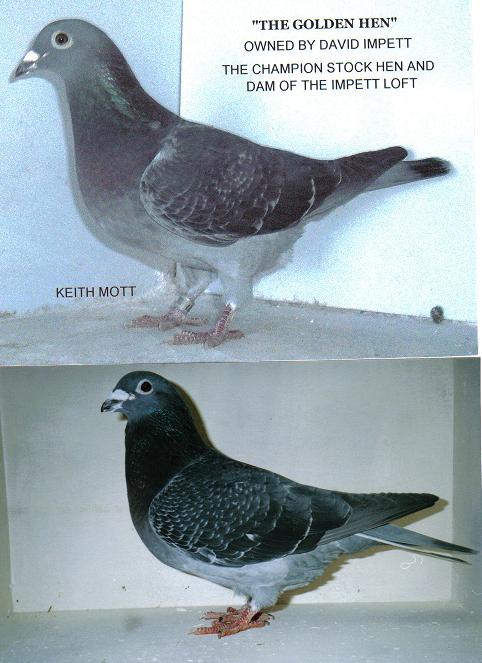
The Goldmine Hen - mother of the loft, above, and below is one of the top stock cocks
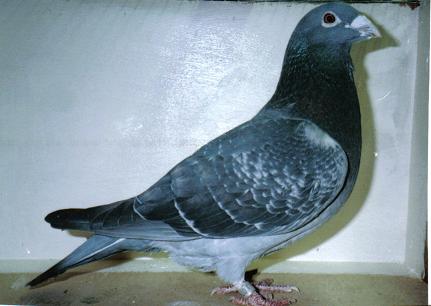
The family are, on the whole, small to medium sized with superb feather quality. The exceptions to this norm are in fact some of the loft’s best long distance performers such as “North Star” mentioned earlier; “Lee’s Star” and “Christine’s Star” which are all above medium sized with a fair bit of keel showing However, the mother of the loft, the aptly named “Goldmine Hen”, is a petite little dark chequer that is responsible through her children and grand children for most of the lofts best performers. “Katie’s Star” also mentioned earlier is just on medium sized and handled beautifully. Most of the inmates were dark chequers or white flights with some smokey chequers and blues. They gave the impression that they would need very little road work to get them in top racing condition and Dave stated that they exercise with relish and when on song, are difficult to get down such is their enthusiasm for work.
The system employed at the Impett loft is based on sound common sense and adherence to basic simple principles of stockmanship. Dave’s mantra is “keep it simple”, if the birds are of the right quality then success will follow. If the birds are not up to it, then no amount of potions, good corn and hard work on the part of the fancier will make them win. Thus the Impett - Brugemann’s receive no tonics, vitamins or treatments whatsoever, just clean water and a good, sound young bird mixture to which Dave adds maize and fat bearing grains when required. All birds have access to large blocks of cow lick which are left outside the lofts or in the stock bird’s aviaries. The old birds enjoy an open loft as much as possible and when racing are exercised once per day for up to 1½ hours at a time. In the build up to a specific race the team might receive a couple of tosses at 20-30 miles just to put the finishing touches to their preparation. The Brugemann Brothers rarely visit their lofts before early evening and this is when their birds have their only daily liberty, being forced to fly for up to 90 minutes each evening.
Lee's star
Stock birds are mated in mid February with the race team a month later in Mid March. The old birds are allowed to complete a natural nesting cycle whenever possible and race returns allow. A team of 50 or so youngsters are reared annually from the 16 pairs of stock birds and the best of the 36 pairs of racers. The young birds are raced totally naturally and if Dave can get 3 or 4 races into them in their first season then he is happy to let them grow on without the weekly pressure and stress of young bird racing.
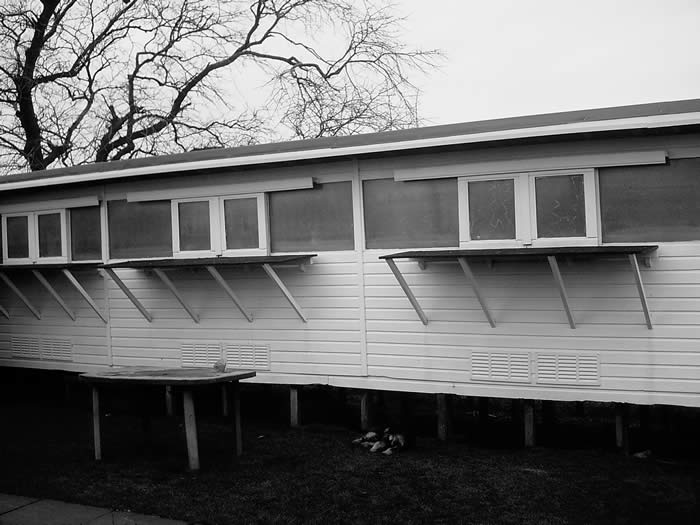
The stock team are housed in two lofts with attached aviaries, whilst the old bird racers enjoy the luxury afforded by a roomy three sectioned loft fitted out with “up and over” German style nest boxes. All lofts are cleaned daily throughout the year and as one would expect, the ventilation and internal environment of all three lofts was first class. This attention to loft hygiene is at variance to the methods employed by the brothers in Holland as their birds are encouraged to develop natural immunity through the use of a dry droppings deep litter.
Old bird racing loft
JOHN McLAREN and his family of long distance racers
“To found a family of pigeons that can win from all distances and stand the test of time by doing so over a long period”, that was John McLaren’s boyhood dream and it is one that he can justly feel that he achieved before retiring from the sport. Along the way he was to become for a time the youngest man ever to win the King’s Cup. This was achieved in the NFC Pau race in 1967 when he was just 29 years of age. During his time in the sport the “McLarens” won just about everything that could be won in National and International racing through to Barcelona 670 miles. The early McLarens were, to a large extent, based on the old English family developed and raced with great success by the late, great Norman Southwell of Ramsdean, near Petersfield in Hampshire.
John McLaren was an integral part of the Southwell set up when Norman Southwell was at the zenith of his racing success. John knew the Southwell’s as intimately as the master himself as for ten years he was at the loft daily helping with the birds and the management of the farm. A highly intelligent individual, John never forgot anything that he saw or heard and with such a tutor as the “King of Pau” it should not have been too much of a surprise when John McLaren became the youngest ever winner of the Pau Grand National.
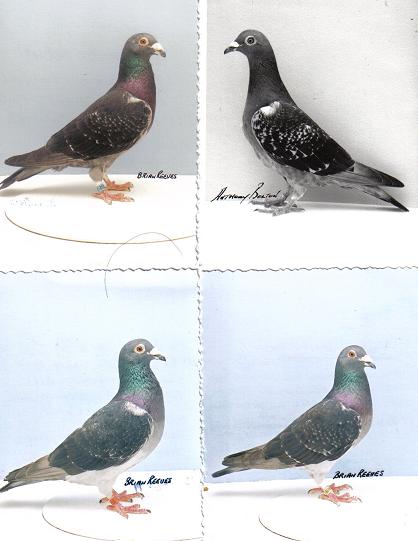
Top left and moving clockwise: Robert - 3rd & 5th BICC Pau and champion stud sire; Julie - 1st NFC Pau 1967; Dark cheq sons of Robert, both prize winners out to Barcelona, 670 miles.
The McLaren story begins in 1950 when the 13 year old John obtained his first pair of pigeons which he housed in an old tea chest. Not long after this he met Norman Southwell and the rest as they say is history. In exchange for his help with the birds and around the farm the young McLaren was gifted eggs and youngsters from the best birds in the loft. Even though this was arguably the best loft in England at the time, John believed he could improve on them and as a result set about acquiring birds direct from other top performers in National competition. Many were tried and tested but only three introductions stood up to the testing process and were subsequently integrated into the Southwell base. Amongst these was a blue cock bred down from Bert Craddock’s top Lerwick pigeons; a light red chequer cock bred from Moore & Wooton’s Pau pigeons.[This partnership were 1st NFC Pau in 1950 and 8th Open Pau in 1952 to Stoke on Trent]. Lastly a mosaic hen bred direct from Jack Brain’s Lerwick pair. The Jack Brain Spangle family were, and for that matter still are famous for their long distance exploits racing from the Shetlands into Somerset . A little later, in the 1960’s, a black cock was obtained as a gift from the successful Up North Combine loft of Gippert & Henry . This cock when crossed with a hen of the McLaren – Southwells produced “Julie” the 1967 NFC Pau King’s Cup winner. Julie in turn went on to produce generation after generation of top class racers especially when crossed with the Vandenbrouke’s which were introduced in 1968. This family had set the south of England alight with their outstanding results in middle distance races and John obtained the best, bred from the original imports, in order to sharpen up his predominantly long distance family ,so that he could develop birds to win from 100 – 670 miles.
The above then is the background breeding which made up the McLaren family, further introductions were made periodically in later years and these underwent the same rigorous testing process before they were incorporated into the family. Although John obtained his last birds from Norman Southwell in 1958, the dominant Southwell type is still evident as the photographs which accompany this article will demonstrate. To quote John’s views on breeding: “I almost think the only sure way to win races is to have good birds, and a good fancier can make good birds by seeing which pair will go together and preparing the offspring physically, and more importantly, mentally for the task ahead”.
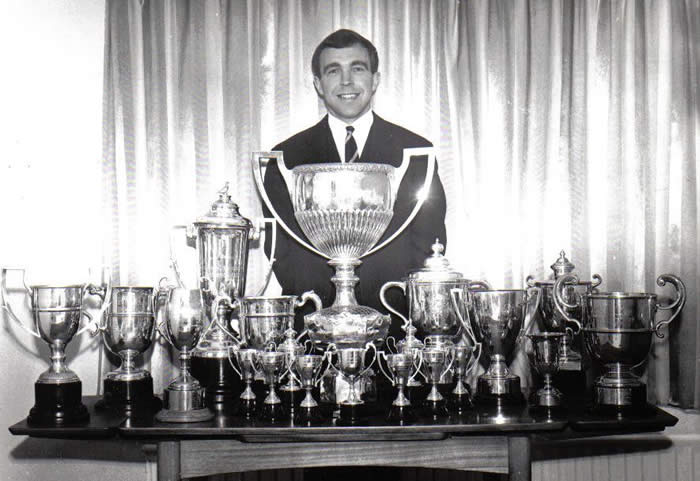
John McLaren and trophies won in 1967 when he won the Pau National
As mentioned earlier John McLaren is an intelligent individual who was quite prepared to question the accepted views on a variety of pigeon related topics. He possesses a highly innovative mind and has designed various lofts to suit their specific locations, the two essential factors common to all being absolute dryness allied to good ventilation. The loft to which Julie raced to win the Pau Grand National had no conventional loft front and the interior was always semi dark due to the wide landing board that ran along the top of the loft doors. This served two purposes in as much as it allowed the pigeons access through stall traps into the loft interior and also prevented rain from blowing into the loft. This latter function was essential as the loft floor was covered with a deep litter of dried droppings. The dried droppings deep litter system employed at the McLaren loft consisted of 75% droppings and 25% litter made up of sand and rough sawdust. When “working” the litter resembled a grey spongy absorbent carpet with no sign of droppings.
Another example of the McLaren innovative approach to loft design was the design of perches. To save time cleaning and at the same time ensure that the pigeons were not allowed to stand in their own droppings, perches were built from an 8 inch sloping board to which 2 inch blocks were attached at 12 inch intervals. The birds rested on the two inch blocks and the droppings simply rolled off the board to be absorbed into the working litter beneath. Readers should be aware that John McLaren designed these perches more than 50 years ago, when the norm was the old fashioned box perch, and therefore long before the “modern” lift off style perch was developed. In later years, floor grids were employed and the accumulated droppings removed annually. Successive lofts were built at various sites and all incorporated these labour saving designs – the only hard work in the McLaren loft was carried out by the birds. This allowed John more time to study individual pigeons so that he could get the best out of them when the time arose. In the years immediately before his retirement from the sport, the pigeons were housed in a converted garage. The old bird team occupied two 8ft x 6ft sections and the young birds one other 8 ft x 6ft section. The whole structure, situated high on a hill overlooking Portsmouth, faced south and had windows front and back which could be adjusted to control air flow within the loft. This was the only loft that John possessed as he did not keep stock birds and therefore had no need for a stock loft.
An old bird team, made up mainly of cocks, was maintained. These were raced on widowhood and the natural system in alternate years, and from the best of these a team of around 40 youngsters were bred annually. John liked to keep the team young and each year he aimed to replace 50% of the older birds, with young stock. Since losses were minimal, John adopted a system of selecting out those old bird racers that had started to slow up or had not “fulfilled their racing potential”. As referred to above no stock birds were kept as all had to earn their keep. Even Julie after her King’s Cup winning performance was put back on the road and flew Pau on two further occasions to two different locations!!
No inland racing was undertaken by the McLaren team for more 40 years. Youngsters, after half a dozen training spins at 10 and 17 miles, were lifted straight into Guernsey 100 miles with 90miles of water to contend with. Sometimes they used to go to France 160 miles in the year of their birth and that satisfied John. The best were then kept to replace old birds. Yearlings were raced to Nantes 250 miles but in the past all were sent to La Reole 400+ miles and on many occasions won. In fact John sometimes sent late breds to Pau 524 miles as yearlings and clocked them to win National prizes! Two year olds and above were sent to Nantes 250 miles first toss and then in one or two additional races out to 670 miles. Each racer had a programme mapped out for it a year in advance. However a certain amount of flexibility was applied to adapt to unforeseen circumstances.
Needless to say with such a perfunctory training schedule it was essential that the birds were flying freely around home and were fit to face the tasks set them. John McLaren firmly believed that individual pigeons have different needs as witnessed by the treatment of the 1967 Pau team. Prior to going to this race the selected team were forced to fly for one hour each day. One pigeon refused to knuckle down to this regime and spent most of the exercise periods sunning itself in a nearby tree – this was Julie the eventual King’s Cup winner!! Norman Southwell didn’t touch his pigeons for a month before Pau and just look at his results. The reader should however be aware that the “Southwell’s” lend themselves to this type of preparation as they are of small to medium build and do not tend to put on fat. They are in effect lean ,mean and raring to go. In the past the team enjoyed the luxury of an open loft 24 hours a day 365 days a year, however the current upsurge in the sparrowhawk population made this impossible at the final loft location overlooking Portsmouth. As a result the team were allowed their liberty twice daily under John’s watchful eye and this only between April and September as they were confined to the loft throughout the winter.
Although the McLaren team were tough and full of vigour with an inbred iron hard constitution, any that “went wrong” were treated. As John once wrote “Several fanciers have told me that they kill any birds that become ill and I tell them that they would have killed some of my best pigeons”. To illustrate this point I give you the example of Julie. After winning her only race as a young bird by 200 ypm from France, Julie contracted coccidiosis and spent several weeks in solitary confinement before being allowed to rejoin her loft mates. She then went on to win her first race as a yearling recording 1700 ypm! All birds therefore were routinely treated for cocci, canker and worms, the latter twice yearly but never when moulting or rearing.
Feeding is another aspect of the sport which many attempt to make into a science but is one which John always approached with pragmatism. As long as the food is sound and well stored then he is quite happy. Over the years a variety of pellets, mixtures and straight grain feeds were tried and good National positions gained with each. However, the preferred grain of choice for the McLarens was the humble tic bean. This generally made up between 25- 50% of the mixture. The remainder being barley when resting, wheat whilst breeding and in the early part of the racing season, and maize when the longer distance races were approaching. All corn was bought direct from the farm. The birds were always hopper fed with unlimited access to food 24 hours per day 365 days per year, the only restriction being imposed on young birds which had access to the hopper between 9am and 6 pm. This purely to maintain control of the more precocious babies.
Those then were the methods of a master fancier. I do not intend to list here the many wins achieved over almost six decades of unbroken success. Suffice to repeat that John McLaren was the youngest ever winner of the King’s Cup from Pau with the NFC. He was also a winner of the Langstone Gold Cup awarded for best average velocity all NFC races and twice winner of the best 3 Bird Ave from Pau plus the 2 Birds Ave from Pau all on the day. The name of McLaren appeared in the top 30 Open positions in the NFC racing pigeons to seven different lofts after seven changes of address. In latter seasons the McLarens competed more regularly on the International scene with placings such as 3rd, 5th & 11th Open Pau; 2nd, 3rd & 20th Open Barcelona; 7th, 12th, 30th, 40th & 41st Open Dax. In addition, McLaren pigeons have been winning for many years throughout the British Isles up to National level. The winners of 1st, 2nd & 3rd Open NFC Pau at 520 + miles can trace their origins back to the McLaren loft as can many other winners in the highest class of competition out to 670 miles including 2 x 1st Open from Barcelona.
It has been a pleasure to include this article as a part of the long distance series. John McLaren was a fancier who, many years ago, opened my eyes and mind to the simple basic principles of loft management and the incredible achievements that are possible in the sport of pigeon racing when these basic principles are applied to top class pigeons. I first read John McLaren’s article published in the BHW Year Book of 1968 following his 1st NFC Pau win of 1967. Whenever I begin to get wrapped up in sophisticated theories I still reach for this article in order to obtain a dose of good old fashioned common sense. The 1968 BHW article was a ground breaker at the time as it debunked many of the myths surrounding the sport. It is no less relevant today.