PAGES FROM THE PAST
Part 3
by Gareth Watkins
In this, the third article in the series highlighting BICC International race winners in the early years after the formation of the club, I intend to put the spotlight on E.V. [Ted] Bennett and John Lane.
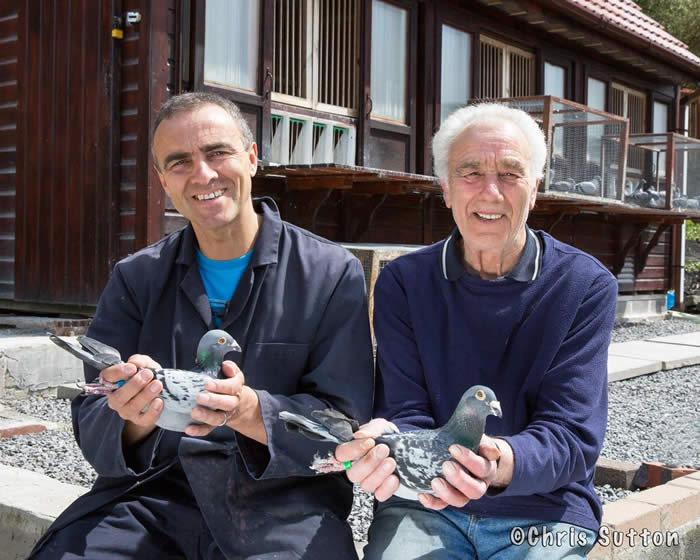
Ted Bennett and his BICC Marseille International winner “Black Pearl”.
In 1979 Ted Bennett, one of the founder members and driving forces in the early years of the BICC, won the Marseille race and was also 3rd Open BICC Barcelona.
Ted had fantails as a young lad and was greatly influenced in his early years by two outstanding fanciers namely Alf Cox and the great Vic Robinson.
Ted’s contact with the sport waned considerably over the years as he spent many years working in East Africa. However, on his return to the U.K. he quickly resumed his interest and a loft was soon erected at the bottom of his garden. A feral pigeon problem at his old grammar school and a request by the headmaster for assistance in removing the problem birds brought Ted into contact with the pigeon which was eventually to win the BICC Marseille race in 1979.
Ted and an old school friend eventually trapped around 150 feral birds and amongst these were three ringed young birds. The three ringed youngsters were duly reported and because of their extended “leave of absence” from their home lofts the owners offered to transfer them to Ted. At that time Ted’s father enjoyed the odd meal of “pigeon pie” and so Ted took the three young birds around to him for inclusion in the next baking, only to be told by his Dad to “… take the black one home and race it”.
This Ted duly did only to find that the black one persisted in returning to the clock tower in the school. After much perseverance the black hen eventually settled at Ted’s loft and was trained in all weathers but nevertheless always returning to Ted’s loft.
After no more than half a dozen such tosses in all directions and as stated in all weathers the black hen was jumped for her first ever race into Pau at more than 500 miles and returned in good time. At about this time the black hen decided that she liked the look of a young cock bird in the young bird loft and so decamped to the young bird section with her young lover. She duly laid and was in such good condition at the time of basketing for the Marseille race that Ted decided to send her. It proved a stern test, not just for the British contingent but also for the rest of the convoy from all over Europe and “Black Pearl” as she was to become known, was found in the loft late on the second afternoon to win 1st BICC 11th Open Hens International and 214th Open overall.
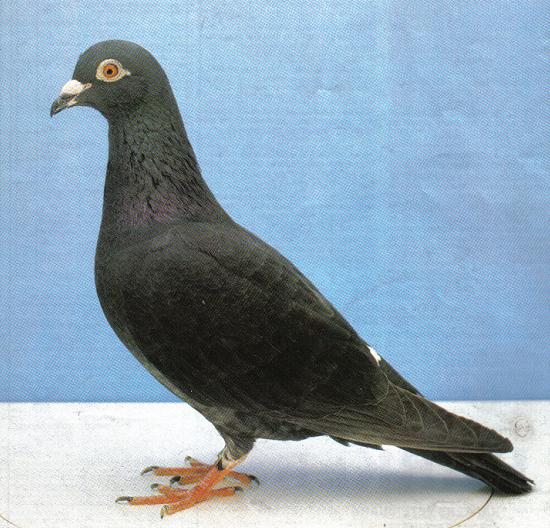
Black Pearl - 1st BICC Marseille 1979
MANAGEMENT
The Bennett management system was kept as simple as possible as Ted had to commute each day from his home in Hampshire to his work in the city of London. This entailed leaving home at 6 am and not returning until late evening. As a result, the birds enjoyed an open loft for most of the daylight hours whilst Ted was away at work and had unlimited access to hoppers of food throughout the day. One hopper filled with tic beans and the other with barley. The tic beans fed were always well matured and at least three years old, or as Ted referred to them “black diamonds” a tip he picked up from Vic Robinson. In addition to this “a la carte menu” the racers were hand fed a dessertspoon of a mixture of Hormoform and Red Band conditioner individually in each nest box each evening when Ted returned home from work. Any training that took place was from all directions as and when Ted could fit it in to his busy work schedule.
So as you can see from the above report, not all strays are duffers and Ted Bennett and his great hen “Black Pearl” can testify to that fact.
JOHN LANE and “Young Danny” and “Kate”.
1st Open BICC Barcelona 1987.
1st Open BICC Perpignan 1987.
The Barcelona race of 1987 proved to be a really hard affair even by the rigorous standards of most Barcelona races. However, one British pigeon excelled and that was a red chequer cock named “Young Danny” which was bred and raced by John Lane of Bromley in Kent.
Young Danny was clocked by John’s wife Kate at 19.40 pm on the evening of the second day to win 1st Open BICC and 158th Open International when there were only 200 pigeons clocked in the whole of Europe on the second day of the race. A truly outstanding performance and one recognised as one of the best ever by a British pigeon in the Barcelona International race. A little over one month later John repeated the success when he clocked his chequer hen “Kate” to win 1st Open BICC Perpignan to end a truly amazing season’s racing.
John Lane has had pigeons since he was 10 years old and the first of these were purchased for the young John by his grand father. John started racing in 1963 and has always been a fanatic of long distance pigeon racing. To this ends he purchased birds from the legendary Kent long distance specialist Geoff Hunt of Westmarsh, near Canterbury. Pigeons were also introduced from another top class long distance fancier, Joe Shore of Congleton in Cheshire who was regularly clocking birds from Pau at close on 700 miles to his Cheshire loft. These introductions, along with birds from Terry Peart were integrated into John’s original birds which had been gifted to him by Doug Mew and which were in turn bred around original imports from Chic King.
At the time of his Barcelona triumph in 1987 John Lane kept a modest team of just 20 pairs of old birds and this number included his stock birds. From this small team of old birds John usually bred no more than 40 young birds for racing.

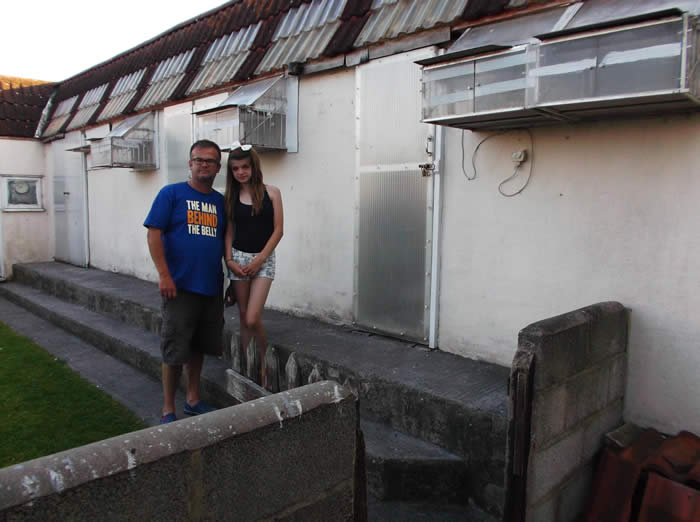
John Lane & Terry Johnson, both winners of BICC Barcelona.
MANAGEMENT
The young bird team were hardly looked at until the completion of the old bird season and then it was “all systems go” with a first toss at 20 miles. This was repeated four or five times and then the youngsters were moved on in progressive stages out to 40 and 50 miles in all directions. After one or two races the youngsters were put aside for the season. As yearlings the birds were given a number of local club races inland with one or two short channel races to complete their education at the yearling stage of their development.
John likes his long distance International race candidates to have plenty of experience before being subjected to the “acid test” of International racing. He also insists on an iron hard constitution with birds showing no signs of distress on return from a race no matter how hard the ordeal has been.
PREPARATION for INTERNATIONAL RACES
In his preparation for the Barcelona race “Young Danny” had a number of 20 mile tosses followed by single up tosses from 50 & 60 miles on both south and north routes. He was then sent to Seaton in Devon for a 120 mile inland race on 1st June followed by a race from Beauvais in France on 20th June where he had 10 hours on the wing. In all these races he had been raced celibate but was mated on his return from Beauvais and was basketted for the Barcelona race on 3rd July with his hen just having laid her first egg. As stated earlier “Young Danny” homed on the evening of the second day in sweltering conditions to be the only bird on the winning day in the UK and one of only 200 clocked that day in the whole of Europe.
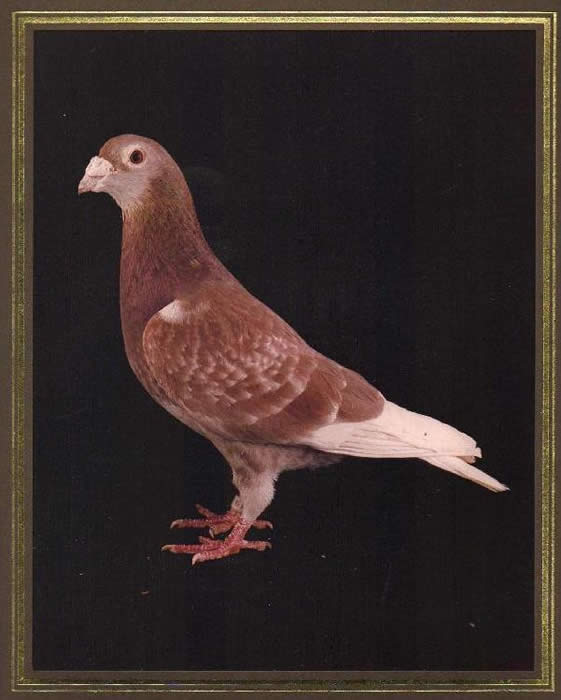
John Lane's Young Danny - 3rd Open BICC Barcelona 1985 923rd Open International; 1st Open BICC Barcelona 1987 158th Open 21,000 birds International.
“Kate”, the winner of 1st Open BICC Perpignan, on the other hand had a far more rigorous race preparation before going to Perpignan. She was trained early in the season and had four inland races before going to Le Mans, Nevers, Nantes and Orleans in cross channel races. Once again all these races were undertaken whilst racing celibate. She was then mated and received a further four single up tosses from points along the south coast in the week leading up to basketing for Perpignan by which time she was sitting a newly hatched squab – her first of the season.
All birds were fed 100% barley for their morning feed followed by a mixture of beans, peas, tares and maize in the evening. In winter the birds received a fairly Spartan diet of 90% barley and 10% beans so rarely over ate which kept them in pretty good trim during the winter layoff.
The above are the methods that brought John Lane great success in the 1980s and he is still winning regularly at the distance up to the present day. Long may he continue to do so.
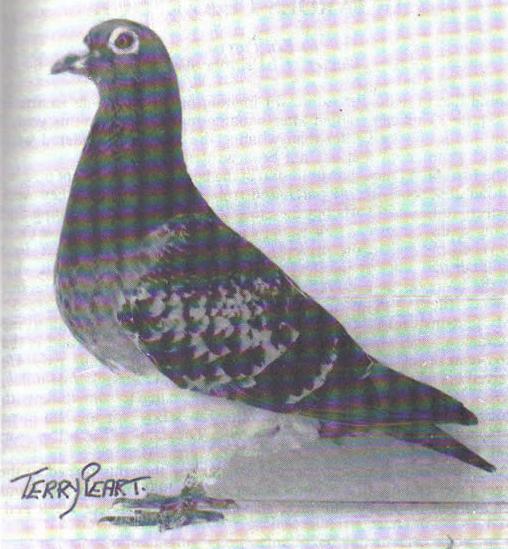
Katie 1st Open BICC Perpignan 1987
---