Thames North & Eastern Counties Flying Club
E. J. SAINS
We are already half way through May. For many fanciers it will not be long before the dreaded young bird sickness begins to spoil their young bird season. While other fanciers have already had problems with the young birds health as well as suffering disappointment with the old birds, but cannot quite put their finger on the reason why. There is no doubt that the racing pigeon of today is unbelievably faster than the racing pigeon of two to three decades ago. But unfortunately the health of today’s racing pigeon leaves a lot to be desired. Some years ago I set about improving my bird’s health by removing young bird sickness and its associated cross infections. This was done by raising the immunity of my pigeons against Salmonella (Paratyphoid)a disease that weakens and allows other cross infections to infect your birds. Below is part of a thesis written about how the salmonella pathogen has managed to massively infect the racing pigeon worldwide on such a scale.
This thesis has been written by a pigeon fancier, who has kept and raced pigeons for over fifty years. In the past few years a definite deterioration in the health of our birds has been noticed by fanciers from all over the world. Particularly with the coming of young bird sickness, the presence of salmonella and the possible connection to P.M.V. (Paramyxovirus vaccination)
Since the middle of the eighties early nineties, the health of our racing pigeons has been slowly, but surely deteriorating. The first thing we need to do in order to understand what’s been going on is to look at where we were and where we are now as regards to the health of our birds.
Around the middle seventies a disease was occurring in Iraq. We now know this disease as paramyxovirus in pigeons. This disease spread northwards towards Malta entering Spain and Portugal until finally reaching Northern Europe in the middle eighties. The M.A.F.F. now known as D.E.F.R.A. was quick on the case after experiencing, what they thought was a transition of the disease to some chicken farms. Although the supposed, pathogen did not seem to have a bad effect on the chickens in question, their answer was for all racing pigeons, that take part in racing, should by law be vaccinated.
Now there is nothing new here to learn, we all know about P.M.V. What is for sure is that you need to vaccinate against this disease. Because if you don’t vaccinate you do it at your peril as P.M.V. takes no prisoners. In the first instance if your birds get infected with paramyxovirus what don’t die are left disabled and certainly almost all survivors of this disease, will be carriers.
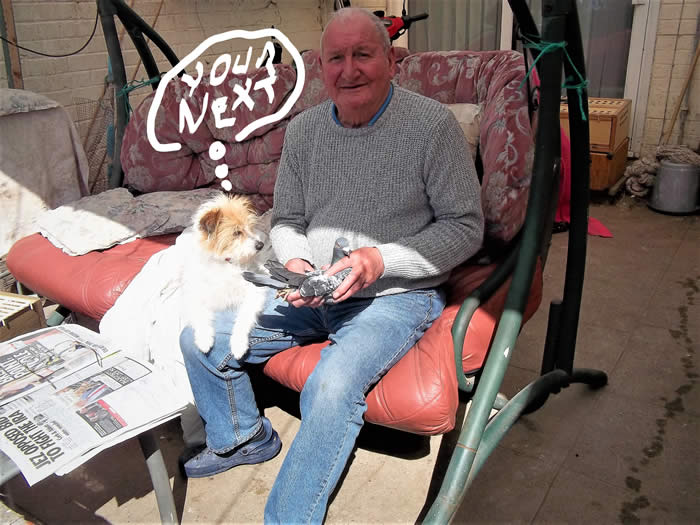
Cross infection =
Fanciers all over Europe and beyond were given the task of vaccinating their birds (some countries the task was left to vets only.)
Of the vaccines available few were supplied with the means of sterilization of needles, between birds. Even less information was given about cross infection that could be caused by using an infected needle from one pigeon to another, bypassing the gut flora the bird’s main defence against aggressive pathogens. Maybe a needle that had been used on a carrier of paratyphoid (salmonella) then is used on many other birds. The reason paratyphoid (salmonella) has been used as an example is because that is where we are today. There are countless other transmittable infections.
The N.H.S. would soon be overwhelmed =
If for instance dirty needles (shared needle) were used on humans in six months the N.H.S. would not be able to cope. Your pet dog has his own needle for his parvo injection, but your unbelievable expensive top stock birds have to share needles indirectly with racing pigeons from across the world.
Avoiding cross infection =
In order to start our long journey of keeping healthy pigeons, we first need to address the problem of cross infection that is being caused at the time of vaccination against P.M.V. We need to vaccinate our birds with a clean needle it is not good enough to trust vaccination with a sterilized needle, each bird needs to have its own needle in order to be positive that no cross infection can take place. This job is relatively easy to do and costs little. The needles are £8.00 per 100 plus £1.00 tax. The loss of vaccine is only one dose per syringe. The extra time taken is relatively small once you are set up. An explanation of how to carry out this vaccination will be set out in a later text.
Paratyphoid (salmonella) =
It seems that because of misinformation, which led to bad practises in the past. We as pigeon fanciers have been condemned to having an epidemic of salmonella in our birds, with carriers of this disease not numbering hundreds, but perhaps thousands. The strange thing is this supposed relatively small disease has become the plague of the racing pigeon. In the past this disease in order to contaminate a pigeon has had to permeate the gut this would mean dealing with the gut flora which has had thousands of years experience dealing with such an invasion provided the animal in question was in reasonable health the pathogen would be soon dealt with.
Avoid Carriers of salmonella in the breeding section at all costs =
A carrier of salmonella is often referred to as a shedder of the disease, the reason being is that salmonella carriers will constantly shed the pathogen in its droppings as well as contaminate orally particularly when feeding its young.
It seems that if there is a carrier or more in the breeding loft that young birds that may be contaminated by these carriers for some reason or another will often become carriers themselves, possible because they have to live with the contamination for a period of time. Then when the time comes to vaccinate the young birds for P.M.V. the cross contamination from the use of dirty needles will compound the problem infecting and re infecting sometimes with slightly varying strains of salmonella pathogens, plus many other types of pathogens that can be transferred to add to the burden these youngsters are having to Carry.
Recognising Salmonella and how do we deal with it =
The first thing that is needed to be understood is that in order to be successful in the eradicating of a salmonella infection, first you need to be aware of its presence, then deal with it. The one thing you should not do is to brush it under the table. What is meant by this is first you need to understand how it exists and why it is so successful in infecting our birds. Most of the time salmonella remains hidden, just showing itself when the birds are weakened. Once a bird has been infected, there is a constant battle going on in the birds gut. If the problem is ignored as often it is, for instance the disease can be cloaked by the use of unsuccessful antibiotics or with the use of a vaccination. Neither antibiotics nor vaccines will solve the problem of pigeons known as carriers or shedders of salmonella pathogens. Such birds have to be recognised and removed from the flock, certainly not allowed into your breeding loft.
Dealing with a salmonella problem, means removal in its entirety this of course is our main aim. To do this we first need to cut off its route into the blood stream from the use of infected needles during routine P.M.V. vaccination. Then of course you need to recognise already infected birds in order to stop them infecting others.
Recognising the symptoms of birds carrying the salmonella pathogen =
There are many observations that can be made as regards to tell tale symptoms of birds that are likely carrying salmonella pathogens. For instance =
One must first be aware that symptoms of the presence of salmonella come and go with the condition of the bird. That is why that a good time to observe the birds is during the moulting period or when the birds are weakened during successive races, when the cocks are driving, or the period of time when the young birds are first starting to fly and their parents antibody immunity is starting to wane, any time when stress lowers the birds fitness. During these times it is advisable to boost the bird’s metabolism. Methods and products used to do this will be explained later in the text, but for the moment we are looking for symptoms or signs of salmonella. Symptoms = Blood quills are a certain sign of the presences of salmonella pathogens during the moult usually from the seventh flight onwards this is a time when a lot of pressure comes to bare on the birds, with even more pressure coming to bare when moulting the last three flights. Symptoms = All the birds from time to time should be picked up and their wings opened, with the main joint in the palm of the hand gently opening each wing, if you feel a click in the wing you cannot hear it you just feel the vibration. Depending on the condition of a pigeon carrying salmonella this vibration can be observed from time to time in some birds that are carrying the salmonella pathogen. Symptoms = Driving cocks if observed standing can often favour their leg joints without giving any outside appearance of swelling in the joint, birds often stand on one leg this is a natural phenomena, but those favouring leg joints can be observed with experience. Symptoms = Birds showing signs of ornithosis can often be troubled with salmonella, this can occur when young birds first start to fly from maybe five to six weeks old. If your loft is dry and free from draft a weakening from the salmonella infection can allow the presence of other pathogens such as ornithosis to appear. Symptoms = If young birds are troubled with young bird sickness observe which young birds suffered the most who are the first to get it and the last to get rid of it are they brothers and sisters maybe the parents need to be looked at a little closer. Symptoms = At all times observe your bird’s droppings.
Any signs of salmonella the birds in question should be isolated under no circumstances should they be used in the breeding section.
The way forward =
What we must try to achieve is a colony of racing pigeons that do not suffer from disease. If your birds are carrying aggressive pathogens, they will at times race well, because of their ability to build up immunity to attacking pathogens. But in time when the stress of racing or cross infection maybe from new birds being brought in, during the moult, or any high stress period. Suddenly you will find your winning streak quickly disappear so where do we start, well first we need to realise that in most cases young birds with impaired health problems are bred from old birds with impaired health problems, quite often the stock birds in question have had their health issues cloaked with the use of antibiotics or a vaccination aimed at salmonella neither of these actions will cure a carrier of salmonella (Paratyphoid.
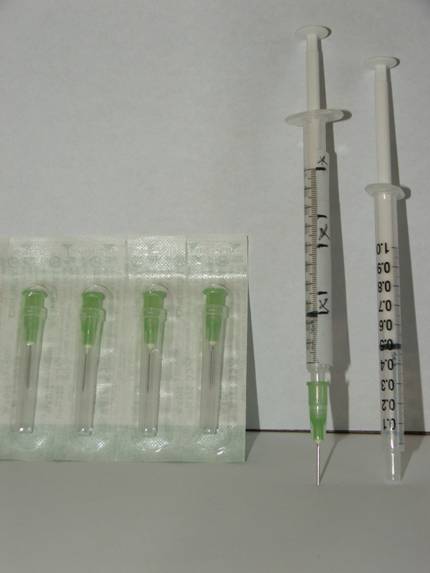
Vaccination without cross infection
Picture shows needles that come in a pack of 100 at a cost of £9.00 including tax. Two syringes one with a strip cut from an envelope label stuck to the side of the syringe clearly marked, ready to vaccinate three birds. The smaller divisions marked with an x approximately 0.1ml apart are used to fill the reservoirs of three separate needles with vaccine as we do not want any air to enter the birds body
The wider divisions are set out at 0.25ml the amount of Nobalis fluid to give full protection against P.M.V. for one year. The second syringe with the plunger already positioned at 0.5ml is only used to put air into the vaccine bottle (balancing the pressure) between using the second needle to draw off the vaccine ready for use. There should be a needle left in the bottle at no time should this be removed. The two syringes are constantly being pushed on and of the bottle needle, first the one to inject 0.5ml of air into the bottle, then the second syringe turning the bottle upside down to draw of fluid enough to fill the syringe to above the first 0.1ml mark that’s marked with an x. Remove the syringe from the bottle fix on a new needle press the plunger down to the bottom of the 0.1ml mark you will see a couple of drips come from the needle. You are now ready to vaccinate your first bird. Once this is done you then need to push the used needle down wards into a container, your first bird has been now been vaccinated with a clean needle. (Do not try to pull the needles of the syringe this may lead to an accident this vaccine is not very forgiving if you inoculate yourself. You must push the needle down wards.
Keep repeating the process until all the birds are done at least twenty five birds can be comfortable done in a half hour. If the vaccination of your birds is carried out in the manner explained there will be no cross contamination.
The fitter your birds are before vaccination and the better condition that you are able create after vaccination, the more antibodies will be produced. Bearing this in mind, the less likely you are to suffer from any problems, such as PMV pathogens that may or may not be produced from birds that are only as healthy as their owners are willing to keep them.
Conclusion
There is no question that paratyphoid (salmonella) has infiltrated the blood of our pigeons with the use of shared needles. So much so that it is now in almost every loft, being promoted both orally in the breeding loft as well as by cross contamination with the use of shared needles. Be assured that once cross contamination has stopped the birds become ring fenced allowing the immune system to develope, building strong resistance in each pigeon. Time and patience will see salmonella disappear into the background.
T N & E C F C Race 4 Flown on the 29 of April 2017
Bedhampton Liberated at 11 45 am into a south East wind 71 members sent 1678 birds
1st 2nd & 5th open Bob Wija of Marks Tey vel 1634.794 1631.901 1629.258ypm 3RD open Tony Buckfield of Hockley vel 1630.385ypm 4th open John Cowlin Hullbridge vel 1630.121ypm 6th open David Coward Talbot Chelmsford vel 1622.895ypm.
There has been East in the wind for three of the last four races. When there is East in the wind especially early in the season, the wind is colder the skies are usually a little milkier making the races a bit trickier. But for Bob Wija one of our longer flyers it proved to be a very good race, with Bobs Hereman-Ceusters taking 1st 2nmd & 5th open. Bob moved to a new house in Marks Tey recently, when he did he introduced a new team of birds based on the Hereman-Ceusters from Premier lofts plus a few others from winning loft. Bob, who is a past winner of the Essex & Kent amalgamation, flew pigeons in New Zealand for 20 years before moving to England in 2005 and was racing pigeons here by 2006.
Taking 3rd position was Tony Buckfield of Hockley with John Cowlin of Hullbridge close up behind him two extremely good performances, taking these positions against all the odds with the wind certainly not in their favour being to the East of the club as well as being short flyers in a fast wind.
6th 7th & 8th position was won by Dave Coward Talbot of Chelmsford. Dave has put together a team of pigeons that are specially bred around top distance birds. This family of pigeons have the blood lines of outstanding birds raced by Daniel Aerens, which Dave acquired vire Sheldon Leonard. The Daniel Aerens pigeons are considered to be some of the best Barcelona racers at international level in the world, their origins are down from the old Cyriel Marters, Jozef Vandenbrouke and Norbert Norman, with later introductions from Anton & Lucie Vanderweger. David has a team of yearling which are raced on roundabout. There is also a team of 20 pairs of natural pigeons, which are all aimed at channel racing particularly the longer distance. His hope is to take the yearlings to 300 miles and the older birds on to 500 to 600 miles.
T N & E C F C Race 5 flown on the 6th of May 2017
Bedhampton Liberated at 8.30 am into a strong North East wind 55 members sent 1195 birds
!st & 2nd open Mr Eric Guinchard of Upminster vel 1276.303 1266.494ypm 3rd & 5th open Tony Buckfield of Hockley vel 1258.741 1258.052ypm 6th open David Coward Talbot of Chelmsford vel 1258.043ypm.
Race 5 out of Bedhampton was probably our hardest inland race so far this season. The convoy of birds were brought back from Poole to Bedhampton, because of inclement weather which persisted to the west along the south coast for most of the day. Luckily our convoyer and race advisor acted quickly getting the birds away at a shorter distance by 8.30am, giving the club a very good race, even though the strong North East wind held the pace of the birds back. In 1st & 2nd place was one of our newest members Mr Eric Guinchard. Eric up to a couple of seasons ago was competing very successfully on the North road. Almost every article I wrote concerning the Essex & Kent amalgamation an organisation that frequently topped 4500 to 5000 birds, Eric was there most often topping his federation. Eric’s first bird was a Kooperman one of his new strains that he is trying with his second bird being from his old strain of Busschaert. When I questioned Eric about what his aspirations were in coming south. He said that the Thames North was a good training club but he was out on a bit of a limb where he lived to do well in the sprint races. But his sights were set on the overseas races. He also mentioned that he had sent to the extremely hard B.I.C.C. young bird Falaise race last year and was very pleased with his birds as he had six birds on the day when many lofts had empty perches. Eric is in partnership with Tim & Jan Rodwell who look after the stock and breed all the race birds. Eric looks after the racing side of the partnership which has led to a lot of success over the years.
In 4th position was Tony Buckfield, Tony is probably one of the most successful sprint flyers in Essex and proves this almost weekly consistently taking positions in the first six whatever the wind. Lets just point out Tones positions in the first 5 races flown so far Race 1 1st 7th8th Race 2 7th 8th Race 3 1st 3rd 4th Race 4 3rd 11th 15th Race 5 3rd 5th 7th open. Now that’s some performance in the Thames North.
Dave Sanders has been having a good season again he has topped the Colchester marking station plus 4th open position. Dave’s first pigeon was one of his Steve Foster Lambrechts. These birds have been phenomenal racers to his lofts. To give you an idea of how these birds race, take this three year old blue hen for instance. She started her career racing North road where she was 6th open Essex & Kent amalgamation as well as topping the federation. She then went South in 2016 she scored well in the East of England channel races, finishing 4th open this week end in a sprint race. Dave tells me he has had them up to 300 miles and hopes to push them a little further this year.
T N & E C F C Race 6 flown on the 13 May 2017
Bedhampton Liberated at 13 15 am into a south West wind 51 members sent 1023 birds
1st & 2nd open John Cowlin Hullbridge, vel 2033.526 2033.526ypm 3rd Mr & Mrs John Buckfield Wickford, vel 2025.820ypm 4th 5th & 6th once again Tony Buckfield Hockley, vel 2024.311 2022.583 2021.720ypm.
The first six positions once again fell to the Hullbridge marking station with the first six being divided by less than a minute. 1st & 2nd young John Cowlin 4th 5th & 6th once again is Tony Buckfield keeping up his unbelievable weekly performance. But in third position is the Mr & Mrs John Buckfield team. Johns usually busy plundering the North road as shown just recently with 1st & 2nd open Essex & Kent amalgamation with some 4843 birds competing, who’s the daddy then. Winning the Basildon marking station and 7th & 8th open is Paul Gilbert of Foulness Island, I remember flying against Paul in the old Leigh on Sea club with Paul being very hard to beat when the velocities are very fast. Jake Hammond once again wins the estuary marking station and 9th open vel 2006 ypm. Topping Colchester marking station is Mr Derick Reis. Gibbs Chaplin & Whiteside top the Laindon marking station this partnership were the highest prize winners in the Laindon R.P.S. in 2016. Tilbury marking station was for the third time this year topped by Mickey Harvey. Mickey trains his birds hard and is successful in both inland and channel racing. Maldon marking station our newest station was won by Mr Jamie Burnby of Witham Jamie just started flying south with a few of his north road pigeons, I know he is looking forward to getting his young birds started. The partnership of Nightingale & Draper of Grays topped the Thurrock marking station for the fourth time this year. This partnership fly an exceptional pigeon, which could be seen at the first B.I.C.C. channel race from Falaise, where they were 2nd section with a loft that’s located in a very Easterly position flying in Easterly winds, for me this pigeon put up an outstanding performance. I am told by fellow club mates that this bird was the product of some Hereman-Ceusters stock birds brought in from Premier lofts.
E.J.Sains.