

The Lancashire Social Circle has over its 110 year history been one of the forerunners leading the sport with seminars, discussions and debates dating back to the early 1900's, when those early members would travel to various parts of the country informing would be fanciers how to get involved in the sport of pigeon racing. One has to remember at this time there was very few telephones and cars were a real luxury.
Debate on Young Bird Losses
At the Autumn Gathering on Saturday afternoon an open discussion on one of the big problems which is affecting the sport at present young bird losses was the topic for discussion. Many fanciers have suffered in silence not knowing how to resolve the problem. It was hoped that by bringing the topic out into the open some answers may well come to light.
The new President of the Circle Chris Knowles gave an opening introduction explaining how we as fanciers have changed our methods over the last twenty to twenty five years, with some of the changes for the better and perhaps some maybe not. A number of points Chris made were Predators, the average number of YB kept, feeding and nutrition, darkness systems, YB sickness, the use of medication and antibiotics, time of year YBs are bred and stress. With perhaps the most significant of all is the change in young bird losses we are experiencing in the present day. In the discussion he hoped that everyone would take part giving their methods and practices that have given them good results and returns along with those that have proved less successful. Chris asked all taking part to be honest with their contributions so we can all learn and hopefully benefit in the seasons to come.


President of the LSC Chris Knowles - Bill Lewis
Problems Fanciers have Encountered
Bill Lewis from Worcester had published a survey in the BHW three weeks earlier and now had the feedback to his 35 questions. From the survey almost everyone who replied had suffered from YB sickness and in several cases with OB's all be it at a lesser extent, with OB's not showing the same signs but losses that could not be explained. Bill explained the way he had gone about the problem in his own loft, the last couple of years he has done nothing and what has pulled through, pulled through and the ones that didn't died. Bill found with this system this last season he had not been able to race his youngsters as the recovery time was so great that the racing season was almost over. He then went on to explain the symptoms of young bird sickness which many of us know only too well. Youngsters that don't trap, go round and round, don't home, poor returns from first two races etc. The birds that died he had a post mortem on them and found there was blood clots on the brain as well as the heart and lungs. One fancier questioned the blood clots saying once rigor mortis set in the blood would clot? One of the questions asked was what the recovery time was with the answer being in most cases 2 to 5 weeks, in Bills case with no treatment 5 months. Again from the survey the time of the sickness was from the end of May until July, but all reported that late bred pigeons don't seem to have the trouble. Protein has a big influence on pigeons and with fanciers feeding 6% to 10% protein youngsters could not fully function, 14% would seem to be a healthy balance. But feeding a high percentage of Protein is not the total answer to the problem as Bill hopper feeds his youngsters so one would think this in some way would help the situation.
Chris explained the problems he had had with his youngsters this season and as a result had not raced a young bird, he explained how he had treated his birds but as with Bill the season was to far on to be able to compete. One thing Chris was very honest about he had made the most common of mistakes, he had a few too many youngsters in the loft, more than normal.
A second point that was very clear was that when treating youngsters it takes more time for the birds to get over the sickness than it says on the bottle, and far too many fanciers train and race their birds to soon after treatment, when they are not fully recovered. One fancier who had come back into the sport this season following a break of several years had a small team of youngsters given to him from all different fanciers, had been feeding the only way he knew which was beans peas and tares he had not won anything but had only lost three youngsters all season and they had all flown the full programme.
Vaccination v Antibiotics
A more experienced fancier a winner of several nationals explained what he did, he vaccinated his youngsters at weaning for e-coli and two weeks later vaccinated for PMV and had Coli-Mix in the water as a preventive treatment. He had tried a Harkers product Wonder Pigeon in the past before going over to the Coli-Mix, with the youngsters having Barley for breakfast and Peas for dinner. He also felt that Herpes is a bigger problem than many fanciers think. Another fancier who had won 7 out of 7 races with his youngsters had again used Coli-Mix to help build antibodies which in his opinion helped the immune system not only in youngsters but old birds.
The question of giving a vaccine to boost the immune system was called into question by one fancier whose wife is a nurse and he felt strongly one can't boost the immune system with a vaccine. The word boost may well have been taken out of context and another fancier explained it was similar to having the flu jab when you are vaccinated with a dead virus which would then build up your antibodies and should you get the flu some time later it would not be as bad as if you had not had the jab. Another strong argument put forward was we have over the years copied the Belgium fanciers and as a result ended up with many of the problems they have. We breed early but don't start racing until July with the youngsters, the Belgium pair up early but start racing youngsters in May. It was felt fanciers breed early but don't start training the youngsters until its too late, having had them on darkness they are sexually mature and want to pair when fanciers start to train and at that time the fly has gone out of them. Training should start early and one fancier started his youngsters at 5 weeks old by basketing them and taking them across the garden a few yards for their first toss. The reason behind this was to get the youngsters to trap as soon as they came out of the basket and as the fancier was there to oversee this, which is not the case when you get them down the road. As the distance increased by the yard he had complete control over the youngsters, confident they would trap on arrival from any training toss. A top National winner from Scotland said the old traditional Scottish birds are getting less and less with fanciers bringing birds in from the continent, that in his opinion have been treated with antibiotics and other drugs that are now adding to the problems.
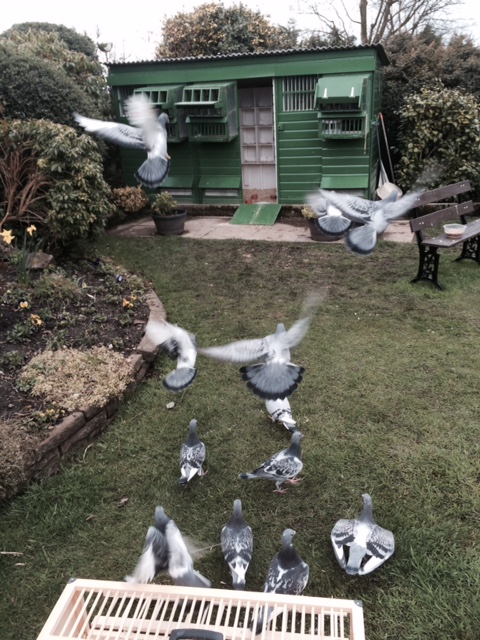
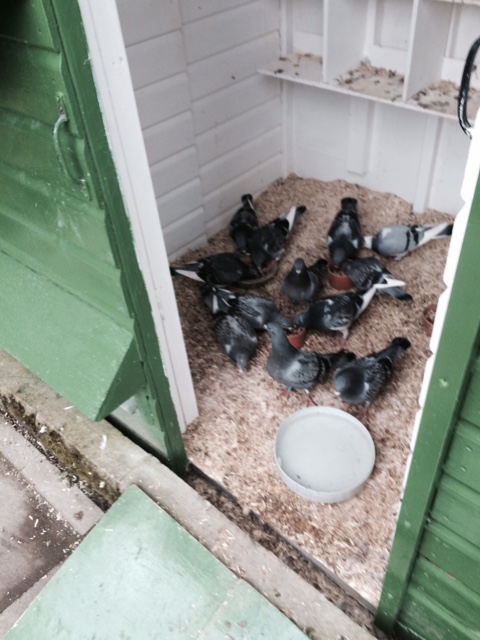
First Training Toss - Birds all Home
(See text above)
It had been noted that late bred pigeons don't seem to have the same trouble with sickness as their older brothers and sisters. The question asked could the reason be the weather is a lot colder. The question of flies and several fanciers had noted that days before the youngsters had sickness they had a lot more flies about the loft and could this give us a clue that all was not right in the loft. The subject of loft hygiene and how often the loft is cleaned gave room for debate, it was the opinion of many we can be to clean and if you have the right amount of pigeons in the loft which is well ventilated and dry there is no need to clean out every day and it was felt that maybe once a week is probably OK. Others felt deep litter is not a bad thing in the young bird loft and it might help build up the immunity.
Another ace flyer was asked how he treated his youngsters, he explained his system was not one that everyone could use, but was quite happy to explain to the fanciers what he did. He was totally in favour of vaccination, as with all other livestock, farm animals are vaccinated as routine. The management of large herds of cattle can't be propped up by treating them for everything, if problems arise they are eliminated as the costs involved justify it. He could not see any reason to be different with racing pigeons. He justified this by saying it is far better to vaccinate as a preventive than to spend time and money on antibiotics later when you are in the middle of training your youngsters. Having said that this is his system the first round from the stock birds are sold and only the second round from the stock and the youngsters from the race birds are kept for him, so his youngsters are not early bred. He has around 100 youngsters all put on the darkness system which are vaccinated for PMV and Paratyphoid, and all birds are vaccinated old, young and stock birds. On the subject of vaccines they must be updated as pigeons build up immunity if this is not the case. The youngsters are hopper fed on beans and have open hole from 10 00am to 4 00pm and are flown out with the old hens. The youngsters are got in and fed by using a good mixture then darkened for the night. We had another fancier/farmer who endorsed this, stockman mentality must prevail as one has not the time or money to treat a whole heard, you take the week ones out, and it's the same with a team of pigeons. Farming is a business and one has to look at a herd which you can't prop up with drugs.
A guest who again is a past National winner has long since given up using any medicines but in fairness did point out he had his birds tested every 3 week and if there was a problem would deal with it accordingly. It was pointed out that a youngster entering this world has its own immune system that is controlled by an immune organ Bursa Fabrici. This organ protects the bird until it is around the age of 6 to 9 months when the adult pigeon immune system starts to develop. A big problem which many fanciers inflict on themselves is introducing second and third round youngsters into a loft that has earlier bred youngsters. These youngsters are more susceptible to young bird sickness and can re-infect the older youngsters.
Conclusion
I would say there were a number of things that came out of this discussion.
1, It would seem it is better to vaccinate the youngsters to build up the antibodies than to treat with antibiotics later which destroys all their good and bad bacteria.
2, It is not necessary to clean the loft out every day and deep litter can be a good thing in the YB loft as the weather is warm at that time of the year and the loft is very dry.
3, Training should start at 12 weeks of age and not left until the youngsters are fully mature.
4, Many modern racing mixtures don't have enough Protein in them to keep the youngsters fully functional. With a minimum of 14% crude protein being the right amount.
5, Quite a number of fanciers said they were going to implement the ideas put forward and wanted to meet up next year to report back with any improvement seen.
Following the discussion I had a number of fanciers who had not made a contribution at the time but have emailed with their contribution, the following is some of their ways of combating young bird sickness.
Many feel it is better to vaccinate for PMV at the time of weaning which contravenes what the manufactures recommend which is 6 weeks old. Don't clean young bird perches for the first 12 weeks. Something I was told some time ago is the use of Colostrum which is produced during pregnancy and through the early days of breastfeeding. It is extremely easy to digest and high in nutrition. The first milk produced by a cow is yellowish in colour thick and sticky; this is Colostrum and also called Beastings. This is frozen into ice cubes then put on the food each day once melted. Another source is to buy a packet of Vallostrum, mix add the contents with two pints of water and freeze into ice cubes then use as above. Other products fancies use and find useful are Enviroboost from Osmond's, Apple Cider Vinegar in the water, a product called Collodial Silver has been used at the first signs of sickness 5ml down each bird’s throat and 10ml to 1 litre of water for two days. Another fancier confirmed he trained his bird early in life all be it from across the road but these early lessons of homing once given can't be taken away from them. One fancier said it's alright for some top fanciers who have contacts in Holland and Belgium to get these vaccines but the average fancier can't. In answer to that if you register with schroeder-tollisan.com you can buy your vaccines from them and have them in three days.
Brian Dearn
Tel.
(01254 772515)