Pigeon Sport Helping Young Students
Most of the time when my phone ring, the question is, "can you", "will you" or "have you", my answer to these many requests is always yes. One of my more recent requests for help was from ED-Class, that is an online education platform for children who require alternative support that might have difficulty in attending a physical school, providing education for 11 to 16 year olds. ED-Class try to constantly update their curriculum in the hope it elevates and sparks the students interests.
My contact was Jane Goodison who was looking to create a short film about pigeons, their history how to keep and look after them, and the part their played in the War. This sounded like something that might help both parties, ED-Class by creating a subject that would help the students with their learning and the pigeon sport promoting itself. The date was set and I made my way over the Pennines from Lancashire to Sheffield to the offices of ED-Class.
On my arrival the very professional film team were all ready set up. Jane asked if I would face the camera and introduce of myself. As this film was being used for students of 11 to 16 years of age I thought it might be appropriate to keep it light hearted and simple as I was not addressing pigeon fanciers but members of the public.
I started by saying, my name is Brian Dearn, and I have kept racing pigeons since I was 9 years old and I am now 76. Keeping racing pigeons as a hobby can be described as a disease and once infected its incurable. Which is the position I find myself in after 67 years of keeping them. I have not only raced pigeons, but been involved in the administration of the sport at all levels. Being President and Secretary of several organisations. At present I am the Secretary of the Lancashire Social Circle something I will expand on a little latter if we have time.
I went on to explain I owe a great deal to my hobby, from being a teenager I ran my local racing pigeon club, progressing to the youngest President of the RPRA North West Region. Charing meetings of over 300 people at one point, when Paramyxo various first raised its ugly head. This experience stood me in a good position in my working life when I was a Works Manager having over 80 staff working for me. Giving me the ability not only to communicate but manage people.
In order to help keep the students attention, at this point I explained, the sport can be as expensive as you wish to make it, with the most expensive pigeon ever sold was a pigeon called "New Kim" that cost 1.9 million dollars in 2020. This certainly grabbed Jane's attention, asking what would happen to such a pigeon. I then explained, it would be used as a breeder and put to stud. I also explained most young pigeons change hands for as little as a few pounds and in many cases are gift pigeons from establish fanciers to new starters.
The question then came up about how much time is involved in keeping racing pigeons. As I explained keeping any form of livestock is a 7 day a week job 365 days a year. They have to be fed and watered as well as cleaned out daily, should you wish to have a holiday you need a family member or a friend to take on the task.
I was then asked about the background of the racing pigeons. with the answer coming more like a history lesson. When I explained racing pigeons have an uncanny ability to find their way home, and as history has shown pigeons have carried messages going back 2000 years, even to the days of Noah and the Ark. In Roman times Caesar used pigeons to bring the news of his conquests, and still later Genies Khan organised a pigeon relay service across Asia and a large part of Europe. Much later the news of Wellingtons victory at Waterloo was conveyed by pigeon, far in advance of any messenger. This news enhanced the fortunes of the Rothchild family, as Nathan Rothchild was the first person in London to know of Wellington's victory. With pigeons being used to particularly good effect in both of the two World Wars, being reliable when making short flights from the trenches, and by 1901 pigeon military systems had been established in many European countries.
With this the subject moved to pigeons in War, when it was explained the value of the homing pigeons for communications, that come into its own in the First World War, and by the outbreak of the second World War they had become established between all branches of the armed forces. With homing pigeons have made an amazing number of successful flights and been awarded 32 Dickin Medals (the Animals Victoria Cross) for flights of distinction, awarded for gallantry in the line of duty. I had brought along a booklet with the names of the pigeons and the tasks they had achieved to gain their Dickin Medals that brought even more questions of the pigeons in war.
I then explained It should be remembered when a pigeon was released under battle-field conditions it was an automatic target for enemy marksmen, and at this time a pigeon was protected from predators, with Peregrines being strictly controlled, As a lone pigeon could be carrying a message of vital information. Which is not the case these days, with all fanciers suffering heavy losses when exercising their pigeons around their home, or on training flights and even in races, when the pigeons are travelling many miles on their way home.
With more questions on pigeons that served in the Wars and the Dickin Medal winners, came the question regarding the distance flown. I explained these could vary from 10 miles (from the trenches) to 500 miles. One Pigeon "William of Orange" flew a distance of just over 300 miles from Arnhem to London in just over 6 hours. In record time for a single pigeon at the time. Following the War its breeder Sir William Proctor Smith JP bought the pigeon back for £300 a considerable amount of money in the 1940's, one could have bought a large detached house with this kind of money.
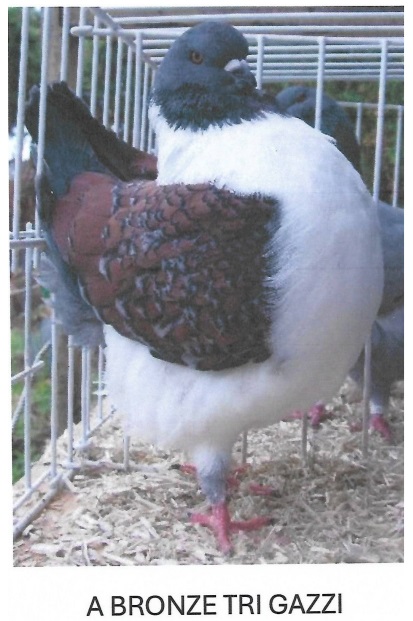
The subject returned to the origin and history of the racing pigeons. Which I explained descend from Rock Doves, and are not un-similar to them to this present day. All that has happened is man has cultivated their homing instinct over hundreds of years. Man has also intervened to create Fancy Pigeons with little homing ability, but have fancy colours and different shapes and sizes, that their owners use to exhibit and show them, with one example being the Modena pigeons. Something I have a little knowledge about as I invited Gary Marsden along to the Lancashire Social Circle Gathering last February to give the members a talk on. Gary left me with a number of photos of these pigeons which created a great deal of interest.
I then explained racing pigeons are athletes of the sky and are not un-similar to race horses in that we all see horses grazing in fields, but none of these would win the Derby Race. And it's the same with pigeons we see feral pigeons in our towns and cities, but once again these would never be capable of competing in a race. Race horses are given a balanced diet monitored exercise along with regular health checks, and It's the same with racing pigeons. Their food is regulated for the tasks they are intended for, Breeding, Short Distance Races, Middle Distance Races or Extreme Distances. With their exercise regulated to the tasks intended for them. When it comes to later in the year when all bird shed their feathers, and re-new them, ready for the winter ahead, a period called the moult. The food at this time is again modified to get the best quality feathers, before the food is altered once again throughout the winter period when the pigeon are resting through the long winter night. I took along a number of different types of grains and mixtures to give examples of what I was talking about, along with samples of grit and minerals.
This created a question from one of my audience who asked, the pigeons she sees outside of McDonalds are not as clean as the ones I had brought along and what is the white bit on top of the pigeons beak. I explained the white bit are known as wattles and are the pigeons handkerchief and are snow white because the pigeons are in good condition, where as the pigeons eating Pizza and Chips outside McDonalds have greasy wattles as a result of what they are eating. What is the importance of grit for a pigeon a question was asked. Grit is very important, and can be described as tiny bits of broken sea shells and very small sharp stones, that the pigeons needs this to help them grind up their food as they don't have teeth. Their food first goes into their crop before passing through to their gizzard, where the food along with the grit is broken down. Another vital item of great importance is minerals that the pigeons also needs to keep them in good condition. It is very noticeable when the pigeons are feeding their youngsters just how much of these minerals the parents consume.
We then moved on to the breeding cycle, when I explained pigeons pair up and after a short 10 - 12 day courtship along with nest building, the hen lays her first egg around 6 00 O'clock in the evening, and a second 46 hours later at around 4 pm. Both sit the eggs, the hen through the night and the cock in the daytime. These times vary with each pair, some being keener that others to take on their prenatal duties. Once the eggs hatch after 18 days both the cock and hen feed their youngsters by regurgitating pigeon milk, that is a fatty substance formed in the pigeons crop over the 18 day period of sitting the eggs. Pigeons are a little unique in that they drink and swallow water as humans do, being the only bird to do this. All other birds dip their beaks in the water then tip their head back to swallow.
Around about a week or so, the parents slowly start to feed their babies more and more solid grains as the youngsters grow older, until they are around 24 to 30 days old when the youngsters fledge. Over this period the parents will have made a new nest and the hen in most cases will have laid a second pair of eggs when the youngsters are around 16-18 days old. The youngsters themselves will take to the wing when a little over 30 plus days old, with their flights around their home taking on a longer and longer time on the wing as they get older.
Taking the youngsters on short training flights would start around 12-15 weeks of age. Starting from short distance of a few miles, and building up to their first race of around 80 miles or so when they are around 5-6 months old. Once again over this period the feeding of these young pigeons would change as they developed and their need for protein and carbohydrates differ.
The subject then reverted back to pigeon in war, as the young students couldn't fully understand why pigeons had to be used to carry messages. My reply came, at the time of the First World War one has to remember communications were very different from present times with no phones, computers, laptops or very little else in the way of communications. Pigeons performed great feats in the course of the war carrying messages back to their lofts with SOS messages that resulted in saving many service-men's lives. In World War 1 pigeons played a vital role, being a very reliable way of sending messages, with over 100,000 being used with an astonishing success rate of 95%. One has to remember communication systems were very crude and unreliable at the time. In the trenches it was soon found that telegraph wires running from the front line back to headquarters were easley cut by artillery bombardment and difficult to restore. In desperate circumstances, pigeons were greatly valued as a last-ditch option for sending vital messages.
The pigeon service built mobile pigeon lofts on top of converted London Buses, that could be moved from place to place a mile or so at a time, and held in reserve for times when normal communications became impossable. Pigeons were also carried into battle using motorbikes and bicycles as well as soldiers carrying pigeon baskets on their backs. Both the allied forces and the Germans used these methods of getting pigeons to where they needed to be. Throughout the duration of the War, fanciers helped in every way possible, supplying pigeons to the British services. Not a single bird for any of the services was ever enlisted unless it was sound and capable of the work it was likely to be called up on to do, and service men had to be taught how to handle and look after the pigeons in their possession.
Following the War a scheme was set up by one of my own organisation the Lancashire Social Circle, past members Capt. E E Jackson, who supply ex-soldiers and sailor, fanciers with pigeons to restart their lofts. He personally bred 100 pairs of young pigeons and placed them at their disposal.
I have to say, while talking of the past, not that many years ago along with a very good friend of mine the late Brian Newson, we made several visits to the army signals HQ. Where we were told the Chinese have around 15,000 pairs of racing pigeons that can still be used for communication purposes as this is the only safe way of commutating without detection. With items like mobile phones etc, all being able to be tracked.
I also spoke of the Royal connection with the Royal family also keeping racing pigeons at the Sandringham Estate. When in 1886 King Leopold of Belgium gave the first racing pigeons to the Royal family as a gift, and where the Royal lofts still stand to this very day with the loft manager Peter Farrow in charge.
I could not let the opportunity pass by without mentioning what the fancy has done for the many charities over the years. by saying, moving on to the present times, pigeon fanciers have been responsible for raising many thousands of pounds for charities over the years. I have been involved in a number of these, raising money for several local Hospice's. What happens is top fanciers are approached to donate a pigeon for the named charity, and an auction is arranged at a pigeon venue or on line. The proceeds are then presented to the charity. One great example of this is, in 1972 a show of pigeons was organised at Doncaster and alongside the pigeons exhibited, was a select group of pigeons put up for auction, with the proceeds going to the Spina Bifida charity. This first show raised £3000 for the charity. As time moved on the show outgrew the Doncaster venue and a move to Blackpool came about in 1986, where its popularity had grown and grown. As well as the Spina Bifida, who has received a total of £576,881 to date. Other charities have also received very generous donations, and up to date the show has raised almost £3 million that it has donated to dozens of charities throughout the country.
I thought at this point we might have finished but no, the questions went on, how do you get the rings on a pigeon? I explained this, and also told them where the rings came from and were registered with the RPRA and should a pigeon be lost can be reported to them and the owner can then clam it and have it returned. I took along a number of old ring of different colours explaining the different colours for the various years. I never brought the rings home as one girl wished to start a new trend and make a bracelet out of them. I also covered the ETS ring and how it works when we enter the birds into a race.
The filming took well over two hours, I am not sure just how much of this ED-Class will use for their on line education but whatever they choose to use, it can only do the sport and the young students a bit of good.
Brian Dearn Tel. 01254 772515.