THE PORT NEWS
Ken Sharratt
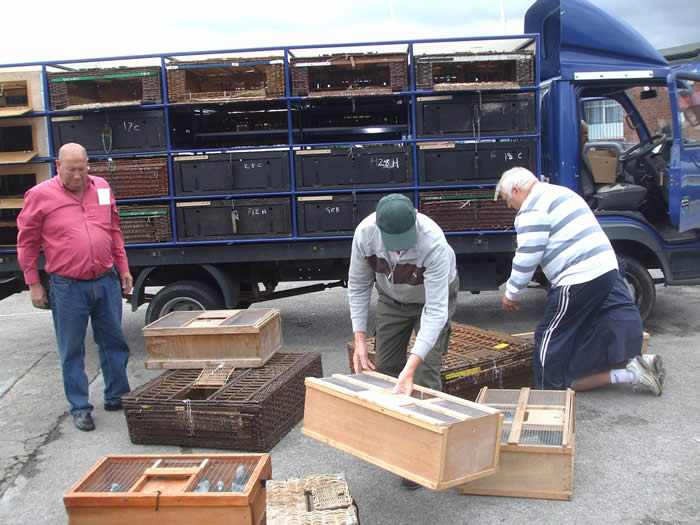
Busy busy. Stan and Robbie and Sid loading their birds onto the Federation training wagon
The digestive system of a pigeon and young bird sickness
The last week or two have been difficult and I guess we all have had that sinking feeling, when one or two young birds do not respond to the corn tin and you know that when you handle them they will have retained food in their crop. Most fanciers have learnt to live with the adenovirus and most know that given the right conditions it will appear. The trigger factors appear to be stress and change of diet. The virus attacks the digestive system. Therefore the best advice that I have received is complete removal of all food for 24 hours and this appears to give the bird the opportunity to combat the attack. My conclusions are that (1) Stress and diet change trigger. The start of training and possibly the introduction of a racing diet and some will be going into a moult. Also the weather is usually starting to get warmer and I believe that helps the virus. The adenovirus also always comes with a secondary parasite, which needs treating once you have got the birds back to eating normally. The corn in the crop does digest and it just takes time. It's a very slow process but once that has gone, then the birds usually perk up. Cease all training. Remove food for 48 hours and the introduction into the water one of the natural digestive supplements that cleanse and replenish the gut linings. I don't want to recommend any particular one. I use the one that friends in the club recommended. If anyone wants to email, I will tell them what I use.
I felt that it would help us all if we discussed how the food that we feed our pigeons passes through their digestive system. We place such great importance upon the grain that we give them and its content and its effect upon their performances. The crop separates birds from many animals because it is an organ that is exclusive to these animals. A crop's main function is to store food. It is like an extra fuel tank for the bird. The crop continuously supplies small amounts of the food to the stomach. There are two parts to the stomach of a bird. The first part is the glandular portion of the stomach. This portion secretes digestive juices which break down the food. This part joins a large muscular portion of the stomach commonly known as the gizzard. The gizzard grinds up food even more. The gizzard contains gravel, or girt, which works alongside with muscles in grinding up food. Some birds (not pigeons) have gizzards that are so powerful they could grind up needles of steel in a matter of hours. In pigeons who ingest whole seeds a gizzard is very important. In these birds digestive enzymes alone cannot effectively break the seed hull. This is where the gizzard comes in to help. They require a large amounts of grit in their diet. After leaving the gizzard the food is passed on to the small intestine where it mixes with bile and enzymes. The enzymes help with the breakdown of sugars, fats and proteins. Bile from the liver breaks down the larger fat molecules. The nutrients are then absorbed and passed on to the blood stream. The liver of the bird has two equal lobes and is nestled next to the heart under the rib cage. Like in humans, the liver acts as a detoxifier, purifying toxins that enter the bloodstream and it recycles red blood cells some which are used to create bile. The pancreas in birds is located near the small intestine. The first function of the pancreas is to neutralize acids that are found in the mixture passed on from the stomach. If this does not occur serious damage could occur to the intestine of the bird. Another major function of the pancreas is to produce insulin so that all the bird's cells are supplied with glucose. Very important from our perspective, continuous supplies of energy. Now we are coming to the final result, droppings and the reason why I wanted to discuss this very important subject. I was at the lofts of one of the Vic fliers and I asked why he was watching his number 1 widowhood cock closely prior to a major race. He replied that it was important for him to see the condition of the bird's droppings. It was a big condition indicator. Because the racing pigeon is a seed eater its droppings should have a firm greenish or brown part, this is the faeces, and the dropping should have a white pasty part, this is the urine. A normal healthy bird should have anywhere from 25 to 50 eliminations a day. There are several reasons why a bird can have loose droppings. It is recommended that you should never drastically change your bird's diet. Stress can also cause this condition in birds. A bird's digestive system is extremely efficient because it has to be to keep up with the metabolic reactions the bird has. Seed eaters usually digest their food within three hours.
Time for a smile with Ken
One night, one of the pigeon fanciers from The Vic is invited out for a night with the lads after winning a race over the water. He promised his wife that he would be home by midnight. Well, the hours passed and the beer was going down smooth, and before he knew it, it was 2:30 a.m. Drunk as a skunk, he headed for home. Just as he got in the door, the cuckoo clock in the hall started up and cuckooed 3 times. Quickly, he realized that she'd probably wake up, so he was quite proud of himself when he thought to cuckoo nine more times. Even in his drunken haze, he fell asleep smiling about how he had escaped a possible argument. The next morning, his wife asked him what time he got in, and he replied, "Twelve." She didn't seem disturbed at all, which made the flyer feel even better. She then told him that they needed a new cuckoo clock. "Why is that?" he asked. "Well, last night our clock cuckooed three times, said "Oh, crap," cuckooed 4 more times, cleared its throat, cuckooed another 3 times, giggled, cuckooed twice more, and then made a rude noise."
WEST CHESHIRE FEDERATION (SR) Niort race. 49 members competed on Saturday 9th July 2011 liberated at 0600 hrs in a west south west wind.
W. WALKER OF CHESTER tops the Federation on a velocity of 1303 ypm and in second and third place L. TAYLOR from Rock Station on 1260 and 1259 ypm and in fourth place M. H.Thornhill Victoria on 1245 ypm.
Deeside Amal Niort 9th July lib 0600 hrs wsw wind. W. Walker tops the Amal from WCSR on 1303 ypm and second is B&N Vernon Wrexham 1267 and L. Taylor WCSR 3rd and 4th on 1260&1259 ypm.
VICTORIA HOMING SOCIETY. Result of the Ludlow race young birds on 23/07/2011 liberated at 1030 hrs into a light north west wind. 10 members sent 310 birds. Griffiths & Sandland are first with a bwf hen on 1332.051 ypm and M.H.Thornhill is second with a blue cock on 1332.000 and third and fourth goes to Griffits and Sandland on 1330 and 1328 ypm The winning hen is a pigeon bred from Roy Sandland stock of Andre Diereck lines and is out of the Belgian rung hen and a grandson of the 06 cock.
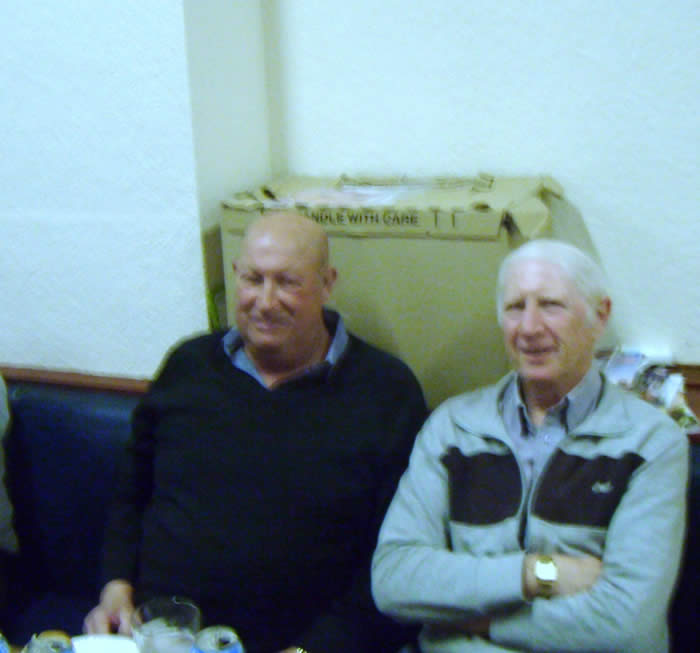
Stan & Robbie of Griffiths and Sandland win the first young bird race of the season
Was I Too Generous?
As it was our Wedding Anniversary yesterday I thought I would treat the good lady. The day went as follows. Champagne and crumpets for breakfast, alfresco. A run out to a large garden centre. Stopped off at at a friend's pigeon loft on the way back (as a treat). Beer, wine and nibbles at lunchtime in the garden. BBQ mid afternoon with a very nice bottle of Rioja. Late evening due to being still pretty full from the BBQ we had a large slice of New York cheese cake and raspberries chased down with a bottle Lanson Black label. Finished off with drippy coffee. Do I know how to lay it on or what! I know, I'm a fool to myself. Take care and be happy.
Ken Sharratt. email