Four Master Pigeoners - Part 2
By Liam O Comain
Jules Janssen
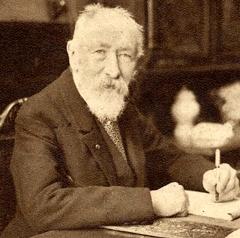
Our subject Jules Janssen from Rue Seutin 6, Schaerbeek, Belgium, once held the position of the Minister of Finance in the Belgium Government and was in his day reputed to be the 'Father of the Sport' in his native country. At least he was one of its founding fathers.
To the older generation of pigeoners this particular Janssen would have been well known through the exploits of the stud of the late T. Buck and the world famous 'Theatre Lofts' of Jack Lovell of Britain. The Buck 'Janssens' as some referred to them were winners of countless prizes in Fed, Combine and Open competition and Jack Lovell of London was noted to have received numerous expressions of thanks and congratulations from fanciers world wide arising from the exploits of his pigeons especially of the Jules Janssen bloodlines. In fact there are many outstanding strains who have had Jules Janssen bloodlines at their foundations including the Janssens of Arendonk. (The latter family were not related to this maestro of the art of breeding).
In relation to the base of the Arendonk family some authorities imply that the Janssen Bros and especially their father was somewhat secretive about the pigeons used. This may have been unintentional but there are those who opine that Jules Janssen was a source if not the full source of their strains base. Suggesting that sharing the same surname of an then famous fancier would have seen the Arendonk family making contact with Jules Janssen.
The strain was of the Brussels type of the long distance racing pigeon which tended towards being large, blue and chequered in colour, and was descended from the Wegge strain. Jules Janssen patiently created his strain after he had received some pigeons from Karel Wegge. He had been helping Wegge for sometime to look after his pigeons and when he decided to have a loft of his own the Wegges were an obvious choice.
In due course his name became famous especially as a breeder of marvellous stock and from throughout his native country his bloodlines were sought by hundreds of the fancy. T. Buck had a stud book of Jules Janssen dating from 1893 which he presented to Jack Lovell and in it is revealed the names of many founding fathers and great exponents of the sport who had received birds from Jules Janssen namely Vandevelde, Gits, Delbar, Grooter, Van der Espt and Jurion. Also there are Delmotte, Carpentier, Gallez, Vekeman, Pittevoil and Coopman. The brothers Cattrysse family also carried their bloodlines via the Vandeveldes and in due course the following strains were helped by the Jules Janssens namely Havenith, Sion, Bricoux, Tremmery and Stassart. Of course there are others but the sample provided should confirm that this was a pivotal strain in the sport of pigeon breeding and racing.
In Britain it is opined that the Jules Janssens lie at the base of or influenced the development of the Kenyons via the black pieds of the Thorogoods. They are also said to have been used by the great English national flyer Marriott via T. Buck and there is a story by Jack Lovell in which it is related that N. Barker got in a red stray cock of Janssens which he was allowed to keep, bred good birds off it before gifting it to J.W. Logan who was of the opinion that it was his best breeder. Yes, as well as Logan there were many other lofts who housed the Janssens for Jules breeding skills helped to develop the sport at its infancy and beyond.
In conclusion, Jules Janssen warrants a special place because of his contribution to the sport of pigeon racing, especially the genetic contribution which is to be found at the base of many outstanding strains of the sport.
John Logan
Although a man of many interests John W. Logan was destined to become the pioneer of distance pigeon racing in England. It was the late scribe and Logan specialist who wrote under the pseudonym of 'Old Hand' S.W.E. Bishop, the original editor of the British 'Pigeon Racing Gazette', who referred to Logan as 'the wild Irishman'. Well its not the first time that persons of Irish blood or association have contributed to the culture and the sport of other lands. And what better area of contribution than the sport of pigeon racing in the land of the rose. Of course because of the close proximity of the two nations the land of the shamrock or the harp would also reap the rewards emanating from the stamina and the endurance of ' The Logans'. For many a fine representative of the strain flew hundreds of miles through all elements including crossing the English channel and the Irish sea to win for their proud owners in Ireland.
John Logan was a man of immense wealth and influence based upon his role as a master of engineering of which his hand is seen in some of the most important engineering feats in Britain of the nineteen century. In fact his success at this aspect of human endeavour as time progressed saw him elected eventually to the House of Commons. A role which as an MP he performed like all his many other interests to the best of his ability. By all accounts Logan was a unique individual.
As to his beginnings in the sport of pigeon racing it is believed that this was in approximately 1870 when there were none or very few long distance pigeons in England. But once he was hooked so to speak Logan would have attempted to move mountains on behalf of the sport as well as establishing the United Counties Flying Club and ultimately becoming Chairperson of the English National Flying Club. Yes, in those formative years of the sport he was often referred to as a person of immense importance. In fact at that fledgling period he was looked upon as the leader of the sport in England if not in Britain. And along with the late Colonel Osman the founder of another great English strain Logan founded the British based 'Racing Pigeon Weekly'.
But in creating in due course England's number one strain where did Logan procure the foundations of the latter? In the nineteen hundreds an Englishman by the name of Northrop Barker from Yorkshire had settled in Belgium and raced so well in the sport there that he was second to the great Grooters of worthy fame. The astute Logan had been observing Barker's achievements for sometime and in 1878 he surprised many by buying out the latter's loft and bringing them to England. He then as an original thinker sold most of the old birds ensuring that he got quite a number of their offspring back crossed with pigeons from those whom he had sold the young birds too. The latter with other purchases for example input from the Gits, Hansenne, Tofts, Blampain, Soffle, Dardenne, and Goosens were the foundations and the blocks of the Logan strain.
With a millionaire revenue Logan bought other outstanding birds although some others he failed to obtain in fact he once offered Gits a pair of the best carriage horses in England for two of the latters best birds but was refused.
He did obtain one outstanding champion and that was 'Rome 1' which he purchased from Gasper Heutz and which was the leading pigeon in the 1878 Rome race, appearing ultimately in the bloodlines of Logan's 'Old '86'. The latter bird 'Old '86' was born in 1879 and in 1882 flew Arras; 1883 3rd from Rennes; 1884 1st from Rennes and also flew La Rochelle; then in 1886 1st Ventnor; 1st Rennes and 1st La Rochelle. Outstanding victories in an era when the transport of the pigeons was an obstacle to their form and health. Surely one of the great racing pigeons of all time was 'Old '86'.
Apparently Logan was a hard but fair task master and was known to have killed off many birds in the build up of his strain. As an advocate of careful crossing the evidence from his time confirms that he was extremely careful and this appears to be part of his genius for otherwise no successful strain would have evolved without this factor.
An important aspect of his breeding method was the pairing of an outstanding Cock with two outstanding hens and then to pair the offsprings of the initial matings. Many successes arose from this method.
His family of racers were very game and definitely of long distance par excellence. And as they were based upon many strains the Logans were noted to be good crossers with any other strain or family. But like some other strain founders inspite of their successes and there were many the development of the strain were helped by others like the late S.W.E. Bishop whose family in due course were labelled 'Bishop's Logan's'.
The latter development is nothing new in the sport for it took other breeders who in a sense were masters in the art and the science of pigeon breeding and racing to develop the work of the founders. As if the founder of a strain was but the seed setter but others were necessary for the nurturing and the fruition of the original work. The latter is true to a certain extent as one can see in the development of the Aardens and the Stichelbauts for example.
It is to be noted that one of Logans famous hens '1826' won 8th and 1st in the English NFC National in successive years at a distance of 640 miles. The latter outstanding racer proved also to be a good breeder. Rome 1st was in her bloodlines as well as another of Logan's finest breeders '129'. Also '1826' bloodlines are found in the great ' Twilight ' of world renown and of latter times.
The record of results which I have encountered in researching the background for this article are too numerous to mention: but apparently between 1877 until 1886 J. W. Logan experienced continual success at both racing and breeding with the family which he created. And in due course the Logans cultivated by others such as the above mentioned Bishops, and to include Shearing, etc., added to their development which has established the strain forever in the folklore of pigeon racing. That is as it should be for there is no doubt in the mind of this writer that the Logans were on a par with the best of distance strains from the European mainland. Thus the 'wild Irishman' if he had accomplished nothing else in his lifetime has left his undoubtable mark on the history of the sport of European pigeon racing.
Alois Stichelbaut
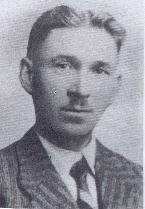
In 2004 one of my most consistent young birds, in the few races that he had, began to blow out like a balloon around his neck area just prior to being sent to his last race. The phenomenon sent me on a journey of learning what was happening to the young checker and in due course I came across the story of a famous pigeon owned by Alois Stichelbaut called 'Opgeblazen' which translated into English meant 'Blown Up'. Apparently this was one of Stichelbaut's best flyers and had returned from a race from Tours with his air- sacs over inflated. In fact he returned from every race in this condition and had to have a sterilized needle treatment to return to normality. But inspite of this he recorded in important races the positions of 1st, 2nd, 3rd, 4th, 6th, 10th, 20th and 25th and accrued a sum of 25,000 franks in the period 1938/1939. Which was some money to win then. 'Blown Up' when sold at the Stichelbaut clearance raised 42,000 franks. Thus the knowledge of the latter successes associated with the inquiry into the happening of inflated air sacs is the key which opened the door to an interest in this great family of long distance pigeons.
We all acknowledge that strength, courage, and endurance are qualities necessary to participate in distance or marathon pigeon racing. Well even the name Stichelbaut itself speaks of these qualities and in its hay day the Stichelbauts were spoken of in the same manner as the Jan Aarden’s. The reference to their 'hay day' should not imply however that the Stichelbauts influence is dead nor that there are no pure or near to pure representatives of the breed at this period of time. For the son of a fancier friend of Alois Stichelbaut races as near as pure representatives of the strain in Belgium, today. That father and friend of Stichelbaut was Daniel Labeeuw of Bissegem and today Daniel's son Frans has the purest colony of Stichelbauts according to knowledgeable fanciers or champions of the strain.
But what was the origins of this great pigeon racing strain of Belgium? Alois Stichelbaut was a flax dealer who when he bought two pigeons in 1922 from the loft of a deceased friend, Alfons Derumeaux, could not have imagined that he was laying the basis of one of the greatest racing strains that the world of pigeon racing ever experienced. Nor could he foresee the success that he personally would experience especially during the years between 1930 and 1940. In truth he was laying the basis of a strain that, aside from their successes at racing, would contribute to the formation of great strains such as the brothers Vanhee, Aarden, Vereecke, Descamps- Van Hasten, Marcel Desmet, and Leo Bostyn amongst others. And that the blood of the Stichelbauts would run in the best of the Vanbruaene and Cattrysse, etc,.
In addition two birds from his uncle Camiel Christiaens were added to his loft as well as some more from Vincent Marien and A Vandecandelaere. The above names may mean nothing to the modern fancier or reader but in their day they were considered the best of flyers. From the pigeons of Vandecandelaere the traditional bronze markings associated with the Stichelbauts apparently derives for the latter fancier had a loft mainly of birds black in colour. Another boost to the family arose from Stichelbaut agreeing to cross his birds with a famous Bordeaux flyer of the time named Armand Declercq. The latter arrangement of crossing the best birds in each loft improved both families and was a major development in the growth of the Stichelbauts.
Alois Stichelbaut was a severe culler and as a result he never kept too many birds which led to him not sending many pigeons to the races. This contributed to a late development in the acknowledgement of his loft as one of the best at the time. In any case he was not a person who sought the limelight and remained in the shadows of others such as Bricoux and Sion. Nevertheless the foundation purchased since 1922 saw the appearance through cross breeding of three outstanding pigeons namely (A) the Old Crayonne which was from Derumeaux and Marien breeding; (B) the Old Scallopede (a cock) again from the Derumeaux and Marien stock; (C) and a cock bred from crossing A and B and a pigeon of Armand Declercq.
Of the strain there were many famous racers and winners amongst whom was 'The Old Bordeaux Hen', a black bronze who from 1932- 1936 won 14 positions from 1st up to 44th in important races and was the mother and the grand- mother of first class pigeons for Stichelbaut as well as other fanciers. Another noted bird was ' De Goode Blekem' which won 25 prizes, 15 of the prizes being in the first ten positions. Another noted racer was 'The Good Black Cock' who won 19 prizes, including 8 in the first ten.
Sadly after years of success breeding and racing a clearance of the strain was held in 1946 raising 145,000 franks. But unlike many families this was not to be the demise of the Stichelbauts for a native of Lauwe purchased many fine representatives of the strain, kept the family pure and advanced it. This was a retired butcher called Michel Descamps- Van Hasten. A survey of his lofts in 1973 confirmed that the stock was 100% Stichelbaut in origin. This shrewd fancier kept crosses to a minimum and the latter included birds from a pure loft of Stichelbauts owned and cultivated by the Labeeuws of Bissegem. Sadly in due course the Michel Descamps- Van Hasten collection of racers and breeders came under the hammer and in six separate auctions were sold for five million franks.
An end to the Stichelbauts? No! For it was then that the mantle of progressing the strain was placed upon the shoulders of a well known racer and breeder of the Stichelbauts namely Daniel Labeeuw. In retrospect Labeeuw and Descamps- Van Hasten it canbe said were the vehicles for the continuation of Stichelbauts pigeon enterprise which began in 1922. Through their managerial skills based upon good horse sense they brought the strain forward as its representatives won at national and international level throughout the world. And in our world wide pigeon racing community wherever you go today the art initially carved by Alois Stichelbaut has left an indelible mark.
In this tribute to Alois Stichelbaut and his strain I think of fanciers throughout the globe who have experienced a unique joy arising from clocking a pigeon of this particular family to win, or come near, or to satisfy in races where hope is prevalent and where no one is usually let down.
Maurice Delbar
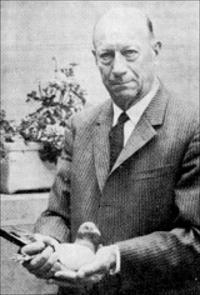
To do a series of articles about great strains of racing pigeons of the past, the present and potentially of the future and not refer to the strain of Delbar would condemn me as being an original sinner. And why? Because this strain has fired the imaginations of countless fanciers throughout the world who have raced and been successful with representatives of the Delbar family. Even today the strain is the number one family of pigeons in the vast country of China, a region where the sport apparently is on the up and up with an increase of approximately 50,000 new members each year. In fact there is a national association of Delbar fanciers throughout the Chinese mainland, a situation not envisaged by the Delbar family of the small town of Ronse in Belgium when they first became participants in the sport before the world experienced the horrors of the First World War.
The Delbar strain's name today derives mainly from Maurice Delbar who succeeded a famous father Oscar in the sport and even before the carnage of the First World War the name was a noted one amongst the European pigeon racing fraternity. This family of pigeons had reaped numerous wins at distances of between 400 and 700 miles and after the war's end the family went unto further glory, especially throughout the period of approximately 20 years- 1919 until 1939. A key factor of their success was the crossing of some birds into the family from a Mr. De Peeter's loft from Puttee not far from Mechelin. Thus lay the basis of the strain: the pre- war Delbar family and the post- war input from the Peeter's. It must be stated, however, that the crosses into the Delbar's were few at this time. However, upon its arrival, the strain took the pigeon racing world by storm and success flourished not only for the master himself but for hundreds of disciples from throughout the whole of pigeondom. In fact in my childhood and youth I heard only of the Delbar's, the Hansenne's and the Putman's in that order as being the major sources of pigeon racing success.
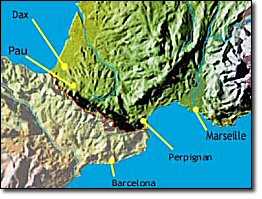
In 1937 Delbar won the Barcelona marathon and approximately 10 years later, 1948, the Barcelona race was won by a 100% Delbar raced by the famous Berlengee. Numerous other fanciers throughout the planet won other distance, and indeed shorter races, too numerous to mention but the whole phenomenon reflected the impact of this unique strain on the world pigeon racing community. In fact the Berlangee win led to the coining of the phrase- 'the Berlangee Delbar grizzles' but in reality Delbar had grizzles in his family long before this. One of his greatest pigeons called the Little Chequer, which had won two Belgium nationals and also had a 2nd, a 3rd, a 4th and a 10th National to its credit, was paired to a grizzle which Delbar purchased from a fancier who lived in his locality. The latter pair bred winners and racers for Delbar and many other fanciers. Inspite of much searching, I have failed to discover the name of the local fancier.
We should also acknowledge that the Jan Aarden dynasty was based upon a number of Delbar pigeons amongst others and that the Delbar strain has influenced other modern pigeon racing strains such as the Jos Thone's. In fact Piet de Weerd had supplied Aarden with a Delbar which lay at the base of the latter's strain. As for the successful grizzles of the Thone strain, some contained Delbar genes. One of the many successful areas of the Delbar strain was in Germany and (on one focus) Thomas Peeters at a distance of over 560 miles won 1st national St. Vincent twice with the same pigeon.This famous cock was born in 1970 and apparently derived from a Delbar grizzle hen known as the Golden Grizzle. A grand son of the Golden Grizzle, which carried the reputation as one of the best breeding hens ever, in 1977, was 1st National Ace Pigeon long distance and also 3rd National Ace Pigeon long distance in the hot bed of German long- distance racing. And it is reported today via the internet, etc., that the Delbar grizzles are still winning within Germany National prizes, especially from Marseilles and Barcelona. Delbar eventually brought in many crosses but his strain through his husbandry remained phenotypical and it was a strain that many fanciers could identify very accurately as being the work of the artist of Ronse. In truth it is a strain of which myths are spun and occupies in the fancy a honourable position amongst the greatest.