The Origins Of The Racing Pigeon
By Liam O Comain
There had to be a beginning to the appearance of the first racing pigeon and history should provide us with the answer. Unfortunately I am not an historian and therefore I did not come properly prepared to see what history would reveal, if anything. What I did discover was that there existed disagreement between those who, like myself, were in pursuit of the truth. On the internet and in the written word I saw different accounts of the origins of our thoroughbreds. And perhaps that is what history is all about for, to borrow from another definition, history 'is in the eye of the beholder'. Unfortunately human vision can, for whatever reason, become negatively influenced by the human ego and therefore is partial or limited in truth.
At the dawn of pigeon racing history the person of Dr Ulens of Antwerp is prominent. He is acknowledged to be the first great Antwerp fancier and to some he was the 'creator' of the racing pigeon. In those early days of the sport it is believed his bloodlines permeated every loft of racing homers in the land of the sport's said origins namely Belgium. Today it is accepted by some that the Ulens were the outcome of crossing three breeds namely the Persian Carriers, Tumblers and Smyters. Thus creating his own strain and he was considered to be the epitome of good breeding management. Others are of the opinion however that it was Ulens' loft manager, a Dutchman called Beernaerts, who was the real maestro who created the strain and laid the foundations of the sport.
But there is another school of thought who contend that it was the author M. Felix Gigot who initiated the above 'erroneous belief'. (Felix Gigot was the originator of the famous, or ill famous, 'Eye Sign Theory' of the sport.) One of the latter being the famous M. Georges Gits who apparently was a neighbour and club mate of Ulens and who, for years, strongly and flatly contradicted the story acknowledging Ulens as the creator of the racing pigeon. In a letter in the 'Le Moniteur Colombphile' on the 26th of December 1912, Gits wrote:
"In an article appearing in the Martinet of November the 13th the Editor professes to give the history of the old Antwerp strains and to prove that all the great lofts are founded on practically one or two. The survivors, myself included, from the period to which reference is made, find plenty of food for amusement in these wonderful revelations. In the first place, the author of this 'humorous' article claims that Chevalier Ulens was undoubtedly the first to form a strain by his clever crossing - a great strain on which all the others were founded. Anybody who was acquainted with M Ulens, or rather his man Bernaerts, who for many years had the absolute control of the lofts, knows perfectly well that they were determined inbreeders and never introduced new blood into the loft; and that their pigeons, roupy and full of canker, were fled from like the plague for fear of contagion...The Martinet also states that Ulens crossed his birds with the English carrier pigeon. In this he is confusing Ulens with Pittevil, one of the most serious breeders we ever had..."
Georges Gits in his letter goes on to undo the foundations of the theory and refers to another fancier, Van Schingen, who was used by Felix Gigot to support his position in his article. In relation to the foregoing Gits cites correspondence from M. Delmotte in support of his position. The letter also contains content refuting Gigot's reference to another fancier called Vekemans whom Gigot used in support of his thesis. In contrast I must state that the pigeon racing historian Jules Gallez apparently supports the 'Ulens theory' in his writings. He cites a Mr P Voot, a friend of Ulens, as the source of the crossing by Ulens of the carrier, tumbler and the smyter. But even Mr Gallez's attempt of confirming by the physical characteristics of the above breeds and the modern racing pigeon is questionable.
I found M. Gits as one of the strongest opponents of the 'Ulens theory', in fact overall I found his letter a very strong statement against the theory. A letter permeated with a sense of anger and disgust if I am not overreacting to its spirit. Perhaps this reflects Gits as an upholder of truth, or as a fellow club member and neighbour was there something negatively personal about the matter? That is perhaps where we need the professional historian's expertise for as a sport we need to be accurate about our origins and it provides perhaps to a student of a University the basis for a masters or doctors thesis.
As for myself, based upon my own perusal of the little available on the matter, I tend towards the position that the 'Ulens theory' is untenable at the present. However, I remain open to the future assimilation of continual information pertaining to the historical origins of the racing pigeon. That is why I will look at the Wegge 'Strain' which, although assumed to be unique in relation to the basic building of the sport of pigeon racing, is considered by some authors to be a part of 'the dark ages of the origins of the sport' and therefore akin to the dark ages of our own species in which the pursuit of truth is sprayed with fallacy. An attitude reflecting the questions surrounding the debate relating to the Ulens contribution to the sports origins which I have referred to. However, this must not prevent us in pursuing the truth if we are to have a record of the sports origins which hopefully will get us as near as humanly possible to the extraordinary happenings at the birth of the thoroughbred racing pigeon.
Some sources contend that the Wegge loft was composed of pure Ulen stock which fits in with the theory that the Ulens were the first racing pigeons based upon the careful crossing of the breeds such as the carrier, the smyter and the tumbler. However based upon my research although acknowledging that Wegge had some Ulen bloodlines it would appear that the latter cross was introduced quite sometime after the moulding of the Wegge family and its initial racing successes. For Wegge received his first racing pigeons from a Mr Schwyck of Antwerp in about 1850 which preceded the Ulens cross via the Vekemans into his family. Here we must bear in mind as we have seen that there is some contentious debate relating to the alleged Ulen / Vekemans connection arising from the vigorous attacks of the late Georges Gits upon what has been called the Ulens Theory.
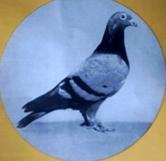
What may not help to clarify the over all situation in relation to our pigeons origins is that Wegges records were somewhat unstable. He also contended that he never practised inbreeding or line breeding, in other words he never produced birds out of blood relatives. The latter of course was not accurate for his favourite pigeon The Vedome was paired according to my research to a grand daughter of this pigeons own sister. The Vendome was a blue cock that was held for stock for two years, then trained and won 4 x 1st that year i.e. 1895. Perhaps Wegge was an eccentric, if so, that was his prerogative but in no way can it deny what he as a breeder produced or as a racer achieved. For the Wegges were at the base of the Jurion and Gigot strains, etc, while the maestro was alive and after his demise in 1897 his pigeons were introduced into many lofts helping to found other strains. Prior to his death Karel Wegge had the reputation of being so generous that he gave dozens of pigeons to new comers to the sport. Quite a contrast to the treatment of novices by some in our sport today.
By all accounts Karel Wegge was a master breeder and a pivotal figure at the beginning of our sport but to be such without inbreeding or line breeding I find it difficult to believe if not impossible. It should be noted however that a modern writer on the sport, Ad Schaerlaeckens, has in his possession a 1903 sales list of Wegges birds and one third of those for sale are pigeons which Wegge bought from others. This scribe does not apparently subscribe to the thesis that Wegge had a strain and that he bought from everyone and thus was an out crosser as Wegge once implied. But could the other two thirds on the 1903 sales list not constitute the Wegge strain? As to the debate about the origins of the racing pigeon Karel Wegge according to some historians of the sport has as much a right to be considered although he never claimed nor has anyone on his behalf claimed to be its originator. However I tend to believe that there exists too much of a grey area at the origins of our sport that perhaps the whole truth is beyond capturing but like the gold miner in pursuit of gold the searching must continue for if anything it is in our nature to do so. Which leads me to suggest again that the subject warrants a master or a doctrinal thesis for a University historical student. As for the Wegges they have an honoured place in the history of the racing pigeon especially at a time in its crawling phase when a shot in the arm was required and when the fledgling pioneering fancy needed someone to provide the necessary product. A provision that was made by the generous Karel Wegge of Lier, Belgium.