Life in the North East of England (47)
Rod Adams
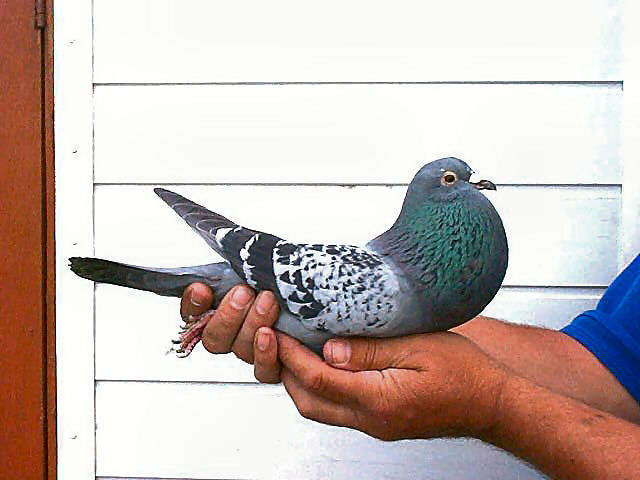
A Widowhood hen racer by choice he’d been a couple of birds short for next year’s team and had pulled two out of the aviary where they had been all season and put them into the racing loft. The quality of their feathering, he said, was astounding. Much better than those kept inside the loft and he was wondering why. It has to be to do with the influence the environment has exerted upon them, as they are fed exactly the same as the rest. Working Border Collie dogs have coats against the world, thick and waterproof the rain doesn’t penetrate to anywhere near the skin. If you haven’t seen how they live you should do yourself a favour and visit a working farm. These animals are not pets to be mollycoddled by some warm fireside, they live and work nearly all of their lives out of doors and have adapted to it. That has produced the dog and the coat to cope with what they have to do and the conditions they have to do it in. Perhaps there could be something like this already at work in the pigeon world? Do some of us mollycoddle them too much and is it doing them any good?
We moved on to feeding. My two friends from London had recently brought me up a bag of an oil seed mixture to try out. Looking at it, I honestly thought the birds would reject it as I have never fed anything remotely like it before, but when I tried it out on my stock birds there was a near riot as they fought each other over it. They weren’t hungry, getting plenty of peas and beans at this time so I decided maybe it was because of the monotony of their diet and took some over to the race loft where variety is the norm and they scoffed it as if they were starving. Despite there still being corn in the hoppers. A bag of Mung beans, given to me as a present for a favour done, went the same way. George and I had previously chewed this phenomena over. You see we both have the same problem, in a way. What you are feeding when you win something really big in the pigeon world is normally what you feed for years afterwards. Why change a winning system and all that? You may not be doing yourself any favours. Times change, and two and two in the world of racing pigeons, more often than not, adds up to five!
Maybe that’s what my mate and I are doing over the De Baere pigeons, adding things up wrongly, but I don’t think so. A fancier in our club, who has had the breed for years, flies them brilliantly and wins with them inland and over the channel. We often talk about the range of distances these birds seem to possess and confirmation has been coming in, as we see it, from all sides and not just locally. We aren’t being selective in our scrutiny of other breeds as in our own neck of the woods the Buschaerts appear to have a similar range, but it does beg the question of how much is due to management and how much is down to the particular strain of bird being used? Maybe some birds are more management/distance adaptable than others, and perhaps the De Baere’s are such birds.
There will doubtless be other strains about if you look hard enough and long enough and wish of course, to really compete over the whole range of distances using only one breed. Specialising in either short or long distance racing is far easier than trying to win them all, but is not something for the impatient or the faint hearted! Ending on a cautionary note, you have to bear in mind that, as was the case many years ago in Scotland, if everyone in an area is flying with say 500 milers, then someone is going to win with these same birds at 80 miles. Anyone who tells me then, that they have birds that will win at all distances is completely missing the point. And will be crucified when the true sprint pigeons appear on the scene!
“Compensatory” pairing. My friend now maintains that after five years playing about with his basic families he has got to the stage where he doesn’t need to use this method of pairing-up any more and is at the stage now where he can pair up and breed off only the very best. I’ve been there. Done it. Got the T- shirt and now I’m not so sure. What we were discussing last night, over a few drinks of course, was the way most fanciers try to compensate for perceived shortcomings in one bird by pairing it to another whose strong points are the other birds weaknesses. You know the kind of thing, a strongly coloured eye to a washed-out eye. A pigeon that is “a bit short” to one that is long cast. A bird slightly too small to one just “a touch on the big side.” Even one that “struggles a bit at 400 miles” to one that “flies Bourges as if it were just down the road.” And so on.
We’ve all done it and I would guess most of us are still doing it, but there does come a time when, if you are lucky, you arrive at a stage where you know you have birds as good as any you are going to get and that you need to consolidate and “fix” those birds in your loft. If you are to have a future with a breed of your own making this is the time to breed off only the very best. Race the progeny as hard as you wish (or dare to) and keep your fingers crossed because now is the time you need the kind of luck which determines whether you win the National or are second! It’s as difficult and as easy as that! Me? Well, as you get older you have less time for certainty and become less sure of what you were once adamant about and I now feel there is still room for compensatory breeding. But on a lesser, more defined scale. It is easy to win with the right pigeons. Getting there is harder. Staying there, which is really what my friend was on about, harder still! Nothing worth doing was ever easy.
Have you ever tried to condense fifty five years of keeping and racing pigeons into a twenty minute talk to a group of people who know absolutely nothing about the sport? Well that was the job I had to do on Friday and I failed miserably. It took me an hour! The talk was to a branch of The British Lung Foundation and took place in The Chest Clinic at The Royal Victoria Infirmary in Newcastle upon Tyne. I still have a slight connection to a group of scientists researching into the immunology of Pigeon Fanciers Lung and had arranged for their previous speaker, an ex colleague of mine, to explain to them the mechanisms involved and what his findings were to date.
He has had a lot of co-operation from pigeon fanciers and others outside the fancy in the past and this is his way of returning the favour as he has the ability to explain his science clearly and simply to non scientists, and he does it well. I was brought in to give an insiders view of the sport, so I threw away my prepared notes and let my memory and love for our game take over, mixing facts, fiction and humour in equal parts. Nobody fell asleep or tried to cut me short and I got some interesting questions at the end. So maybe now we have a few more people on our side. It can’t have done any harm and if my expenses were non existent, well, the sweet mince pies were out of this world!
There were a couple of people there, now in their eighties, with whom I worked with as a boy and whom I haven’t seen for many, many years, which was nice. It has been a week for renewing old friendships as, thanks to my writings I was put in touch with an ex pigeon man whom I last saw thirty years ago when he left these parts for pastures new. Alan once flew with an old friend of mine in the South Shields Central club and I have often wondered over the years what had happened to him and where he was. Now nearly fifty three years old and established with his own business he is taking up the sport once more. Once a fancier always a fancier eh? We chatted about all the local pigeon men we both know and when he asked me if his old mentor was still alive. I had to smile. “Alive, you’d better believe, it he might be getting on a bit but he can still knock the living daylights out of us when he feels like it.” Two Federation wins this year isn’t bad for a man who must be eighty one or eighty two. He won’t die naturally. We’ll have to shoot him! Welcome back my friend, you know where to come if you want some pigeons.
The number of corn mixtures, supplements and additives is mind boggling, not to mention the sheer amount of time required to administer them. It must be almost a full-time job keeping pigeons like this, and it is not for me, even though I am now retired. Like the vast bulk of the fanciers in the North East I used to fly my birds from an allotment site, not from behind a cosy little house with a nice warm secure conservatory from which I could watch my birds flying about whilst mixing all their feeds etc and sipping a cup of coffee. Which is what I do now. Water then had to be fetched, carried and boiled when necessary on a stove or a calor gas heater. Corn and everything else the birds are to be fed had to be carted up the path and stored, not in a nice, well ventilated room but in a cabin alongside the rest of the gear where it might well, like the pigeons themselves, not be there in the morning!
I also have a life outside of pigeon racing and choose not to devote my time obsessively and exclusively to the birds. So what did I do? Well, it isn’t on simply writing off something that might well do you a lot of good, so I compromised and adapted the best of what is on offer to my own peculiar set of circumstances. A lot of expert thought and experience has gone into these feeding methods, and it would be foolish to ignore them, but equally foolish to try and slavishly follow them come what may. The countries and the circumstances in which the birds are kept are very much different. Modification seems to me to be the answer. It is worth a try. I have a different game plan in mind for my birds almost every year so a different feeding method might just make a difference!