
Life in the North East of England (62)
Rod Adams
My friend had problems. His birds were dying and he didn’t know why. Neither did I, but that’s hardly unusual, so we discussed the many possible and the few probable causes and what to do. A mutual friend of ours, called David, naturally came into the conversation. Quite a lot of his birds had died almost overnight, nearly seven years ago now, and we knew exactly why at the time. Proving it had been the problem but prove it he had. “Did I know” said my friend that “David had won his case. £3000 as compensation for the loss of his birds and £5000 in costs?” It had been a long slog, one that would have deterred a less determined man, and had been made partially possible by the professional knowledge of a couple of retired Veterinarians who instead of closing ranks, as you might have expected, had spoken out in support of David’s case.
His problem had occurred as a direct result of properly using a legally prescribed veterinary product. My involvement was limited to the best advice I could offer as a friend at the very beginning of the struggle and I’d quite forgotten the case was ongoing. I really should have put two and two together however as one of the two retired Vets is a good friend of mine and he had mentioned giving his professional opinion on a case ongoing in this country, but I didn’t catch on. What I find quite alarming is the thought that if birds can die en masse as a result of being given an approved substance under veterinary control, what risks are those fanciers running who are bringing into this country and using non- approved substances of which they have little or no knowledge and which may or may not be adulterated into the bargain?
How then, in the event of a tragedy similar to the one I am writing about occurring, would they then go about achieving compensation? David had fought his corner because of the principle of the thing not for the money. Money will not bring back the time he had spent building up his birds to the level he was at, nor the birds themselves, but at least he has gained some measure of satisfaction which would be denied to the unqualified do- it- yourself users of imported medicines. You pay your money and you take your pick. As for my friend’s problem, there are some straws in the wind, there always are, we’ll just have to see which way they blow.
The race itself went pretty much as I expected it to go and the regular form lofts were to the front once more, so I was neither surprised nor disappointed with the result and also with the way the returns worked out. When birds are sent primarily to prepare them for future races they are seldom in with a chance of winning against birds sent to win. Birds raced on a regular weekly basis will always beat those that have been laid off for a week or two in the short to middle distance events, so where are the surprises?
There is no such thing as a normal season. The only thing normal about this season is that the same men are winning at the same distances they usually win at, but the wind has been blowing from a different direction than normal, that’s all. It certainly doesn’t surprise nor worry me. It is to be expected. Why fret about it as some folks are doing? When the sprint men beat us so-called distance men why invest these fanciers with incredible intuition, severe culling methods and better pigeons/management systems than you yourself are employing if you are aiming your birds elsewhere? Of course if it is disturbing you and you do badly want to beat them but can’t, you must change things. You must put up or shut up. And remember whilst certain events might very well be worrying you sock it is totally wrong to assume they worry anyone else!
Muscle wastage. Tell me about it. I once broke my left leg and when the plaster came off, seven weeks after it was first put on, my leg was not a pretty sight. I’d expected a bad smell and a lot of shed skin, maybe even some mushrooms growing on the sole of my long unwashed foot, but not quite such a thin leg. It set me to thinking how quickly muscle can be gained or lost and how such changes would in turn affect our birds. Not that we ever put their wings in plaster (their legs occasionally, yes) but how enforced idleness would put weight on, fat not muscle, and how periods of extreme exertion would take it off. And what we could do about both scenarios. All athletes, and our birds are just that, tread a very fine line between fitness and injury.
Their body weight and the composition of that weight is very important in achieving maximum performances. All kinds of variables come into this equation, nutrition, training, health are just a few but the bottom line is work. “If you don’t use it you lose it” and muscles have to be used and used regularly if they are to operate as they should. Poorly muscled pigeons will not win races. To flag them or to train them or not is very much an individual choice, often dictated by personal circumstances, but the desired result is the same. Strong healthy muscles able to do the job that we require of them.
There was this fancier, well out of my area, who had experienced an exceptional young bird season last year. Who had carried on this year where he had left off and with exactly the same birds. One cock however, racing on the roundabout system and winning well, although in seemingly excellent health had watery droppings. And it had been that way all season. The droppings of the others in that end were perfect and the reason for the one exception was niggling the fancier as it would niggle any good pigeon man. Had I any idea why he asked?
I have seen this phenomenon before with widowhood/roundabout cocks and I believe it is to do with the motility (contraction rate) of the gut. The contraction rate is not something you can consciously affect as you can your rate of breathing because it is under a different nervous control, but it can be affected by circumstances such as say excitement. The main job of the large intestine is to conserve water by extracting it from the remaining gut contents. If the gut is contracting too fast water is lost and it appears as watery droppings instead of being absorbed.
The bird will then, in consequence, drink more to replace it and the cycle continues until a change in circumstances alters the pigeon’s metabolism and normal service is resumed once more. It most certainly doesn’t mean the bird is ill. Far from it. Temporarily administering electrolytes or Kaolin / Morphine solution (to replace water with salts or slowing down the gut with the Morphine whilst the Kaolin provides bulk and absorbency) is the proof of the pudding. Me? I would leave well alone! If it isn’t broken don’t fix it.
“Balloon Crop” (see photograph), that’s what the old timers called the condition. Ruptured air sacs are the problem and injury or disease the cause. Now I have dealt with this situation many times over the years and it is a simple enough procedure to expel the excess air through a small incision but, and it is a big but, are the birds any good as racers afterwards? Once deflated the bird seems “cured” and it is rare for the air to build up under the skin again but as I only see at most half a dozen birds like this in a year. I have been unable to follow through on their ability as racers afterwards. I know for sure that it doesn’t affect the birds as breeders because I have been able to check on them, but as racers? It would be interesting to find out for sure.
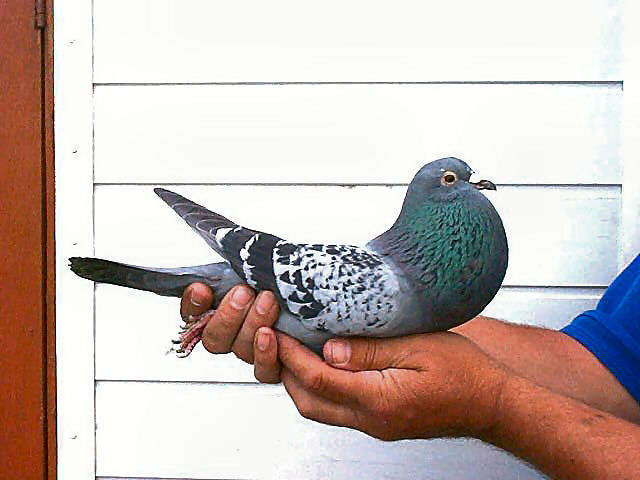
See text above
Anything wrong with any athlete’s respiratory system, even temporarily, must be a worry. Now Air sacculitis is a very different thing altogether to ruptured air sacs. Usually caused by Aspergillus fungi or Coliform bacteria it can be present for some time and become fairly extensive before any outward signs are evident. The air sacs are nothing more than thin- walled extensions of the lungs which hold about 80% of the respiratory volume, are only two cells thick and have no blood vessels, so you have a large “dead space” if you like, filled with warm, moist air and therefore very subject to infection as the body’s defence mechanisms in this area are not that effective. Inhalation therapy via a nebulizer is the only effective treatment and as to exactly how effective that is I don’t really know.
Only a specialist Veterinarian would know that. What you pay for when you get an expert is not for the simplicity of the treatment given, but for the accumulated knowledge that enables that treatment to be carried out with at least a degree of success. It is a bit like a T.V. repairman hitting the T.V. set with a hammer to make it work. The skill lies in knowing where and when to hit the set. Anyone can use a hammer, but can they make their television work by doing this? Some people think so. They, in my book, are called amateurs!