NORTH ROAD CHAMPIONSHIP CLUB
by George Wheatman
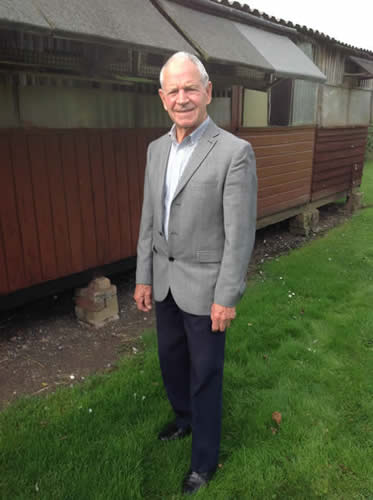
Peter Crawford Thurso Section 8 Winner 2013
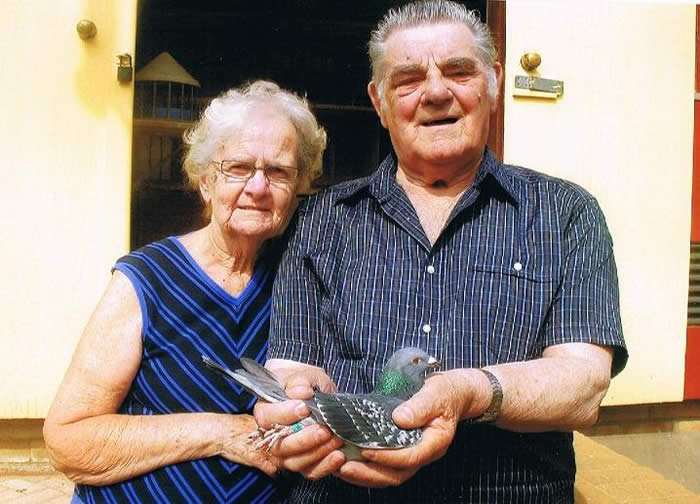
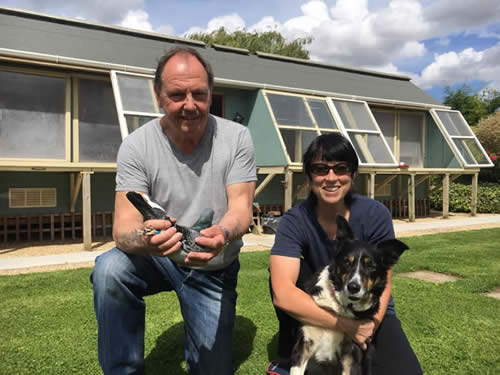
Mr & Mrs Peter Crawford
The Suffolk town of Ipswich was home to many North Road Championship Club legends of the past but it is also home to a present day legend. That man is Peter Crawford.
Peter will be 84 next year and he signed off the 2013 season by taking first and second places in the strong Section Eight from Thurso to bring his total of section wins to something like 15 (he cannot remember the exact number).
He has also been runner-up in the King’s Cup from Lerwick, as well as being 4th, 7th and 10th open in this prestigious race.
The amazing thing is that, despite his advancing years, Peter retains great enthusiasm for the sport of pigeon racing and, despite having had a pacemaker fitted and being hampered by creaky knees, he still has ambitions to land that big Lerwick prize. Should that arrive, there will never have been a more popular winner
The bird that won the section from Thurso was a two-year-old Westcott x Janssen blue chequer cock, which had been a consistent pigeon but had not won anything before, and second section was another two-year-old, this time a light chequer Wily Thas x Janssen, which had been the more successful of the two in the past.
In an enthralling interview, Peter told his story in his own inimitable manner:
“I keep 16-18 pairs of racers on roundabout.
I am OK apart from my knees troubling me a little. Trouble is that I have to go up some steps to the loft. I have had a pacemaker fitted, and take my medication daily.
My uncle Jim Catchpole, who won the animals’ VC, the Dicken Medal, with Mercury, had pigeons, but my own family did not have pigeons. My brother just kept them in with the chickens, actually.
I just went into pigeons because in Ipswich at that time there were about nine clubs with an average of about 40 members, and I went as loft boy to Ben Westcott, used to help around the loft as a young boy but I knew him all my life. I knew the Westcotts but I knew Ben better than Rick. I finished my pigeon education with Wally Grantham (W Westcott won the King's Cup from Lerwick with the NRCC in 1926, followed by BJ Westcott the following year). Other Ipswich winners have been: SR Atkins 1934; S Powling 1949; AW Keeble 1955; J and R Brill 1970.
There were some excellent fanciers then. The Keebles, Westcotts and Grantham. What I liked to do, because I neither smoked nor drank, you had to meet them at the pub because, then as boys, you could not be in a bar, could you? They used to walk round the back and I used to love the pigeon chat, then walk home. Of course you just don’t get that sort of thing now.
I first had pigeons myself in 1937. I had pigeons from Rick, you see, and my mother had four children and could really only afford two of them. I was the youngest and I was always with the birds down the garden and she always used to know where I was. When I got a bit older I played football and I liked sport, but pigeons were always my main love. I have never been without them. I even had them in Egypt when I was in the Forces.
I made a loft there with the dining room tables we used to acquire. They used to be 6ft by 2ft and we used to nick one of them every so often. I was with the Royal Artillery long range desert group. I came out of the Forces in 1953. I had to stop on another year. I had done six years and was in for five and seven. My time was coming up but they kept us for another year because of the Suez Crisis, the first one, of the MacMillan era.
I did not mind life in Egypt because life is how you make it. As far as I was concerned, as soon as I was old enough I left home and never bothered to go back.
I travelled with the fair and then, when I was old enough, I volunteered for the Army, and volunteered to go abroad and, after my training, that is where I went.
Then I came back and settled down. I found that the Army was a good background for me. If you go into the Forces and think that you are going to do this, that and the other and bang your head up against a brick wall, that is up to you. I enjoyed it and finished up as a Bombadier in the Army. I did not mind the Army life at all.
As soon as I got home the main thing was to get a job which was with Babcocks and Wills steel erecting, but my wife said she would prefer me on the ground so, after a year at that, I went to Fysons on the bagging plant. I used to go where the money was. The harder you worked the more money you earned.
One day I thought I would get a decent job, and we had a plastics factory, and I went there in 1954 and did 42 years there.
I retired in 1965 but, by then, I always kept the Westcotts, only them and nothing else, and I only lived for Lerwick and Thurso.
If I took a pigeon in, it would be a pigeon that had won from Lerwick or Thurso, from such as Wally Grantham, Keeble or the Westcotts. They were 100 per cent, but when I came up for retirement I thought I would buy a new loft.
I got some brochures and I was looking at them when my old pal, Bonker, came round and he said what are you doing? I said I am going to try this roundabout when I retire. I shall have more time and I can study it, but this open loft is no good so I think I will buy one. He said “I will make you one, if you like Pete.”
He used to look after a lot of pigs for a gentleman in the country, and he said “Get in the motor” and we jumped into his pick up and he said to the pig bloke “Can I have some of the plywood there?” He had some 8x4 sheets of plywood which he used for the pigs but they were almost new, and he had about 100 or more laid there, and he said “Certainly” and Bonker put 20-25 in the back of the pick-up and, a fortnight later, I had a nice double, open-door loft, which he made me and I thought what will have to go now are the Westcotts. They do not fly on the roundabout; you might get one in ten fly widowhood or roundabout, but they just don’t like it. The hens want to pair together, so I thought I had better get some decent pigeons.
When I went to the NRCC I just said to Geoff Clare “I am looking for some quick pigeons; I want to try the roundabout, what am I going to do?
He said “Have a word with Mr Bristow.” I said I don’t know the man.
He gave me his ‘phone number and, when I got home, I telephoned Mr Bristow and the exact words I said were: “You don’t know me, I am Mr Crawford of Ipswich, and I am looking for some decent pigeons to go on the roundabout. It is no good asking funny money because I don’t have it, and I want the best you have got.”
That is the exact words I said.
He said “First of all I know you through the NRCC and, secondly, I have not said the price and, thirdly, you might not get them, but come up and see me.”
So I said OK, we made arrangements and he told me when to go, and I went up and I came back with about eight. He never charged me one penny not one penny. He just said to me “You tell me how they get on.”
The Wily Thas started winning almost at once and among them was a grizzle, well it was a grizzle when I got it, but it moulted out as a black pied. Some of them do that. That is a characteristic of the Wily Thas pigeons, so I am told.
I had them and then I had a word with Geoff Clare and I said to him “Send us up something decent. I don’t want any old rubbish I have got enough of that”, but I think I said it in a nice way.
He knew me anyway, so he sent me a pair of the Simon Brothers Janssens, free of charge, and I said to him you are going to rue the day when you find out about this hen you sent me. That was the pair that bred, altogether, for me and other people five section winners.
I said to him, and Frank, if you want anything back, you only have to ask, and every year, even now, I sent four to Frank this year, out of the original grizzles and that, and the first race he was 1-2-3 Federation with three out of the four young ‘uns.
I was more than pleased. Every year I take some back to Frank, and he lets me have a different lot. I have never had a mealy in my life, but he did give me a mealy and it did top the Saxon Valley Fed for me as a baby last year. I have some very, very good friends in that way, but it works both ways and, if they ask, and want something back, they have it immediately.
What are some of your best performances? I was first section, third open Faroe Isles, 750 miles. I was 12 hours, the last Faroe race, and the pigeon was here an hour before I timed it in. I was on 12-hour nights and I said to my wife I will get some sleep. Frank Segal was stationed there and he said to me “You won’t get anything from there inside a couple of days.” I normally had in the old loft a board that when the pigeon dropped it rang a bell and it went off in the bedroom. I switched it off because my wife was going to be there. My daughter came round with the grandchildren and I am afraid they did not take any notice, but my neighbour who is a lay preacher said the pigeon had been there for over an hour. I happened to wake up I had been seven nights on 12-hour shifts and, at 10 o’clock in the morning, she was standing there on the board. The bloke who beat me only flew 600 miles into Wales. Having said that, it is the clock that tells the tale. It was our silly fault, and it was no good moaning and groaning, it was gone.
Somebody said, I believe in the Racing Pigeon, that was the fastest pigeon ever timed into England from the Faroes, and it was the first, and only pigeon timed into Ipswich, and Suffolk, from there.
I called her Fully Expected. She was a blue chequer pied hen, and I expected her and I got her. I was pleased about that. She did not breed anything special, nothing outstanding at least.
I started in the NRCC in 1954 and the next year Arthur Keeble won the King’s Cup into Ipswich in a light south-east wind.
I like the long races and that is why I am annoyed that they are making it a short distance club by going to Arbroath instead of Fraserburgh.
I have been lucky in that I have been second open from Lerwick, and, I believe, fourth, seventh and tenth, or something like that, but unfortunately I have never quite made it.
It has been won down here by some very, very good, honest fanciers.
The last time in Ipswich was by Jack Brill in the ‘seventies (1970, vel 731ypm). He was a school friend of mine.
How do you keep your enthusiasm at your age? When I get a nice sunny day, I sit in the garden, on the top step of the loft. I have peanuts in my hand and I talk to my pigeons. They are walking about and they will come up, and I give one a peanut. Another one will jump up on my knee and as good as say where is mine. If I feel a bit depressed I sometimes go down and talk to my pigeons. My wife says to me sometimes, you don’t talk to me like that. I say, no, but they don’t answer me back.
I can’t remember a day when I haven’t been down to clean my birds out. When I moved to this house I said to my friend I want you to cut this wall out and put a picture window in, so that I could sit in my dining room and I can see out, and see my pigeons all day long.
I never grudge what anyone else does, or anyone who pays a lot of money for a pigeon. I have never been like that. I am just satisfied with what I have got, and when I think to myself that I could do with something to add to the team, I speak to the fancier personally.
I get up, probably have a couple of biscuits, take my tablets, probably read the sports pages and then go down to the loft between 9 or 10 o’clock at this time of the year, but at about 7am during the season. I clean out, starting with the young birds, and they are out while I clean out, then I get to the stock loft, and then the hens loft, and then the old bird cocks loft where they race to, and make sure that they are nice and clean.
On my loft floor I have a plastic non-stick thing, and I only have to sweep it. Once a week, normally on a Sunday, I go round with the hoover and blow the dust away, because you do get a bit of dust.
But when I am racing I get up earlier because I want the cocks out flying from 7 to 8am. I clean out and make sure they do the hour. In they come and they are fed a light feed, and then shut up until 5pm when they go out again until 6pm. I have one of these oven things and I set the time. Then they are shut up.
About three o’clock in the afternoon out go the hens and normally they fly with no bother for an hour to an hour and a half and, as soon as I open the trap, down they come and they are shut up for the night.
I only train before racing starts, never during the season. They have about four tosses to what I call Bury Hill, which is about 20 miles. I go ten miles and then I go to Bury Hill and do it about four times, and then they are flying nicely round the home. They are content and so am I.
Then I don’t bother going up and down the road. They youngsters have to have more, of course.
What I generally do, otherwise it gets expensive, I basket the cocks, and then I basket the hens as well, but I keep the baskets in a sort of holdall so they don’t see one another and I put them in the back of the car. One day I let the hens go first, having left the double doors at the loft open, five minutes later I let the cocks go.
I don’t leave the boxes open, I leave them closed, but normally when I get home they are all there on the ledges to the boxes. I normally give them a couple of peanuts each, and they stand there waiting for them, and I put the hens back in their section.
The next time I go, the cocks go first. Occasionally I get the odd hens that pair up, but when I had the Westcotts they would not take to it and I had the problem of hens pairing up.
I don’t box the hens up. I have tried that, but I found that, as soon as I go in, they want to climb up the front to get out, and I did not like that at all, so what I have done I have got some curtains and when they go in, and have had a light feed, I generally pull the curtains and keep it semi-dark. Not too dark. You could read a paper with no bother.
When they go out at 3pm, I put the hopper in, and after they have had all they can eat I never skimp them I take the hopper out and I pull the curtains slightly again and that is all I do.
Do you put anything in the water regularly?
I use cider vinegar. Nearly every product I get, I get from the supermarket. Such as . . . I don’t buy bath salts, I buy what we have in the bath, Radox. That is about £1; if you buy the others, it is about £4.
I put the water in the bath, it sinks and the pigeons go in and they make it all nice and frothy. But if you make it all bubbly, they don’t want to go in. I just leave the water there and the Radox sinks to the bottom and when they want to come down and go into the bath, they jump in straight away.
I always put in a handful of ordinary household soda because that is an old trick Kees and all them used to use years ago, and if you have got worms or anything that will kill them stone dead and, within 15 minutes, your pigeons will be as clean as a whistle.
You can try this yourself. If you have got some concrete round your loft and you put the bath out and then put in a good handful of ordinary washing up soda from the supermarket, that is about 60 pence a bag, I put it in hot water to start with and it melts, and then put the cold water in. Now a pigeon never, ever bathes without testing the water. Now, when they have had a bath, they generally lay about. Now look on the concrete, and you will find that their droppings are pure water within a quarter of an hour, and if there were any worms they will be cleared out right through your pigeons.
I have been doing that since the ‘50s when all the old boys swore by it, but, in those old days, you may remember, you used to get it in a blue bag. If you had any worms, you used to get a bit, about as big as a pea, because it used to be a crystal, but now they have made it into a sort of a powder, put it down in the crop and hold the pigeon for a minute or two. When you let it go, it will go on the perch and you will see it try to be sick. They won’t be because it is melting. If there are any worms they will be on that perch the next day.
Then I use cider vinegar, possibly twice a week, but what I did this year, because I read an article, to keep young bird sickness away. I tried it and it does work. I used cider vinegar when my young birds were 10-12 days old in the nest. They were on hard food. I gave it to the old birds, about three times a week, and I kept doing this right the way through and I never had not even a touch of young bird sickness.
I will try it again this year.
Also if you want a good one for respiration, use some cayenne pepper. Put some oil on the food and use some of the pepper, a couple of times a day, and that will clear the tubes out as clean as a whistle.
Another one what you can have in the water when the birds come home is Listerine. It will kill 99 per cent of the germs. If it is good for humans, it is good for pigeons. That is Listerine mouthwash. Ten mil to a drinker. If you use that it is going to cost you one pound, as against £4 for some other products.
Nearly all my stuff comes from the supermarket.
I treat for cocci, canker and respiratory before breeding, after breeding and a fortnight before racing starts. All birds, racers and stock birds, are treated exactly the same.
When I take the young birds away, I give them half a tablet for canker.
During the racing season, I treat for canker about every four weeks, and the young birds about every three weeks.
My young birds did not come too well this season, and I had the same trouble last season. For some unknown reason they did not want to fly round the loft. I am training and they are beating me home all the while then, all of a sudden, a hawk or something like that, gets among them and they are struggling, and I think that they have got to be rested and, before you know it, they are up the road a couple of races.
I only entered four young bird races. I did not go in for the young bird national, which I like to do, for the simple reason that I could not seem to get the young birds going until near the end of the season, when one of our members, Mr Laws, said he had bought a Meditech product from PJ Lofts, so I did the same and that seemed to put my pigeons in good condition.
I thought to myself that he is a very, very good fancier and so I will try some. I tried it and my young birds started working and, after a fortnight, we had two Bostons and two Peterboroughs, and the first one I entered I was 1-2, all pools, the next week I was 4-5 I believe, the next week I was 1-2 and, I hadn’t got my pool pigeon, so I put it in and was fifth as well.
I believe that I got about six prizes in the four races.
So I was quite pleased that the youngsters started working, but what was even better was the fact that people who I had let have other youngsters said they came extraordinarily well. That pleased me more than anything.
What about feed? What do you feed the pigeons on? A very good friend of ours sends for it by the pallet load from up north. I generally buy about 15 bags at a time and the last time I bought it the price was about £8.70, but now it has gone down to £8 a bag.
It is a mixture but, the trouble is, there is a little bit too much wheat for my liking, so what I normally do, I buy a couple of straight mixes, a bag of peas, or a bag of maize, and add to it to cut down on the percentage of wheat, because they do leave wheat. My pigeons don’t rally like those white peas, either.
I use seeds for fats. A mixed canary seed, or budgerigar seed, a kilo of that with a kilo each of rice, sunflower hearts, hemp, black rape, linseed and white dari and I mix it all up. I give more than just a pinch of that and, then, on Thursday and Friday they are fed in the morning with the hopper, and in the evening they are fed as much as they want of the seed. If I am going long distance I take that to, probably, Tuesday. After they have had a good meal I put plenty of that in and they can eat as much as they like.
I believe a pigeon wants protein to put the red muscles back. When they come back from a race I use protein only on a Sunday to replace whatever they have lost on the muscles. I use peas for that, normally maples.
You know if you are doing right because, if they have got their muscles back in shape, by the Tuesday they are going round the house better. They are not struggling.
Whatever you have taken out of them in the race, you put back on the Sunday with a good protein mix. Then I start on them with my normal feed which is carbohydrates, and I use my fats. A pigeon uses protein for building, carbohydrates for darting away, getting up, or getting away from hawks etc, and once they start flying on the level they start using the fats.
A normal pigeon will fly 500 miles if he is bred for it but, if he has been fed the fats, he will give you those extra miles. A lot of people put in just the carbohydrates and forget about the fats.
For the moult I use the same mixture, but I do chop greens up for them. I don’t buy a special mixture for the moult. I use exactly the same mixture all the year round.
They get a little of the seed all the while because they do need the linseed to help with re-growing the feathers, at least that is what I think.
I enjoy other sports, especially football and I particularly like the way Arsenal play the game but you can get spoiled because, after you have seen Arsenal play, the others don’t seem so good.
I like the Spanish-type of football.
But pigeons have always come first with me.”
Just as a reminder the first 20 in the open NRCC result from Thurso were (228 members sent 1732 birds): 1 Mr and Mrs R Boulton, Skegness 1663, 2 Nuttall and Son, Nottingham 1483, 3 EH Gregory, Eastwood 1470, 4 Rick and Spiers, Nottingham, 1456, 5 Mr and Mrs L Gilbert, Grantham 1454, 6 Mr and Mrs DA Phillips, Ely 1452, 7 LR Carlin, New Ollerton 1447, 8 Mr and Mrs Green and Son, Nottingham 1443, 9 Jessica Newbold, Friskney 1442, 10 I and S Rich, Isleham 1441, 11 W Bearder and Son, Nottingham 1436.4797, 12 A Bennett, Peterborough 1436.0838, 13 J Wheeler, Alford 1434, 14 LR Carlin 1429, 15 Mr and Mrs RA Marshall, Nottingham 1420, 16 D Page, Spilsby 1419, 17 Mr and Mrs G Knowles, Mansfield 1418, 18 DV Brown, Nottingham 1416, 19 Wooff Bros and Son, New Ollerton 1414, 20 Hunt and Perry, Alford 1409.
First 20 in Section Eight: 1 and 2 SP Crawford, Ipswich 1364 and 1281, 3 J Palmer, Ipswich 1277, 4 W Hall, Felixstowe 1266, 5 CI Salmon, Woodbridge 1212, 6 J Palmer 1203, 7 SP Crawford 1177, 8 J Boyd, Ipswich 1154, 9 SP Crawford 1135, 10 T Gunn, Romford 1121, 11 KR Chenery, Felixstowe 1081, 12 I White, Laindon 1073, 13 J Boyd 987, 14 J Palmer 984, 15 BM McDermott, Laindon 968, 16 T Gunn 953.8364, 17 T Ablett, Ipswich 953.7308, 18 G Gibson and Son, Ipswich 939, 19 SP Crawford 928, 20 J and T Ivatt, Ipswich 923.
---
Elimar December 2013