Looking Back at Lerwick6
By George Wheatman
When he was convoyer for the North Road Championship Club, former chairman John Norris used to fly to Lerwick because he was not a good sailor and did not like the ferry crossing to the Shetland Islands.
Also it was, in fact, cheaper.
Our pigeons, unfortunately, do not have the option, and the 12-hour crossing, often less than comfortable, is something they have to endure.
Just one of many obstacles they have to face, and it is important that they have plenty of time to settle down before liberation.
When they are waiting to be released for their 500-600 mile journey home, from the shelter of the transporter, they could well witness many changes in the weather.
One moment the Shetland Islands will give you a benign, sunny smile; the next it will have switched off the lights and brought in the fog. Then there is the rain, so often at the ready, and the gale-force winds.
So the weather at the starting point can be a big headache for convoyer and race controller.
A look back at the races over the past decade will tell you some of the difficulties they have faced. Of the ten Lerwick races in the programme for the years 2006-2015, six were holdovers and one was abandoned.
Breakdown of these races is as follows:
2006 Liberated on the day; hard race in hot weather; only three birds timed on the day.
2007 Another liberation on the day; good returns despite rain in many places. Half the competing members verified day birds, and there were good returns.
2008 For the third successive year the birds were away on the scheduled Saturday. There were 39 verifications on the day, and the first three were each in different sections.
2009 Two-day holdover and the race took place during what was the hottest spell for a long time. There were 33 verifications on the day.
2010 Held over until Monday, and the race was one of the toughest on record. There were no day birds, and the second day started with rain in many places. Only 50 per cent of the competing members verified; some fanciers had good returns, others none at all.
2011 Held over until Tuesday and 200 of the 247 competing members verified, despite the fact that the birds hit bad weather down country.
2012 The race was abandoned, and the birds brought home, because of bad weather, and a bad forecast for the rest of the week.
2013 Held over until Tuesday, but this was a successful race after the birds had had six nights in the baskets, and the longest-flying Section Eight winners, N. Holliday and Son, flying 586 miles, were fourth on the provisional open result.
2014 Held over for a day, liberated at 8am, and an excellent race resulted with the last verification on the day being at 9pm to the Ipswich loft of G Akers, a distance of 570 miles. An excellent race for most.
2015 Another holdover until Tuesday and nine birds were timed on the day, only two of these flying more than 500 miles. Hot day and head wind. Verifications were slow on the second day and some members were timing their first birds as late as tea time on Day 2.
So there you have it, bad weather, allied to the distance, are obstacles to a successful race, and the importance of a good start is of paramount importance.
It is easy for fanciers, sitting in their own back garden, to decide that the weather is OK for a liberation. The convoyer and race controller have a much bigger area to consider, and have to make a careful assessment of what the forecasters, and their many contacts, are saying.
As I remember writing on a previous occasion: “Lerwick is a classic sporting event a testing duel between skilled and committed competitors; has drama and disappointment; patience can be rewarded with elation; there are superb performances by the winners, backed up by mind-boggling efforts in some of the long-flying sections.”
That is what makes competing from Lerwick such a special challenge.
Winners, both fanciers and birds, are held in high esteem by fellow long distance enthusiasts, whatever the direction from which they compete.
This is highlighted by an anecdote told to me by NRCC chairman and race adviser Brian Garnham who recalled that Callum Miller, the highly-respected Scottish distance flyer, was so impressed by Ivan Rich’s performance in winning the King’s Cup last year that he and his son travelled all the way from Wick to Isleham in Cambridgeshire to see, and handle, the winner.
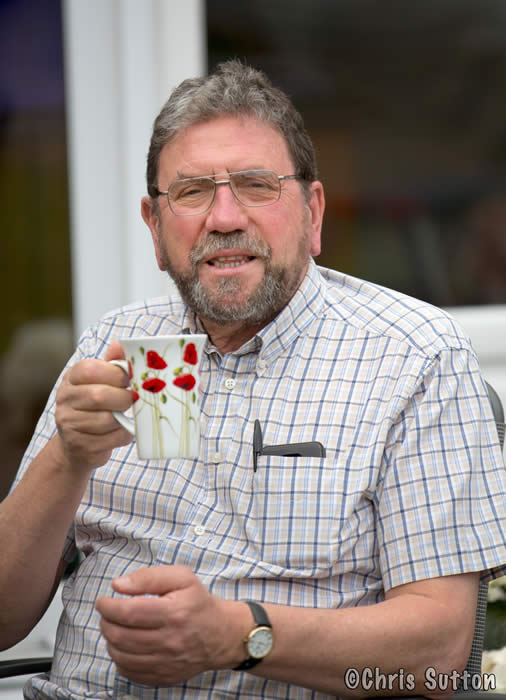
Brian Garnham, chairman and race adviser for the NRCC.
Interesting Facts
Trawling through reports of the race over the past ten years has unearthed a number of facts which may be of interest:
*Winners of the race in 2007 were the Louth husband and wife partnership, Mr and Mrs Ray Johnson, who soon received an offer for the bird from the Louella Stud from where the bird was bought as a youngster by Mrs Johnson as a gift for her husband. They accepted the offer because, Ray said, “it was a lot of money to us.”
*When Norwich fancier Gordon Cockaday won the race in 2005 (at a distance of 527 miles), in second and third positions was Kevin Lawson, of Ollerton, who had two birds arrive together after a journey of 481 miles. Kevin sent ten and had them all home on the day. The following year, when there were only three birds home on the day, he timed one of them to finish third.
*Roger Hallsworth, of Selston, named his 2006 winner after his grandson Jake, who was three at the time. Unfortunately, it did not encourage Jake to become a fancier and Roger is still flying all alone. Two other King’s Cup winners who named their birds after grandsons were Frank Bristow (Oscar) and Tony Richardson (Beacon Hill Kai).
*Perry Brothers and Son, of King’s Lynn, famous for that incredible 1-2-3 in 2002, finished second in 2007, just 10ypm behind winners, Mr and Mrs Ray Johnson. Closest winning margin? Probably that of Frank Bristow, of Horbling, in 2008 when he beat the late Tim Dales, of Louth, by .3 of a yard on a day when there were just 39 verifications. Tim was left wondering whether his reluctance to use ETS could have cost him his biggest moment in pigeon racing.
*Thirty-three of the 1,627 entry were verified on the day in 2009, and two of them belonged to Rob Walton, of Ollerton, who took first and third places. His two birds were separated by one belonging to Russ and Denise Skinner, of Boston, winners from Thurso in 2006 and 2012 and Perth in 2004. The excitement of the win had prevented Rob from going to bed on the night of the race, so he was still up at 5-28am to time his third bird the next day. The pigeons had been held over until the Monday.
*Tony and Elizabeth Richardson were the first fanciers from Newark to win the King’s Cup since Captain Quibell Graves won it in 1931.
*Dave Fox, of Norwich, won the Lerwick race in 2003, with a velocity of 1622ypm, over 527 miles, and then went on to win the 2011 race from Saxa Vord (only the third organised by the NRCC from this race point) on a velocity of 2064ypm for 569 miles.
*Bill Bearder and Son, of Nottingham, won 1st Open Fraserburgh in 2014, with a pigeon bred down from their 2004 Lerwick King’s Cup winner, Bill’s Pride.
*It seemed like a good idea at the time, taking the birds by air to Lerwick in 1977, but it was something that was never repeated so perhaps it was not so good after all. Because of bad weather on the Shetland Islands, the birds were brought back to Thurso, from where the race was won by Mr and Mrs Joe Brand, of Ely
*In 2010, the late Ray Farrington, of Gt Abington, timed a day bird at 10-20pm when it was so dark that he could hardly see the pigeon and had to use a torch to time it in. A few years earlier he had timed that bird’s grandmother at 10-10pm. When he won the race in 2010 a year when there were no day birds Ray named his winner Fergie, after his hero and manager of Manchester United, Sir Alex Ferguson. Guess it is unlikely that honour will be bestowed on the club’s present manager.
*The King’s Cup has been won in Skegness just once, and that was by Frank Stevenson in 1932 the year in which present member from that area, and past Thurso and Dunbar winner, Bob Boulton was born. Bob recalls that, as he grew up, Mr Stevenson’s pigeons were housed in an old caravan on the caravan site he owned.
*Believed to be the only NEHU-rung bird to win the King’s Cup was the winner for John Norris, Grantham, in 1995.
*And, finally, here is a story told to me by the late Roy Todd, dubbed King Roy by the local Press in Boston, after he won the King’s Cup one week and the Peterborough and District Federation race from Lerwick the following week back in 1979.
Roy said he was fearful that the preparation of the hen bird destined for NRCC Lerwick would be disrupted when her cock bird died. So, to make sure that she would not miss her mate, he put the dead bird in the freezer and took him out when it was his turn to sit the eggs.
Unfortunately, Roy knocked the head off the cock bird in the transition, so there followed the sight of a headless pigeon sitting eggs, often with the hen bird, so keen on her eggs, sitting alongside seemingly unperturbed that she was next to a block of ice!
Well, that is the story as he told me . . . the mind boggles.
CLICK HERE - Looking Back at Lerwick...No 7