NORTH LIVERPOOL FED
NEWS FROM DARREN SMITH
Loft Report on Williamson & Murphy
2012 Season highlights:
1st North Liverpool Federation Wincanton old birds
North Liverpool Federation inland old bird average winners
Runner-up highest prize-winner North Liverpool Federation
Premier Prize-winners Vauxhall HS 5x1st, 8x2nd, 4x3rd, 6x4th, 2x5th
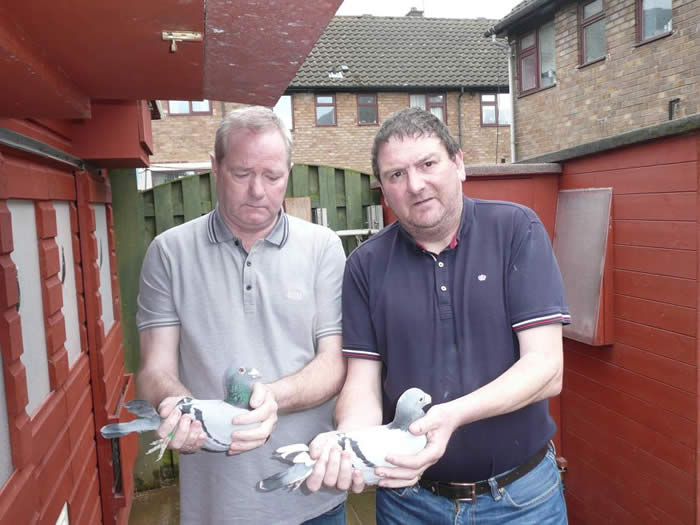
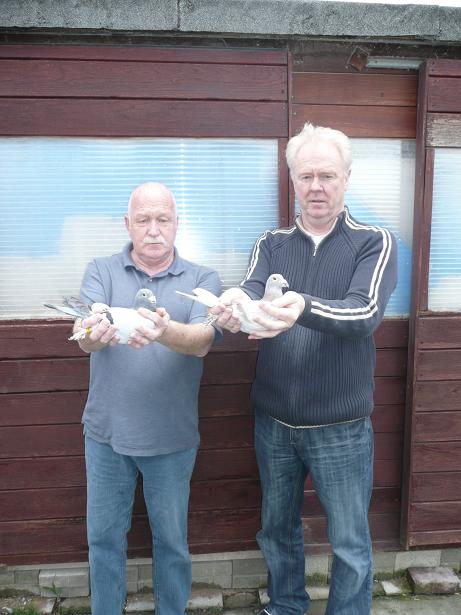
Stevie and John holding 2 of their fed toppers
Can you tell me a little about yourself and how you became involved in the sport?
SW: I first became involved in the sport through ‘stragging’ and later on went in partners with a fella called Wareing. John was flying in the Vauxhall at the time and his missus and my missus have always been best mates. We went away on holiday to Torquay one year and when we came back that’s when the partnership began.
What was your first club and what club/s do you fly in now?
SW: My first club was the Central and John has always flown in the Vauxhall.
Who were your mentors in your early years in the sport?
SW: Mine were the late Sammy Kelly who flew in the Spellow FC and Birdie Cotter who still flies in Speke HS.
JM: Mine was always John Harrison and he flew in the Spellow, the Vauxhall and the Breeze.
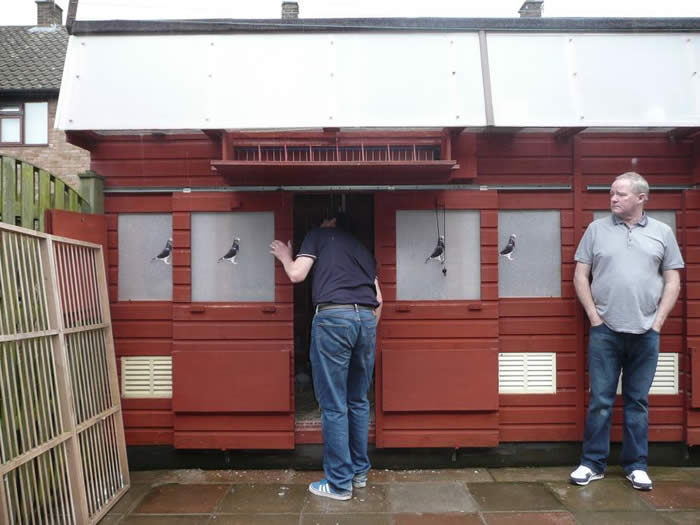
The young bird section
Have they taught you anything which you still practise today?
SW: There are bits that have stayed with us, but the sport has moved on now and you try to improve and get faster. We’ve added a lot from our own experiences.
Can you tell me what preparation goes into your breeders prior to pairing up?
SW: Everything goes into them. We administer a ten day treatment of Baytril followed by a cocci, canker and worming treatment
What method do you fly your pigeons on?
SW: We fly roundabout from the first race to the last.
Can you outline your system from the time you pair up, to once racing commences?
SW: In September we Baytril everything for 10 days as explained, nothing else then we allow them to go through their moult. We then administer the flock treatments prior to pairing up and before racing commences we administer an antibiotic treatment for respiratory ensuring there are 10 clear days between the last day of treatment and the first race.
JM: We pair all our pigeons up in November and float all the eggs up from the stock loft under the racers, very rarely do we breed from the racers. Our thinking being if we lose one half of the pair and the young bred from them do well we can’t reproduce it so we concentrate on those from the stock loft. We take between 4 and 6 youngsters from our proven breeding pairs that are responsible for our better racers.
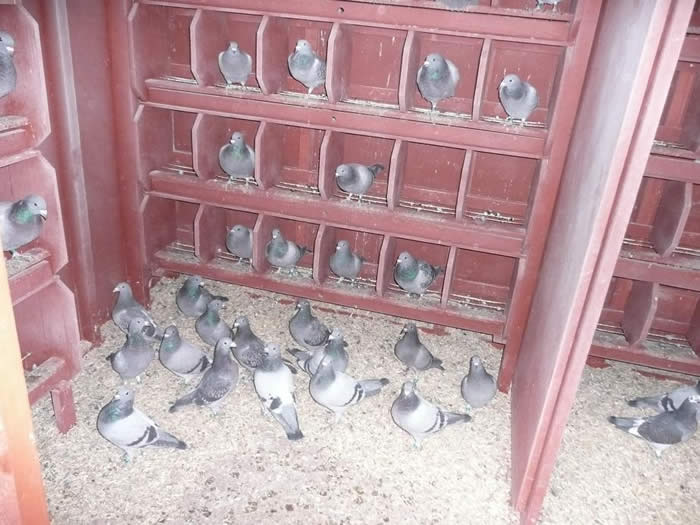
Inside young bird loft
Do you believe you must stick rigidly to your management routine once your racing season kicks into swing, or do you adapt it as situations arise?
SW: We stick religiously to our method from the moment the pairs are separated providing everything is going well. We might make the odd tweak as needs arise, but in general we don’t veer from the course we set.
Describe in as much detail as possible your Friday preparations, from feeding and at what time, through to basketing for the club?
SW: Our team consists of a lot of yearling pigeons and I was told years ago by John Crowder of Mansfield that yearlings need educating and it wasn’t enough throwing a hen in with a bowl for 5 minutes prior to basketing. So what we do is first we introduce the bowl with plenty of nesting material and then the hen at around midday on a Friday and we leave them together until John comes up and baskets them and then it’s off to the club.
Again, we do this religiously, not just the first race. As we go further down the line, or if it looks as if the race is going to be a had one, we will give them less time together so as to try and reserve their energy and likewise if it looks like it will be a quick race, they get more time together to try and take the fly out of them for when they get home.
We’re not there to motivate twenty pigeons, we’re there to motivate one and one week it could be cock A’s turn, he might adapt immediately and the week following, it could be that the penny drops with cock B who then races to the front.
JM: In terms of feeding we don’t feed on a Friday whatsoever. Thursday night we allow them to eat as much as they want from a high energy mixture of diat, fats, Superstar Plus and hemp fed on the loft floor and as soon as they start leaving food it is cleared away and they don’t get anything else until when they return Saturday.
People look at me funny when I say we don’t feed on a Friday, but I say you try feeding your widowhood cocks on a Friday morning, they won’t eat. I’ve tried it and more often than not, end up scraping it up as they won’t eat. Fellas say they feed but it’s not that they feed, more like they put it down and it goes uneaten.
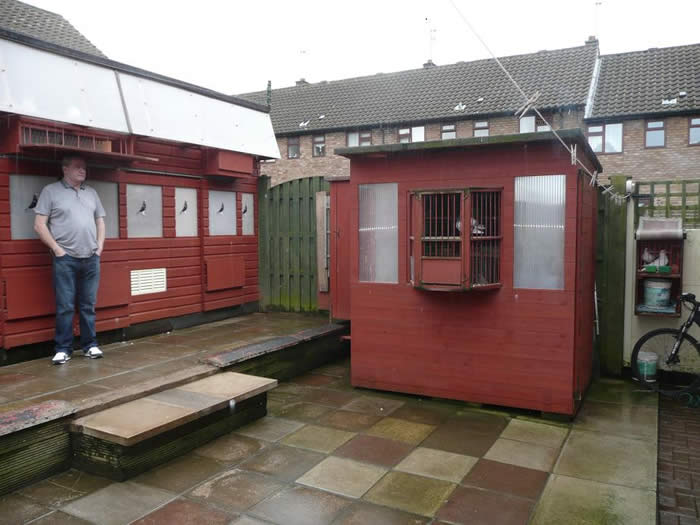
One of the stock lofts
Do you prefer sprint racing, the channel or do you enjoy racing at all distances?
SW: To be honest John loves sprint racing and I can see why as you can normally guess to within ten minutes when they will arrive. I love the channel myself, but as the distance increases and flying time goes on we find ourselves taking shifts to ensure someone is always there.
What is your criteria for getting another season at your lofts?
SW: Well we like to breed 70 youngsters and if it means getting down to a quality 20 at the end of the season, so be it. John’s way of thinking is that if a pigeon wins or shows promise they are the ones to keep, whereas I tend to value the breeding of a pigeon, so if John has selected say 15 cocks based on performance, I will fill the remaining 11 boxes with pigeons selected my way.
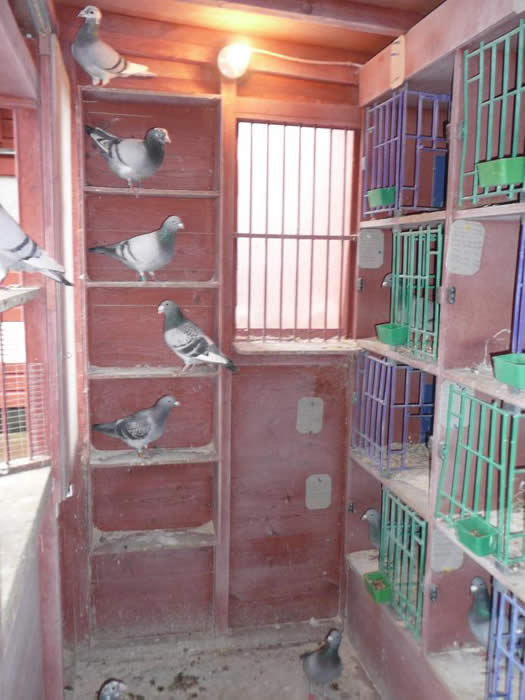
A glimpse inside the stock shed
Do you stock your best racers and when do you do this, e.g. when they reach a certain age or if they win a major race or produce a number of top club/federation/combine honours?
SW: To be honest with you we’ve got a fed topper out there and a 2nd federation winner and we’ve never had a young’un off them. Maybe we’re wrong by not doing so, but because of the strength of the stock loft we just can’t keep them all and there are some brilliant racers we’ve kept hold of for sentimental reasons but we’ve never bred off them. What we tend to do if someone comes and buys young’uns off us and we find out they’ve done exceptionally well, we’ll probably take something off them the year after.
JM: We did stop one cock ‘07‘ and he bred us some fantastic pigeons. He was a son of our number 1 cock ‘18’ and was 1st North Liverpool Fed, 3rd North West Combine on a decimal from 7,500 pigeons. Stevie went in the loft one day after he’d been flying out and he was smashed to pieces, so much so we had to put him down.
What do you prefer, a good racing cock or a hen?
JM: We have no preference really. It doesn’t matter if it is a hen or cock as long as they win. There’s a 25 bird limit in our club and basically if we have to send 15 hens and 10 cocks we don’t have a problem with it, we just try and pick the best out.
Can you outline your health schedule during the race season?
SW: Going back a few years ago, we won the first 5 races on the bounce and I said we’ll canker these and we never won another first after that, so now if they are flying well we leave well alone. If we think they need something we will do what we can to bring them around as it’s like Bert Braspenning says, when they go off, they go off. But we wouldn’t just send pigeons to a race if we thought they weren‘t right, for the sake of losing them and throwing good money down the drain.
Do you use supplements, if so, are they specific to pigeons or do you use natural products or both?
SW: We try to use mostly natural products. On a Saturday & Sunday we use twister oil and brewer’s yeast to dry the corn with and naturaline, tea and iodine in the water. We also use blitzform and blood-stim of a Tuesday and Wednesday, but always give clear water of a Thursday and Friday. Water is taken out on a Thursday evening after they have had a good drink and then re-introduced on a Friday to make sure they get a good drink.
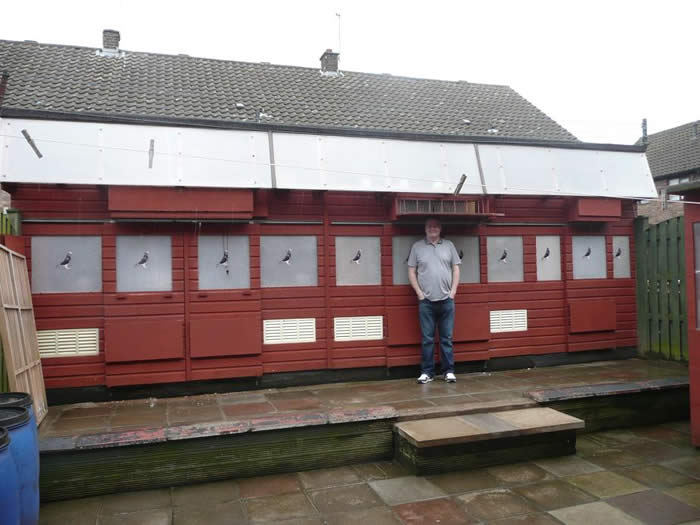
The racing loft
What corns/feedstuffs do you use and when?
JM: On return from the race we feed breed & wean with the above supplements on. On a Sunday they stay in and are fed an ounce of diat mix. Monday and Tuesday morning they get a bit of budgie seed after their fly and an ounce of diat in the evening. On a Wednesday we start to increase the energy and they get a mixture of fats, superstar plus and diat and on
Thursday they get the same mixture with added hemp as much as they can eat.
Do you feed ad-lib or believe in feeding measured amounts?
SW: We feed ad lib on the loft floor which is always spotless. We will feed the big stuff first as this is the best indicator that they are working, so they’ll hit the maize first and as they clear what’s put down we’ll add another handful and so on until they start to leave corn.
Is there any difference in the way you feed old and young birds when racing?
SW: Well the young are on the breed & wean now while they are growing and moulting and in 3 months they have only had a pro-biotic for the first time this week. Nothing goes on the corn at all. I’ve learnt from John more than anything. Come breeding I used to have this oil and that and the other product going on the corn and he’ll stick to a basic mix, black minerals, a pick stone and plain water and people who see our babies on weaning say they’ve never seen young birds like them and you wouldn’t believe the stock had bred four rounds come the end of breeding the condition that they are in.
JM: In a couple of weeks the feed will be lightened up, so basically we’ll start feeding a 50/50 of diat and breed & wean as you have to start getting them under control, but it’s vital you get the body on them before you start taking it off and this is especially so if you are adding babies to the loft all the time. You have to make sure they are getting the heavier stuff or they will go backwards because the older young birds will muscle them out at feeding time.
SW: What you will also find when you’re adding babies all the time, one will develop sickness so you treat them. Then 3 weeks later another will go so you’re treating them again. Whereas if they’re all of a certain age they’re developing at the same rate and if they do get sickness I know we will have it cleared up within 3 days and then they tend to be over it rather than there being varying levels of immunity throughout the loft and it keeps cropping up and you get individuals going backwards.
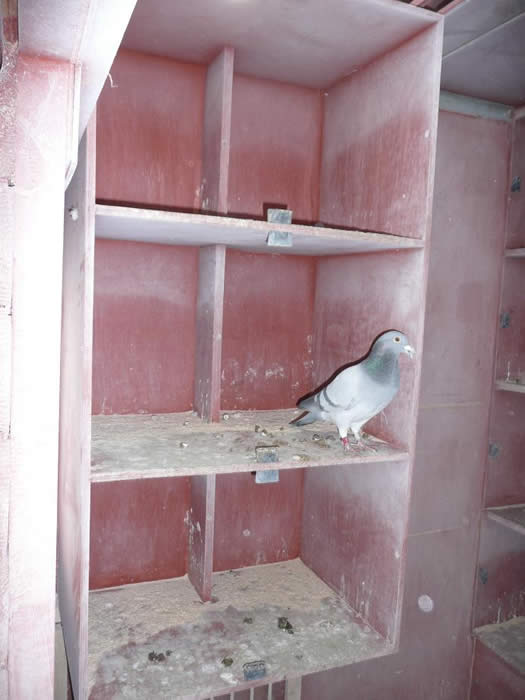
Inside the old bird loft to the left
Do you feed your cocks the same as you feed your hens, if not what are the differences?
SW: No difference whatsoever. They are all going to race so they all get fed the same on the floor ad lib and once you start seeing them leave the big bits, stop feeding. We have the hens locked up on a Thursday & Friday to try and avoid them pairing together and once they go in on a Friday they are robust.
What are the essentials in terms of nutrition?
SW: On return from a race, protein replenishment is essential. They have got to get that body back on them as quickly as possible. From then on the job is getting the fats into them midweek and carbohydrates towards the week’s end as this will be the first of the stored energy to be used come race-day.
How much time do you devote to your pigeons?
SW: I’m here every day and will keep them ticking over throughout the winter period so there‘s no need for John to be over so much as they are virtually resting all the time. Once racing arrives John will be here every day with me, scraping out, training, exercising around the loft, feeding, basically there is somebody here all the time.
JM: We do have a routine in terms of exercise and Ste will have them out first thing in the morning cocks and hens and I’ll be over later on. The beauty of it is you know as soon as you drop that board they’ll be straight in and sorted and you can move onto the next job then.
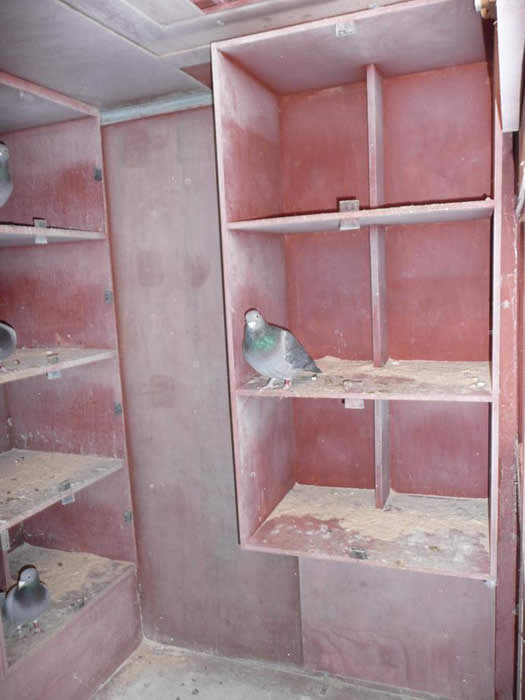
Inside the old bird loft to the right
Do you believe spending a lot of time with your pigeons is essential and if so why?
SW: No, not really I’ll be honest with you I’d have deep litter everywhere if I had my own way, but because it’s a house garden it would mean you traipsing muck back through the house on your feet and John’s is only a small back garden so he will scrape the floor before he sets foot in the loft. Going back a long time ago, I’d have everyone that visited out looking at me widowhood cocks and it’s no good for them so now I’d rather be at work and knowing that the loft’s shut and they’re relaxing more. Every time you’re opening the loft door, the pigeons are being disturbed.
JM: Basically, you’ll have the widowhood hens out of a morning, 40 minutes then back in. Same with the cocks and if you’re doing a bit you’ll go out then. Young’uns will be out late morning and back in by 2pm. Old birds don’t go out ‘til Monday following a race and then we’ll go training Tuesday-Thursday afternoon out to Hale or wherever we think they need a toss from. Hens will go up first and be locked up on their return and then the cocks and sometimes we’ll give them the half hour upon return going back and forth and then the sheds are locked up before teatime until the next day.
Do you visit other fanciers and observe their methods / share their ideas?
SW: We’ll go for a cup of tea and visit lad’s houses, but we don’t go out of the way, say to see Charlie (McCardle) or up to (John) Porter’s.
JM: we’ll slip down to Danny Kelly’s when he’s in and have a cup of tea and a natter, but basically that’s it like.
What are your aims for the future as a partnership?
JM: Just to keep on winning really and basically enjoying the sport, though you have to accept in this game some you win, some you lose.
SW: We’ve had our chances to win the North West Combine but that is still an ambition of ours and perhaps even win the Midlands National once we‘re set up for it with the classic club. But ultimately I think racing in the Vauxhall is our be-all and end all and will remain our priority.
JM: Well you have to win your club before you start thinking about fed or combine wins and the way I look at it, what we get back out of it in terms of winnings comes via the club, not the fed or combine.
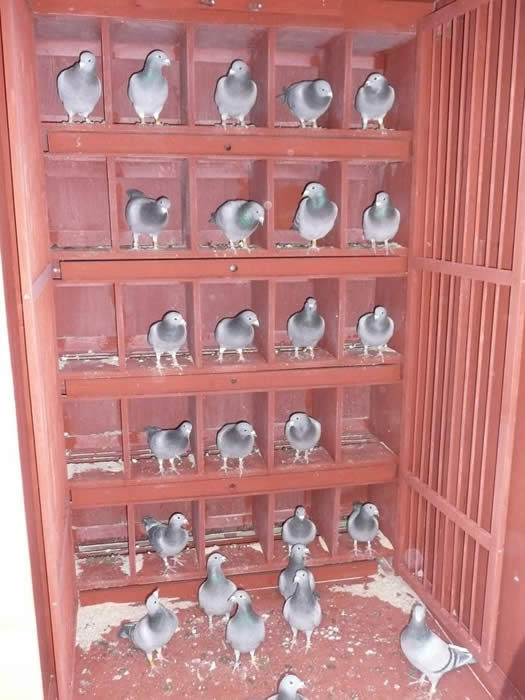
The hens' resting section
What do you look for when introducing new stock?
SW: We are firm believers in eye-sign and will visit top fanciers and purchase future stock based solely on this selection method and if any of our own pigeons breed pigeons with good eye-sign we will keep hold of them for breeding. This year we’ve been to a fella in Germany. John Gerard had them before I got them and he’s been flying well with them and this fella has took the first 15 in the combine from over 25,000 pigeons.
If you’re bringing in new pigeons you have got to go to top performing lofts and every time I visit Belgium or Holland, if we go to a decent loft I don’t want what the fella wants to give me, I want eye-sign pigeons. I don’t care if it’s 1 cock and a hen, 2 cocks or 2 hens all I want is them eye sign pigeons.
The handling of a pigeon is always secondary and the reason I say that is because we had a dark cheq cock that was a terrible handler but it went to every channel race one year and either won or took a prize and ended up winning bird of the year.
How many old birds / young birds do you race and how many pairs of stock do you house?
SW: Our old bird race team consists of 26 pairs but this will be reduced to 20 pairs in 2014, 70 young birds and 33 pairs of stock.
Have you ever stocked young birds you have bred based solely on their conformation and if so, what kind of success have you had from the resultant offspring?
SW: Yeah we have done but to be honest with you they haven’t been bred from.
How do you train your young birds and how often before and once racing starts?
SW: Starting about 5 weeks before racing, we train from 3 miles then 5 miles, increasing distances up to ten miles and we’ll stay here for 2 weeks.
JM: To be honest with you we have trained almost exclusively from Hale the last 2 years twice a day, then last year in the week leading up to Bedhampton we trained every day from Chester just to put some ‘ollies’ in their head.
SW: last year we done something we’d never done before, if it was a westerly wind we’d go to Malpas and if it was easterly we’d train from Wrexham, just to get them thinking. I think we got a long toss in with club-mate Lee Powell one day last season and we were standing waiting for them in the park just over from the house, I think it was a south west wind and about 30 came bombing over from St Annes Street direction and about a minute later the rest came from the direction we expected given the wind that day and I was like how have the first batch managed to get away from the main batch and the following Saturday we took 1, 2, 3, 4 in the club. But that is what it is all about about, putting ollies in their head.
The best advice we were ever given re training was by Vic Taylor when we used to go up and get the corn from him and he told us take a basket of pigeons with us wherever we went. We’re having a go at the Midlands National for the first time this year and our pigeons won’t know what’s hit them when the batches start breaking up and going in all different directions as they have been used to corridor flying all their lives, you’ve got to make a pigeon think for themselves.
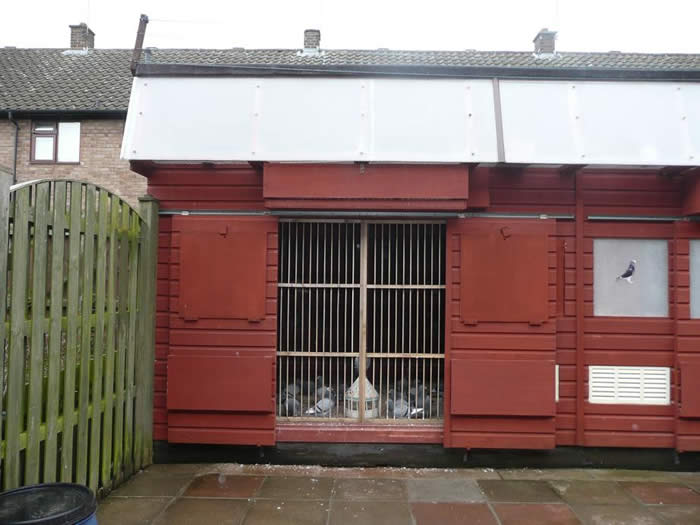
The young bird loft with window covers inserted
What has been your best achievement in the pigeon sport?
SW: I think the year we broke the club record when we won 13x1st would you say?
JM: Yeah the year before that we broke the club record of 8x1st with 11x1st and then the following year broke it again.
Can you tell me about your best pigeon/s?
SW: Best pigeon has got to be ’18’ do you reckon?
JM: For racing performances I’d say ’20’ without a doubt. Couldn’t trap him as a young bird he’d just hit the roof and stay there. Tommy Carroll seen him come over his one day and we give him about 800 yards overfly and he wouldn’t trap and still ended up 2nd fed. But the year after you couldn’t stop him, he’d come and he’d be like bang, bang, bang every week. He won 7x1sts in all. 21 his nest-mate won 3x1st.
SW: ‘18’ was a Rietvink bred via Davey Burns stock and he won 6x1st racing but was a phenomenal breeder and sired 21x1st prize-winners, including 5 separate winners in the same week. Another day we got three together off him in a west wind when we had no right and took the first 3. We used to give everything away off him as he was another one that wasn’t a great handler but he bred a beautiful pair one year. One we gave to a lad called Carl Arthur and the nest-mate we kept and he topped the fed for us on a decimal from club-mate Billy Early. ’18’ was a once in a lifetime pigeon.
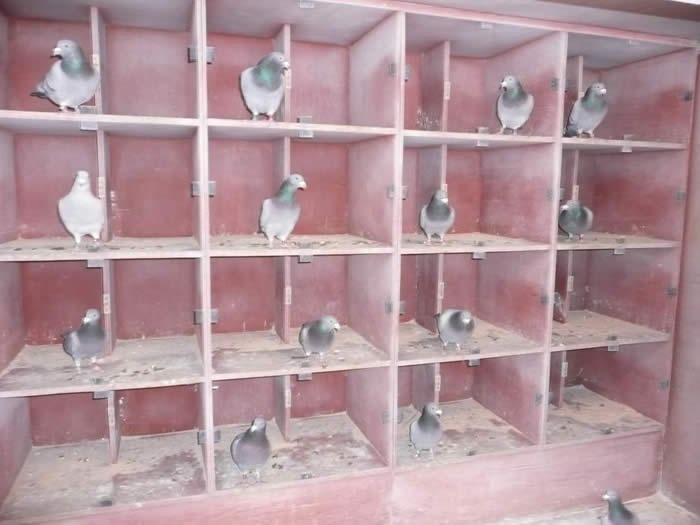
Inside the old bird loft
What advice can you give that would help improve the management/results for a novice/new starter?
SW: Go and get an ETS right away! To me personally the most important thing for a novice is that he has got to be dedicated. A young kid coming into the sport expects success to be overnight. They come in and go great I’ll have a go at this and then the enthusiasm goes when they’re not cracking eggs immediately and they drift away.
JM: As Ste said then it’s about dedication. I’m not being nasty when I say this but when a new flier comes into the sport and is racing against successful fliers with resources and years of experience behind them they can be fighting a losing battle. Don’t get me wrong, we’d give anybody pigeons and they can have the best but if they don’t know what they’re doing with them they lose heart.
SW: It’s like your lad there, at some point he’ll say Dad can I have me own loft and he’ll be all keen and raring to go at first, but in time to come he’ll get a girlfriend he won’t want to know, it’s happened to us all. But eventually he’ll get married, get a house of his own and end up with a back garden and they come back into it around about age 25/26 and that‘s when you see a difference. What I’d say is go to the best fancier in the worst drop and buy 6-10 young birds off him and have faith.
Who do you admire in the pigeon sport?
SW: You’ve got to admire the old school: Charlie McCardle, Teddy Davin, Birdie Cotter, Kenny Simo and Brian Maguire. John loves John Harrison but he’s no longer in the sport, but he was outstanding. You’ve got to look at fellas who are there week in, week out and these up and coming lads who are doing it now. Sammy Kelly was another brilliant fancier who helped me a lot.
JM: For me, the best flier ever would have to be John Harrison. You would have to feel his pigeons to understand what I‘m talking about. They were pure power but there would be nothing in them in terms of weight. He liked racing up to 2oo miles but they were phenomenal across the channel. He sent a late-bred carrying every nest flight to Niort one year and won with it. His pigeons came from Dr Rigg and I think that is who educated him. You’d go up the shed which he had up in the air and go in the shed and the floor would be covered in maize!
What is it you love about the pigeon sport that keeps you involved?
SW: Just the buzz I get in me stomach. If I didn’t have that I’d call it a day. There was a race last year we’re waiting for them, his stomach’s turning, my stomach’s turning and suddenly there’s a pigeon appears like a dot in the sky and it starts dropping like a brick. It folds it’s wing back and we’re calling it and the next thing it hit’s the roof at the back, it was a strag! You have to laugh sometimes don’t you eh!
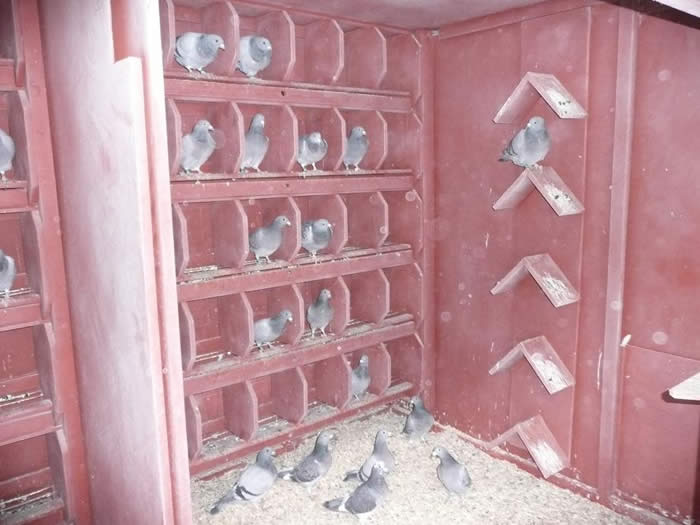
Another view of the young bird loft
What drives you mad about the pigeon sport?
What drives me mad is club members who don’t do any work or take any roles on in a club, but like to dictate as to how the club is run.
What is racing in your club like?
SW: Brilliant, we’ve lost a few good lads this year, but hopefully one or two will come back. Since Kelly, Powell & Whelan came into the club they have added a lot of humour to what was a great bunch of lads anyway. We haven’t got a pub where we mark but every marking night they would bring crates of ale up and do a chippy run and it would just be a great atmosphere, a pleasure in fact.
Who is the one to watch out for in 2013?
JM: No disrespect to the other lads as there are some good fliers in our club, but probably the 2 Danny’s especially after the season they have just had.
SW: I would have said Kelly, Powell & Whelan if they were still flying as they were the partnership who took our crown, but you probably can’t look beyond the 2 Danny‘s.
Do you have a message for your club-mates?
SW: Gerard get them holes in your loft floor sorted, them rats are eating your young’uns! (everybody laughs).
JM: I’d like to wish them all the best for 2013 and say we are privileged to have such a good bunch of lads.
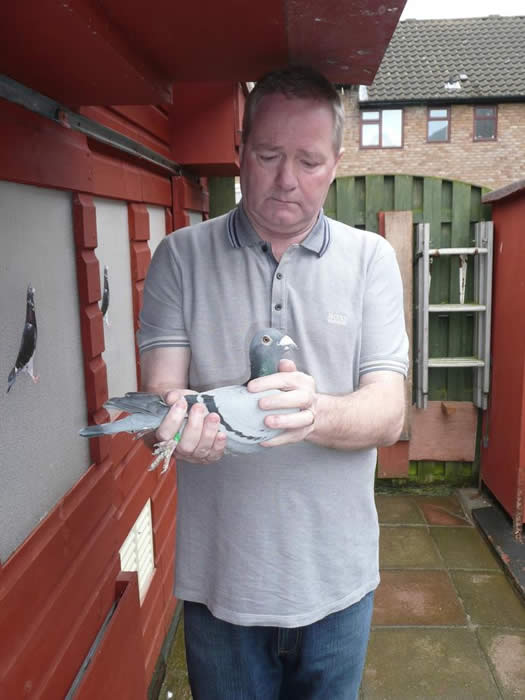
Stevie holding 1st North Liverpool Federation Wincanton old birds
---
Well folks I hope you enjoyed that. We had a great time with plenty of laughs throughout our visit and there is probably the same amount of content in stories retold that was not included in this report once the lads got going.
The rain limited the extent of the photo-shoot, but as you can see from the pictures we took, the set-up is super tidy and highly functional with ETS trapping to all sections and the fleeting time we had looking at the pigeons left us with an appreciation of the top quality housed.
Stevie & John have been one of our top partnerships for years now and as an added bonus to their racing prowess, if you look through North Liverpool Federation results in any given season, their names crop up time and time again in the breeding of winners for others. The acid test for any fancier breeding pigeons for others to race and both Stevie & John say the feedback they receive gives them great satisfaction.
New challenges have been set and 2013 will see the lads take their first steps towards competing with the newly formed Liverpool Classic Club and the might of the MNFC establishment. I don’t see this conveyor belt of success seizing up any time soon. But we might well see a new and improved beast coming off the production line as their pigeons adapt to the rigours of specialist racing.
I’d like to wish you both the best of luck for 2013 and thanks for having us over.
Thanks for reading.
Darren
---