J.H.Shore & Son of Hankelow
“The old and the new”
With Les J Parkinson
We start this report with the old part of the partnership as mentioned above when Dad Joe was racing with younger son Alan. Most fanciers around the country will have heard of Joe Shore & Son for the many good results they have achieved over the years, which include a 3rd Open Nantes National with “Champion Westholme Mick”, also winning the motor car. The total amounted to £3,300 which was a world record at the time for a single entry. More on what Joe's father did not have pigeons but it was still early days. In fact school days when he first obtained a collection of birds from the local farmer who had them in the lofts above the shippons. These early birds were fed on mixed hen corn along of course with the hens and the birds loved it, they had no special loft but lived in the hen pen.
The birds were kept like that until Joe got married by which time they had to go as Joe himself, along with his good lady, reared nine of their own.
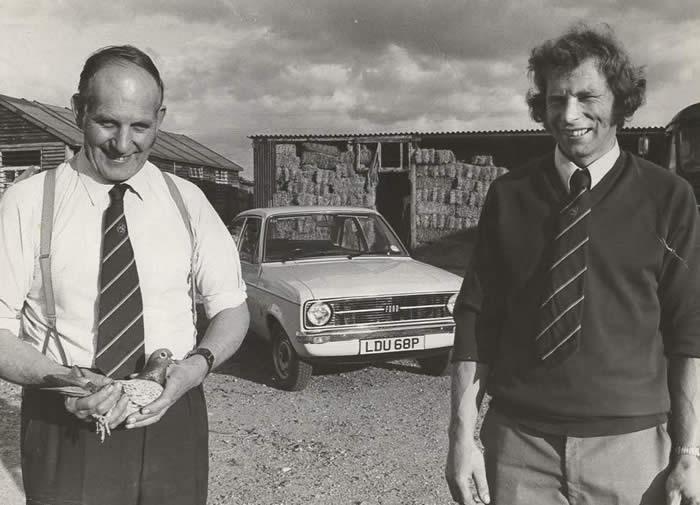
Joe & Alan Shore with the car they won in the background
In those days the cash was not available as it was only a small wage of 35 shillings a week to rear nine healthy youngsters on. Then about 1949 a stray appeared which used to sleep under the cart shed, this bird soon attracted the attention of Joe. He started to feed the stray which soon became very tame this prompted him to get a mate in order to keep the bird around. Then a few sheets of galvanize were collected to make a lean to and was soon stacked with several late from local fancier, Reg who charged 5shillings, also a few from George Parker who charged half a crown each for 6. One particular hen from Reg’s, he paid 7 shillings and 6 pence for proved to be a valuable stock hen who when paired to a cock called “Freddie” which incidentally was bred from strays, bred birds to win in both Club and National. Pigeons were Joe's only interest in sport as he was far too busy running his business which started from scratch. One particular fancier who Joe set his sight on was Alan who at that particular time was top dog which was the position he was after. Eventually Joe reached this target after a lot of hard work and has won more than his share since. The birds have been raced for all but a few years in the mid 60's when he took an interest in a garage business with his father. During this time the birds were sent to the races but on many occasions Joe was not there to clock them in. One thing he did achieve during this particular time was winning the Bordeaux Cup outright by taking 1st position three times in four years a distance of 571mls also on one occasion he clocked the only bird on the day which is no mean fete. These birds by the way bred were from grandchildren of stock purchased from John Taylor's disposal sale of and the blood is still in the birds today. Over the years the line which have the same origins have been crossed into the already winning family. More recent introductions include the beautiful Krauths & Dordins which seem to be hitting it off very well. Joe has always tried to get the birds that are winning 500 miles plus races to breed into his own and as he says it is working out well as he has always maintained that the birds must have the right genes for the distance. On the subject of mistakes in those early days, Joe said yes I have made many, for interest I won a second from Rennes, which was his first across the water with a late bred and full of confidence sent him back to Weymouth and lost him, by the way he had hatched out after Rennes. I think you have to make your own mistakes and then you learn by them, you can listen to different fanciers who advise you different and all in good faith, so you have to find out what suits your own birds and above all learn to have patience which is worth more than any other commodity and is a lot cheaper. As I said earlier the first loft was a galvanize lean to but the present loft is 24” x 9” split into 4 sections plus a corn store in the middle. There is a covered passage along the front with sliding doors to enable the birds to fly into their own compartment. The loft is some six foot off the ground which lends to give the birds that bit more confidence at home as nothing should interfere with birds in the loft. One of the most important factors in the loft design for Joe is that it must be dry at all times as damp is the worst enemy of the birds. This particular loft has a good gap at floor level with a 9” vent the length of the loft at the highest point, as well as the racing loft there is a stock loft at the back with a rather large aviary. Birds kept consist of 20 pairs stock, 24 pairs racers, which rear 50 young birds. Both stock and widowers are paired around mid February with the naturals loft to the middle or end of March when the weather suits. About widowhood, Joe says having seen my friend T.Porter from the Potteries fly the widowhood system which was about 5 years ago I decided to try it. I fitted the loft out for this system and seem to have got things right as they have flown well for me winning from Worcester to but it is no good expecting the birds to be better that they are you must put the best on it and they will respond. You must also be particular about food and times of exercise also they must have their rest so do not disturb them unnecessarily”. To Joe, Old bird racing is fitness which is the most important point, get to know what it means not fatness, fitness is a different thing altogether. Get your birds really fit and you can take liberties and they will do their best but if not fit you can lose the best, an old saying is, never send if in doubt, which is the most truest thing about pigeon racing that is of course next to patience. This family of birds have won from Worcester to Angouleme, not forgetting a few years ago when they used to fly Bordeaux to this area. Joe has tried to Pau and got positions but thinks that it is too far for day racing and does not like it much with the night out in France.
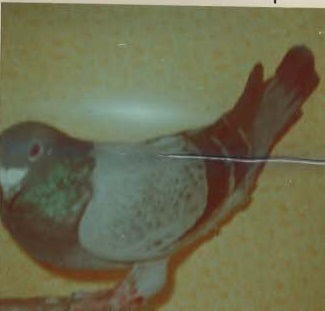
Champion Westholme Mick
Singling out any one performance is difficult for Joe as he has achieved many great successes winning the Midland National from Angouleme 521 miles must rank very high but the one that has the edge was when he got the only bird on the day from Bordeaux which is a distance of 571 miles, especially as he timed by candlelight at 10:15pm also a great performance was getting 2nd Sec, 3rd Open Nantes National nearly 11,000 birds winning a new car and £1,880. Joe said one thing that I did like which is “I think the main thing is the satisfaction of timing your all pooler & nom from 500 miles plus in 2 bird or National which is an unforgettable sensation”. As for the most disappointing experience is “of course when an old favourite fails to arrive home it brings you back to earth and you can get your hat on again as the worst thing is not knowing what really went wrong and why they have not come”. It is not really surprising to hear the comments from such good fanciers as to why some never manage to reach the table, Joe's is “most fanciers over feed probably with the wrong food anyway, also most tend to overcrowd a loft is better off being half empty that over full. An old saying amongst stock men is an animal’s worst enemy is another animal. To give you an example, a man with 12 hens they do very well for him, then he decides to have 24 he will most probably do well the first year but the next year decrease builds up and he is in trouble and no amount of curing will do, as good as prevention in the first place”. Joe gets the best out of his birds by making them happy and says that they will confide in you if you will look and listen. Always remember it is a partnership and must have confidence on both sides and don't send for the sake of covering miles. Fitness is the most important point better to wait until they are over fit, better to miss a race; it is the averages that cost fanciers many a good bird. It is up to the individual as to how far he or she sends their birds but Joe has found it best if the Old Birds are raced to Angouleme 521 miles also if they are fit that is the young hens are sent to this same race point with the young birds to fly so well Joe does not necessarily train them hard as they generally do fly well round home ranging pretty well. If they start to stack around home then they do go up the road but Joe prefers them to be ranging out of site. The youngsters do need plenty of basket work, get tosses from 20 to 30 miles every day that is until the first race when it is out to around 10 mile mark. As to what they are fed on, well Joe is a corn dealer and has a varied selection which is just what his birds get as he believes variety is the spice of life and they will eat anything when they are in the basket during the channel events. On top of the variety of corn they do get a tit bit which is Red Band and they home to it very well. On the subject of eye sign Joe said “I do not really have a great lot of views but always remember the eye is the first point to look when inspecting a bird for a race. If the eye does not sparkle like a glass mirror you need not send it to any distance if you want to be in with a chance”. Birds have raced to the lofts under all conditions and what suits one does not suit another. All you have to do is study each bird on its own and see when it is at its best. This is where the novice must have patience and use his common sense if he is to get to the top of the list. He must first of all go to a local loft that is keeping in the prizes regularly. Help him for 12 months before spending any money after which time buy a dozen late breds and train them about 20 30 miles then make them the base to work from. If you go to a good fancier you ill find that he will rear you late breds off his best, then it is up to you. Get down to the club and help out, put the birds through, handling the best and compare them with your own which will give you some idea of how to get them for the races. Another bit of advice from Joe takes fly always into account and is also good advice for the novice. “I think that when the loft gets overcrowded the natural thing is for the birds to look for a perch of their own. You can regulate their desire by the amount and type of food you give them. If you give them a very high energy diet you are asking for trouble. It amazes me to see what some fanciers feed their young birds on, they tend to give them the same as they give the Old Birds who they want to fly 10-12 hours and when the young birds go off they wonder why. Any young thing is full of play and when a lot get together they will go for miles and you will find the weakest home first. Next question was do you do any showing with a reply of “yes I think showing helps as it keeps interest during the winter months when some people tend to forget. An old saying is that races are won at the backend very true meaning the fancier who looks after his birds 356 days of the year has that bit better chance when racing. Joe likes to inbreed and finds that an inbred family crossed into another inbred family which fly some distance can usually come out very well. There are also a few late breds off the birds that have proved themselves for the stock loft generally but they must be worked hard first as you would any other young bird. Joe is very lucky in that his family have always taken a lot of interest as Joe said when father and son talk about nothing else, how it can be otherwise. When I visited Joe I noticed that there were books, cups and replicas all around the house. To Joe and his family it has become a way of life with all its ups and downs. Joe has travelled to Spain, Tenerife, Canada and the USA, finding pigeon fanciers the same the world over. “I spent a week in Mass USA as the guest of Ken Howe, a pen friend. What other sport could make this happen, 4000 miles and never met them and invited to spend a vacation over there. Not only the invitation but whilst there, loft visits were arranged for every day and entertainment included all free, a holiday of a lifetime. By the way they have all different ideas same as we have and fanciers from all walks of life, all on the same level by being pigeon fanciers. The hospitality over there is fantastic, I only hope I shall have the pleasure of getting them over here to repay them”. During his many years with pigeons, Joe has served his clubs at all levels, including Sec, Pres, Fed & Centre delegate and has had to give them up at some time or another through not being able to do them justice but is always there to help mark and set clocks, or in fact anything else he can help out with. It's rather funny really to think just how many people have the same views on my next question, yet nothing is ever done, even though when you come to way it up, it is wrong. The question put to Joe was, is there anything you do not agree with in the management of the sport. “Yes I think that paying union fees in each club is very unfair. If all union fees were paid direct to the union and they issued a card which could be presented to a club before flying took place or rings were issued it could work”. Before finishing off I would like to add one more thing from Joe and that he doe’s stress that the sport has progressed during the last 20 years and coming from a fancier of Joe's calibre that can't be bad.
Now onto the new with Mr & Mrs Alan Shore
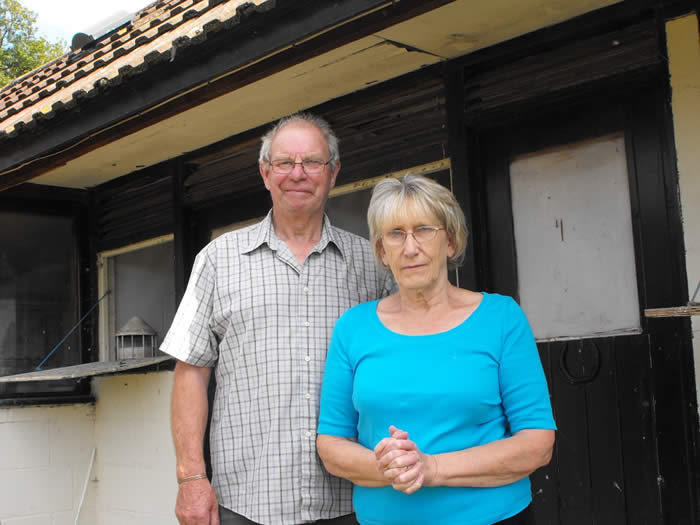
Mr & Mrs Alan Shore
I have been saying that I would like to start and do a few loft reports and after having a word with the Editor I am bringing back a few of the older reports. I was also talking to Brian Stansfield and he was on about the ever present National performance partnership of Mr & Mrs Alan Shore so I am combining the two together. The early days of Alan’s in the sport have been covered so what of the new, I say new Alan has been flying many years away from the old partnership of father and son. Anyway we now move on a few years to Joe’s son Alan who races the birds as Mr & Mrs Alan Shore and only live around the corner from where he raced pigeons to the second tier of a building with his dad all those years ago. Alan has been a real good fancier in his own right for many years and is a fancier who prefers the National type races but has come through all the levels of racing the pigeons and done well. As you can see from the first part of this report I have known Alan Shore for many years and have seen how he competes at the highest level. Alan does set his sights high and that is at National level, he has for many years been very successful racing the pigeons and before the slump in the local area was very often seen in the Middlewich open and specialist races including the Middlewich 2B which was a real good competitive club at one time but like many more has suffered in recent Years. As already mentioned it was via Brian Stansfield that we set up this visit because Brian wanted to look in on Alan because he was aware of the high standard of racing that Alan competes in and therefore wanted to see his lofts and birds and of course was interested in the way he races the pigeons. I had arranged with Brian to meet at the lofts because we were making the trip to see Mr & Mrs Alan Shore form different direction and Brian arrived a few minutes before me. Knowing Alan had not moved since my last visit, which must have been getting on for 30yrs I took it for granted that I would be able to go straight to their home. That was not the case and it was funny afterwards because I went up and down the lane twice and on my second run back up the lane looking I saw Brian going the other way so looked in my mirror and he was gone out of sight. Just then I saw the postman so asked him and he stood there looking at me and said "I have been on this run for quite some time but I don't know anyone by that name" I looked and said "It is Shore of which I spelt out and he said OH yes I was thing of the other Shaw" He then promptly named the bungalow and told me where it was. I wouldn't mind but I had drawn into the drive and turned round on my first run but with not seeing a pigeon loft and more horses I thought I was at the wrong place, I put it down to my age. Anyway when I eventually arrived all I could see were three dogs and one in particular was a rather big Alsatian cross and there sat Brian having a brew. For the first 30mins or so we were talking about fanciers from the past because Alan knew some of the great fanciers of Cheshire as I did and there were some good ones such as Denis Gleave, George Stubbs Etc real good fanciers who you were always looking to beat. Anyway we eventually went out to see the birds and what a pleasure they were to see. As most will know my thoughts are with the channel races or National races so am always looking at pigeons to fly the distance. Having seen these pigeons what I will say is if I did start racing again this is the loft that I would go to for a team to compete in National type racing and that is something I have never said before on a loft visit and I don't say that lightly.
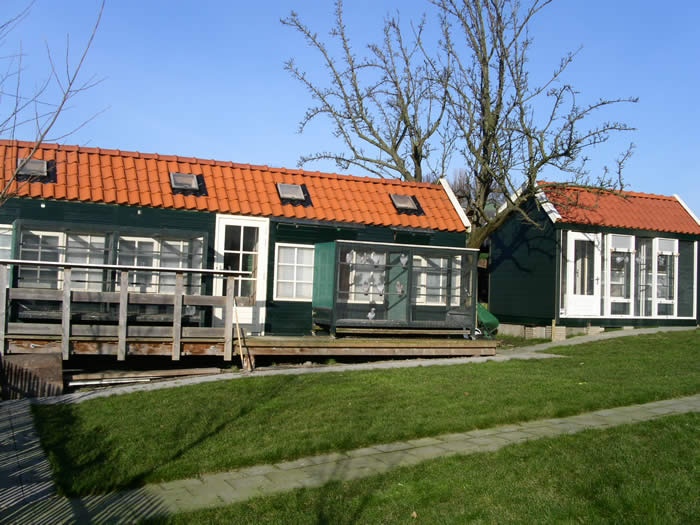
The Race loft of Mr & Mrs Shore
Yes I have visited many good winning lofts over the years and seen many top winners that have been a credit to their owners. Brian will verify that these pigeons were a pleasure to see and handle and they were in cracking condition. The lofts were built by Alan himself so he had put a lot of thought into what these lofts needed to be like and what they do have is a very good airflow. The ventilation is good and even I could be in the lofts and have no problem with my breathing, if I go near pigeons without a mask I start to get flu like symptoms but that did not happen here which goes to show what a good airflow there is. We handled all 24 widowhood cocks and they did handle well and apart from one I did say that I would be pleased to have any of them in my race and stock team, in fact there were a few cocks that would go straight into the stock loft instead of being raced down the road where they could meet all sorts of obstacles. Alan was telling us that they are based on the pigeons of John Barnett & Daughter with a few from the old Ko Nipius lines from Roy Barton of Whitchurch. Alan went on to say that he is currently trying a few new introductions and a few from the Vandenabeele lines and both Brian and I were picking them out they handled much different from Alan’s old winning family but as Alan said you have to keep trying new blood. With distance in mind Alan is also trying the Red Barcelona line from his good friend Derek Lawton they have not yet been tested but no doubt in the coming year they will be put into the races that will tell Alan whether they are going to be retained or parted with. These 24 cocks were split between 4 sections about 6ft square with 6 standard widowhood boxes in each section.
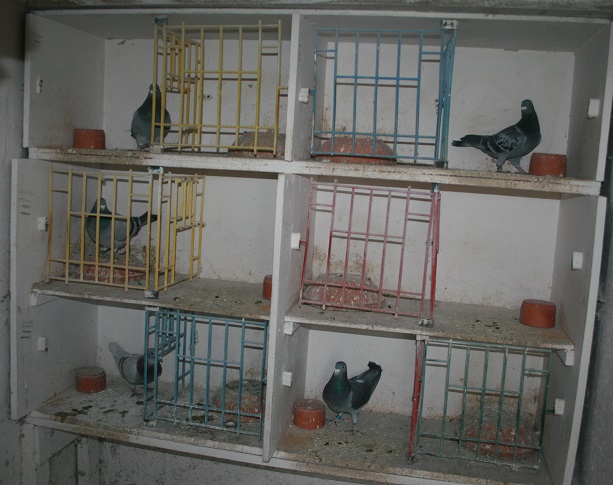
One of Alan's 6 bird sections (there are 6 in total)
There was also a section with a few young cocks in but from what I am hearing Alan is patient and does not push them too far and throw away potentially good pigeons for the longer races in the future. It is a fact that some yearlings are better with a few races and I do mean few and brought out as 2yo and Alan was working on that basis. However he did go on to say that there are fanciers who race yearlings to the distance races successfully. With Alan having a good percentage of his pigeons from John Barnett he has found that he has to cross them because John's pigeons do not appear to take too kindly to racing on the widowhood system, probably because John is a natural racing fancier of long standing. As we all know John has been a good National flyer for many years but he is racing the natural system and Alan found that changing them is not always easy.
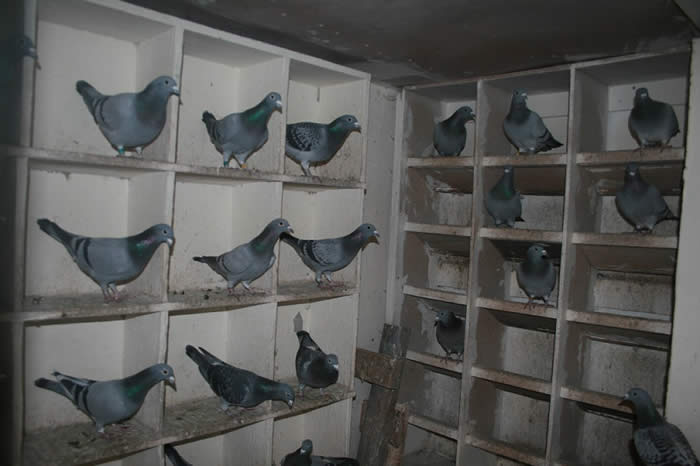
Widowhood hens section
There were some really nice hens in the next section that are used for the cocks and some of them will be breeders of the future. We then moved onto the stock hens where there again are some real quality breeders as there are with the stock cocks that were in a separate loft around the corner. No matter what type of racing you are competing in the hens need to be good sound stock otherwise they are not going to produce the pigeons that you need to achieve success. In every loft I have ever visited there are pigeons in the stock loft that are my kind of pigeon and this loft is no different but I think with the new introductions Alan could widen his racing to the shorter Middle distance events and produce some really good pigeons. The stock team look more of an all round team than the racers, probably because they are all tried and tested to a certain level but it will no doubt be interesting to see if the new introductions come good under Alan’s management methods that have served him well in the longer races. I did ask Alan what he had won in recent years and out came 7 pages of winners and as I looked through them all I was seeing were performances from across the channel, that is until I reach the last one on the list that said , 2nd Yeovil in the Audlem club. With there being so many I cannot list them all don’t want to upset the Editor for room.
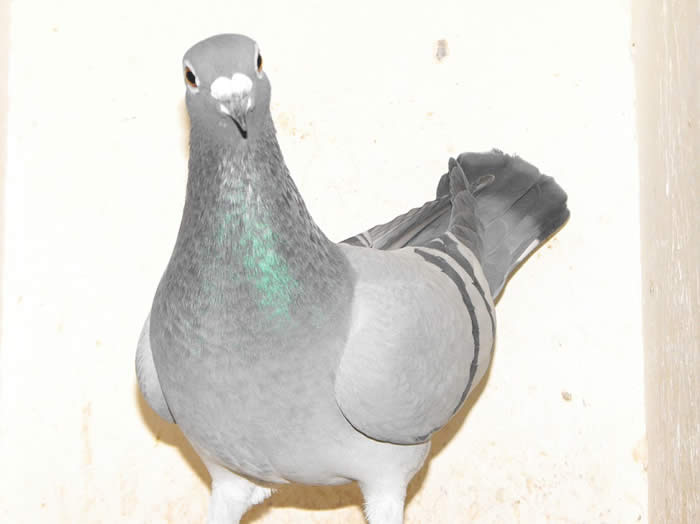
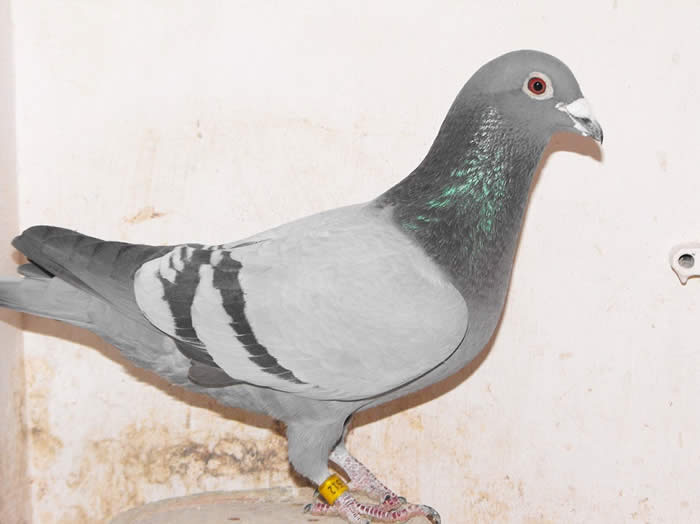
Left:-Saintes cock GB12N "80" 10th Section, 109 Open NFC, 21st Open Fougeres BBC
Right:- GB11N "12" 3rd Section 46th Open Tarbes NFC, 16 Section 331 Open Tarbes NFC, 2nd Section 36th Open Niort BBC
I am going to cover some though and we start with the section performances, 27 x 1sts 21 x 2nds, 18 x 3rds in National competition. Then we have 1st Open MNFC, 2nd Open BBC Bordeaux. 2nd Open BBC Coutance. 3rd Open BBC Fougeres all in National races. I am going to pick out a results because they are impressive racing up into Cheshire against fanciers flying towards 200mls less. Bordeaux BBC National 2nd 14th 15th 16th section 2nd 38th 54th 69th Open. Coutance. 1st 2nd 3rd 4th 5th section 2nd 7th 8th 9th 10th Open Coutance. 3rd section 72nd Open NFC Tarbes 685mls. 1st 1st 3rd 7th section, 27th 33rd 55th Open Pau. 1st 2nd 3rd section 6th 8th 9th Open Lambelle BBC National. 1st 2nd section 1st 14th Open Carentan MNFC. 1st 2nd 4th section 21st 36th 54th open Niort BBC National. 1st club 1st fed 1st Amal Saintes over 500mls. 1st section 20th Open Bordeaux Nat. 1st section 4th Open Messac BBC Nat. 1st Middlewich 2B Specialist club Nantes also with the same club 1st Picauville plus many more.
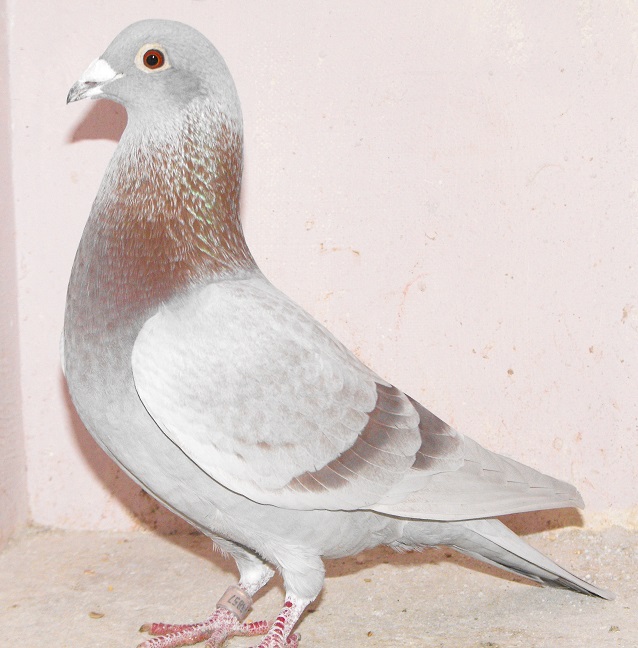
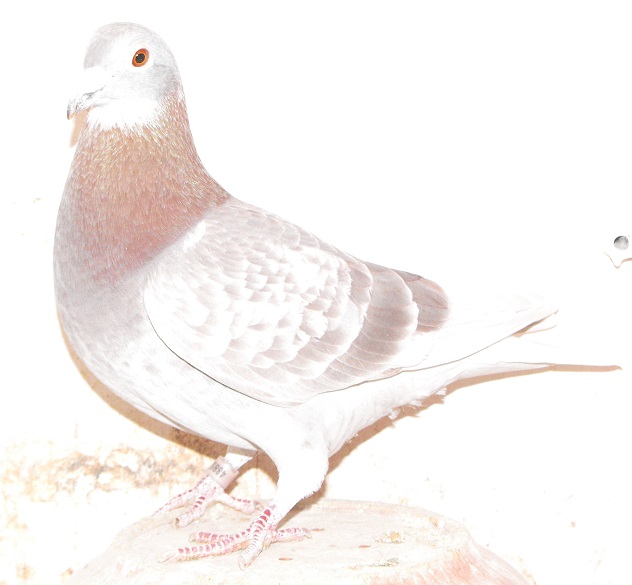
Two cocks from Alan's yearling team
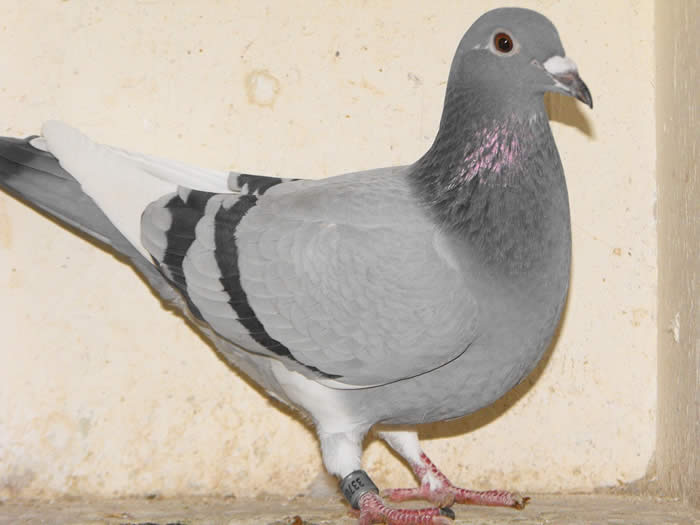
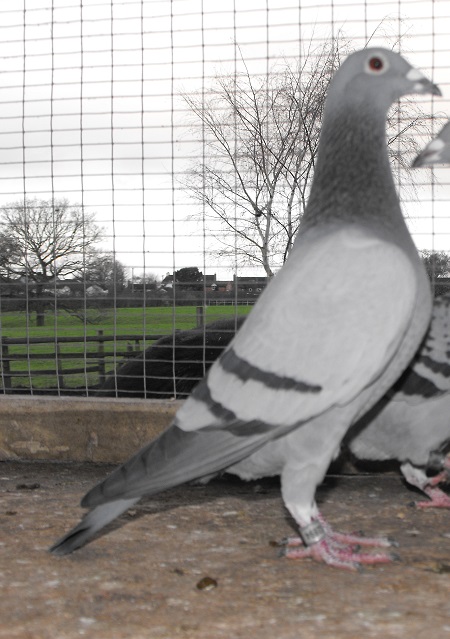
Left:- Blue pied hen GB15A "03" 1st Club, 1st 2 Bird Carentan
Right:- Blue hen GB12N "94" 2nd Section 2nd Open Bordeaux BBC, 1st Section 2nd Open Coutances BBC
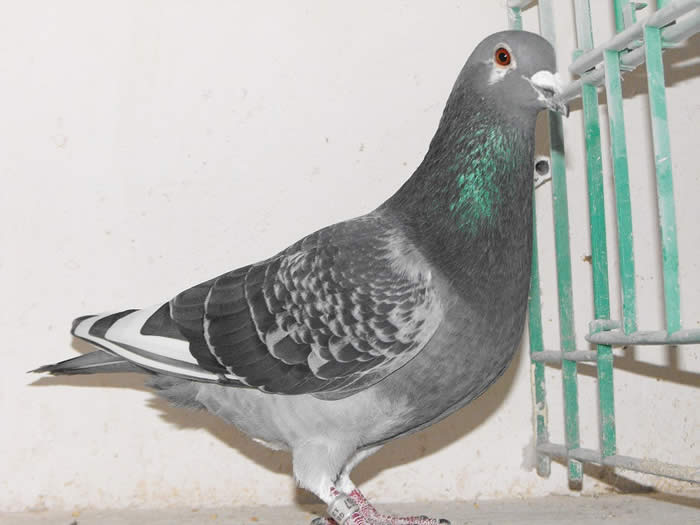
Left:- Cheq pied cock, GB12Z60567 11th Section 35th Open MNFC Vire, 11th Section 92nd Open Fougeres BBC, 1st Club, 1st 2 Bird Fougeres
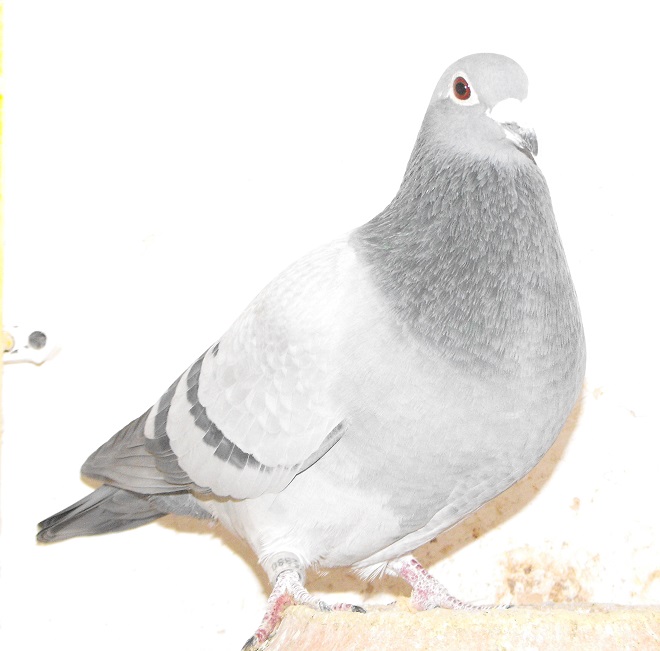
Right:- Blue hen GB09Z "44" 1st Section 3rd Open Fougeres BBC Old Hens, 1st Section 4th Open Fougeres BBC Old hens, 1st Section 6th Open Old Hens BBC
Just thought I would have a quick count up and the partnership have been just short of 100 times in the first 100 in open competition at National/specialist level in the last few years. Remember these are channel performances into Cheshire and not land races, as I say these are just a sample from the 7 A4 pages of results that Alan has supplied. We also need to take into account that Alan mostly selects just a handful and mostly not when he is sending to these top class races. On the subject of what the pigeons are given Alan was saying that he does not treat pigeons and does not believe in doing so. He does stick to the rules of competition and vaccinates the birds and does add Garlic and cider vinegar to the water. Alan was saying that they should not need all the treatments that fanciers give to them and if you do they don’t last long and don’t do so well at the distance. Alan did make the point that he has given the pigeons no medication whatsoever for the last 7yrs. For the winter the feeding is a diet mix and breeding mix evenly put together and they get a small amount of trapping seed. Then when racing comes along they are given a diet mix in the morning and a good widowhood mix in the afternoon. The only addition to this is peanuts during the racing season. Once the birds have started racing they rarely get any training tosses but when Alan is taking the birds to the marking station he does take some with him, after all why waste a day out. As Alan said he has found that if they are not right you must rest them because if you keep hammering them they will continue to go backwards. The new stock being the Vandenabeele’s have started to make their presence felt in the race team because one has already had three channel races and has already won the club and the 2B then he went to the MNFC and was well up in the open finishing off with a BBC race where he was in the top 10 of the section and was well up in the open. Alan did say that he has kept him at the same distance because he did these races as a yearling and he didn’t want to burn him out. The yearling cocks that are in a separate section to the main team of widowhood cocks are raced paired and will be raced steadily and then a few are selected to fill any spare boxes in the widowhood team. If Alan can get a couple of races around 330mls with these yearlings then he is happy and that will do. It’s all about patience with the yearlings which many fanciers do not have and he said they would do the likes of Tarbes but again he said they are potentially ruined for life. Alan’s motto is keep it simple and plain and you will enjoy them more because the more complicated you make pigeon racing the more problems you have. Well that’s about it so thank you to Mr & Mrs Alan Shore for their time and I hope Brian enjoyed the visit as much as I did.