Les J Parkinson
The sponsorship for the North West Classic Club continues to come in, maybe not as fast but never-the-less we are adding to the all-round support that the club are having. I was talking to Geoff Kirkland about me taking the secretaries job on again with the club and straight away he said he would give a pigeon to be auctioned on the Elimar site with 100% of money raised going to the club. The sponsorship has gone past the £2000 mark and as I sit here typing this article up the phone went and it was Gerry Clements to say he was adding to the sponsorship and would be sending pigeons along to sell for the club, as they say onwards and upwards. If you have membership to pay or want to join the club send your subscription to the address below but please check if you are in the radius first, there will be an advert appearing with all the details on. Anyway, as is often the case I get side tracked, Elizabeth said it’s my age. Yes, my conversation with Geoff Kirkland who was saying that the club was once a really good club for the North-West fanciers and it was a shame when the membership dropped so dramatically but I see no reason why this cannot be turned around with the support we are getting suggests that might be the case. I don’t think that money has everything to do with racing when it comes to channel racing, I say this because the local Middlewich FC was sponsored to the tune of £75 per race and the members still did not send. It looks as if there are other reasons but finding them is another matter but I do think that most of the modern-day strains are not good enough to compete from across the channel into the North West. If you look at modern-day racing many fanciers to this part of the world want a quick fast race, lock up and that is it for the day, all pigeons home and locked up but that does not always happen. There have been some really bad races even on land in recent years and I am sure a lot of it is down to the breeding of sprinters who suffer when there is a hard day. They cannot cope with a hard race; they want it easy, basket home at near 50mph and in the loft again. Then when they drop down to less than 40mph they struggle and because of the way they are not conditioned they spend a night on the tiles and if the next day is not an easy one they fail to get home. Over the years I have handled some real nice pigeons that fit into the hand like a glove. They also look a picture when standing in the loft but percentage wise I know a lot of them will not cope with the longer channel races into the North West in fact many will not win races. At the end of the day it all comes down to the fact that do we want to race pigeons or just look at some pretty ones on the perch. I have seen a lot of Jan Aarden’s recently and some I would not rate in the looks and handling department but when the going gets tough they do breed good pigeons especially in the longer races. The only way we are ever going to find out what their potential is, breed off them and give them a chance. When I say give them a chance we are talking of a 3yr project before we are going to know their potential especially for the longer races.
Building a team of channel pigeons is never easy but I have always believed that in every family of pigeons you will find the odd ones to cover all distances. Even the modern-day sprinters will turn out a good distance pigeon now and again; you know the ones that are passed over because they are behind. These are the ones that given a fair chance could possibly be the ones to send to the longer races and turn out to be something special. The size of the pigeon does not matter a great deal and I know from experience that there were some really good Dordin’s that were above average size that flew well in the longer races. I had a nest pair myself that few well out of Pau when they were the fashion of the day but like them all they are never always the fashion for very long. Going back to the Jan Aarden’s that I have come across recently there are not what we would say are big ones amongst them and some are not what most would call ideal pigeons in the hand but again they do come good in the longer races. We must remember that there are not many of what we would call perfect pigeons about in comparison to the number that are house din our lofts. Having said that I suppose some will work on the basis that if they are winners then they are perfect. As the saying goes “Beauty is in the eye of the beholder”
The weather the last few weeks has been up and down which has not been brilliant for those who have egg’s chipping out. A chill for them when they are so young never goes down too well and does set them back but most do not appear to recover and go on to be strong young birds.
“Hi Lez, hope you've all had a good Christmas! Just reading through your article about the Golden Triangle and thought I'd send you my thoughts. I too was thinking about my return to the sport in the near future and my challenge to dominate in the longer races especially the Nationals as I did in the shorter middle distance races at club and federation levels and setting records that I doubt will be beaten. It was after assisting Mick Barlow and team for Derek Nichols at his sales at the Hotel Sheraton at the Blackpool weekend a few years ago, where Premier Stud was selling the De Rauw-Sablon pigeons from their direct Imports. At the time, I did not know much about this strain but having penned all the birds and handled every one of them I was hooked. If that was the time for me to enter back in the sport and funds being available, I would have happily bought the lot. I was that impressed with them that I did not have to read the pedigrees etc. to know that these birds are definitely the ones for me for the Nationals and One Loft racing. Perfect medium bodied silky handling birds with hearts of lions. When I do decide to re-enter the sport and provided I am allowed into my local club then these birds with perhaps one other cross which I'm not going to mention at this time will be the ones I will choose to concentrate on. I will not be paying £12/14 per bag of corn to race for £10 prize money in my club again they will have to pay for their keep this time and so producing National winning stock to me is the only way forward. I left the sport starting to dominate the channel races with to hear one ex club member say 'sprint birds' won't win you the later races. Well if I could club, fed and combine averages with 'sprint birds' then I'm sure I could put my mark down with non-sprint pigeons that are actually bred for the job and are already proven from within your 'Golden Triangle'. Anyway, nice read Lez, I knew you knew a bit about pigeons to be honest and it wasn't all bluff ha ha. Here’s another great little read Lez of the birds that first set me off. I bought 6 of these from a guy called Ray Joesbury from the Owen Joesbury & Son partnership of Wednesbury, West Midlands, they turned out to be 3 pairs that all bred winners. In my first ever race flying alone from my dad’s in Groby Road as Turner Bros these birds were unreal. It was an open race in Greenbank FC flying against the cream, G Stubbs & Son, Dennis Gleave, Mellor Bros, etc etc. We sent 14 young birds and when 10 swung round I said to my brother 'blimey a couple of ours have brought some strays back with them' but as they landed on my Sputnik trap I soon realised they were all mine and duly clocked the first 6 of them to take 1,2,3,4,5, and 6th in the open race including all pool money!!! Wow what a first race to be involved in that set the seed I guess for the future, all were the famous SVRs. STAF VAN REET OF MOL. “The fastest pigeon in the world” claimed Piet De Weerd - it’s a common claim, especially in magazines and clubs. Many different fanciers have made the claim. Staf Van Reet, of Mol, has never been guilty of such statements but others extol the virtues of his pigeons. Staf has always had a breeding pair which produced one good flyer after another. Pigeons which easily flew to dozens of first prizes, almost always on pure speed from Quivrain, to be precise. And when any fancier, anywhere in the Netherlands or Belgium, unpacks birds which are genuine contenders for the first prize, you all know how the average fancier reacts. His achievements are derived with the remark that “he’s seen nothing yet”. In other words, coming first means nothing if there’s no competition. Well, with regard to Van Reet, there are convincing arguments to underline the superior quality of his pigeons in terms of speed. As many as 22 times, his birds have been the fastest in the entire province of Antwerp. According to Van Reet himself, more than 100,000 pigeons from the province are actually released from Quivrain each week. Staf was born in 1935. His grandfather was a “fancier” and from his earliest years, Staf was involved with the pigeons. His grandfather answered to the name Staf Snijers and Van Reet can still remember when, at age 10, he went with him to Janssen’s.
It was not entirely by chance that the Arendonk grandfather did so well. Janssen’s cousin lived next door to Van Reet. Grandfather Snijers was a person who had to spend money on his pigeons. More than that every penny he earned went towards buying pigeons, grandfather Snijers came into possession of the pure Janssen strain. He had also bought two pigeons from the sale by the famous Louis Vermeyen. The Vermeyen type seemed to “match” the Janssen pigeons very well. In 1961, grandfather Van Reet died and the pigeons were sold again. Van Reet bought the eight, which were, in his opinion, the best, and amongst these were three half-brothers. Pigeons bred from the same Vermeyen female with three different males of the Janssen strain via Vreys. With the three half-brothers Van Reet defeated all the competition in Mol and the surrounding area in 1962, 1963, and 1964. He bought two pigeons, a Schalie female from a Vos breeder - which went missing from the coop and a male. The cock was a direct descendant of “Halve Fabry of 60”, which was also the progenitor of “Oude Witoger of 65” He was then period with a female bred from the Vermeyen/Janssen cross. From this pair, Van Reet got the legendary “Janssen pigeon of 69”. Together with the “Genopte Witpen of 68”, they formed Van Reet’s “Golden Pair”. The “Genopte Witpen” was bred from Vos, directly descended from “Natural”, and a daughter of “Blauwe of 57”. The latter was one of the three half-brothers and a fantastic flyer. This Golden Pair actually came about by chance. The cock appeared regularly every Sunday but to the great sorrow of Staf, obstinately refused to come in. To the point where he stopped thinking about flying and “in anger” took him to the breeding coop.
As a young bird, the female had already proved her quality by winning 3 first prizes. The first young produced by the pair was the “Prinz of 72”. As a young bird he never saw the basket and as a yearling was suddenly thrown in at the deep end. After a few failures, which can be expected from such an inexperienced pigeon, he emerged in Quivrain as a flyer to beat them all. In this 132km flight, he took 32 first prizes until clever Jan Grondelaers got wind of the existence of the high flyer. In 1978, “Prinz of 72” moved to Opglabbeck for a substantial sum, and the following year showed what a connoisseur Grondelaers is. From Prinz he bred his Stuka, famous in two ways: Stuka would race home to the coop so incredibly fast that on four occasions not even Jan himself or any of his watchers saw him arrive. Jan heard him each time without seeing a feather, just a thump on the floor of the coop. Another feature of Stuka (B-79-5185502) was that he won 12 first prizes. It is interesting to hear how Prinz got his name. Borgmans from Turnhout, who at that time was racing through the Noyon flights like a hurricane, bought a female from Van Reet’s “Golden Pair”. She bred so well that Borgmans called her his “Prinses”. It struck Staf Van Reet as a suitable name, so the “Prinsen” family was created by Van Reet. In the plural, as you can’t call a breeding pair a “Golden Pair” if they only have one chick.
In 1974, the Dikke Prins was born (B-74-6710998). He flew 26 first prizes. Still in 1974, the Witoog Prins was born (B-74-670895). He sat on the flight coop, but before his season began, broke one of his wings (fortunately, as it happens). He was of necessity rehoused in the breeding coop and there produced several first prize winners, the most famous being the “Genopte Witpen of 76”. 1976 is the year in which the most spectacular son of the breeding pair was born, Daniel (B-76-6635973). He flew no less than 57 firsts. The story is that a friend of Van Reet took him to the “De Reisduif” championships in his worst season. He came out of the box as the best speed pigeon in Belgium! Staf van Reet races his birds from the first week in March to the last Sunday in July. Always alone. Then he lets them nest, and as soon as they have young, he flies them again in the autumn. With young in the nest, the birds get home even faster, according to Van Reet. This system naturally has its disadvantages. “Daniel” was left standing in five starting pens in the winter of 79/80. And understandably, Staf thought he would have to slow down with Daniel. On his first flight, in spite of his frequent victories, he only came in 4th. But Daniel, on his first competition in 1979, proved that the starting pen isn’t that important if the quality’s there. He won with a four-minute lead. In June and July of that year, Daniel won the first prize 12 times in succession. Staf says that with such pride that you know he’s not boasting. The Kleine Prins (B-76-6721975) is a brother of the phenomenon described. Staf lent him out in1982 to the German van Ravenstein. From him, in 1983, he bred a female who won 9 first prizes before going missing on a disastrous flight. In 1978, the “Prins of 78” was born from the Golden Pair (B-78-7722716). He flew only as a yearling and a two-year old. That didn’t prevent him taking 12 firsts. He was the last pigeon the breeding pair produced. The cock ceased to be fertile, and the female stopped laying eggs. Both partners had given up at the same time. It is remarkable that from this pair, two totally different types of pigeons came. One type resembled the father (such as Daniel), the other was the image of the mother (such as Grondelaer’s Prins). That’s not important. Both were equally good flyers. The Van Reet pigeons were able to keep up their lead. From 1972 to 1976, Staf paired up with Frans Verbruggen. During that time, they raced many times, and their successes were nearly all on speed alone. Which reminds us of the remarkable flight from Lirnoges in 1975. Eleven birds were entered, and ten were clocked in within 11 minutes. In the national results, “Van Reet of Mol” stole the show with 10 prizes starting with 4th, 7th, and 9th overall. 31,000 BF were bet on the flight. The ten pigeons brought home BF 197,000. From this period, Van Reet also remembers the result at Dourant in the Zuiderkempen races. He won the top four. His greatest rival at the time - so he says- was none other than Janeke Wouters. In 1975, the Van Reet/Verbruggen combination was crowned Champion of the East Antwerp area. Second was Mariman Raey and 3rd Gust Hofkens.
Later van Reet was to put even more effort into speed. As on the Sunday when he took part in a “match race” with just two birds: Daniel and Prins. They flew into the coop together, 8 minutes before the third pigeon in the race. Van Reet keeps his pigeons in a bone-dry attic coop, which is never heated artificially. The females are always shown to the males before they are put into the basket, but when they get home from the flight, there’s no system. Sometimes the mating is short; sometimes a male and female can look at each other for four hours. The coops are well ventilated and the males are free to sit on the coop. See you all at Blackpool and have a great New Year. Cheers. Carl A Turner”
Brian Stansfield
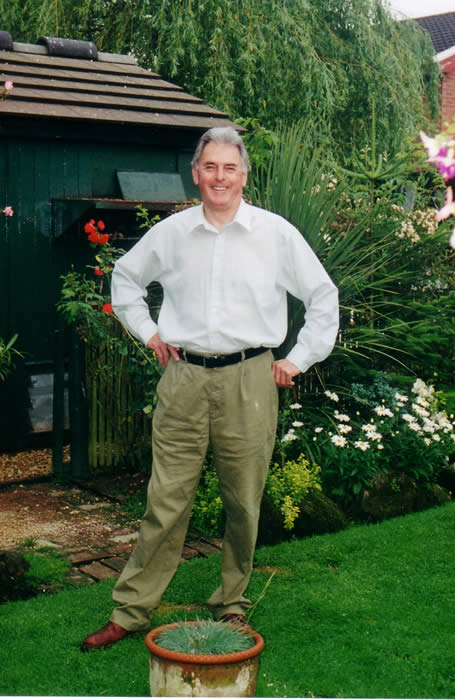
I was very sad to have a phone call from a good friend of mine Brian Stansfield who told me that he has Multi Nuron disease.
What was more surprising was when he told me how fast it had come on, 3 weeks earlier he had been fine and now cannot walk. Brian went on to say how good everyone has been to him and the lads were looking after his pigeons with the aim of Tarbes National so Cameron must set his sights on that Job. He went on to say that he could not thank his family enough for all the help they are giving him. I reminded him of the day we were racing from Tarbes and a pigeon dropped in the gutter on the conservatory for a drink. The pigeon was only feet from me so I reach up and picked it up, the surprise was when I opened the wing I recognised the number so called Brian and told him. We have both had a laugh about that one so let’s see what happens when they go this year.
Les J Parkinson.
11 Rushton Drive, Middlewich,
Cheshire, CW10 0NJ.
01606836036 Mobile 07871701585.
Email
web site www.elimarpigeons.com