“ON THE ROAD” WITH KEITH MOTT.
LOOKING BACK OVER THE YEARS (PART 24.)
The late Gorge Kimpton of Richmond.
George Kimpton first became a pigeon fancier at the age of 14 when he spent most of his time in his uncle's loft learning the ropes and watching the birds coming from races. George had been in pigeons for 24 years and whether it be racing or showing he is always the man to look out for. With some help from Harrison Bros of Richmond and Jim Emmett of Hounslow, George started racing on his own when he got his first house in 1971. George said the performances of Charlie Harrison in those early days drew his attention to the sport, winning four water races out of five and 1st SMT Combine in one season and 1965 winning Champion Young Bird at the People Show. George's first club was Richmond & District where he raced Barker pigeons but with little success. His first loft was an asbestos 8ft x 4ft shed with a piano trap and his early mistakes were overfeeding and training in bad weather.

The 1983 season saw the Kimpton pigeons win many top positions racing and showing including 1st West Middlesex Federation Blandford, 1st West Middlesex Federation Exeter and 4th West Middlesex Federation Weymouth. George's very smart loft was 22ft long, made up of three sections and had open door trapping. He maintained the most important factors in good loft design were good ventilation, freedom from damp and open door trapping. The loft housed two pairs of stock birds, twelve pairs of racers and thirty youngsters were bred every year. All the old birds were paired up in early March and raced on the Natural system as George liked to race cocks and hens, with water racing his main interest. He raced only South Road with the Chiswick & District, National Flying Club and Inverness 2-Bird Club. He flew two main families, J. L. Roberts of Marple and the old Dooran family.
One of George's main stock birds was the six year old pencil pied hen 'Janet' and she was only raced as a young bird in 1978 winning 2nd club Blandford and 2nd club Weymouth, before being put to stock. This great hen was the dam of four 1st Federation winners and had won twenty nine firsts in the show pen. 'Janet' had won two firsts at West Middlesex Federation shows and B.O.S., and had scored several times at the Old Comrades and R.P.R.A. Southern Region shows. One of 'Janet's' daughters was the dark chequer pied hen '77' which won 1st West Middlesex Federation Blandford as a young bird in 1983.
George said his most thrilling experience in pigeons was when he won a first at the Old Comrades, but his biggest disappointment was entering four birds in Olympiad classes at Birmingham, the Old Comrades and Southern Region shows, winning several firsts and top awards and then not having his birds picked for the 1983 Olympiad. His families of pigeons raced really well right through to 450 miles and showed really well in the winter months. His then 23 year old son, Fred, was his pigeon partner and he was a good pigeon man and a great help with the management of the birds. The partners fed a first class mixture and said it kept the birds weight on. The birds were trapped with Red Band conditioner. The Kimpton birds, old and young, got 25 mile training tosses every day weather permitting and their favourite racing condition was sitting eggs 10 to 12 days.

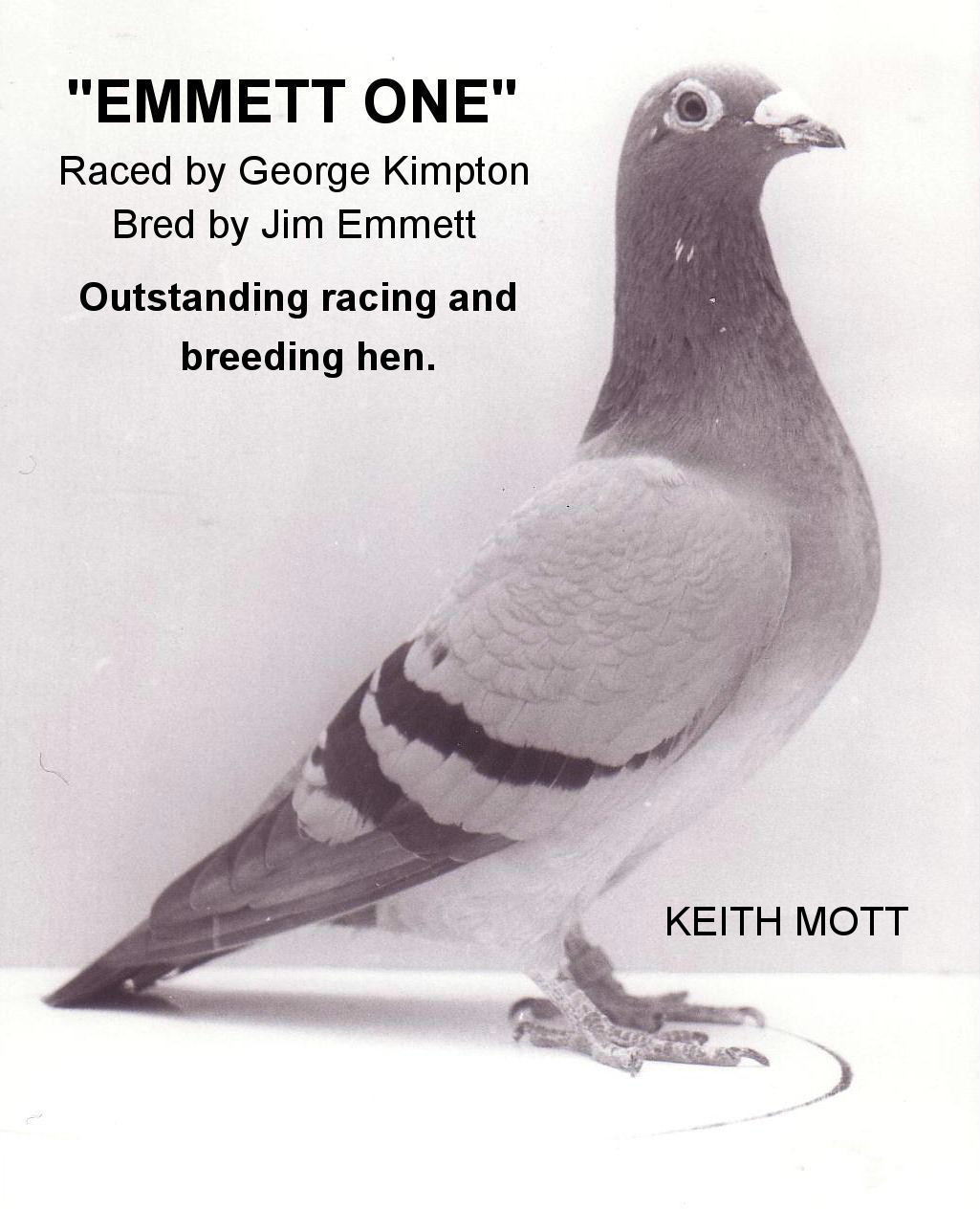
One of the Kimpton’s best birds was the eight year old Jim Emmett blue hen 'Emmett One". She had won many top positions racing including 25th section, 36th open Nantes NFC and 76th section, 399th open Pau NFC in 1979 and 1st club Exeter. 'Emmett One' was retired to stock at the end of 1981 and had bred many useful birds including the blue hen 'Cash' which won 4th West Middlesex Federation Exeter and was 3rd Champion Young Bird at the Old Comrades Show in 1983. Another good daughter of 'Emmett One' bred in 1983 was 'Daylight' and she won as a youngster 4th Ashford Weymouth Open, 2nd club Plymouth, 3rd club Weymouth and 3rd club Guernsey. Another of the Kimpton's best birds was another Jim Emmett blue hen '53' and she won 1st London Federation Rennes, 16th section, 326th open Nantes NFC for George and Fred.
George said he was interested in eyesign but knew very little about the subject, although he was learning all the time. In his opinion they pick a pigeon on its good eye after it has won a race not before. George was clock setter and Federation delegate in the Chiswick club and president of the Inverness 2-Bird club. If he could pass a law to benefit the sport he would put a ten bird limit per member per race. He didn't like it when fanciers vote against a top flier joining a club, just because his competition is strong. George told novices to get their feeding right, don't train in bad weather and listen to any good advice from a local man who wins out of turn. The Kimpton’s said that Jack Newell of Feltham was the top local fancier because he had won from every race point and was always willing to help the newcomer to the sport and give advice. The Kimptons had put up many great performances but one that George was very proud of was when they were 1st, 2nd, 3rd club Bergerac (448 miles) with the only three birds recorded in the club in race time. Another great performance was in 1979 when the partners sent two birds to NFC Nantes recording 36th, 272nd open to win £525. Another of their best racers had been put to stock, a chequer cock 'Midnight' and he had done well racing and in the show pen. His wins include 1st club Niort and 1st club Bergerac. The partners other Federation winner of the 1983 season was the mealy '74' which won the West Middlesex from Exeter.
George said fanciers breed far too many youngsters and to avoid fly aways he let his youngsters out late at night for exercise around the loft. He loved showing his racers and was very successful. His advice to starters on showing was keep your loft clean at all times; use a deep litter of wood shavings 3ins to 4ins deep; keep an eye on your birds for bent feathers, if this happens, steam over with a boiling kettle and keep the loft sprayed out with Duramitex and give regular baths through the moult. He never bred late breds and said he likes deep litter as it worked for him. He would stop imported pigeons because there is far too much money being made out of it. When selecting producers, George liked the pigeon which sat right in the hand, with good tight feathering and wings to fit the tail nicely. I knew Georgie for many years and he would help anyone in trouble. The sport’s ‘Mr. Nice Guy’ and also a very good pigeon racer!
Tony Theodorou of Richmond.
The month of December saw my daughter Caroline and I drive the ten miles through wintery Richmond Park to visit the home of the late Channel ‘ace’ Tony Theodorou. We were in that part of the world that day to judge the Ealing Show, so could only spend two hours in Tony's company, but with the quality in his lofts you could stand there all day handling birds.

Tony had two lofts set out very neatly in his massive garden. The main loft was a 30ft Petron, with corridor and the birds were trapped through three Sputniks. This very smart loft was well ventilated through the tiled roof and housed young birds, widowhood cocks and natural racers. All the old bird sections were fitted with wooden widowhood style nest boxes, and the whole set-up was cleaned every day. Twenty five pairs of stock birds were housed in a 12ft loft, with a flight where the inmates could take fresh air and have a bath. Tony had spent a small fortune on his stock birds and this loft contains many birds obtained direct from the Belgium masters. The main families raced are Peter van de Eijnden, Denys Bros, Staf van Reet, A H Bennett, Van Bruaene, Janssen and Kirkpatrick. The stock loft housed several direct children of champions, including a Kirkpatrick from 'Virgo' the 1st open Young Bird National winner. Although Tony was a 100% Channel racer he said he won a few of the short inland races with the Staf van Reets.
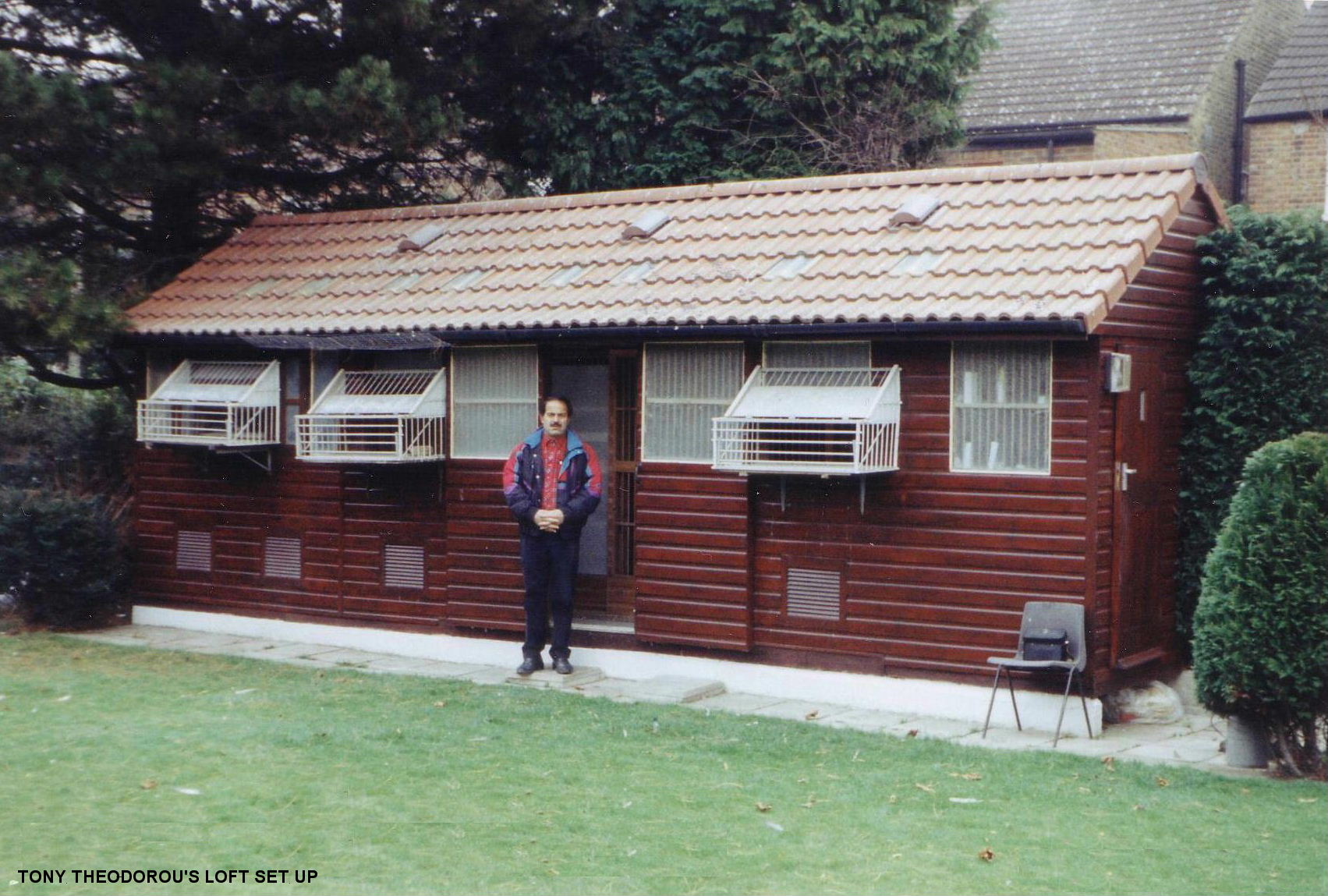
The Theodorou loft flew in the very strong Richmond club (Three Borders Federation), National Flying Club and Surrey Championship Club. To say Tony had a good season in 1993 would be an understatement. He won major trophies in the club, including O.B. Average, Continental Average, First Three Water Races Average, First Combine Race Trophy, Second Combine Race Trophy, Niort Cup, Longest O.B. Race Cup and Longest Y.B. Race Trophy. In Combine racing in the 1993 season the Theodorou loft swept the board, and won many top positions in the Surrey Championship Club, including 1st Wadebridge (young bird) lifting £230 and 2nd Bordeaux (455 miles).
The Theodorou loft won many major positions inland and Combine racing in the 1993 season including: 1st club, 21st Federation Rennes (1); 1st, 3rd Club, 1st, 20th Federation, 6th SMT Combine (6,976 birds) Nantes (1); 1st club, 11th Federation Nantes (2); 2nd, 3rd Club, 12th, 13th Federation, 72nd, 76th SMT Combine (6,594 birds) Rennes (2); 1st club, 3rd Federation, 17th SMT Combine (5,389 birds) Bordeaux; 1st club, 14th Federation (1,316 birds) Wincanton; 1st, 2nd, 4th club, 5th, 9th, 18th Federation, 21st, 37th, 61st SMT Combine Wadebridge (young bird), 7,594 birds competing in the Combine. Tony's young bird Wadebridge winner, a nice blue chequer cock, was a really bad trapper and sat out for over ten minutes when he won. The start of the lofts in 1993 was the handsome Denys blue chequer cock, 'Mr Denys', which recorded 1st club, 3rd Federation, 17th SMT Combine Bordeaux 455 miles (5,389 birds). This Natural cock handled medium, apple-bodied and had a wonderful eyesign. He had a sister in the race loft and she had scored several times from the Channel.
Tony's father kept all types of fancy birds in his home in Cyprus and the pigeon bug hit Tony at the age of 21. A young Indian boy came to the Theodorou restaurant in Knightsbridge with a rung pigeon, and Tony got interested and knocked up a small loft in his back garden. In those days Tony trained his birds in shopping bags, he didn't have any baskets. The first real racers Tony obtained were Kirkpatricks from Mr Adams of Durham. He started racing in 1968, with his wife Hazel clocking in, as he had to work all day on Saturdays. His first club was the very big Richmond & District SR and says he had a lot of help from his mates, Kenny Harrison, Mick Honeyball and Couch & Cudmore in the early days.
The then present lofts house 25 pairs of stock birds, 38 pairs of racers and about 60 youngsters were bred each season. Half the stock birds were paired up in January with the widowhood cocks and the other half in February. The Natural birds were paired up in March, with the Channel and longer races in mind. Tony said he raced the widowhood system ‘the Dave Allen way’ and won more of his inland positions on this method. The Natural birds were trained from Winchester (50 miles) Monday to Thursday at 5am in the morning. He had to train in the mornings as his business was in London and he got home late at night.
He reckoned the main factors behind success with racing pigeons were good corn and lots of training. He told me his Bordeaux win in 1993 was his best performance, as he had had many day birds from the longest old bird race, but this was the first time he had won it. He maintained his most disappointing race was also in 1993 when his Wadebridge winner sat out for ten minutes and could have won the SMT Combine. All his birds, old and young, had to race through to the longest distances. He rated Bob Besant of New Malden the best all round racer, winning 1st Federation from inland races and twice 1st open in National Flying Club races. Although Tony liked the widowhood system, his main interest was the natural birds in the Channel events and he liked birds sitting ten day old eggs or feeding a small youngster. There you have it, the late Tony Theodorou of Richmond.
Kenny Harrison of Richmond.
Although Kenny Harrison had never won a 1st open Combine his great team of birds had come close many times and he had won many average trophies including the Old Bird Average and Combined Continental Average in the SMT Combine several times. For many years the Kenny Harrison & son partnership had become almost a household name as far as the SMT Combine races are concerned.
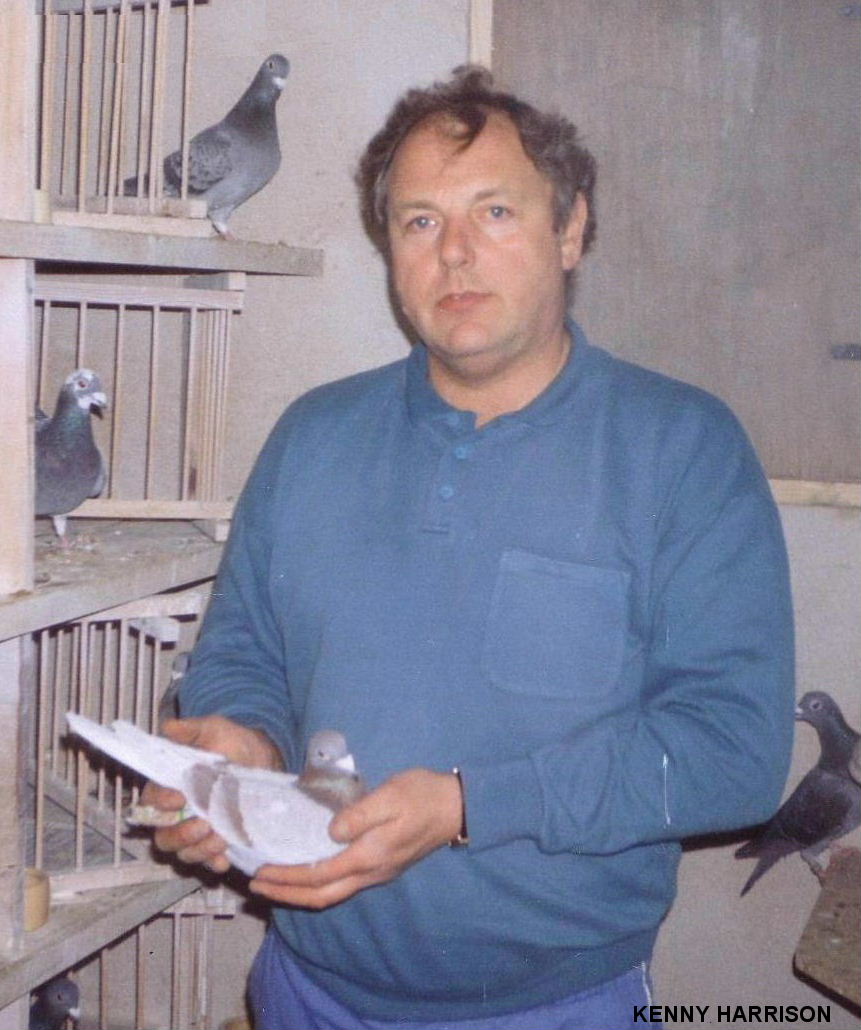
Kenny started up in the sport 50 years ago with stock from his brother Charlie and joined the Barnes and Mortlake club. When I asked Ken who encouraged him he said all the jealous, bad sportsmen in the clubs he flew in! He said they got his back up and he wanted to beat them all. One interesting fact that Ken said he had learned from his novice days was to keep horses for courses and bide his time. A blue chequer hen named 'The Combine Girl' was one of the ‘all-time’ Harrison greats being a champion in the truest sense, winning major positions in the Federation and Combine, time and time again including 2nd Combine (4,713 birds) Nantes. Ken said one year his brother pushed him to send 'The Combine Girl' through the programme, with her being second day from the last race. The great hen was never the same after that. He says that it was one lesson he learned to his cost and he always remembers that great pigeon.
To say the Harrisons had a good season in 1990 would be an understatement, lifting ten cups and averages in the very strong Chiswick SRFC and four in the West Middlesex Federation. As a young bird in 1990 Ken's good dark chequer cock 'The 76' recorded 1st club (only bird on the day), 18th SMT Combine Alencon. Another Alencon winner, but the year previous to 'The 76', was the handsome pied cock 'The 80 Cock' and he chalked up 4th West Middlesex Federation. Ken's good mate was George Burgess, who won 1st open NFC Pau Grand National, bred another of Ken's ace Channel birds. This was the mealy cock 'Treble O' and he has to his credit 1989: 2nd club, 3rd West Middlesex Federation, 22nd SMT Combine Bergerac; 1990: 3rdclub, 9th West Middlesex Federation Niort. Kenny liked hens for the longer races and one of the best hens in the loft was the blue '747' which has won in 1989: 3rd club, 7th West Middlesex Federation, 66th SMT Combine; and in 1990: 1st club, 13th West Middlesex Federation Bergerac.
Ken's racing loft was of the widowhood style, brick-built, pan tiled roof, roof lights, controlled ventilation and all floors and walls were lined with moisture resistant chipboard. It had one sixteen nest box natural section and one sixteen bird widowhood section, with two sections for young birds to house approximately 70 in all. Sputnik trap entry for young birds and natural pairs and open windows for the widowhood cocks. The stock loft had two sections twelve nest boxes and fifteen box perches; with aviaries both ends. The partners kept an average of six pairs of stock birds, so they enjoy plenty of room and fresh air in their loft. Ten pairs were kept to race semi-widowhood and natural. Kenny tried to get the full widowhood system going to no avail, so he phoned Peter Hookins of Morden, who races outstandingly on the widowhood system and he put Ken right. After a few pointers from Peter the next race was Alencon when the Harrison loft recorded 1st and 2nd club and had outstanding results through to Bergerac.
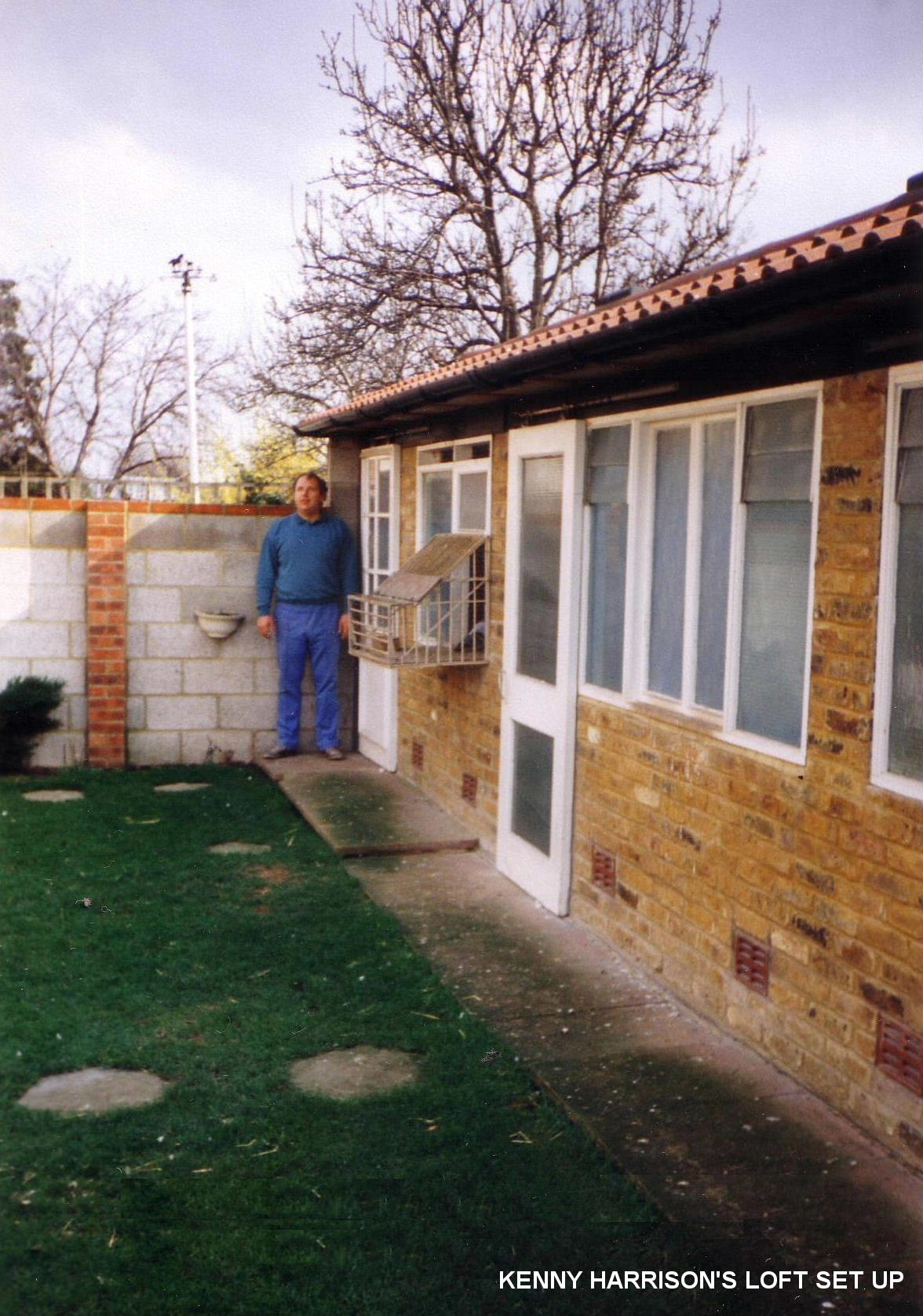
Ken had purchased basically Channel birds, such as Van Bruaene (direct), Peter van Aarden, George Burgess, but he won his fair share inland. Ken was a hard taskmaster and all had to go. All the birds were tested and no 'good lookers' were kept back. The birds' diet was always changing, for type of race and time of year. He used ‘Hormoform’ a lot, linseed, and all oil seeds at the appropriate times, like the moult etc. Ken also used garlic oil on the corn and garlic in the water, along with TCP. The birds were trained four times a week by Ken's two good mates, Andy Hagilouka and Tony Theodorou, both good Richmond fanciers.
Kenny said most of his best racers through the years have been hens and one of the best was 'Blue Tops', winner of 1st club, 1st West Middlesex Federation, 4th SMT Combine Bergerac (458 miles). She was a good long-distance type being medium to long cast, with a wonderful eye. She was a Rigg-Barker bred by Ken's brother Charlie. Another Bergerac winner to grace the Harrison loft was the blue chequer hen 'Six In A Row' and this gem handled medium-size, long cast, with a wonderful eye and she recorded 1st club, 1st West Middlesex Federation, 10th SMT Combine Bergerac, 3,094 birds, 458 miles. The old favourite and probably the best was the red chequer hen named 'Brooke's Pride' and she was bred by Joe Brookes of Dartford, Kent. This great old hen handled large, long cast and had won many major positions including 1st club, 2nd Federation Avranches; 2nd club Rennes; 3rd club, 6th Federation Nantes; 1st club, 2nd Federation, 31st Combine Avranches; 1st club, 1st Federation, 3rd SMT Combine Niort. A remarkable pigeon!

Ken liked to send to the longer races with them sitting seven to ten days. The only time he sent any feeding youngsters were when they have been kept dry all year and never had an egg hatch. He used deep litter granules in the stock loft and pea shingle in the aviaries. He scraped the nest boxes clean on to the floor and it turned to dust, but replaced it with hardwood chips. As the droppings were heavier it turned the woodchips over keeping the top surface dry and free from the droppings. Ken bred late breds but he went through them in the nest and culls the ones he didn’t not like visually. He told me his biggest let down was the birds trapping. '747' was a very bad trapper; she had sat out ten minutes on some Channel races and still taken cards in the first three. Kenny said his best two pigeons of all time were 'The Combine Girl' and she won through to Bergerac including 2nd SMT Combine Nantes, 10,000 birds, and the 1979 red cock 'Joe' and he was ‘ace’ up to 200 miles. Kenny Harrison one of the time greats of the Richmond area!
That’s it for this week! Some ‘all time’ greats of the Richmond pigeon racing fraternity this week. To view some old video footage of some of these fanciers and their birds go on to my YouTube channel. I can be contacted with any pigeon matters on telephone number: 01372 463480 or email me on:
TEXT & PHOTOS BY KEITH MOTT (www.keithmott.com)