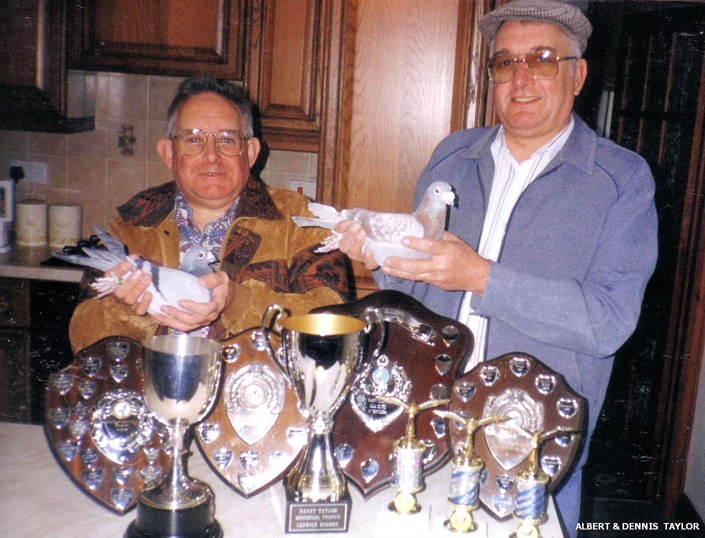
STEVE APPLEBY OF ASH
BY KEITH MOTT
I first met Steve Appleby about twelve years ago, when I first started convoying for the London & South East Classic Club and he was my race advisor. In that time we had some great fun working together, producing some good racing for the Classic and have become very good friends. Stevie is the best race advisor in the sport and in recent years has taken the job to new higher level of excellence. I ask you, where would race advisory be in this country with out Steve Appleby? He has the best technology available and is 100% dedicated to producing the very best racing for the fanciers every Saturday, whether it be Federation or Classic.

Steve has enjoyed a good 2008 old bird season racing to his loft at Ash, with the main highlights being 1st club, 22nd Three Borders Bergerac, 27th and 73rd open L&SECC Tours. Steve only races a small team of 10 pigeons as he says the less pigeons you have the more you know about them. Steve’s Bergerac winner is a yearling blue cock now named ‘Sky Wonder’ and he is a nice handling pigeon, complimented with quality feathering. He was sent as a single entry to the Bergerac race winning the Guildford club and chalking up 22nd Three Borders Federation with 584 birds competing. As a young bird he was consistent always back to the loft within half an hour of the early pigeons and this year he was raced on the widowhood system, and was prepared for the race by sending him to Kingsdown two weeks prior to the Bergerac race. After liberation from Kingsdown at 07:30hrs he arrived at the loft five hours later at 12:30hrs for a distance of 113 miles clapping round blowing out his crop. Those five hours on the wing were to put him just right for Bergerac a distance of 445 miles to his loft. After that race he was then let out with the young birds every day and flew with them for a full hour not pulling out as most old birds do from a young bird batch. He was sent with the S.M.T. Combine to Bergerac, being liberated at 06:10hrs and timed in at 18:09hrs, recording a velocity of 1090 ypm. He was in excellent condition on his return and appeared to have taken the race in his stride. His full brother was 73rd open in this years L&SECC race from Tours and his half brother, ‘Sky Supreme’, was 27th open in the same race. The sire of this family is a blue Janssen cock bred from gift pigeons from Cyril Luxton of Worplesdon. The dam of the Bergerac winner, ‘Sky Wonder,’ is another Janssen bred for stock from a pair of pigeons obtained from that good fancier Mick Chaplin of Woking.

Steve was born near Great Yarmouth in Norfolk and was the first in his family to keep pigeons, as his father was not a fancier. He has always liked pigeons since he was about 10 years of age and watching local fanciers race them fascinated him. He often sat down at the bottom of his garden which over looked a railway line and watched a local fancier who had a loft on the other side of the track exercising his team. The fancier was called Jim and gave Steve his first pigeons. Steve kept these pigeons in a disused railway carriage at the bottom of his Grandfather's garden. His grandfather was a racing man but was only interested in horse racing. Steve always remembers the oil paintings of famous race horses hanging on his grandfather's living room wall. A friend of Steve's also kept racing pigeons and they used to cycle into the country, and let their pigeons go, to race them home. They were always beaten home by the pigeons. Steve decided to join the Royal Marine Commandos at 18 years old and had to abandon the hobby he liked so much. His other hobby is playing chess and he was a serious chess player representing Plymouth Chess club on a number of occasions whilst serving in the Royal Marines. Obviously whilst in the Marines he was unable to keep pigeons as he was continually going abroad and he decided to become a silent partner when home on leave to learn about the sport with the aim of starting up when he completed his service. He served his apprenticeship with Stan Stout who taught him a great deal about the sport of racing pigeons, most of which holds true today. Stan, who won 2nd open NFC Pau, always said pigeon racing is common sense, but common sense is not so common. After 22 years service Steve left the Royal Marines as a Colour Sergeant and settled down in Guildford, and now his job is a warrant officer with a major utility company. He soon went back to his favourite sport pigeon racing helped by Annette, his wife and daughter, Jennifer. They both take an interest in the sport and when required help out with any jobs when necessary. His first stock came from pigeons that were given to him from different local fanciers and believe it or not the first race he won was from Dax, 520 miles with the Solent Federation when he was a member of the Ash Vale Club. Steve's first loft was a Kidby 12 x6 foot, which looking back was inadequate and far inferior to his present one. His biggest mistake early on was failing to work his birds hard enough, and obviously they were not as fit as they should have been when entered into a race. He also found he had little success trying to breed and race at the same time.
When Ash Vale was disbanded Steve raced with the Guildford Club which is his club today. The club is grown in strength and the partnership of David and Christine May are ones to beat as they have won the Three Borders Fed three times in the 2005 season. His other club is the London & South East Classic Club, where he is a Life Vice President and committee member. Two years ago Steve moved from Guildford to Ash and started to race again from his new garden, and his present loft set up is 24 ft. long by 8 ft, which includes a 2 ft. corridor. He told me the following points he considers the most important when it comes to loft design. Well ventilated, dry and facing south if possible. A corridor is very useful for many reasons, the birds can be timed in from races through open doors with the inmates still in their compartments. The ends of the corridor can be used for storage, corn bins, baskets etc. The corridor can be partitioned off temporary making an extra section that can be used to keep a second round of YB's until they are old enough to join the first round. He does not use deep litter, but the scraper all year round, and maintains he has nothing against the use of deep litter provided it is a good clean material.

When Steve started in the sport the natural system was employed but found he was not happy with it as he was not making full use of the hens while waiting for them to lay and start sitting again. Because he only keeps a small team his loft was at a distinct disadvantage not racing hens. He then changed to the roundabout system as both sexes are available to race all the time. This has been a very good decision for him and has given him a fair amount of success. He believes that the cock bird will race home just as hard to his nest box as he does to his hen. The hens will always race back to their cocks. Undoubtedly his best racers have been hens. Steve keeps about 8 pairs of racers which are very manageable, as he finds 16 good pigeons can just about meet his requirements. He says the more pigeons you have the less you know about them. The most old birds he has sent to any old bird race have been six. The main disadvantage of racing a small team is that sometimes he can't stretch to each race, both in his club and the L&SECC at the same weekend. Racing a small team he can easily identify any changes in behaviour which can some times be used to his advantage when it comes to motivation. To do well entering just a small team gives him a great sense of achievement and usually he never enters a race unless he can be competitive. As Steve enjoys racing every weekend he keeps a team of short to middle distance pigeons, as the majority of races are short to middle distance. Keeping a team of distance pigeons and waiting for the end of the old bird season to enter the distance races is not Steve's cup of tea. Of course occasionally distance birds do win on the shorter races especially when the weather conditions are difficult. On the other hand a middle distance pigeon if not up to speed on the shorter races can race well on the longer races. He feeds a good wholesome no bean mixture all year round and uses garlic in the water. Minerals and grit are given twice a week, and the birds are fed individually in their boxes as this method ensures they eat all the grains. This way they are not given the option of picking and choosing different grains if a hopper was used.
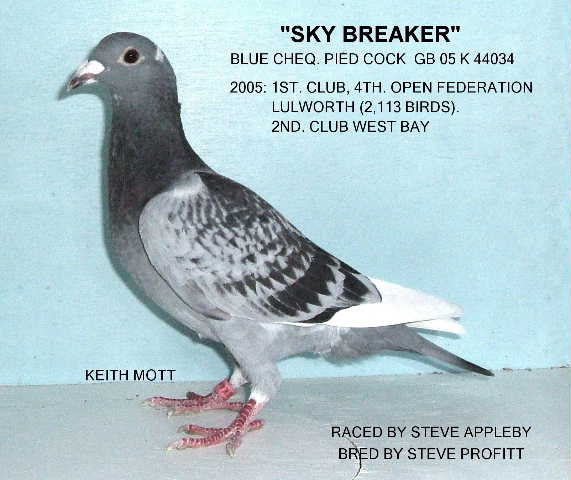
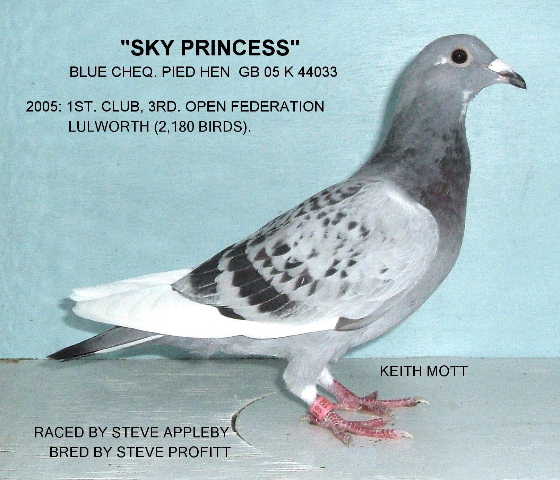
Four pairs of stock birds are housed, which we have been obtained from top flyers, including Cyril Luxton who has now retired from the sport, Mick Chaplin, always a force to reckoned with especially in the L&SECC, Tony Adams, from the well known partnership of Adams and Gilmore, and most recently, Steve Profit, winning the mighty UNC twice and was second twice. Steve Profitt used to race in the partnership of Mahoney, Nixon and Profitt. Their famous Paddy Cock won 1st and 2nd UNC a unique achievement by a pigeon. Steve Profitt is now the chief convoyer of the UNC and no longer races. He still houses a top team of stock birds which he breeds from and gifted Steve a nest pair of youngsters in March 2005, which were Janssen De Klaks. The blue cheq. pied hen, “Sky Princess”, won 1st club, 3 rd Three Borders Federation from Lulworth with 2,180 birds completing and the pied cock, “Sky Breaker”, won 1st club, 4th Three Borders Federation with 2,113 birds, again from Lulworth. This game young bird was also 2nd Guildford club from West Bay. It is not very often that a nest pair wins and scores at the top of the Federation as young birds, and it's full credit to the breeder, Steve Profitt, and racer, Steve Appleby.
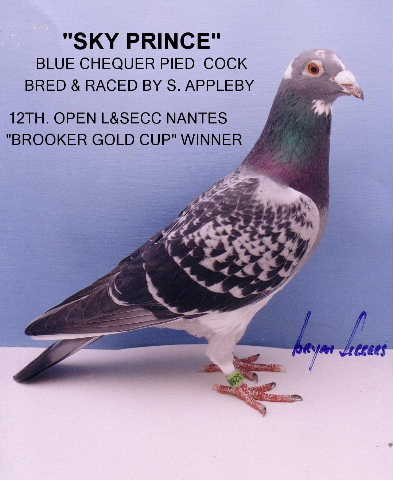
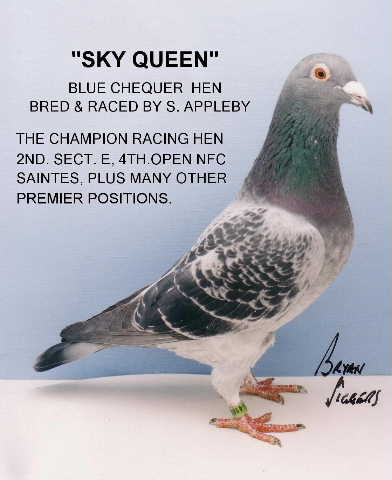
Steve believes in the introduction of one or possibly two new stock birds every year. This is a serious commitment. With Steve racing a small team every pigeon must be a consistent racer and no passengers are carried. Every perch is valuable and must be earnt. It will take at least a couple of years to find out if the off spring from the new stock is racing for us. Steve's other position within the sport is, as I've previously written, race advising and he is always watching the skies on his satellite system at weekends. For this reason he has named his family of pigeons with the word “Sky”. To name some of them, “Sky Prince” was 12th Open L&SECC Nantes and won the “Booker Gold Cup”, as the first nominated yearling in the race, “Sky King” won 1st . SW Section, 5th Open L&SECC Vire, velocity 925, in a very hard race. At that time convoyer Doug Went on his return journey described the northerly head winds over the channel of sledge hammer force. “Sky Train” won the Three Borders Federation as a young bird from Blandford. “Sky Girl” a yearling won 3rd section E, 181st Open NFC Bordeaux 443 miles, in a north east wind. At that time Tom Sherwood was the man to beat in the NFC and was a tremendous national flyer, winning section E on several occasions. On two different NFC races, one from Nantes and the other from Saintes he was just in front of Steve winning Section E. Steve's best racer was the Busscheart blue cheq. hen, “Sky Queen”, never out of the first 20 in all National and Classic races she was entered. Steve told me, she was born with that natural ability to win races. She won from the word go as a young bird and never looked back recording 17th open L&SECC Vire, velocity 885 ypm, 7th Open L&SECC Angers in a north east wind, velocity 1049 ypm. This wonderful hen was sent as a single entry to the Saintes National with 5,244 birds competing. The NFC convoy was liberated in a north east wind and after 9 hours 37 minutes on the wing she was spotted racing hard over the rooftops. She folded into the loft, winning 2nd section E, 4th open NFC Saintes, velocity 1158 flying 380 miles.
Before it was sadly disbanded in recent years the wonderful old London Columbarian Society was one of the oldest clubs in the pigeon fraternity and reached one hundred years of age. Originally it was formed to create Wednesday racing for London area shop keepers and fanciers who had to work on a Saturday and was probably the first ever mid-week club. This old club had wonderful tradition and quality, and I’m proud to say I was Chairman and Press Officer of it for several seasons in the mid 1970’s. The London Coly had a brilliant array of top quality trophies and cups, and the ‘The Brooker Gold Cup’ was originally presented to the London Columbarium Society by Mr W. Brooker in the early 1900’s. It was a very valuable cup, being solid gold and is now insured for £5,000. When the Coly disbanded the cup was presented to the L&SECC and is competed for each season in the Yearling Derby, and is won by the first nominated yearling recording the highest velocity. Steve Appleby first won the cup racing on the south road from Nantes 279 miles in 1999 and his game pied cock also recording 12th open. In 2006 the race took place from Morpeth on the north road, a distance of 275 miles and Steve was delighted to win this cup for the second time. ‘The Brooker Gold Cup’ has only been won twice before by the same fancier, Steve and Skeet & Keen, but the Appleby loft is the only one to win this coveted award on the north road and the south road. His Morpeth yearling chequer hen, ‘Sky Crusader’, was three weeks after winning the ‘Gold Cup’ turned round and sent on the south road as a single entry to Cholet, again with the L&SECC, a distance of 289 mile. She was timed after 9 hours and 21 minutes on the wing winning recording 94th open, velocity 947 ypm in a north east wind. She was bred from a cock gifted to Steve from Cyril Luxton, a Guildford fancier when he retired from the sport and was paired to a hen on loan from Tony Adams of the Adams and Gilmore partnership of Fareham.
This year Steve bred 24 young birds which were on the darkness system and Steve maintains that these days if fanciers don't employ this system they are certainly at a disadvantage. After training and with the usual loses he ended up racing a team of 12 young birds, not all sent each week. These pigeons are raced to the perch and the sexes separated, as Steve is not keen on pairing up youngsters. Once the young birds have had the initial intensive training and their first race then they go down the road training as often as possible, about 20 to 30 miles. Steve has a good idea what the weather has to offer, so this is a plus when it comes to training. It takes time and hard work to reach the top in pigeon racing, learning by your mistakes along the way. Steve says, nobody likes making mistakes, but if the errors are converted into good results, by learning from them, it's all worth while. Good quality pigeons are essential, born with that natural ability to win. Once you have reached the top it is even harder to keep there and after you have built up, and established your own winning family, you must try and maintain these bloodlines. No interest is taken in eye sign and Steve, does not enter shows regularly in the winter.
When I asked Steve how he thought the sport had improved over the last few years, he said, with out a doubt the availability of modern technology. The use of mobile phones, quartz clocks, weather satellites has advanced our sport to a new level. As Steve race advises for many of the major organisations in England and Scotland the use of technology has been crucial. The value of this technology has proved its worth many times as without the accurate incoming data mistakes in assessing the line of flight could easily have been made. The rainfall radar he uses is the same system that Formula One motor racing uses to enabling them to change tyres quickly in the event of any rain coming in. This system identifies rain using new images every 15 minutes. On our race days the same system picks up any rain on the flight path of our pigeons especially over the channel and France. His one major concern about the sport is that it is shrinking in membership as few people were joining clubs. Those already in the sport were not getting any younger. There is so much for youngsters to do these days and unless they are brought up connected to families or friends racing pigeons then the chances of them coming into the sport were not good.
Well, I hope my readers have enjoyed this article on my ol' mate, Steve Appleby; he is a great lad and gives up a lot of his time working for our sport! If you have any comment I can be contacted on Telephone: 01372 463480. See yer!