
Joe Murphy visits
Jim Donaldson of Peterhead
Jim Donaldson is a household name within the sport of pigeon racing not just in Britain but within Europe. He was fortunate to win a Gold Award in the SNFC with his grizzle hen Reims Girl (SNFC Record holder for furthest fling Gold Award winner in the club’s history) and while at this presentation I asked Jim if he would assist me in compiling a story on his achievements for the press. I’m happy to say he agreed and in early February I made the 260-mile round trip to Peterhead for this report; however this has stayed on the back burner until now due to other things taking priority.
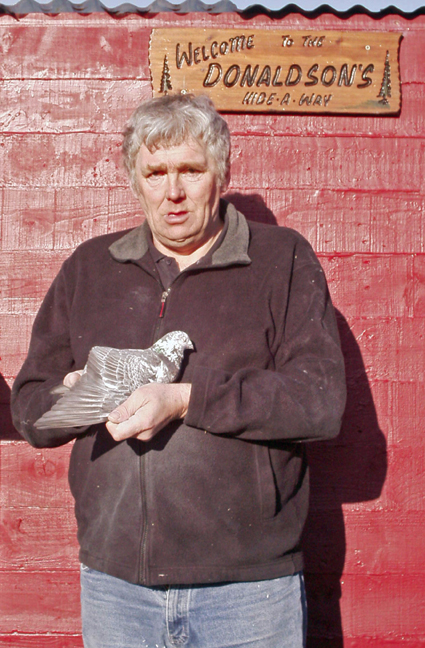
Jim Donaldson holding Reims Girl
My Introduction
I have known Jim and Ann Donaldson since the early 1990s when I was a long distance lorry driver and stopped over in Peterhead for the night. At that time I used to meet up with Jim Wiseman and Irvine Buchan who introduced me to Jim & Ann. Then as time progressed I would go to each of their houses the following mid week and we would talk about pigeons late into the night. We covered every topic under the sun and it was a very special time, we bounced certain ideas off each other and also the pros and cons and increased our knowledge each week. Can I just say that during these conversations it was obvious to me that Ann Donaldson played a large part in the management regarding her husband’s team of pigeons, as at that time Jim worked alongside Irvine in Jim Wiseman engineering company and Ann attended to the birds' needs on a daily basis. She was also very enthusiastic and although Jim receives all the praise for the awards he has achieved over the years, I know that Ann is as much a partner in the loft as she is in their marriage. As a matter of interest Jim and Ann celebrate their wedding anniversary on August 19th being 42 years married. To exemplify my remarks about Ann’s loft management skills when Jim had to undergo a triple heart bypass a few years ago Ann looked after the birds and kept the Donaldson name to the top of the SNFC race results: most memorable being with Little Amie who won 1st north section 7th open Sartilly and Niort Lady who won 2nd north section 14th open Niort which proves how competent a pigeon fancier she is and these results were indeed a great tonic to Jim as he lay in his hospital bed.
To return to the 1990s I assisted Jim and Ann with their feeding system and when they came down to the SNFC race marking station they would bring their longer distance national candidates with them and I would take them over to George Archibald the next morning when I took my own. These would be released along with others trainers from Scottish borders and once the Lothian birds dropped off mine and Jim’s headed into Fife then the Donaldson birds had to steer the homeward journey on their own and this made them use their brains and navigation skills to full advantage.
As I said earlier I was a long distance lorry driver at one point in my working career and therefore have a vast knowledge of the terrain and distances involved from the central belt of Scotland up into the Scottish Highlands and believe me I would not like to race pigeons into this area. It takes a special band of fancier and more importantly a unique category of pigeon to fly into this environment from the ultra long distance races especially from the central belt of France. When you look at the distances and performances of Reims Girl then you realise we have within our midst an exceptional pigeon as she has won 3 times from Reims 620 and twice from Tours 707 miles but more about this great pigeon later on in this story.
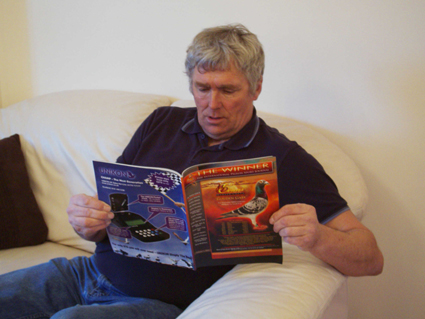
Jim relaxing
The Beginning
Jim and Ann’s son James started up the pigeon when he left school but soon afterwards decided to take up employment as a fisherman and when he was off shore it was Ann who assisted him out (this is when she became hooked on the birds); as she did not know enough about them she and Jim started to read the weekly pigeon papers to gain some wisdom. First thing she organised was to get Jim to erect a small 12 x 6 foot loft with two section one for old birds and the other for the youngsters. Like everyone who starts up young James had a collection of pigeons from strays (he caught) to gifts from friends and it did not take Ann and Jim long to realise that these birds were a waist of time. Jim noticed an advert in the RP regarding a sale in aid of a fancier who had been killed in a car crash, so he drove down to Brechin to view the sale birds, 2 birds caught his eye and they were both bred by local fancier Dave Scott who purchased the first bird back himself; however Jim was successful in obtaining the other. After the sale Dave introduced himself to Jim and asked why he showed particular interest in his two pigeons and Jim’s reply was ‘I just liked the look of them’. This was the first meeting of these two fanciers and Dave invited Jim back to his home to view his family of birds within his loft. These two men hit it off right away; so much so that Jim was invited to stay for tea such was the mutual respect they had gained for each other, and as time passed by their friendship grew from that day until the present time and they contact each other on a weekly basis and Jim told me that Dave gets more excited about the birds than he does.
To quote Jim: ‘Joe that first visit and the view of Dave’s pigeons has stuck in my mind and that was the best team of pigeons I had ever witnessed. Of the 30 birds kept 19 of them had flown and scored from France and you cannot ask for any better than that’. Dave gave Jim a pair of youngsters away with him and these along with other introductions from the great man are the foundation of the Donaldson family of pigeons. Dave Scott’s pigeons were based on the renowned pigeons of the late Norman N Dall of Ladybank, Attwell Brother of Wales and a grizzle hen bred by Mr Geddes of Greengairs. From these pigeons Dave bred a chequer hen that won 4th section 7th open SNFC Nantes who was to become a gold mine at stock and bred countless national prize winners. Jim is eternally grateful to Dave Scott for his help and assistance over the years and although their lofts were 60 miles apart and visits were few and far between. Dave told Jim ‘I will tell you all I know about pigeons, but the final piece of the jigsaw is that you and only you will know when a pigeon is right to be entered into a channel race and this will only come from experience’. Jim said ‘Joe he was spot on, and this advice is as good today as it was when given to me all those years ago’.
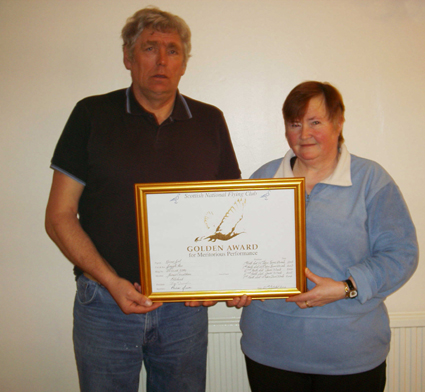
Proud Jim and Ann with a SNFC Gold Award
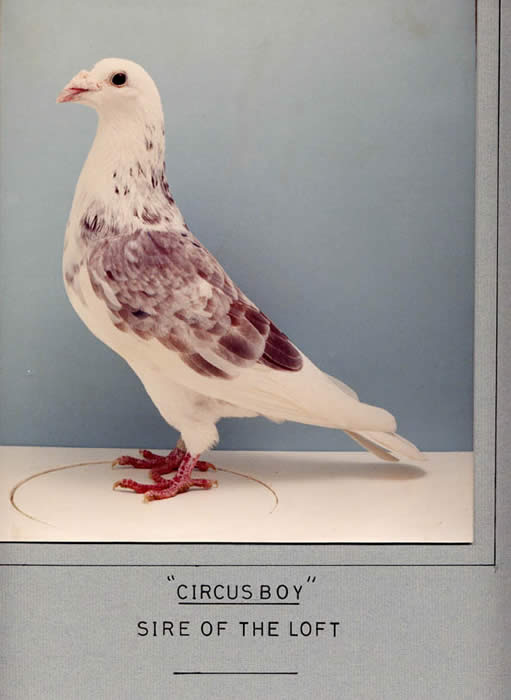
As time progressed Jim introduced six birds from Sid Beard of Hemel Hampstead being from the Lancashire Rose and Blue Anglia lines. Unknown at that time these birds produced what was to be Jim’s foundation stud cock within the loft namely Circus Boy. This cock passed away in 2008 aged 27 years old and it was a very sad day in Meekhill Road as he was part of the family. Circus Boy was raced to Doncaster 480 miles as a yearling then the family moved to their present address he was broken to the new location and was entered into the Newton Grange race point a distance of 120 miles failing to return. During his loss 2 youngsters from him were the only 2 birds home on the day to the loft in a very difficult race and an older sister had also shown her potential by being 1st north section Sartilly. So you could imagine how Jim and Ann felt when they received a card through the letterbox from the SHU reporting a stray pigeon; yes it was Circus Boy who was in a loft in Essex however he was in a very bad condition. When he returned he could not even fly up to the perch so was given a lot of TLC from guess who; yes your right Ann. This outstanding breeder has produced countless SNFC winners over the years and I will illustrate this latter in the pedigrees of the present day winners.
Lofts
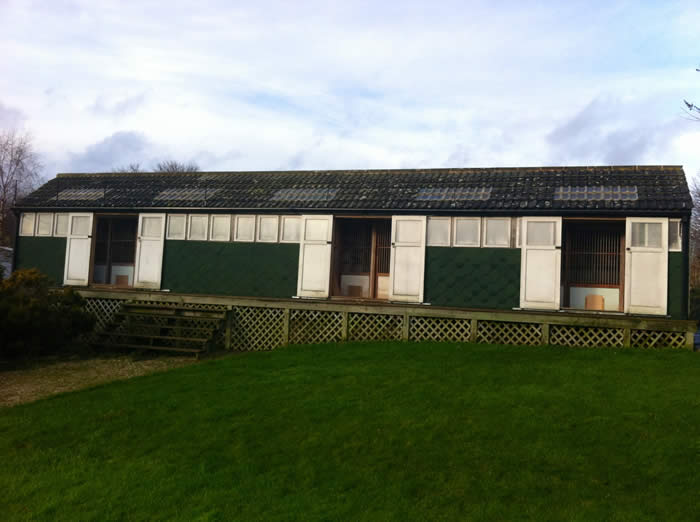
The present day loft is 30 feet in length by 12 deep, and has 4 sections 3 for old birds which are opened up during the season and if a pair decided to go into another section for a nest then they are allowed to do so, contentment is the number one issue and a very important contribution to the success within the Donaldson loft. In the past Jim has used open doors for trapping, now sputniks have been installed for trapping with the Unikon electronic timing system used. Jim says ‘ I basically see hawks every day of the week so after the last young bird national I close my loft and the birds are never out again until the middle of February. If all the fanciers did this it would reduce the hawk problem. Other fanciers around me let their birds out during the winter and these are picked off by hawks on a daily basis and when it comes to the summer months when I let my birds out the hawks still go to the other fanciers loft locations as they know they will be a supply of food available to them. However this does not mean that I’m free from these terminators; my first bird from Alencon in 2008 to win 2nd north section 7th open SNFC flying 661 miles; has just returned after being missing for 10 days. She has only half a wing; gaps in her tail and was so dehydrated that I cannot understand where she had been for the 10 days she was missing. She was in a sorry state of affairs when I saw her picking about the grass in front of the loft, however I’m happy to have her back and she will now remain at stock.’(You never know she may turn out to be as good as Circus Boy as a potential top breeder; only time will tell).
Main racing loft
Management
Birds are mated up around the middle of February with 70 young birds bred each year for racing plus a few extra for charity sales; again very little training is given only a couple of 30 miles tosses then into the first club race which is 60 miles. The team are raced natural and receive their morning and evening exercise round the loft which lasts about an hour and they do this freely with no flagging whatsoever. Once the youngsters have been moved the race team are given a couple of 60 mile training tosses prior to the first race then training stops.
The race team consists of 70 old birds with another 10 or so kept at home as mates for the main national candidates, these are what we would term stock pigeons however they are not prisoners as they are allowed their freedom with the race team. Jim is not a great believer in stock pigeon as such and said ‘Joe as a rule of thumb my best racers have been my best producers, with the exception of 3 or 4 birds in 25 years and these birds have produced good birds in every nest. I have to laugh when I read that some fanciers have 20 pairs of stock birds I don’t believe that they are all that good and to be honest some people don’t have 20 good producing birds in their life time never mind in one season. Although it is important to breed a few birds to continue with a strain, one of the things I have always done at the end of each year is pair my best flying hen with my best producing cock, disregarding how close bred they are and by doing this I always continue to keep my main family blood line going. If fanciers do introduce a bird always put the offspring back to your own birds that way you ensure that you are keeping your own bloodline’.
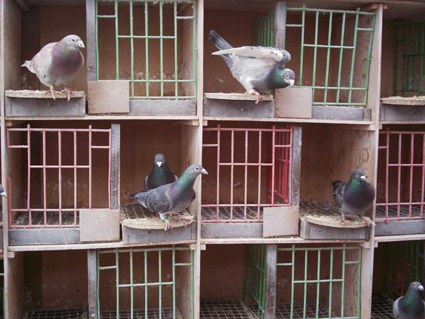
Old bird boxes
Jim is a great believer in having the mate at home so to keep the impetus and love of habitat most imminent within the mind of the racing pigeon on the final part of the journey home. This to Jim is so important as he says ‘Joe we all have ‘homers’ but it is getting the right birds to be up with the leaders which is most important objective’. The Donaldson birds are now achieving this as lately Jim has been 4th & 7th open Tours; 7th open Alencon; so they are right up with the SNFC winners. All national birds are raced on the natural system with the majority entered for the race basketting sitting on a 2 day old baby and this system never changes. Jim counts back from the race marking day to make sure the eggs will hatch on time and the birds are paired accordingly for the race they are set up for. He also has other birds down on eggs at the same time in the event of anything happening to the prized racers babies. We all know that this can happen within the best of lofts however Jim covers all avenues just in case, this is what makes fanciers of his calibre continue to win year after year. This meticulous planning ahead with nothing left to chance is what makes ordinary fanciers into top quality fanciers. The Donaldson national candidates only get their youngsters the night before basketting this is usually their first youngster of the year. He and Ann spend a lot of time watching the birds and generally if this motivation is going to work both parents will sit on the young bird all night and they will know that they will get a race out of them. Again the importance of ‘observation’ I don’t know how many times I have written this word in articles over the years; and I just hope that readers will learn that this is the most important task in achieving your goal or making it to the top.
To be continued
© Compiled by Joe Murphy
Jim Donaldson of Peterhead- Part1
- Details
- Hits: 2106
Related Articles



Continue Reading
Continue Reading: more racing pigeon articles from the Elimar archive