The John Kirkpatrick Story by Joe Murphy
A few months ago while having some work done on our driveway, I took out a tray of coffee and tea to the workmen. While we were talking it came to pass that I said I had a Westminster Chiming clock that I was not working. I had taken it to a jeweller but they said I would have to leave it for a YEAR, before they could look at it. Needless to say I never left the clock. The owner of the company doing the driveway said he knew someone who would have a look at it for me and he took the clock away with him. Prior to Christmas he arrived at our house with his neighbours who was holding a clock. He informed me that the clock was in impeccable condition and congratulated me on looking after the clock. I told him that I had done nothing to the clock (in fact) I thought I had overwound the clock hence the reason it had stopped. He then came into the house and set it up and it chimes every 15 minutes and it is like ‘Big Ben’ on the hour. It is truly wonderful to hear it going again and the man informed me that he had done nothing to it but gave it the once over and it has kept perfectly ever since. The next day a fellow pigeon fancier phoned me just prior to the hour and he heard the clock in the background and remarked how wonderful this was. When I told him that this was the clock that the famous John Kirkpatrick of Annan was awarded for winning the SNFC Gold Cup race from Rennes in 1937, you could have knocked him over with a pigeon tail feather.
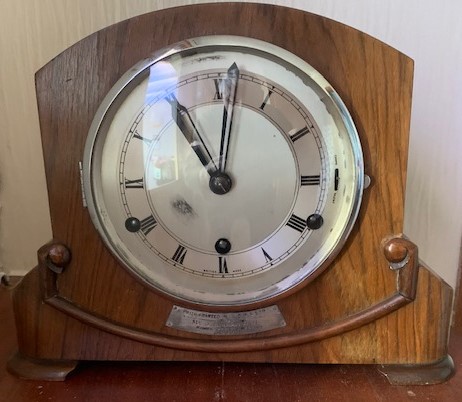
1937 Westminster Clock
We continued with our phone call and he remarked to me ‘Joe, you must do a story on this clock and the history of how you became the owner of such a wonderful piece of Scottish National History’ to own a clock that the famous John Kirkpatrick had, wound up, and heard it in his house all those years ago it truly wonderful. So I went back into my old files saved on my hard drive and looked for the original article which I wrote back on the 2nd December 2009. I will go over it and proof read it and attach to my column for the next couple of weeks as it was quite an in-depth story about one of the most famous fanciers in fact a true legend who ever graced the sport of pigeon racing into Scotland. I hope readers of my column enjoy this story.
John Kirkpatrick - The Supreme Pigeon Fancier 1898 -1954 by Joe Murphy
PART ONE
A few months ago I received a phone call from a Mr John Smith from Jedburgh; he had been given my number by a pigeon fancier in the area. He had been informed that I was steeped in the history of Scottish Racing Pigeons especially the SHU and the Scottish National Flying Club and had over the years highlighted the quality of Scottish pigeons and I was to be complimented on my contribution.
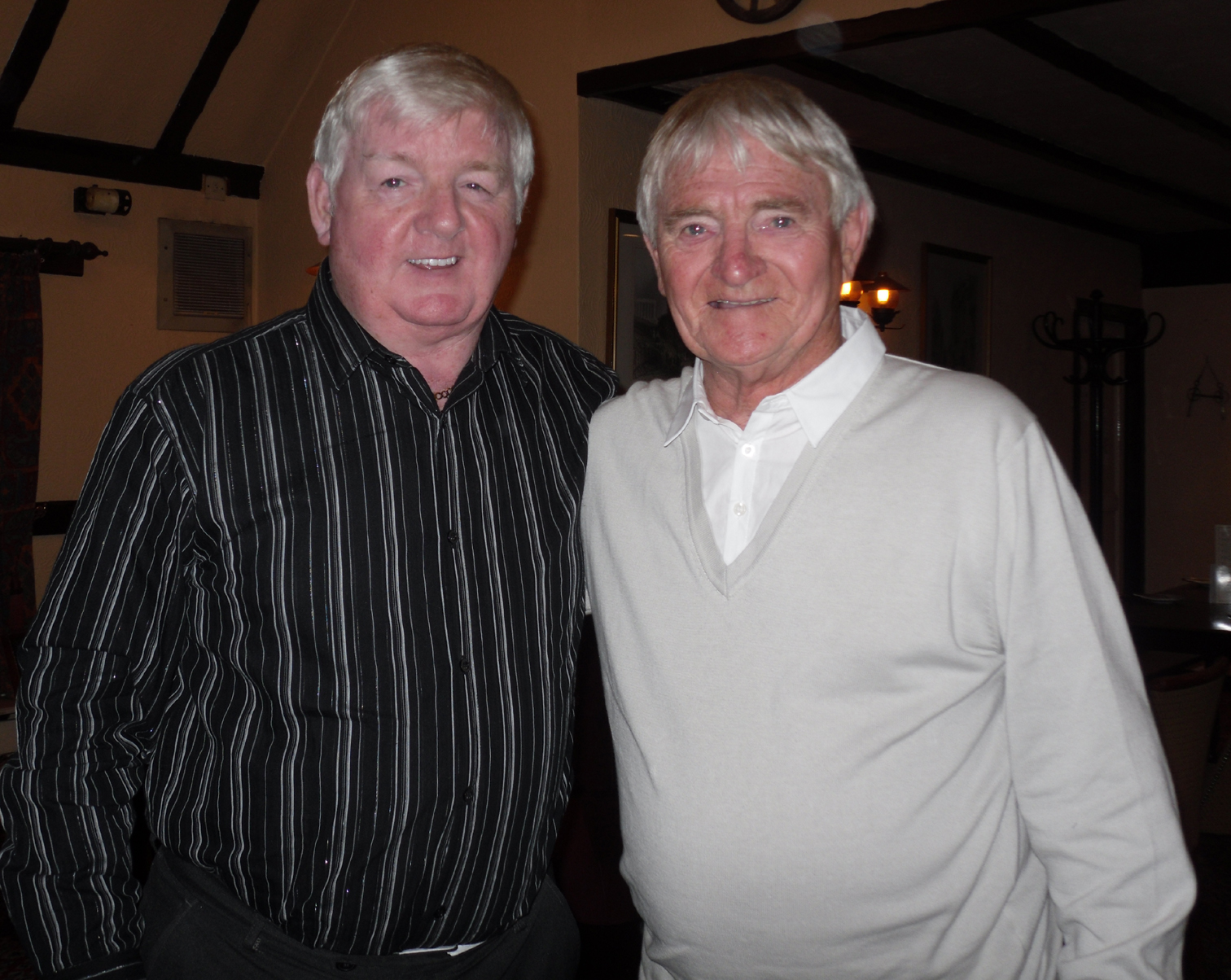
Joe Murphy & John Smith
At first I thought it was a ‘wind up’ but it wasn’t and to be honest as the conversation continued it became indeed a great honour to speak to this man. John Smith’s mother was Jean Moore and her sister was named Carrie. Jean married Fred Smith who was to become one of Annan’s most respected footballers; he had pace; wizardry and scored goals for fun. Fred is still living in Annan and is now 98 years old and is remembered by the older generation as ‘One of the Best’ ever players. John Kirkpatrick was also a fine footballer and had played with Solway Star joined Workington Town and played it the North East League. His first marriage produced a boy Jack who moved to Rhodesia and in fact was captain of the international Rhodesian football team who played against Scotland in a friendly in Rhodesia. His daughter Hannah married Andrew Cowan through time became the secretary of Annan Homing Society. After the passing of his first wife John started to become friendly with Fred and Jean Smith and would join them on a trip to visit Jean’s father Mr Moore’s who lived in 105 High Street; he also was a pigeon fancier and had a large 40 foot loft out in the back garden; It soon became apparent that it was Carrie who was catching John’s eye and not Mr Moore’s pigeon and they married in the late 1940’s. When a young Laddie in Annan John Smith would accompany his mother and father to visit Aunty Carrie and Uncle Johnny at Galabank; as he grew up he became fascinated with the pigeons and would often cycle up to Galabank lofts to help out his uncle Johnny. These were special times for young John Smith and John Kirkpatrick looked on him as a second son. John was with his uncle Johnny when he won the Scottish national from Nantes and remembers this with love and affection. His aunty Carrie loved young John Smith so much so that she left him the Westminster chime clock that John Kirkpatrick received as a memento of winning the 1937 SNFC Rennes race in her will. This Gold Cup winner Coronation Express won the race in record time and believe it or not on the same day that John Smith was born.
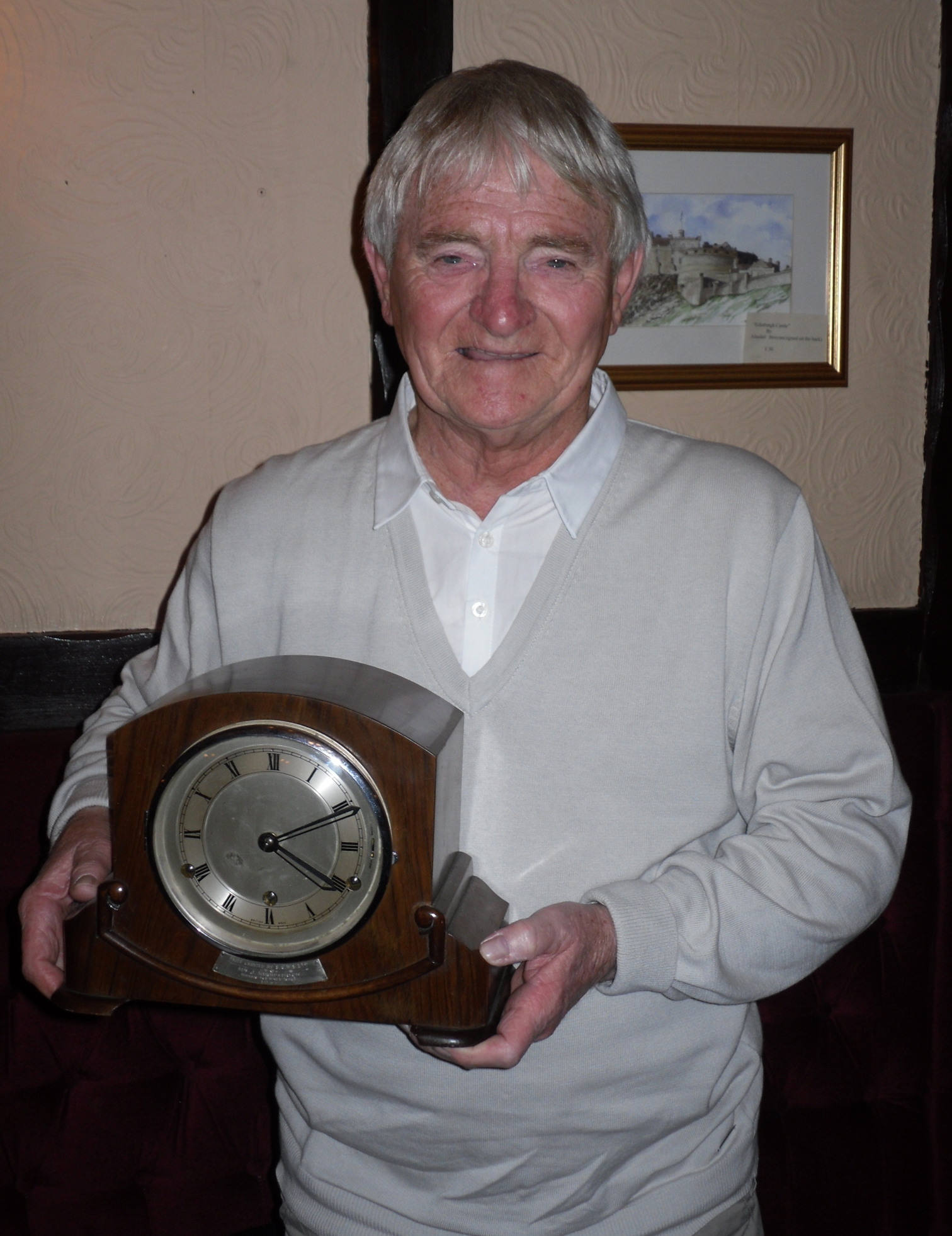
John Smith with the Kirkpatrick Clock
John Smith never kept racing pigeons due to work commitments he became an administrator in Cochrane & Co of Newbie Annan; and worked worldwide as senior manager for L.S. Starrett Co. Ltd in Jedburgh; finally finishing his working life as a retailer with a shop in Jedburgh high street. However his memory of the time spent with his uncle Johnny has never left him and the reason for his phone call to me was to see if we could meet up as he wished to present me with this Westminster clock. We arranged to meet at Stair Castle Hotel outside Pathhead and John asked me to bring my wife Margaret with me as he had also been informed of her contribution in assisting me over the years. We met for lunch and John (being the charmer he is) gifted Margaret with 6 red roses and a box of chocolates; we spent the whole day sitting talking and believe me it was indeed a great pleasure. There were times when the memories of John’s past caught up on him and he became overcome; however this was a true reflection of the man whom we had met for the first time and it endeared us to him. No matter how well he had done in life; deep down he was still the little boy who visited his uncle Johnny away back in the late 1940’s early 50’s and saw his national winners drop out of the sky. I took some photos of John with the Westminster clock that is inscribed;
Prize Granted by SCWS Ltd Mr J Kirkpatrick Winner Rennes Race 1937
This treasured memory of John Kirkpatrick’s early years has sat on a table in our since we brought it home and I look at it every day as it chimes every quarter of an hour and cannot believe that John Smith presented me with such a wonderful piece of Scottish Pigeon history; and I’m very proud that he thought so highly of me to do so. After our meeting I was on such a ‘high’ that I thought it only appropriate to do some research and compile an article on John Kirkpatrick. The reason for this is young fanciers like my son Kevin could read about this ‘giant of a man’ who transformed pigeon racing in his short life time; they could keep the article and revise some of the history of the SNFC as a memento of John Kirkpatrick. Nowadays we have fanciers creating their own part in the history of the club and to be part of the history and folklore of this great club is indeed a great honour.
The Beginning
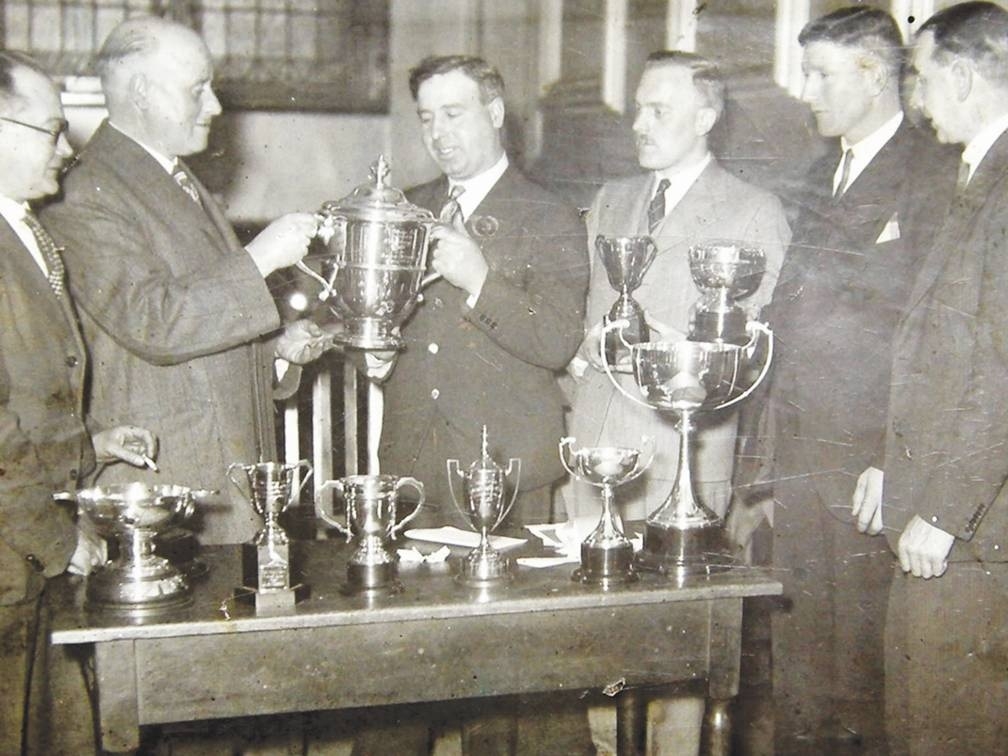
John Kirkpatrick was born in Maryport in Cumbria in 1898 and his family moved to Annan in 1912. His father, who kept pigeons, was a founder member of Annan & District Homing Society and John was always among his dad’s pigeons. In 1924 John Kirkpatrick won his first prize card when he appeared on the Rennes result winning 32nd open result. Before winning 1st open SNFC Rennes in 1937 with his fabulous 3 year old blue chequer cock called ‘Coronation Express’ setting a record at that time with a velocity of 1559 yards per minute. He was named after the famous locomotive of that time which broke all rail records and here was a pigeon breaking the record as the fastest ever Rennes winning in the 43 year history of the SNFC which was established in 1894. Coronation Express flew Dol as a yearling being well up in the federation open result; the following year as a 2 year old he won 72nd open Rennes in a disaster. In 1937 he was paired up on the 7th March and yet by the time he homed from Rennes he was carrying 3 new flights and had in fact thrown his 4th flight in the basket. Since his first win in 1924 John Kirkpatrick gained 2 x 3rds; 4th, 2 x 5ths ; 9th,11th, 16th, 17th, 18th, 22nd, all from Rennes and a 7th, 21st, 39th, 40th, and 42nd from Nantes. John Kirkpatrick was totally convinced that distance birds should be fully tested as yearlings and his outstanding record from Rennes and Nantes consistently showed that his champions had previously scored from Dol as yearlings before achieving further success at Rennes or Nantes. In 1931 he was 5th open Rennes with a yearling hen that went on to win 5th open again as a 3 year old. His red chequer cock Galabank Lad flew Rennes as a yearling in 1933 when he won 11th open; he was sent back the following year and won 18th open; and would have been on the result the following year but was disqualified over a timing technicality. Galabank Lad raced from Nantes in 1936 and 1937 being 42nd & 59th open respectively; and as a matter of interest Galabank Lad flew the English Channel no fewer than 11 times. In 1939 the Rennes convoy were liberated at 7-10am into a west wind and it was not anticipated that there would be any pigeons on the day. However there was 3 arrivals into the Annan area; John Kirkpatrick times his first at 22.17 hours and then another in the dark at 22.58 hours. Bob Douglas timed in a bird to split the Kirkpatrick duo and to be 2nd section. For years; the constitution of the SNFC had been so worded that generally it was believed that the first fancier to win the Gold Cup twice would be allowed to retain the famous trophy. With many of John’s club mates going to bed that night in the belief that John Kirkpatrick had indeed won the trophy for the second time. However the following morning a wave of birds were timed into Central Scotland and the eventual winners were Anderson Brothers of Falkirk. To end any confusion; the clause was subsequently modified to make it clear that the Gold Cup for all time would remain the property of the SNFC.
Hard Work
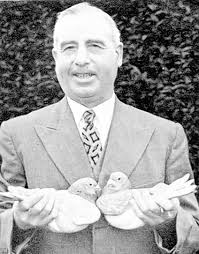
John Kirkpatrick had a very special work engine and over a long period initially as a footballer with Workington Town in midfield, then as a master pigeon administrator, his attention to the detail of essential requirements in preparing pigeons to be at their peak at the end of June each year was remarkable. John was keenly aware of what constituted a long distance pigeon and with the outbreak of the war he had already established a remarkable family of pigeons. However like many of us he was not satisfied and was compelled by introduction of a series of successful importations. In 1937 the year he won the Gold Cup he was asked to attend a winter show in Galashiels and was introduced to a businessman from the local mill a Mr. Richardson who showed him a pair of Belgian rung Bricoux, a mealy cock and a red chequer hen. John Kirkpatrick was so impressed with these pigeons that he purchased them direct from Mr Richardson and what an investment this turned out to be. This pair proved to be without doubt the finest producers the racing pigeon the world has witnessed and believe me ALL subsequent Galabank champions can be traced back to this pairing. It is worth noting at that time Mr Richardson kept about 200 pigeons in 2 large 40 foot lofts and he had spent a small fortune on stock. Many Scottish fanciers at that time obtained birds from Mr Richardson and without being disrespectful to the man they had more racing success than he had with the same birds. John Kirkpatrick was a very frequent visitor to Mr Richardson after they stuck up their friendship. The Bricoux pair in 1939 produced the world champion ‘Galabank Supreme’ who was to become the keystone in Kirkpatrick’s pedigrees. This pigeon was brilliant on the road with his favourite nesting condition being feeding a big young HEN. However it was at breeding the he excelled and was indeed the sire; grand sire and great grand sire of many winners. Kirkpatrick’s outstanding champions in distance races were in the main cock pigeons and he had a consistent policy of introducing top class hens from various sources to see if they fitted into his closely worked out breeding programme. Among those that succeeded was a blue pied Marriot hen from Mr Aitchison from Brampton near Carlisle; the sister of which had twice won the East Cumberland federation from Nantes. He also in 1941 purchased a Logan hen from Summer Brothers from Wrexham; which was logged as a granddaughter of Logan’s ‘1826’. Other introductions were a Barker hen ‘2716’ from L A Barker of Bridgewater; direct from Masonic Wonder and Masonic Cracker; he also obtained a Gits hen named Lady Margaret from the loft of Ed Clayon; and the famous 1948 bred grizzle hen ‘6498’ from Arthur Hill of St Just; Arthur had put up some outstanding performance into Cornwall after the war flying on the new East to West route from the continent. However one of the final successful imports was the red hen ‘5554’ from John Reid of Stenhousemuir she was of the highest quality as she was a full sister to Jock Reid’s 2nd open SNFC Rennes winner in 1950. In 1948 with the resumption of channel racing John was 2nd open from Guernsey with a 5 year old red cock from Galabank Supreme Bricoux line. Three years later he was again 2nd open SNFC this time from Rennes with Galabank King he later won 35th open Nantes. His sire was the cock who won 2nd open Guernsey and his dam was a blue hen from the son of Coronation Express when paired to a daughter of Galabank Lad and the Marriot blue pied hen.
Kirkpatrick’s own words
Following his success from Rennes he was asked to contribute an article to the first issue of the Homing World Annual Diary (as it was called at that time) in 1938. He wrote ‘I felt it a great honour in being asked to subscribe an article in this the first issue of the Homing World Annual Diary. While I do not feel really able to do the occasion justice; I shall at least try to make this article as interesting as well as instructive. Let me say at the outset that this is no great infallible secret in being successful with racing pigeons; nor is there to my knowledge any elixir or magic potion. But I will now give my own methods of feeding; training and racing to a successful issue.
The first and premier consideration is the food; I feed the whole year round on a mixture consisting of peas; beans; tares; wheat; Dari and a little maize; but the quality of this must be assured and absolutely free from dust and dirt of any kind. The food at all times must be given at very regular intervals. Personally I feed three times a day during the long summer days; the times of feeding during this period are at 7am; 12 noon and 6.30pm. At the evening meal after the birds have had their usual corn; I give them a tit-bit in the form of seed mixture; which is 25% Millet; 25% Linseed; 25% Rape and 25% hemp. When the racing season is over and the days get shorter I feed twice a day; morning as early as possible and early afternoon. At this time I gradually increase the amount of wheat in the mixture until it presents 50% of the diet. I am a great believer in wheat; as I am convinced it is very beneficial during the moult and at this time I increase the seed mixture especially the linseed. I, at times feed the birds by hand, and never by hopper, and I may be classed a fairly heavy feeder; as I always give the birds a full crop at every meal, but I make sure there is never any surplus food lying about. I give green food via; lettuce; chopped cabbage; plantains; watercress; chickweed etc.; whenever these are available; these I believe are great blood purifiers. With regard to attention I give to cleanliness in the loft. I clean it out twice daily; morning and night; changing the water on each occasion and at the same time putting a little grit on the floor; this ensures the grit being always fresh and dry; and the birds seem to appreciate it better this way than in a trough or hopper. I mate up according to the distance I map out for my individual birds; the longest distance candidates being mated later than the others. The stock birds and yearlings are put together the first week in March and the others are mated at intervals in accordance with their programmes. Thus my ‘Coronation Express’ the winner of the SNFC Rennes race was paired on March 7th. It homed with 2 ½ new flights; the 4th having been dropped in the race basket. This was perhaps a little advanced, but it is, of course, evident that this proved no handicap. I do not care to have my channel candidates moulted beyond the 4th primary; as any further advance in the moult is; I consider; a severe handicap. Any fast moulting bird which I have, I delay pairing until the last week of March; as also my Nantes candidates, as our national Nantes race is usually the third week in July.
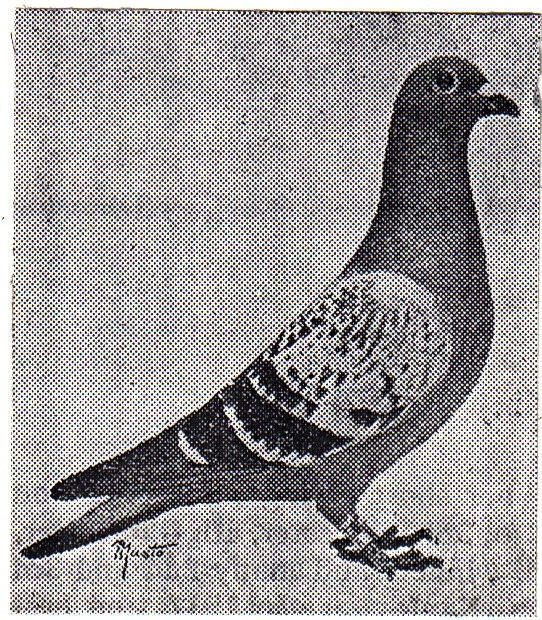
'Coronation Express' 1st SNFC Rennes 1937
Training
I always give my racers 5 tosses before they go into the first race – 9 miles; 15; 20; 30; 40 as I believe that to have a chance of winning, the birds must be thoroughly fit. We have all heard fanciers state ‘They jumped this right from the loft’; but how many times are these birds in the prize lists? They may certainly home; but to race to win they must have training and experience. I fly my bird’s natural system; although I may say I have tried various ways. I tried the widowhood system some time ago; but I was disappointed with the results as it was frankly the worst season I had for nine years. I do not wish to imply that the widowhood system is no good but the natural system appears to suit myself; and my birds are better than any other. Immediately the racing season is over I separate the sexes and never allow them together again until the mating period. I also at this time lime wash and disinfect the loft; which I again do previous to mating. I also bathe each pigeon separately previous to separation; with a solution of sodium of fluoride; in Luke –warm water to which is added a little soap; this of course is only done on a sunny and warm day.
My loft has a southerly aspect and has fully one-third of the front lattice work; which ensures plenty of air and sunshine. In this district we have no traps; all lofts being built to the open door arrangement. When the doors of my loft are open the loft would appear to have no front whatever. The front has glass shutters which I use only on the occasion of heavy rain from the south-west as I like the loft floor to be always dry.
My birds have regular exercise twice daily; morning and night for half an hour on each occasion. The hens are exercised at noon for 45 minutes. This is imperative as like athletes, pigeons cannot compete with success unless trained to the second. As the races get longer; the birds exercise is extended to 40 minutes morning and night; the hens then have one hour exercise at noon. I have no difficulty in making my birds fly at home; but if the train service were convenient I would give my birds two tosses weekly; as I think these tosses would be more beneficial than the home exercise.
I race both cocks and hens with equal success and I very rarely send a mated pair to the same race; as I’m sure that a pigeon likes to see its mate when it arrives home. The best results I have had with cocks were when the hens were never raced at all and should I see a cock racing well to a particular hen; I always keep this pair together, not forgetting to give them the same nest box. As I have said; cocks and hens do equally well for me; as either sex sitting 8 to 11 days is in the best condition for the channel races and most of my successes have been gained with birds in this condition.
To be continued next week;
© Compiled by Joe Murphy