A TALK WITH STEWART GUY BY JIM EMERTON
Q.1 How did your love affair with the countryside begin?
Q.2 Were you raised in rural villages as I was?
I was born in Sherborne Dorset and at the age of five my family moved to Alweston 3 miles from Sherborne and right out in the heart of the countryside. This was definitely when my love of country life began.
By the age of 10 I was milking my father’s five cows by hand twice a day before and after school. I developed a love of country pursuits which was a very accepted part of country life. All my summer holidays were spent working on a local farm during the harvest collecting sheaves from the binder.
On leaving school I started work on a large poultry farm in Martock in Somerset. Here they had heavy horses to do a lot of the work and I really enjoyed bringing them in each day, grooming and working with them.
In 1963 my parents moved to Reading to another large poultry farm and it was here that I ran an isolation unit where poultry that had been brought into the country had to spend six months in quarantine.
While motor racing at an event in 1968 I had a horrific accident which made me to decide to give up motor bikes and I took up pigeon racing. I joined the Tilehurst Racing Pigeon club and in 1974 Janet & I started the Berkshire Racing Pigeon Federation along together with Cyril Kidby and Pat Pattinson.
In 1970 I married Janet. That was 47 years ago - fortunately she also has a love of the countryside and has supported me in all the different hobbies and activities I have pursued.
Q.3 What are some of your favourite topics and experiences in your long and great filming career?
Q.4 with extensive work in the media did you enjoy Radio & TV?
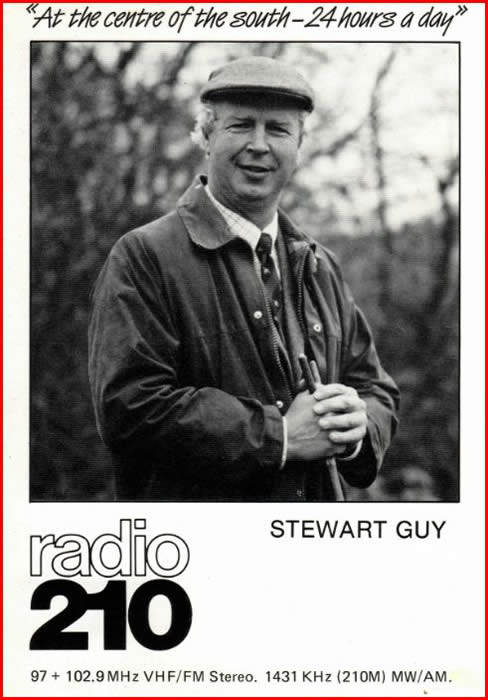
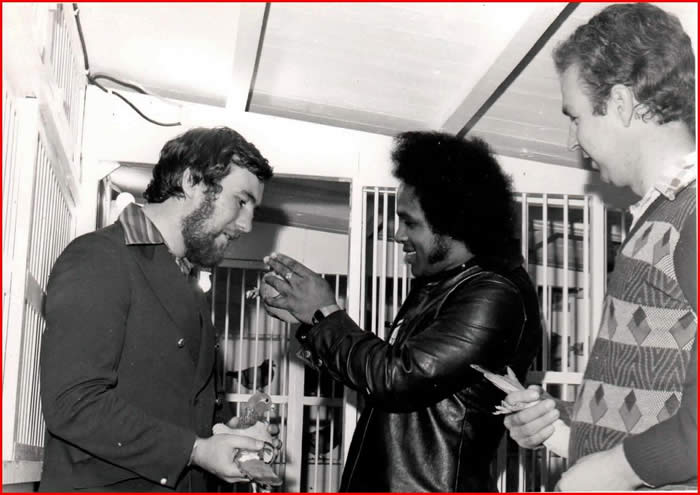
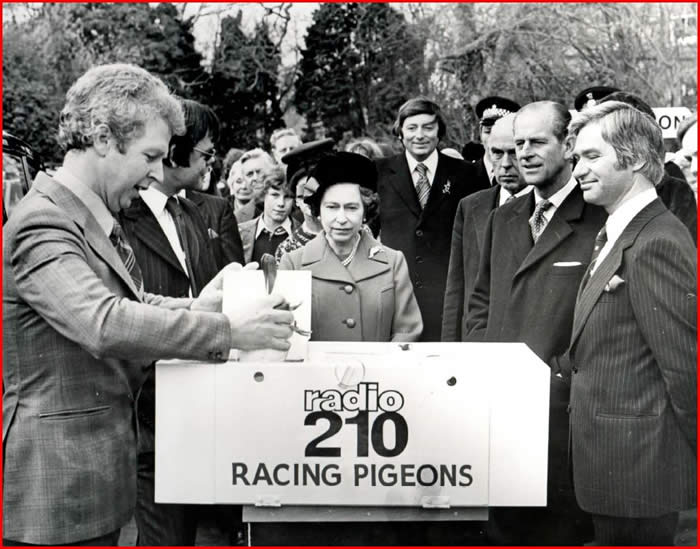
In 1976 Radio 210 was launched as a local independent radio station in Reading. Before going on air I approached them with a view to promoting racing pigeons and as a result I did my talk on the first day they launched the station. This was to be the start of a change of career! Over the next three years I was given a weekly programme on racing pigeons and my guests included: Film Director Jack Clayton, Sir Gordon Richards, Willie Carson, England Captain Gerry Francis, pop singers Mac & Katie Kissoon, Pam Ayres and it was a very special day when Her Majesty the Queen came to visit the Radio 210 and the highlight of her visit was an exhibition of racing pigeons which I was very proud to present to her.
In the loft with Tony Holden and Mac Kissoon
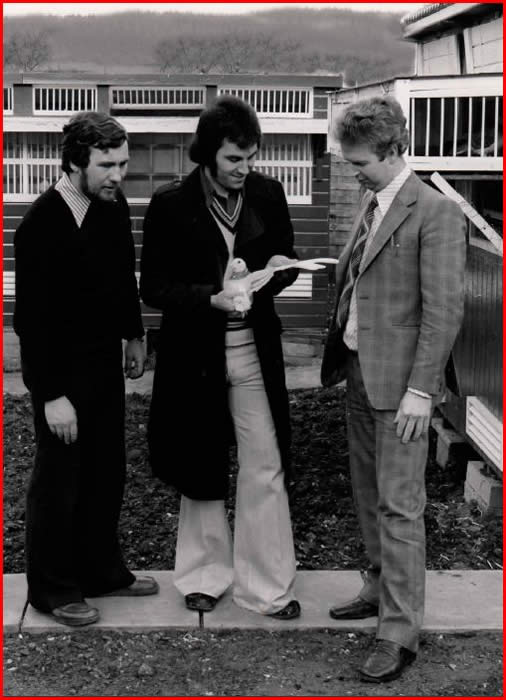
I also formed a team of racing pigeons for Radio 210 and the support we had from fanciers to build this team not only from the U.K. but also from America was amazing. This team did promotional work for the Radio station and also took part regularly in races and competitions at outside broadcasts.
After three years of presenting weekly pigeon sport I was given the opportunity to present a weekly countryside programme. This programme ran for ten years and included subjects such as fishing, shooting, hunting and also different aspects of farming: arable, cattle, pigs, sheep, forestry beekeeping and many aspects of our countryside. All my enthusiasm and knowledge gathered in my childhood found a very keen audience each week.
I also presented many outside broadcasts at different events in the Thames Valley over several years.
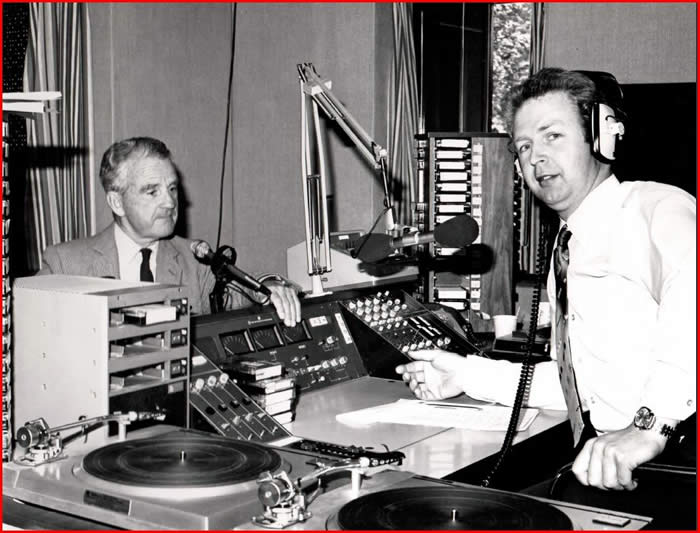
In the studio with Sir Gordon Richards - With Tony Holden and Gerry Francis
As I worked on my programmes on Radio 210 I had to learn the art of interviewing and using all the technology involved in recording and editing. One of my first recordings was at the very first Blackpool Show which was also the Olympiad and I remember interviewing fanciers from Japan for my radio programme.
Many of my Radio 210 programmes were syndicated to other radio stations which meant travelling outside of the Thames Valley to record more material for them.
I really enjoyed working on the radio and meeting people from all walks of life. As my experience and ambition grew, I travelled abroad to make programmes. On one occasion I followed the British Event team at an equestrian competition and there I was introduced to the Commanding Officer of the Kings Troop Royal Horse Artillery this was the start of many years of association with them first making audio recordings and later to make documentaries which I filmed. Then later I was introduced to the Household Calvary and again I made recordings with this magnificent regiment. This gave me a real thrill and I enjoyed every minute of my work with both these ceremonial units.
By 1989 my friend David (Diddy) Hamilton had secured me a job as a countryside presenter on Sky One TV working with Tony Blackburn and Jenny Hanley. At the same time I was also a presenter on Life Style TV with Pam Rhodes and David Hamilton. I also produced several programmes for Radio 4’s Farming Today around that time.
During 1991 I was head hunted to film and record audio work for the Countryside Foundation for Education. This was a charity set up to promote the British countryside and working to the national curriculum educated the children into the world of this working environment. I worked with this charity for 8 years giving me immense pleasure and lasting friendships.
While working in my studio in 1996, I had a visit from a football agent who lived nearby. This started another direction in my career when he asked me to be a freelance cameraman for him producing work for Sky Sports and Super Sport in South Africa. I travelled the world filming international football matches and interviewing all the top players at that time. I filmed the African Cup in Africa, the Confederation Cup in Japan, the under 17 World Cup in Scandinavia and the 1996 World Cup in Germany. I also travelled top to bottom of the U.K. filming the press conferences of the premier league with all the top football managers and players each week. Most of this footage was immediately sent via satellite out to Johannesburg for showing on Super Sport Africa while it was still current news.
During these years I also started my own small company Countryside Audio & Visual making documentaries about special interests connected to the countryside. I still continue this today and now have over 100 titles in my film library.
Now as we are supposed to be retiring we are concentrating more and more on filming the subject that got me into the media Racing Pigeons. My first film was with John Puddephatt and since then we now have 12 films in our pigeon library. Over the years I have met many of our leading fanciers Alf Baker, Les Davenport, R & B Smith, Bill Ishmael, Frank Perry, The Padfield family, Mark Gilbert, Frank & George Bristow, Geoff and Barbara Kirkland, Dennis Blakey, David Goddard and Roger Lowe who I have known and flown with for 40+ years and the latest film just released Jim Emerton famous for his success and support for marathon racing. Also included in my library of racing pigeon films was in 2010 we filmed a year with the British Barcelona Club looking at the outstanding flyers for that year.
From a personal point of view I have loved my participation with pigeon racing and I get great enjoyment out of flying the extreme distance races without doubt one of the most difficult to achieve.
Q. 5 Janet and I have shared a love of the countryside since we first met in 1965. In 1994 she gave up her full time employment and joined me at Countryside Audio & Visual. We had regular income and as the work load was increasing she was able to take on many tasks. Janet became a successful photographer, audio recorder and a hostess to many different clients who would visit our home to edit or record films.
In addition to this we lived on a small holding with lots of livestock sheep, goats, ducks, the odd calf, chickens, shire horses and our daughter’s event horses. So life was really busy. We also had visits to our small holding from different camera crews and their directors making films never a dull moment!
Q6 Leading fanciers.
Apart from the fanciers already mentioned I was also very keen on Show Racing Pigeons and in the 1970’s I did belong to the London Show Racer Society. I met all the top names such as Doug McClary, John Robilliard, Ron MCarthy and the man who bred me my Best is Show at the Old Comrades Show Bill Meader.- grand times!
Q7 How do you publicise your films to receptive audiences in the world?
When producing my Countryside Programme for radio I selected a super piece of music as my signature tune: The Arabesque No 1 by Debussy. This was such a great success that when I started my own productions I commissioned some folk songs to be written to go with each of the subjects in question i.e. The Hunting Horn, Highland Keeper, Sika Deer, The Six Fell Packs, The Racing Pigeon and many more. These then sold as music C.D’s which have been well received and we have had many requests for these to be played at special family occasions. We are always heartily encouraged when we get telephone calls from disabled people who can no longer leave their homes and they tell us how they can still enjoy the countryside and ask us to keep filming as they enjoy our films so much.
The media world today is a very different place to 40 years ago. In the 1970’s pop music stations had just started and the BBC was the industry standard to work to. It was a marvellous time to join that world.
Because of the specialist subjects I have recorded it is very difficult to promote ourselves to all to reach the required audience. We used to rely on advertising in the British Homing World, The Countrymans Weekly, The Field, Horse & Hound, Heavy Horse world etc. Today everything revolves around the internet and shopping on line so we have had to adapt and move with the times.
Even the recording equipment has changed from very large reel to reel machines and cameras you could hardly struggle to lift let alone run across fields with. Now these have been replaced with much smaller, lighter equipment with very high quality output. Technology has changed beyond belief.
Today many of our films can be seen on TV pay channels including channels in Spain, Russia, New Zealand and Scandinavia.
Q 8 Have you ever met royalty?
As mentioned, I was extremely privileged to meet HRH the Queen on her visit to the Radio 210 together with HRH the Duke of Edinburgh. Janet and I were also invited to a special evening at St James Palace to Meet HRH Prince Charles in recognition of the work I had done with the Countryside Foundation for Education. Prince Charles was at the time one of the trustees of this charity. We have filmed HRH Princess Anne who was president of the Shire Horse Society. We filmed for the Shire Horse Society for 20 years. Buckingham Palace was the venue for my interview with HRH the Duke of Edinburgh regarding carriage driving of which he is passionate about.
Q. 9 What makes a champion pigeon?
There is no set system that will breed you champion pigeons. The vast number of lofts that I have visited varies considerably. Everyone is different in size, ventilation, number of birds housed, cleanliness, temperament of pigeons feeding, general management etc. Yet they can all say they have had a true champion. The breeding is really the key to producing champions keyed with management and patience with your birds but this can take many years.
One thing all top flyers have is the amount of time and dedication they spend with their pigeons plus many hours planning their breeding and racing system. Seeing all these many valued and different operations does give one the encouragement that it is possible to achieve great things with your own racing pigeons but it does take time. If you are looking for a quick sustained result do not take up the sport of pigeon racing. Champion birds come in every size, shape, colour and sex. You should really put yourself in the pigeons place and think ‘ would i really like to fly back to this loft in the present condition and environment’ and if the answer is yes you may well be looking to a bright future.
Q 10 Do you personalise each interview to match the individual.
Yes, I do as much research as I can on each person so that I can hopefully word my questions to bring out the best in them.
Q.11 I am sure pigeon racing will be around for a long time to come, but not in the present form. I feel club racing will fade and local clubs and federations will offer training facilities and competitive racing will be offered by the specialist clubs. The back garden fancier will struggle and we will see more and more professional lofts set up with large numbers of birds each getting 24 hour care and attention.
Of course one loft races will be available if you wish to be an onlooker and not be involved in looking after and preparing the birds. I would like to say that I am glad I joined the sport when I did and feel that I have enjoyed the very best pigeon racing for that time but always hopeful that things will get even better.
One thing the RPRA has missed is the opportunity to build the sport themselves and not rely on news stories which are often sensationalised and detrimental to people who do not understand what pigeon racing is all about. If we can change the image to update with things such as the ETS system being linked to more computer programmes and rings chipped and linked to satellites so that birds could be monitored en route travelling home. This could make pigeon racing more interesting for members of the public and interest television channels and make pooling birds more exciting. Ideas are already in their infancy but could prove to be a way forward.
The sport is very time consuming and we should be looking to cut down the time a family man is away at clubs at weekends. Obviously birds need to be taken to clubs for marking but if there was a central computer so that once your bird clocked it also registered with the relevant club, national or international centre saving a second visit to a club or clock station. More has to be done to encourage young people into the sport. We do need to explore all ways to drag this sport into the modern world.
Jim Emertontalksto Stewart Guy
- Details
- Hits: 1029