
FOCUS ON PRACTICAL PIGEON RACING
Actual hard results are the evidence of sound racing practice. To do this, the job has been done correctly and consistent good results mean that you the birds and your system are working. Failures would warrant an analysis of where improvements can be made e.g. in housing/feeding/breeding and planning. The only way to prove the ability of racers is to send them to the race points, at your chosen distances and 7 to 800 miles is normally the racing peak of distance in the UK. Increases in distances often compound the degree of difficulty, where stamina and navigational ability come into the equation-those that do it, have it. Wise to put your mind and theories to the test and then study the remaining birds-how do they appear to be on surface observation. The residue can be bred from, as inbreds, outbreds or any other breds, as performance breeding genetics is not an exacting or predictable science. Performance levels are very dependent on the prowess of the fancier. It is a bold thing to do to send every old bird beyond 500 miles, and there is no standard physical type for a distance pigeon-i have bred small, medium and large. The inside of a bird is key.
Jim Emerton
COOL CALCULATED RISK
Thoughtful planning years ahead with individual birds is a concentrated and risky stratagem. We lay down a blueprint of operation and aim to execute the races that we have thought about. Often there is no fluke to success, as the top fanciers have a well oiled system of practice. Wise to go thought first followed by action. If you have made the right decisions, then in time good results should come your way. Potentially, the further the distance of the race point the greater the calculated risk. The highest risk is normally in the Barcelona Int. race, which is a great test of the skill and resolve of the fancier and the abilities of the bird-both of these elements are co joined. Liberating pigeons, at any distance is risky, with the natural elements to face. If the sport was safe and predictable, it would be of little interest.
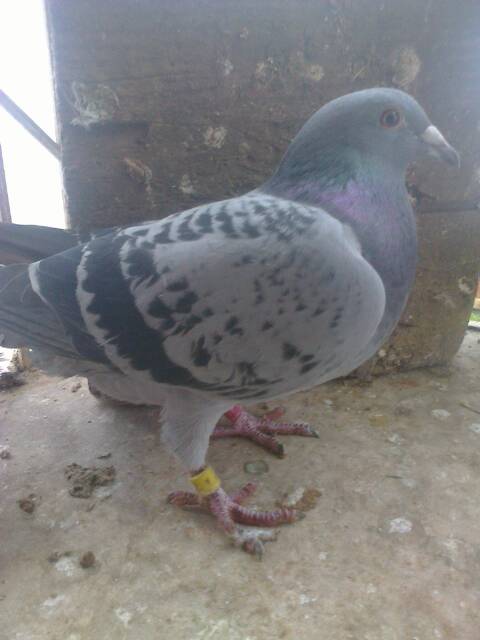
MUSGROVE PERSISTANCE HEN-THREE TIMES BARCELONA INTERNATIONAL EMERTON/HARVEY INBRED LINES OF THE EMERTON KEY BIRDS LIKE BARCELONA DREAM AND DARK ENCHANTMENT-A BIG POWERFUL HEN.
Jim Emerton
MODERN MYTHS OF PIGEON RACING
I believe what I have learned to be true from my own experiences, which may not be the popular conventions of the day. A bird may be versatile at different distances and its racing abilities are brought out by the fancier who races it. Birds are sold as sprint/middle distance and distance, as marketing tools - few will achieve great things in race reality. The truth is that all are individuals like the fanciers who fly them. There is a popular belief that young birds need racing to make good birds later - a few nice tosses up to say 100 miles can do the trick. Some of my best racers have been inbred over generations-good ones may be inbred or outbred - all are different from one another. Selection theories are plentiful, yet it is always the race that proves if you were right or wrong - a good bird performs that way. Birds flown on a type of darkness system may grow into good old birds. I find that tic beans can be a valuable food source in a mixture and pellets once frowned upon are now popular, due to G10S. I find the best way to reality check a belief or myth is to test it out in your own breeding and racing system - what happens will have the ring of personal truth to it. Trends project the idea of the superiority of a particular strain name-the real world tells me that champions are rare from birds of any origin. Wise perhaps to think in a creative and original manner and find out for yourself - you may hit on something new.
Jim Emerton
Focuson Jim
- Details
- Hits: 701