
CHASING THE DREAM
A loft profile on R. J. Goddard & Son of Tilehurst
by Gareth Watkins
Anyone who has studied the results of the BBC, BICC and NFC over the past thirty or so years, cannot have failed to notice the name of R. J. Goddard of Tilehurst , which has appeared with monotonous regularity near the top of the results of any long distance race organised by these prestigious National clubs. The name of R. J. is slightly misleading, as the active fancier is Dave Goddard. However, the name has been maintained in honour of Dave’s late father Raymond Jack. Both Dave’s brothers, Alan and Tony, are pigeon fanciers and have enjoyed a great deal of success over the years. Alan is the breeder and Tony the racer as he has topped the section of the BBC or NFC on four occasions and is also the owner of a Spanish Diploma winner with the BBC. It is Tony who Dave looks to as a yardstick of his success. Both brothers encouraged Dave to concentrate on long distance racing at the start of his pigeon racing career and have been supportive of his ambition throughout.
The racing loft
So it is no surprise that Dave Goddard has been a keen student of long distance pigeon racing since his early teens. As a result, he has travelled extensively throughout the British Isles in his quest to see, handle and obtain some of the best long distance bloodlines from the best long distance lofts in these islands. Many birds have been brought in over the years but very few have met the Goddard “gold standard” which, to say the least, is exacting. Dave’s love affair with one race in particular, Palamos, began in the 1970s and his goal has always been to achieve consistency of results from this near 700 mile race point. I think it can now be safely stated that this goal has been well and truly achieved as Dave’s record of success over the past thirty years from Palamos and Barcelona is second to none. This success has not been achieved without a great deal of hard work and sometimes heart breaking disappointment as anyone who has entered pigeons in these long distance races will be aware. Nevertheless, by relentless, near obsessive attention to detail and the single minded application of a specific breeding and management plan Dave Goddard has achieved the near impossible – consistent performances of the highest calibre from possibly the most difficult race point in the long distance calendar and all this achieved with a small number of pigeons.
The team wintered at the Goddard lofts rarely amounts to more than 40 pigeons in total – that is old birds, young birds and stock birds. The old bird race team usually consists of twelve pairs and these are supported by a small team of eight or so stock birds. These stock birds are mainly retired racers that have raced and usually won, from Palamos or Barcelona on a number of occasions and have therefore earned their right to retirement to the stock loft. Thirty or so young birds are reared annually and Dave does like to take some late breds from the top performers after racing has finished in order to consolidate the gene pool for the future. Very often these late breds are reared from father / daughter, mother / son matings, but always from proven pigeons that have been successful at the distance.
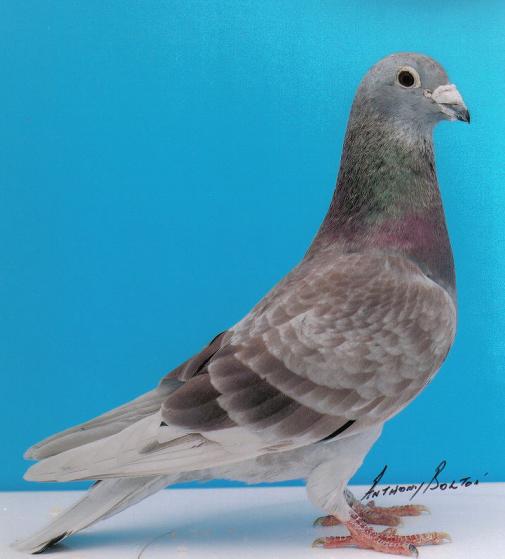
Red Cock "Toe Nails" - 1st section 3rd Open Palamos.
The present loft of pigeons can trace their origins back to birds obtained in the 1960s, 70s and 80s with further introductions over the years from the likes of the late, great Geoff Hunt of Westmarsh in Kent. One of the greatest influences on the foundation of the Goddard team was the base pigeons obtained from Mort Mann of Gloucestershire in the 1960’s. Mort Mann proved to be very reluctant to part with any of his family but after numerous visits he gifted Dave a youngster and subsequently sold him a kit of six babies all of which were to make their mark at Tilehurst. The Mann pigeons were later supplemented with pigeons from the late Tom Clarke of Frampton on Severn. The Tom Clarke family of long distance racers had proved to be phenomenally successful in long distance races over many years for both Mort Mann and Tom Clarke and many other fanciers who were fortunate to obtain the same bloodlines. I never had the pleasure of meeting the great Tom Clarke but those fanciers to whom I have spoken who knew the legend, have had nothing but praise for the ability and integrity of a true giant of the pigeon racing scene.
In later years, pigeons were introduced from Scottish fancier Alex Geddes and these also had an immediate impact on the development of the Goddard family of long distance racers, as did one particular pigeon introduced from Ken Morey of the Isle of Wight. This pigeon, ringed 02252, was to prove outstanding at stock and has had a massive influence on the development of the Goddard family of pigeons. She was bred from 30577 which had won 40th Open Palamos. His sire had also been successful at the distance having won 2nd,16th, 21st & 40th Open Palamos. The grand sire of 30577 on his sire’s side was the winner of 23rd Open NFC Pau and 11th and 50th Open Palamos. The dam of 02252 was also an excellent long distance racer having herself won 38th Open Palamos and 17th Open NFC Pau. So you could say that with such a well bred pigeon steeped in long distance winning performance pigeons both 02252 and Dave Goddard were guaranteed to succeed!
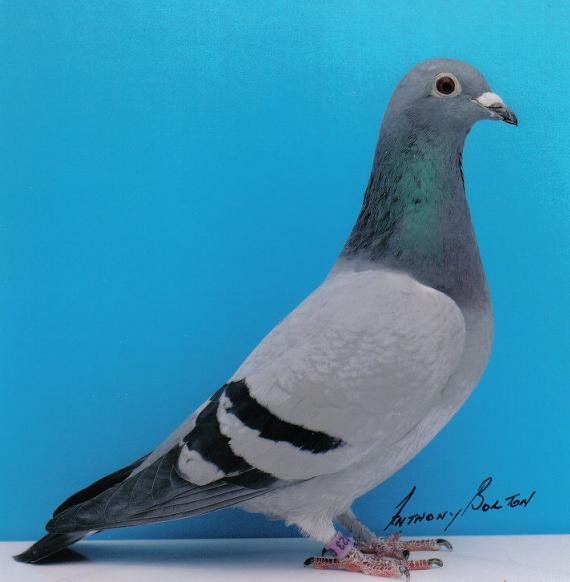
Blue Hen "Rebecca" - 2nd section 3rd Open Palamos.
Dave’s first attempt at Palamos was to take place in 1972 when he entered two of his fledgling team of long distance racers in what was to turn out to be one of the hardest Palamos races on record, won by Cyril Medway’s Palamos Pathfinder. Dave never saw either of his two entries again but remained undaunted – on the contrary he was even more determined than ever to succeed at this “Everest” of long distance races. In 1975 he entered a pigeon that he had purchased from a Dr Meyrick who was retiring from the sport. This hen was selected in the dark by Dave, purely on her handling qualities. When he asked the doctor for her details he was told that she had won 60th Open Palamos. Dave took her home settled her and sent her to Palamos in 1975 to win 15th Open. The hen went on to fly from Palamos again in 1976 but left nothing of note to further the development of Dave’s family.
Three pigeons were later introduced from local fancier Mike Smith who, once again, was retiring from the sport. One of these introductions was to prove to be an excellent long distance racer as she was to win 65th Open Palamos in 1980 followed by 46th Open and 34th Open from the same race point in consecutive years. These performances earned the hen Dave’s first of three Spanish Diplomas awarded to the Goddard loft. Although he was beginning to record regular performances at the distance Dave realised that he was no further forward in developing a team of RELATED pigeons that could be relied on to consistently turn in performances at the distance.
All this was to change when he was taken under the wing of the late Geoff Hunt. Geoff advised Dave to slow down and get a team of pigeons around him and only then move forward. These proved to be words of wisdom, spoken by an ace long distance fancier and with hindsight it would be fair to say that this proved to be a seminal moment in the development of the Goddard family of long distance racers. Not only did Geoff Hunt offer words of wisdom he also supplied Dave with numerous pigeons from his tried and tested family of long distance racers, based in the main on the “old English” strains. In later years Geoff gifted Dave some of his newly acquired Roger Vereeke and Julian Matthys birds and these were to make a significant impact on Dave’s performances at the extreme distance. The main stock cock at the present time, aptly named “Geoff” after his good friend was gifted to him by Geoff Hunt. “R. J.” the mealy cock whose photo accompanies this article is a “Spanish Diploma” winner and he contains the Geoff Hunt Vereeke bloodlines. The red cock “Toe Nails” the dark chequer hen “Sophie” and the blue hen “Rebecca” as well as “R.J” are all closely related as they are all bred down from the Geoff Hunt introductions.
Mealy Cock "R. J." - 26th, 31st, 65th Open Palamos; 14th Open Bordeaux; 210th Open Pau.
As a result of working with the aforementioned bloodlines and applying a carefully thought out breeding programme to successive generations of pigeons that had been tested at the distance Dave Goddard has now most certainly developed a FAMILY of pigeons that rarely fail when put to the test. Below I give you some examples of these successes achieved with an entry of 2,3,5 and at most 11 pigeons .In the past ten years alone, starting in 2000: 1st sect 3rd Open Palamos with a single entry plus 14th Open Bordeaux. All of the performances listed below, unless otherwise stated, have been achieved from Palamos at close on 700 miles.
2001: 8th sect 31st Open 9th sect 34th Open with an entry of just 2 birds. 2002: 14th sect 65th Open sent 4 birds.
2003: 2nd sect 11th Open ;6th sect 26th Open; 21st sect 146th Open with an entry of 4 birds.
2004: 7th sect 20th Open; 11th sect36th Open; 28th sect 159th Open sent four.
2005: 2nd sect 3rd Open; 4th sect 8th Open; 12th sect 121st Open sent five.
2006: 12th Open Bordeaux.
2007: 11th, 17th, 25th & 28th sect; 45th, 57th, 97th, & 120th Open with a further two birds verified from an entry of 11 birds.
2008: 7th sect 24th Open sent 3.
2009: 3rd & 19th sect 12th & 40th Open sent 2.
2010: 3rd sect 8th & 25th Open sent 3.
If you add to this remarkable string of recent results a further 2nd, 5th, 8th, 15th, 34th, 46th and 63rd Open prizes in previous years, plus the performances outlined in the earlier paragraphs, and the winning of THREE Spanish Diplomas and “ The Patron’s Trophy” for clocking the first nominated bird first on three occasions,[ no other fancier has won this trophy more than once], then you have one of the most remarkable records of long distance success of the present day.
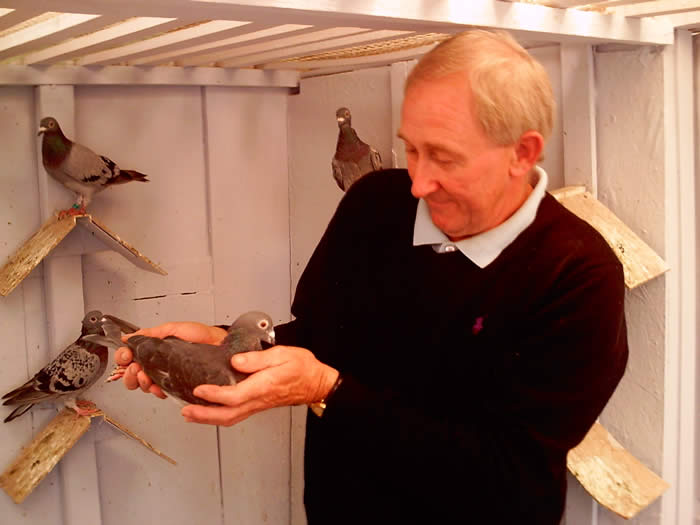
Dave Goddard holding Champion Sophie.
In order to achieve such remarkable consistency of performance in one of the most testing long distance races, there must be a top class management system in place that helps to bring the team into condition at just the right time. To this ends, the birds are mated in mid March and are allowed to rear a round of young birds. The Palamos candidates receive very little work, indeed they do not even go out of the loft until the end of March. Once the days begin to lengthen the racers are then locked out of the loft for a short time both morning and night but rarely fly for more than a few minutes. At the beginning of May they begin their preparation in earnest with a few short 15 mile training spins followed by a few 45 and 60 mile trainers from the south coast of England. Pigeons that have flown from Palamos on previous occasions DO NOT GET ANY FURTHER basket work before being entered in the Palamos race. They do not have any preparatory races prior to being sent to Palamos! The idea is to build them up not wear them out. Birds going to Palamos for the first time may get one, or at the most two, short channel races plus the same preparatory training tosses as “the old hands” before making their first attempt at “Everest”. Yearlings have one or two short channel races and that is the end of their racing for the season. Young birds are rarely, if ever, raced in the year of their birth. The young birds and yearlings regularly make a mess of their limited training education and this does not worry Dave Goddard one iota. In fact he likes them to struggle as he believes they learn a lot more by being AWOL. On occasions during the winter months Dave may basket up the young birds and late breds and take them 60- 70 miles down the motorway for a mid winter tester. Very often they make a complete mess of it and the survivors virtually “walk home”. However Dave has found that the best are better for the experience and learn more from this one toss than they would learn from a hundred simple A to B tosses. Some of the present day champions have been away from the loft for up to a year before finding their bearings and returning home. They have then gone on to achieve great things in their later racing careers. As two year olds the surviving yearlings from the previous season are set up for the Pau National at 550 miles and those that return are then pencilled in for the Palamos team. Three year olds are sometimes sent to Palamos but the general rule at the Goddard loft is that the Palamos candidates are usually four year olds before being set up for their ultimate test. The loft is so designed that certain pairs can be separated and raced celibate at various times during the season. This is so that Dave can get the Palamos candidates into his favoured nest condition, feeding a four day old young bird, at the time of basketting.
Stock loft and aviary
Feeding is a subject that Dave has no strong feelings about. In the early years he used to be an enthusiastic bean feeder, but in recent years has changed to Gerry Plus with the addition of peanuts and brown rice in the final build up to basketting day. The Gerry plus is fed at the rate of one ounce per bird per day and always fed in pots in the nest boxes. Occasionally, Red Band Conditioner is fed to the racers along with a small amount of Hormoform, this being an additional source of fats to energise the racers. After racing and when the moult is complete, the birds are fed 100% Beyers barley until shortly before mating. In January the birds are subjected to their annual jab for Paramyxo and this is followed by a short treatment of Sulphatrim to eradicate any nasties that might be lurking in the gut.
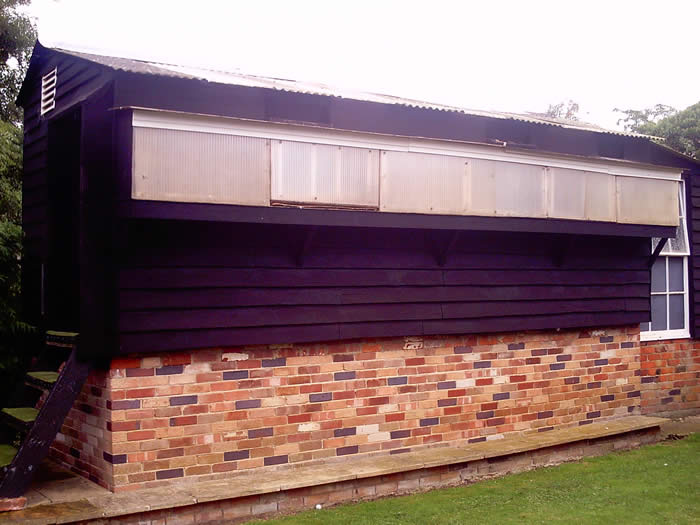
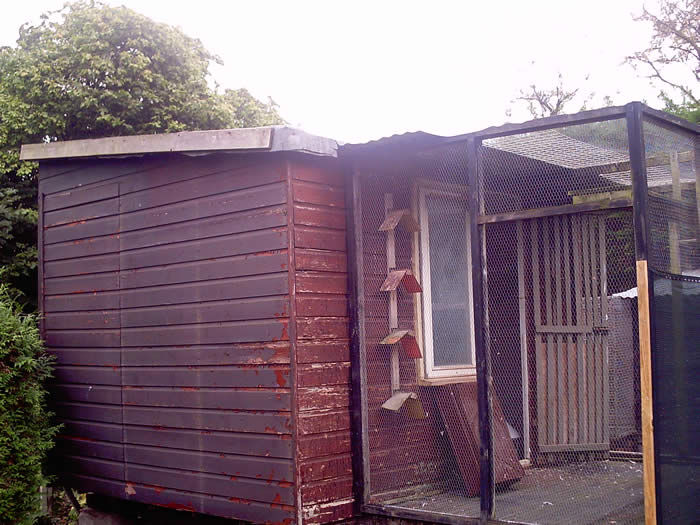
Finally, we come to the loft that is home to these long distance gladiators. This was self built and consists of three sections. One has 16 widowhood style nest boxes. Adjacent to this is a section containing V perches which houses the racing hens at various times of the year and next to this is a section for young birds. The loft is built on a brick base and stands some five feet clear of the ground. The two old bird sections have grid floors and the droppings fall through into the five feet deep pit beneath. This is cleaned regularly and doused with creosote and Jeyes Fluid giving the internal loft space a clean and fresh smell. Perspex sheets have been incorporated into the roof so that the interior of the loft is light and airy. The birds enter and leave the loft via traps set high in the loft front. A small stock loft with aviary attached houses the small team of retired racers that make up the bulk of the stock birds.
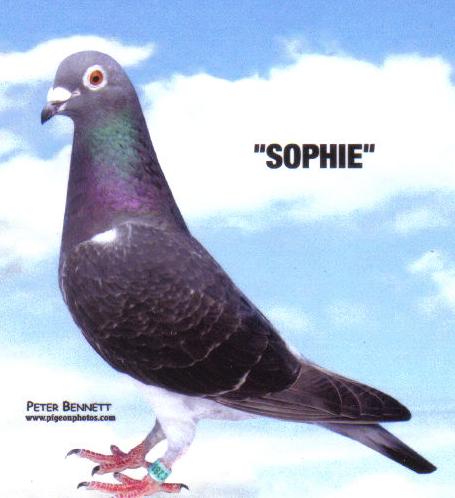
Dark Hen "Sophie" - 24th & 120th Open Palamos; 8th & 12th Open Barcelona.
Before closing this report I think I should describe the type of pigeon developed by Dave Goddard after thirty years of trials and testing his family at 700 miles. At the time of my visit in early September, the old birds were in a heavy moult. However, the quality of the individuals handled stood out. The cocks handled just on medium sized with the hens just a slight bit smaller. Bone structure was excellent and there was not a deep keeled pigeon in sight. The pigeons gave the impression of buoyancy in the hand – just like balsa wood with a core of steel running through the middle. All birds had excellent strong, rich eyes and there wasn’t a “fish eye” to be seen. A variety of colours were present including reds, mealies, chequers, blues and dark velvet chequers. The consistent thread linking all was the fact that they had either done the distance or were bred from birds that had done the distance successfully.
All things being equal I can only see the Goddard team getting better and who knows, perhaps that elusive first Open prize will be his. One thing that I’m sure of is the fact that it won’t bother Dave too much if he doesn’t hit the absolute top spot. Dave Goddard’s only wish is that he remains CONSISTENTLY successful at the extreme distance.
A Loft Profile On R. J. Goddard & Son of Tilehurst
- Details
- Hits: 1648
Related Articles





Continue Reading
Continue Reading: more racing pigeon articles from the Elimar archive