THE NORMAN SOUTHWELL SERIES PART 4...
ON ACHIEVING A LIFETIME’S AMBITION - A LOFT PROFILE ON JOHN McLAREN
BY GARETH WATKINS
“To found a family of pigeons that can win from all distances and stand the test of time by doing so over a long period”. That was John McLaren’s boyhood dream over 50 years ago and it is one that he rightly feels he has achieved. Along the way he became the youngest man ever to win the King’s Cup from Pau in 1967 at 29 years of age, and has won just about everything else that could be won in National and International racing through to Barcelona 670 miles.
This is the next in a series of articles outlining the influence that the pigeons of the late Norman Southwell have had and continue to have up to the present day, on long distance pigeon racing into southern England. I feel it is therefore appropriate, that this follow up article should feature John McLaren as he, more than anyone else, was an integral part of the Southwell set up when Norman Southwell was at the zenith of his racing success. John knew the Southwells as intimately as the master himself as for ten years he was at the loft daily helping with the birds and the management of the farm. A highly intelligent individual, John never forgot anything that he saw or heard and with such a tutor as the “King of Pau” it should not have been too much of a surprise when John McLaren became the youngest ever winner of the Pau Grand National.
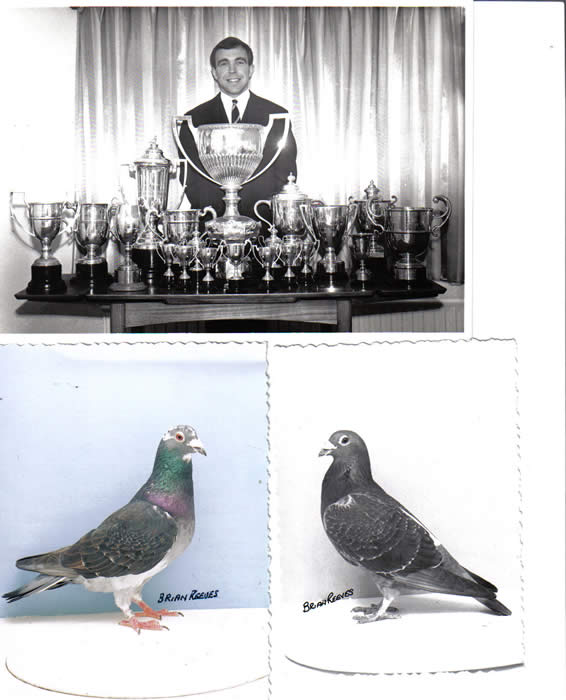
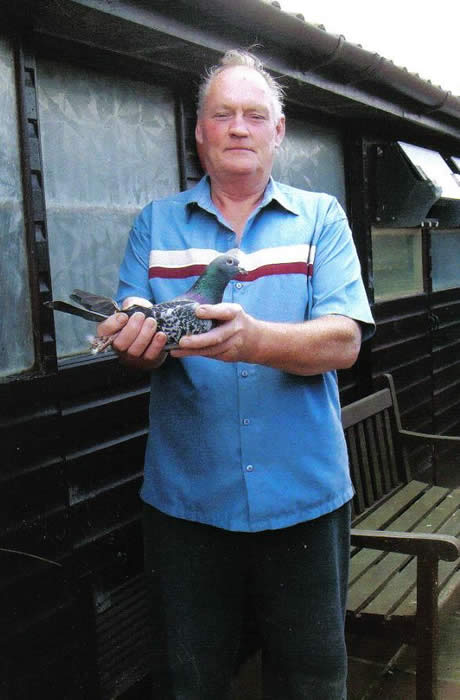
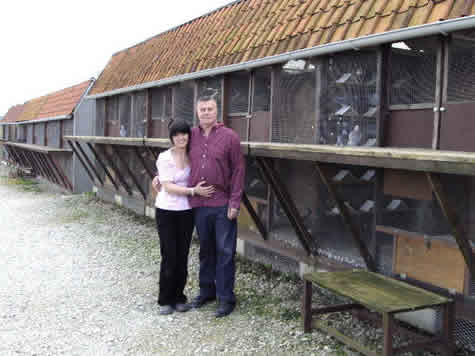
Clockwise: John with trophies won in 1967 including King's Cup, Langstone Gold Cup, Oliver Dix Trophy, Osman Memorial Trophy and RPRA gold medals etc; Palamos Snowcap [Dk Pied Cock], 1st bird into England Palamos 3rd Open BBC, 16th BICC Pau & 24th BICC Pau; No 20 Cock, 28th Open NFC Pau on the day and responsible for many good pigeons. G.Son of Julie.
The McLaren story begins in 1950 when the 13 year old John obtained his first pair of pigeons which he housed in an old tea chest. Not long after this he met Norman Southwell and the rest as they say is history. In exchange for his help with the birds and around the farm the young McLaren was gifted eggs and youngsters from the best birds in the loft. Even though this was arguably the best loft in England at the time, John believed he could improve on them and as a result set about acquiring birds direct from other top performers in National competition. Many were tried and tested but only three introductions stood up to the testing process and were subsequently integrated into the Southwell base. Amongst these was a blue cock bred down from Bert Craddock’s top Lerwick pigeons; a light red chequer cock bred from Moore & Wooton’s Pau pigeons.[This partnership were 1st NFC Pau in 1950 and 8th Open Pau in 1952 to Stoke on Trent]. Lastly a mosaic hen bred direct from Jack Brain’s Lerwick pair. The Jack Brain Spangle family were, and for that matter still are famous for their long distance exploits racing from the Shetlands into Somerset. A little later, in the 1960s, a black cock was obtained as a gift from the successful Up North Combine loft of Gippert & Henry. This cock when crossed with a hen of the McLaren – Southwells produced “Julie”, the 1967 NFC Pau King’s Cup winner. Julie in turn went on to produce generation after generation of top class racers especially when crossed with the Vandenbrouke’s which were introduced in 1968. This family had set the south of England alight with their outstanding results in middle distance races and John obtained the best bred from the original imports, in order to sharpen up his predominantly long distance family, so that he could develop birds to win from 100 – 670 miles.
The above then is the background breeding which makes up the present day McLaren family. Obviously further introductions have been made periodically in the intervening years and these have undergone the same rigorous testing process before being incorporated into the family. Although John obtained his last birds from Norman Southwell in 1958, the dominant Southwell type is still evident as the photographs which accompany this article will demonstrate. To quote John’s views on breeding: “I almost think the only sure way to win races is to have good birds, and a good fancier can make good birds by seeing which pair will go together and preparing the offspring physically, and more importantly, mentally for the task ahead”.
As mentioned earlier, John McLaren is an intelligent individual who is quite prepared to question the accepted views on a variety of pigeon related topics. He possesses a highly innovative mind and has designed various lofts to suit their specific locations. The two essential factors common to all being absolute dryness allied to good ventilation. The loft to which Julie raced to win the Pau Grand National had no conventional loft front and the interior was always semi dark due to the wide landing board that ran along the top of the loft doors. This served two purposes in as much as it allowed the pigeons access through stall traps into the loft interior and also prevented rain from blowing into the loft. This latter function was essential as the loft floor was covered with a deep litter of dried droppings. The dried droppings deep litter system employed at the McLaren loft consisted of 75% droppings and 25% litter made up of sand and rough sawdust. When “working” the litter resembled a grey spongy absorbent carpet with no sign of droppings.
Another example of the McLaren innovative approach to loft design is in the design of perches. To save time cleaning and at the same time ensure that the pigeons are not allowed to stand in their own droppings, perches were built from a 8 inch sloping board to which 2 inch blocks were attached at 12 inch intervals. The birds rested on the two inch blocks and the droppings simply rolled off the board to be absorbed into the working litter beneath. Readers should be aware that John McLaren designed these perches more than 40 years ago, when the norm was the old fashioned box perch, and therefore long before the “modern” lift off style perch was developed. Nowadays, floor grids are employed and the accumulated droppings are removed annually. Successive lofts have been built at various sites and all have incorporated these labour saving designs – the only hard work in the McLaren loft is carried out by the birds. This then leaves John more time to study individual pigeons so that he can get the best out of them when the time arises. At present the pigeons are housed in a converted garage. The old bird team occupy two 8ft x 6ft sections and the young birds one other 8 ft x 6ft section. The whole structure faces south and has windows front and back which can be adjusted to control air flow within the loft. This is the only loft that John possesses as he does not keep stock birds and therefore has no need for a stock loft.
An old bird team, made up mainly of cocks, is now maintained. These are raced on widowhood and the natural system in alternate years, and from the best of these a team of around 40 youngsters are bred annually. John likes to keep the team young and each year he aims to replace 50% of the older birds with young stock. Because losses are minimal John selects out those old bird racers that have started to slow up or have not “fulfilled their racing potential”. As referred to above, no stock birds are kept as all have to earn their keep. Even Julie after her King’s Cup winning performance was put back on the road and flew Pau on two further occasions to two different locations!!
There has been no inland racing by the McLaren team for 40 years. Youngsters, after half a dozen training spins at 10 and 17 miles, are lifted straight into Guernsey 114 miles with 90miles of water to contend with. Sometimes they go to France 160 miles and that satisfies John. The best are then kept to replace old birds. Yearlings now go to Nantes 250 miles but in the past all were sent to La Reole 400+ miles and on many occasions won. In fact John has even sent latebreds to Pau 524 miles as yearlings and clocked them to win National prizes! Two year olds and above go to Nantes 250 miles first toss and then in one or two additional races out to 670 miles. Each racer has a programme mapped out for it a year in advance, however a certain amount of flexibility must be applied to adapt to unforeseen circumstances.
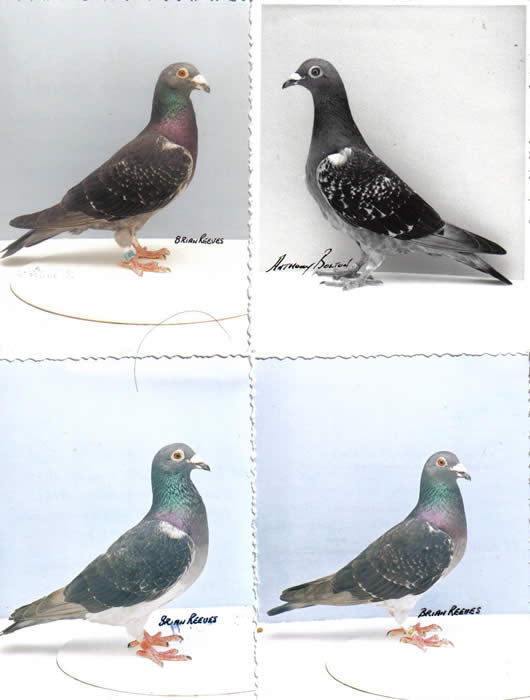
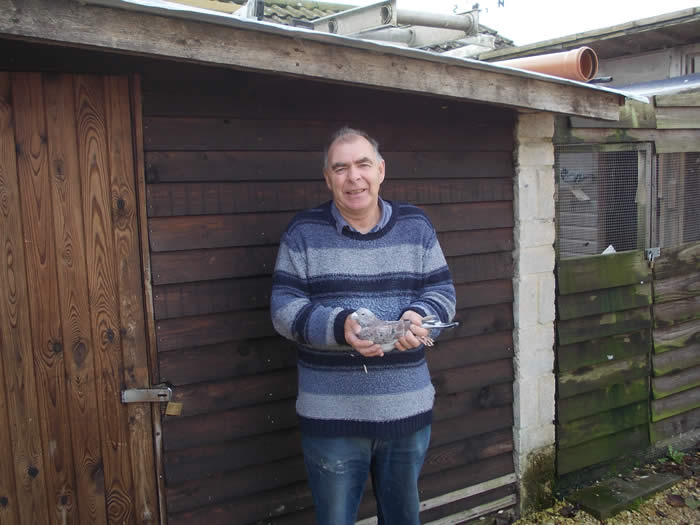
Clockwise: Robert, 3rd BICC Pau, 5th BICC Pau; Julie, King's Cup Winner from Pau 1967; Top 20 Cock, 11th BICC Pau, 19th BICC Barcelona also flown Palamos; De Barcelona, 2nd BICC Barcelona, Pau 3 times and sire of 7th BICC Dax.
Needless to say with such a perfunctory training schedule it is essential that the birds are flying freely around home and are fit to face the tasks set them. Individual pigeons have different needs as witnessed by the treatment of the 1967 Pau team. Prior to going to this race the selected team were forced to fly for one hour each day. One pigeon refused to knuckle down to this regime and spent most of the exercise periods sunning itself in a nearby tree – this was Julie the eventual King’s Cup winner!! Norman Southwell didn’t touch his pigeons for a month before Pau and just look at his results. The reader should however be aware that the “Southwell’s” lend themselves to this type of preparation as they are of small to medium build and do not tend to put on fat. They are in effect lean, mean and raring to go. In the past the team has enjoyed the luxury of an open loft 24 hours a day 365 days a year, however the current upsurge in the sparrowhawk population makes this impossible at the present location. As a result the team are allowed their liberty twice daily under John’s watchful eye and this only between April and September as they are confined to the loft throughout the winter.
Although the McLaren team are tough and full of vigour with an inbred iron hard constitution, any that “go wrong” are treated. As John once wrote, “Several fanciers have told me that they kill any birds that become ill and I tell them that they would have killed some of my best pigeons”. To illustrate this point I give you the example of Julie. After winning her only race as a young bird by 200 ypm from France, Julie contracted coccidiosis and spent several weeks in solitary confinement before being allowed to rejoin her loft mates. She then went on to win her first race as a yearling recording 1700 ypm! All birds therefore are routinely treated for cocci,canker and worms. The latter twice yearly but never when moulting or rearing.
Feeding is another aspect of the sport which many attempt to make into a science but is one which John has always approached with pragmatism. As long as the food is sound and well stored then he is quite happy. Over the years a variety of pellets, mixtures and straight grain feeds have been tried and good National positions have been gained with each. The preferred grain of choice being the humble tic bean. This generally makes up between 25- 50% of the mixture. The remainder being barley when resting, wheat whilst breeding and in the early part of the racing season, and maize when the longer distance races come around. All corn is bought direct from the farm. The birds are always hopper fed with unlimited access to food 24 hours per day 365 days per year. The only restriction being imposed on young birds which have access to the hopper between 9am and 6 pm. This purely to maintain control of the more precocious babies.
Those then are the methods of a master fancier. I do not intend to list here the many wins achieved over almost six decades of unbroken success. Suffice to repeat that John McLaren was the youngest ever winner of the King’s Cup from Pau with the NFC. He is also a past winner of the Langstone Gold Cup awarded for best average velocity all NFC races and twice winner of the best 3 Bird Ave from Pau plus the 2 Birds Ave from Pau all on the day. The name of McLaren has appeared in the top 30 Open positions in the NFC racing pigeons to seven different lofts after seven changes of address. Recent seasons has seen the McLarens competing more regularly on the International scene with placings such as 3rd, 5th & 11th Open Pau; 2nd, 3rd & 20th Open Barcelona; 7th, 12th, 30th, 40th & 41st Open Dax. In addition, McLaren pigeons are winning throughout the British Isles up to National level. The winners of 1st, 2nd & 3rd Open NFC Pau at 520 + miles can trace their origins back to the McLaren loft as can many other winners in the highest class of competition out to 670 miles including 2 x 1st Open from Barcelona.
It has been a pleasure to write this article on a fancier who, many years ago, opened my eyes and mind to the simple basic principles of loft management and the incredible achievements possible in pigeon racing when these are applied to top class pigeons. I first read John McLaren’s article published in the BHW Year Book of 1968 following his 1st NFC Pau win of 1967. Whenever I begin to get wrapped up in sophisticated theories I still reach for this article to obtain a dose of good old fashioned common sense. The article was a ground breaker at the time as it debunked many of the myths surrounding pigeon racing. It is no less relevant today.
Sadly an era of British long distance pigeon racing came to an end on Sunday 29th July 2007 when the McLaren loft was dispersed due to John's long standing health problems. The McLarens have won wherever they have gone for the past 50 years I see no need for this deeply inbred trait to stop now. The lucky purchasers will have inherited a lifetime's work of a master pigeon fancier.