ON ACHIEVING THE GRAND SLAM
A loft report on Geoff & Catherine Cooper
1st Open BICC, 1st International Bordeaux 22,029 birds
by Gareth Watkins
The Grand slam! This is exactly what Geoff and Catherine Cooper achieved in June 2011 when they clocked their Dark Chequer cock to win 1st Open BICC and 1st Open International Bordeaux / Agen from a total field of 22,029 pigeons entered by the best fanciers in Europe. The partners had previously won 1st Open in BICC races and the King’s Cup with the NFC when they won 1st Open Tarbes a few years back. Add to these wins at National level, scores of Club, Federation and Combine wins then the winning of 1st Open in an International race completes a terrific record of wins at all levels of competition within the sport – thus the title of this article THE GRAND SLAM.
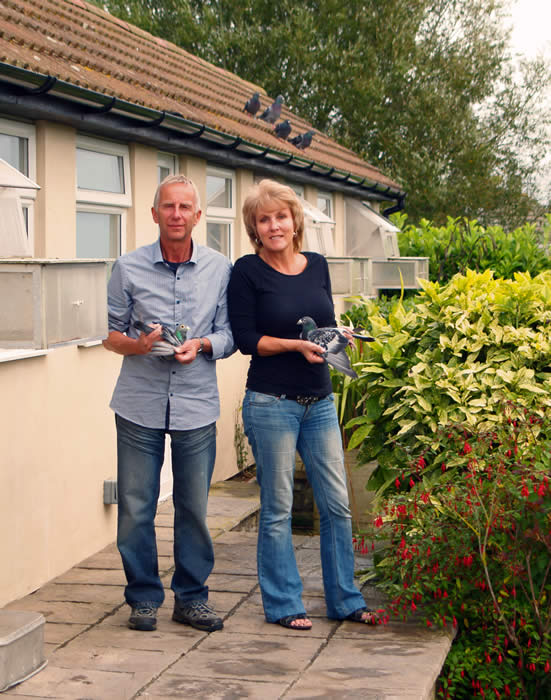
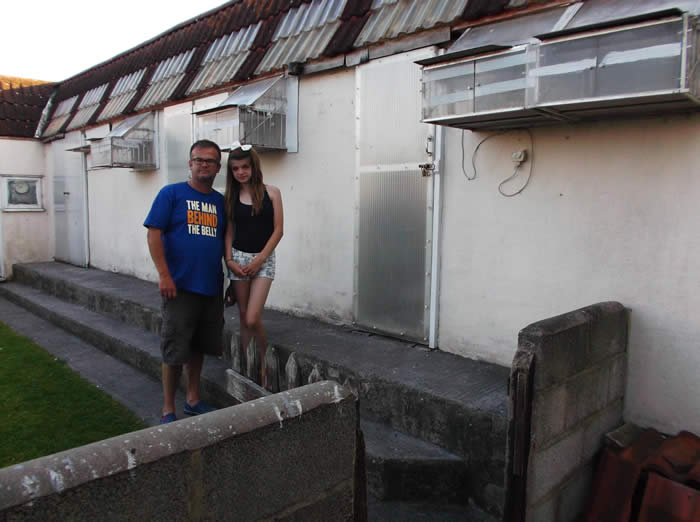
Catherine & Geoff
I first met Geoff some 24 years ago when he was flying a highly successful team of pigeons to his then home at High Littleton a few miles from Geoff and Catherine’s present home at Peasedown St John. At that time, the late 1980s, Geoff had a superb team of widowhood cocks bred around imports from Andre Vermote and Emiel Deweerdt & Sons. On the first and many subsequent visits I made to High Littleton, I handled all the loft’s big winners - pigeons such as “John”, “Silver”, “Stumpy”, “Bernard”, “Little” and the incomparable “Bulldog” – one of the finest pigeons I have ever handled and with performances at National level to match.
The lofts at that time were built into the stone outhouses at the rear of Geoff’s home and business premises and a deep litter of dry droppings was employed in all lofts. Since those days, a move has been made to Peasedown St John and a brand new purpose built breeze block loft built to accommodate the race birds and stock team. Despite the move and the change in home environment the winning of races at the highest level has continued without a hiccup.
That covers a little of the background to the present success story but what of the man himself?
Geoff is now retired from his butcher's business and had from an early age a love of birds, having pet jackdaws, owls and kestrels as a boy. He started in the sport at the young age of 13 when he used to clock his uncle's racers on their return on a Saturday. That’s when the racing bug really bit deep. Geoff’s first major influence was therefore his uncle, who, although he never enjoyed much success, “did the deed” and introduced Geoff to the sport of racing pigeons. Another fancier from the West of England who had a major influence on not only Geoff, but also many other fanciers in the area, was the great Reg Venner from Street. Reg and his wife Myrtle raced their team of birds with great success on both the north routes through to Lerwick at more than 600 miles as well as the south road through to Pau. However, probably the greatest influence on Geoff’s development as a fancier was Emiel Deweerdt from Kortemark in Belgium. Geoff first visited the Deweerdt lofts in the early 1980s and was impressed both with the birds and just as importantly the man himself. On subsequent visits to Kortemark, Emiel and Geoff spent many evenings together talking about racing the birds and he told Geoff that the secret to racing pigeons was that there is no secret. There were certain “do's and don'ts” but no secrets. Even now Geoff still races his birds to the same principles as Emiel recommended all those years ago.
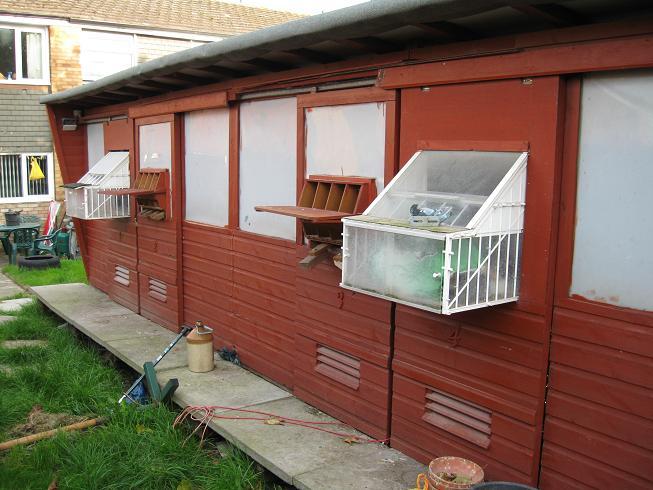
Home to 1st International
Geoff’s first loft was a far cry from the present purpose built loft. It had an open front and was raised a couple of feet off the ground. There was honeysuckle planted at the front of the loft and as the honeysuckle grew and covered the loft front Geoff noticed that the birds’ performances improved. He let it cover more of the front of the loft and Geoff realised that the protection from the draughts was why his birds were performing better. It wasn't long before he had the front of the loft completely covered so no air could blow directly in onto the birds. This was in the late sixties, so in all probability he had one of the first closed in lofts in the West of England. The stone built lofts at High Littleton were also designed on the same lines with minimal ventilation and the birds raced out of their skins.
The first birds raced were a mixture of top local birds, Fred Channing of Bristol and Reg and Myrtle Venner from Street. These formed the base of a successful family which won 2nd BBC National Palamos and 6th BBC National Palamos at 701 miles. Geoff raced the birds on the natural system in the 1970s, turning to widowhood in the early 1980s when he raced so successfully to High Littleton.

THE MOVE TO PEASEDOWN ST JOHN
Geoff has raced with his wife Catherine at his present location since 1994. The present loft is a block built structure, 32 m long and 2.5 m wide. This houses 60 widowhood boxes in four sections. The two young bird sections are fitted with 140 perches - 70 in each section. There is also a section for racing 18 hens plus a stock section with aviary attached. The loft faces due south so attracts the full benefits from whatever sun there may be in the West of England. All sections have hardwood grid floors which have loft granules underneath and this is replaced as needed. The boxes and perches are cleaned every day and the corridor running along the front of the internal sections is also vacuumed daily.
THE RACING SYSTEM
This year Geoff and Catherine have the biggest team of race birds they have ever had as they are racing 18 hens on widowhood as well as 50 cocks. They rear a large young bird team each season, as they like to race as many of the inland races as possible with the young cocks whilst the young hens go to as many channel races as they can manage if fit and well.
All the old birds, both cocks and hens, are raced on widowhood, the cocks racing to their hens and the hens racing to their cocks. Geoff doesn't like racing roundabout as on too many occasions the birds can return and find an empty box. He doesn’t have many hard and fast rules but one of them is that when the birds are raced widowhood, their mate must always be waiting for them in their box when they return.
The young birds are raced on the sliding door system, whereby the cocks and hens exercise and live separated in adjoining compartments during the week and then run together on basketting day. When they return from a race they can spend the race day and night together before being separated once again until the following basketting day.
The birds are paired any time between the beginning of December and the end of January. However, this year Geoff and Catherine were invited to Australia to give a talk at the Adelaide Convention, and this was over the New Year, so none of the birds were paired until their return in the middle of January.
Whenever the birds are mated they are all mated at the same time both stock and racers. The cocks rear one round of young birds as do the racing hens. All the hens are removed from the cocks section before they lay a second round of eggs and the cocks then finish rearing the young birds by themselves.
At this time all the birds, cocks and hens are exercised separately, once a day. Once the young are reared and the cocks are on their own they are on widowhood, exercised twice a day for an hour, as are the hens. If the birds are reluctant to exercise Geoff will put up a flag for the hour. All the birds are used to this routine as the young birds are flagged during the young bird season, so it is all part of the daily routine for them.
Prior to old bird racing the cocks will have two or three trainings tosses up to 25 miles, with five days minimum between each toss. Once racing starts, no more basket training takes place.
YOUNG BIRDS
The young birds have between eight and twelve training tosses prior to the young bird season and then no training once racing starts. The only exception is if they are going to a race from a different direction, then instead of going to a race the week before they will have a training toss on line for the next race. The young hens have every inland club race until the National and Classic channel races start and are entered in as many channel races as possible if they are fit and well. The young cocks normally race the inland club programme, occasionally having a channel race. This is because Geoff has found that the hens usually mature faster then the cocks. All young bird are raced on the darkness system, and Geoff has used this system with great success every year since 1994.The youngsters are separated as soon as they show signs of pairing and are then raced on a sliding door system, as outlined earlier.
FEEDING
All the birds are hopper fed and the stock birds have food in front of them at all the times. The race birds have 40grms [just under 1 ½ ounces] per day of Verse Laga widowhood mix, more if they need it. This is fed in two meals, morning and evening after exercise. Geoff always adds 5% barley to the mix - if they eat all the barley they are hungry and he feeds a little more, if they leave the barley they have had enough. Before each National (channel) race the fat content is increased for the last seven feeds prior to basketing.
MEDICATION AND THE USE OF SUPPLEMENTS
Geoff does not routinely treat for canker, worms or cocci, he only ever treats if there is a problem. He always vaccinates for paramyxo at the start of the year and does not like to see the misuse of antibiotics as bacteria soon become resistant to antibiotics if they are misused. Geoff controls problems like worms with good hygiene in the loft. Once you break the cycle the birds do not become re- infected. Nevertheless, he always keeps medication in the cupboard because problems can and do arise during the racing season and must be dealt with immediately if the season is not to be disrupted.
Supplements are used in the form of natural oils [ground nut and oregano], plus hemp, peanuts and the usual grit and minerals. No vitamins are fed, as the Versele Laga corn mixtures have all the vitamins the birds require. If Geoff could only use one supplement it would be natural oils, usually bought at the supermarket.
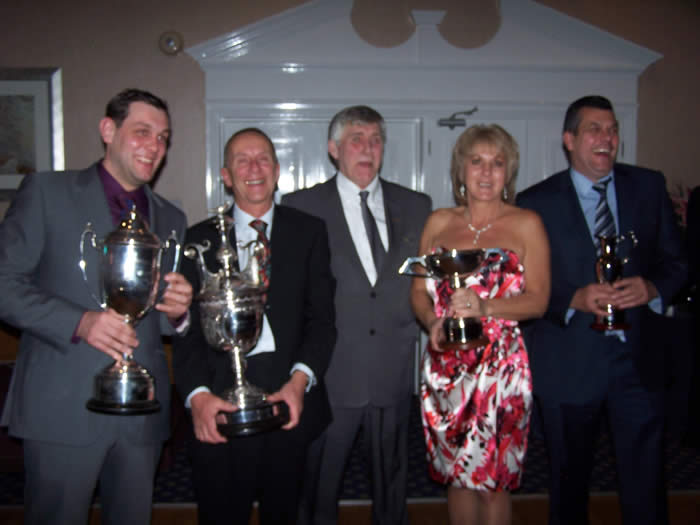
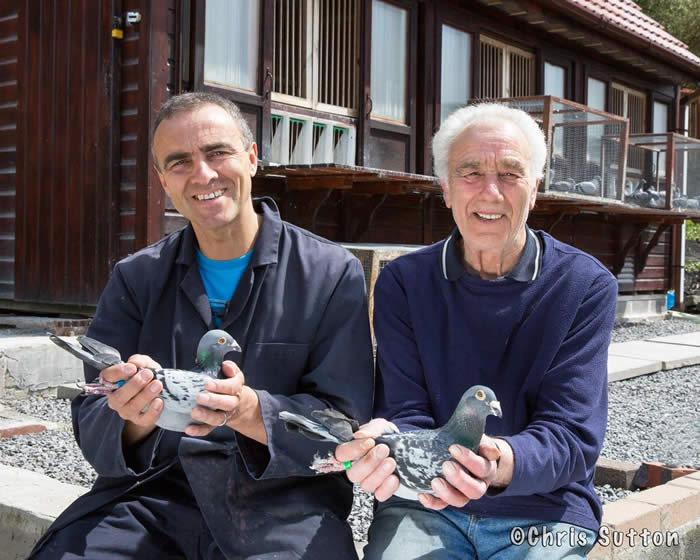
Three International race winners at the BICC Prize Dinner - Bullen & Son, G & C Cooper and Mark Gilbert
BLOODLINES HOUSED
The main bloodlines housed can now be termed the “Cooper” family. These are largely based on the Deweerdts from Kortemark, Belgium. As mentioned in the opening paragraphs, Geoff first visited Emiel Deweerdt in the early 1980s and purchased children of his top racers. Many more visits were made to the Deweerdt family over the following twenty years and Geoff introduced more children from the top performers. The children of these introductions were tested and the best racers were then retired to stock and from these the “Cooper” family has developed and grown in strength. Geoff gifted birds to Gordon Harding of Harding Bros who won the Pau Grand National with the progeny of these gift birds. He then had children back from these successful racers to pair to his own stock birds, thus increasing the strength of the stock loft. This has proved an excellent method for keeping the good bloodlines prominent within the loft.
Over the last thirty years many other birds have been introduced to try as a cross. If any of the young birds from these introductions prove good enough, they are then paired back to the original Cooper family. Not many have past the test but one notable exception was the fast flying Serge Van Elsacker birds. This pairing bred “Day Break” who scored four times from Pau 560 miles, winning a coveted National Flying Club Merit award. A Van Elsacker hen bred and raced successfully by Geoff was gifted to his very good friend and fellow International winner, Mark Gilbert, and bred Mark his 1st International Dax winner “Southfield Supreme”. Interestingly, the sire of “Southfield Supreme” was a brother to the sire of “Day Break”.
Geoff's ideal pigeon is a light handling bird with long flights and good feather quality, anything else, size, shape, the back, is irrelevant. He has seen too many winning pigeons of all shapes and sizes to look for just one ideal shape.
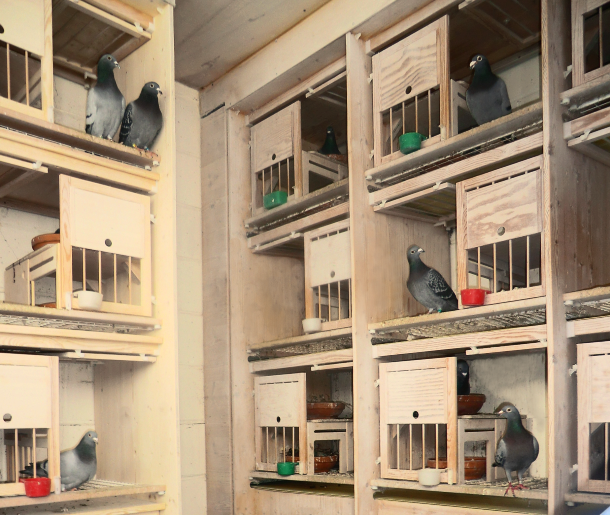
Breeding loft
SOME WINNING PIGEONS
The Cooper family have bred birds to win from 45 miles through to 649 miles. Geoff and Catherine were 86th International from Perpignan with a seven year old widowhood cock called “Flipper”. Some of the founding birds were:-
“Bulldog”, 1st National section G Pau, 18th Nantes National plus many other prizes.
“John” twice 6th Nantes National, 2nd Nantes National and 12th Pau National.
“August”, who was 5th Nantes National, 1st Plymouth etc.
The above three birds were the foundation birds of the current Cooper family. Other super racers included :-
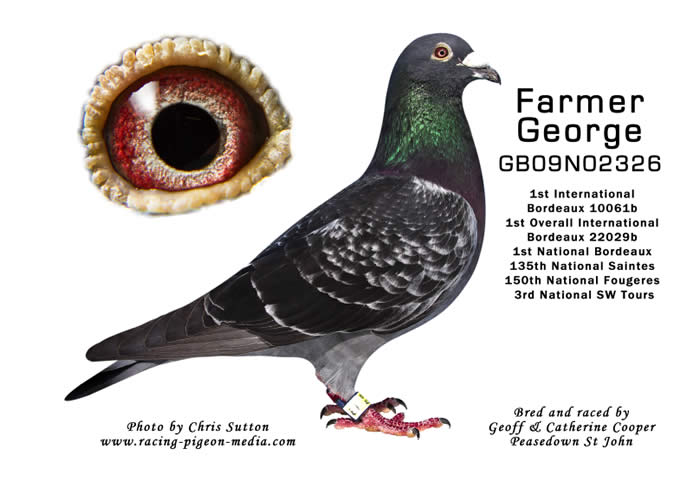
“Farm Boy” 12 th International Dax 3rd National Dax, 475th International Dax and 3rd National Dax. He is the sire of “Farmer George” who won 1st International Bordeaux OB by over an hour against 10,061 birds and fastest of 22,029 birds by 45 minutes.
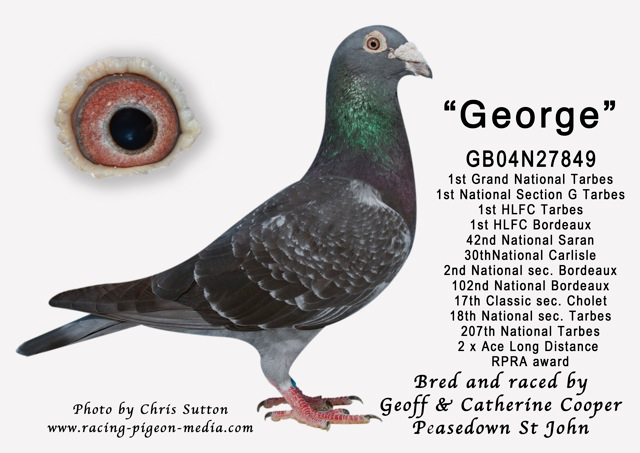
Another super star is “George” who won 1st Grand National Tarbes and is responsible for many top pigeons including breeding three individual birds to win 1st International Bordeaux, 2nd International Bordeaux yearlings for Mark Gilbert and 1st National Section Fougeres.
At the moment Geoff and Catherine have some children of Hans Brockamp's “George”, “Euro Diamond” and “Marseille 09”. These will be bred from and their progeny put to the test. Any that survive will be retained and integrated into the “Coopers”. So far Geoff is very pleased with the introductions as one young hen called “Wollongong” was 4th National Tours, 1st Exeter, 10th National Section G Fougeres, 1st HLFC Tours. “Wollongong's” sire is a Brockamp of Euro Diamond lines and her Dam is a half sister to “George”, Geoff’s winner of 1st Grand National Tarbes.
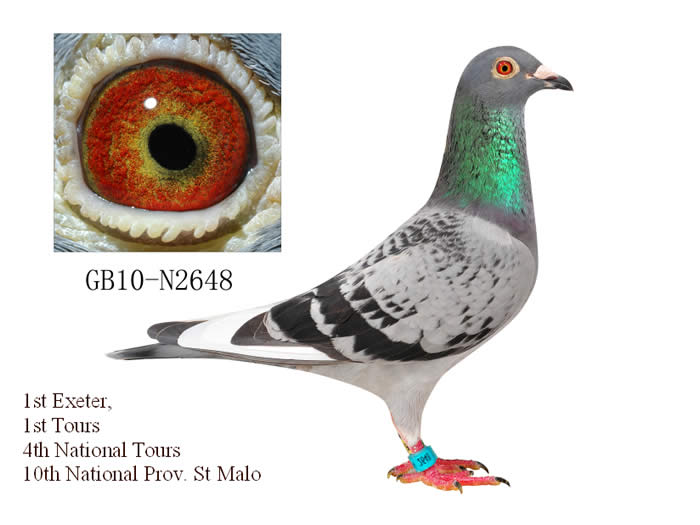
Wollongong
PERFORMANCES
In the last ten years Geoff and Catherine have won 1st International, 2nd International, 12th International, 475th International - PLUS 4 x 1st Nationals, 2 x 3rd National and over 35 FIRSTS SECTION in National and Classic races.
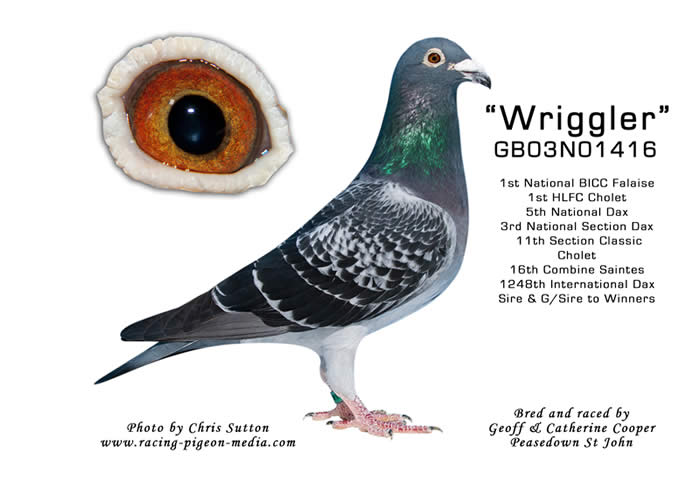
“Farmer George”, winner of 1st International Bordeaux. was bred “in the purple” as his sire was “Farm Boy”, who won 12th International Dax, 475th International Dax plus 2 x 3rd National Dax, and his dam was a daughter of “George”, the winner of 1st Grand National Tarbes.
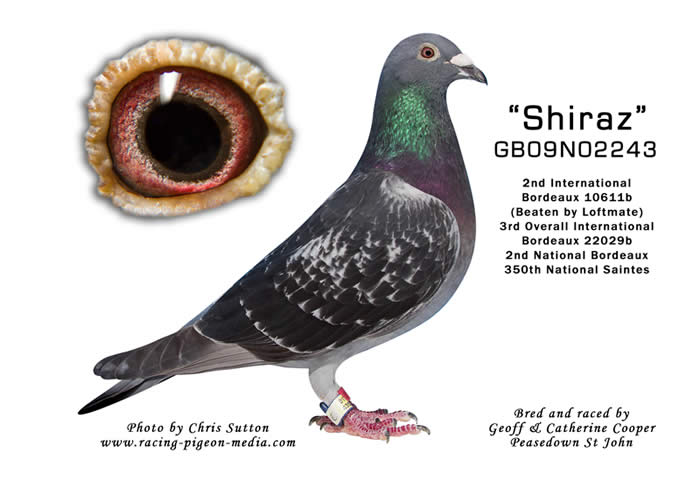
The sire of “Shiraz” the winner of 2nd International Bordeaux , was “PD”, who was twice placed 2nd in the section of National races.
It is always a hard decision to retire a good racer but most of Geoff and Catherine's top race birds have been bred from retired top racers or daughters of these top birds.
THOUGHTS ON THE FUTURE OF THE SPORT
Many fanciers are leaving the sport for a variety of reasons and are not being replaced by new ones. Geoff feels many of these problems could quite easily be addressed. He often hears fanciers complain about clubs voting to exclude good flyers, yet they forget they are only as good as the fanciers they fly against. Back biting is also causing fanciers to give up, as many are disillusioned by the lack of sportsmanship. Add to this family break ups and fanciers having to relocate then the numbers leaving the sport grow each year. Although Geoff does not take part in One loft Races, he feels they are a good way of getting the general public interested, especially now several schools are getting involved.
Geoff and Catherine are looking forward to racing more of the International races in the coming season, and their main aim is to win another International in 2012. They were pleased to see more fanciers have joined the BICC taking up the challenge of International racing. With three first International wins in 2011, Geoff believes that British fanciers have proved they are as good as any in Europe and if more were to take part in these premier races many more wins would be possible.
They would also like to wish every one a good season for 2012. Who knows, the next winner of an International race could be you. One thing is certain though – you have to be in it to win it so join the BICC the home of International pigeon racing in the U.K.
It only leaves me to wish Geoff and Catherine the very best of luck for the 2012 racing season. Geoff was winning top prizes long before I first met him in 1988 and I’m sure he will continue to excel well into the future – his mantra being “Keep it simple”.