Lancashire Social Circle
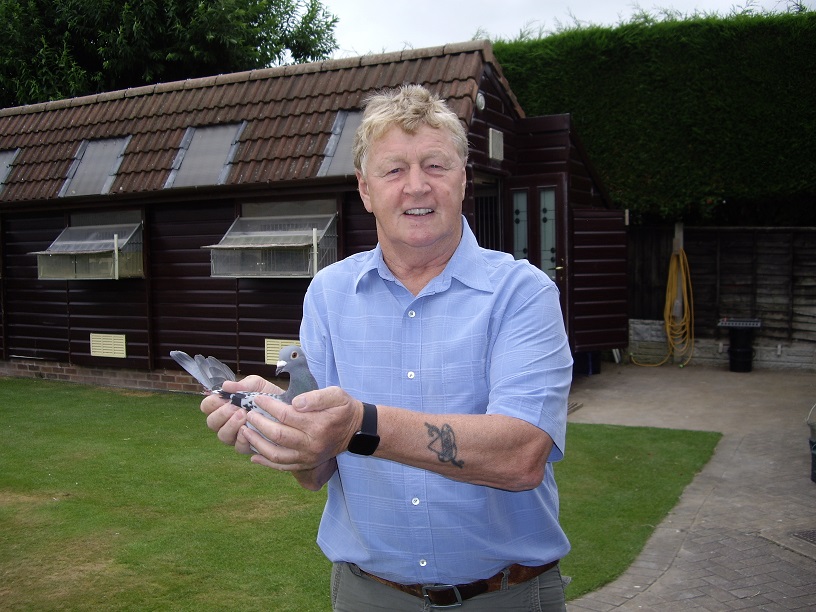
It is a real pleasure, to put together a report on one of the Lancashire Social Circle's Honorary Life Vice Presidents, George Hilson. George has been an ultra-successful pigeon fancier for several decades with his winning team of long distance pigeons. There are very few in his area of Lancashire who have won as much as he has, be it at Club, Fed or Combine level. George's winning performances don't stop there he has been a strong competitor right up the National level, with some very strong performances in section L and several top open positions in Specialist Club racing, but more of these throughout the article.
George was born in Edinburgh, Scotland one of 12 children, 7 brothers and 4 sisters. From the age of around 12 young George had pigeons of the fancy type, a year or two later his interest grew into the completive side practised in Scotland with Horseman pigeons. This is a special type of pigeon based around Pouters thief pigeons. According to George many people kept these in their homes in a small box in the bedrooms and would be brought out and placed on the windowsill and the sash cord window closed to hold the box firm. The idea is to capture somebody else's pigeon, both cocks and hens are used to attract other Pouters back. The dooman, the name given to pigeon fanciers in Scotland, then nets the attracted bird and it is legitimately his, and can be sold on. This hobby could be described as pigeon kidnapping.
In George's early working life he was an apprentice joiner but with a misunderstanding with the owners son and other job prospects somewhat limited he moved over the border to England. George brought a small team of his Horseman thief pigeons with him but found the game was not practiced in England. It was while working he was introduced to a racing pigeon fancier called Sammy Robinson and it's from this meeting in 1970 that George got involved with racing pigeons. A year earlier in 1969 George married Maureen known to all as Mo and set up home in Parker Street, with a small loft in the back yard. 1972 he joined Bury FC and won his first race to his Parker Street address even though members of his club told him he had no chance of success flying to that location.
George flew some good pigeons over the next few years learning from his mistakes and gaining knowledge how to race successfully in the Channel races. He set about obtaining top class Channel pigeons from Eric Rae, who had the best of the KO Nipius pigeons from Ken Kippax, Eric was a very close friend of Ken and Marjorie and used to look after their pigeons when they went away on holiday. Eric kept around 12 widowhood cocks and all were multiple first prize winners. With a policy of severely testing each generation of pigeons in the races these great pigeons were bred for, soon paid dividends. George was driven to see just how good his performances could be, with every passing year, the birds we're getting better and better alongside the management of them. He decided to join the National and test his family with the big boys having won dozens of firsts federations along with a number of top prizes in the Eccles Two Bird Clubs. Following some great performances from over the water and with a strong friendship with his neighbour Roy Barber a partnership was formed in 1992. Roy Barber had for many years been one of the best fanciers in the area sprinting his team of Busschaert and Stichelbaut widowhood cocks, taking the top four places in the Fed almost every week. The way these widowhood cocks would fall out of the sky from a race was unbelievable when you consider his loft location at the rear of his house that was surrounded by very tall trees. The two of them joined forces and formed what was to become a formidable team, everyone in the area knew they would be successful as both are master pigeon men. George would be up early to have the birds out before going to work, and Roy would be there in the afternoons to have the YBs out and basket the OBs ready for training a couple of times a week. The decision to enter the open races held just before the start of the OB season saw them clean up all the top prizes giving them a healthy bank balance to race the pigeons for the rest of the season. These open races were open to all Lancashire, and over a 3 year period they won all 14 of them. As time passed these races were discontinued from the racing calendar as most of the money if not all going to the partnership of Barber & Hilson.
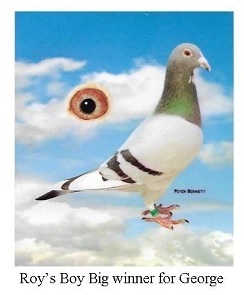
Around this time The Lancashire Combine was the number one racing origination for members who wished to race their pigeons from the French race points with almost all Lancashire Federations being members of the Combine. As the Combine only organised and ran races from France the birdage at the time ran into the thousands, so to win one of these four OB races as you can imagine was very difficult, and anyone achieving it was well respected all over Lancashire. The annual prize presentation was the highlight for many fanciers and their wife's who enjoyed a fabulous night of entertainment when these magnificent silver trophies were presented by many top local fanciers over the years.
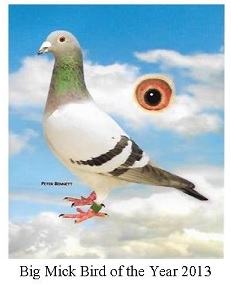
Over the next few years some top pigeons were introduced to strengthen the team from Geoff Kirkland's Alfons Bauwens national winning family, along with 5 late breds from Gordon Rigg from his Delbar based pigeons, these were blended together with the original KO Nipius pigeons formed a great all round family. It was around this period the partnership moved up another gear and National racing came to the fore alongside Specialist Club racing. The North West Grand National was just one such racing origination that saw the partnership dominate the results, the NWGN has been won a total of 14 times with some great team performances over the years having several pigeons figuring high on the result. To prove this the results of just one pigeon racing with the NWGN a pigeon called "Big Mick" won 1st Open Fougeres, 7th Open Messac, 20th Open Carentan, 22nd Open Messac, 20th Open Carentan, 6th Open Messac, 10th Open Falaise, 43rd Open Fougeres 18th Open Fougeres and 5th Open Messac. Many of these races were won with their team of sprint pigeons fed for the shorter channel races with their feed adjusted for the time on the wing. Clubs like Eccles Two Bird Club, Lancashire & Yorkshire Four Bird Championship Club and Lancashire Social Circle have all seen George take the top honours on several occasions. In the early days of Eccles Two Bird the pigeons were transported by Gloucester Fed and the pigeons had to make their own way from that part of the country on their own making it a true two bird race. George has won Eccles 12 times from several race points from over the channel with some top pigeons not counting many other top places in this two bird club. With the National Flying Club even more remarkable performances have been achieved, having won 7x1st Section L and numerous top open places, and I think I am right in saying no other fancier flying this far into Section L has won more. The Lancashire Social Circle trophies, most have George Hilson's name engraved on them, some many times over, which is remarkable, since he first became a member in 1991. Over the years he has won a grand total of 78 diplomas, and when you consider only 6 diploma are presented in any one race and one member can only take one prize from the Circles 3 OB races and the 1 YB race alongside the exchange races. Goes to prove just how good a flyer he really is. Finally if these results were not enough in the Bamford Gold Ring Race George has won a staggering amount of money over the years totalling around £13,000.

Saintes was a race point George loved and his team performed tremendously year after year from this 550 mile race point winning him a string of cards with the NFC. He recalled to me with some great emotion how he would wait for his fantastic team of 550 milers late into the evening, when on many occasions he would have a fellow fancier with him, who had commented, "you will be luckily to see one tonight". But George's faith always paid off, timing one or more on most occasions on the day of liberation, with pigeons flying up to 14 hours on the wing. In most of the Saintes races his total entry would be around six pigeons, but remembers once entering a very large team when he had a strong team of winners that were getting a little older. Having clocked a good number on the day had his T3 clock reset for the following day. Returning a little later than hoped the following morning to find a flock awaiting to get in, he timed them all filling the clock and later had a phone call from a good fancier remarking those turned up well the following day having them all on the result. A number of his winning 550 mile winning day pigeons have been tried at the 700 mile race points but in George's words, he has thrown away many good 550 mile pigeons, trying to clock them in at 700 miles. Many a good long distance day pigeon has been ruined in the quest to time a 700 miler. What he found was the 550 mile pigeons that did not make it on the day could be sent to the 700 mile race points and many of these have made the result. His feeling is a good 550 mile pigeon flying from a greater distance will often follow the light up country and end up in the sea never to be seen again. Another reason for this, is the decision to liberate at mid-day and make it a two day race and the following season go for an early lib forcing the pigeons to night out has been the ruin of many good distance pigeons into Lancashire. This is not to say he has not had some success for these greater distance races, George was the talking point of every fancier in Lancashire when he timed his good hen on the day from Bordeaux flying 600 miles. This good distance hen was bred by George from a great pair of stock pigeons presented to him by Gordon Rigg from Congleton. She was 1st section L NFC her full sister was also 1st section L and another from this pair was also a 2nd section L winner, as I said a great stock pair. The system used for these fine performances was they would have 2 or 3 inland races starting at the 130 mile mark raced on the roundabout before going to one or sometimes two Channel races. 20 days before the big one they would be paired up and sent sitting 10/12 day eggs. In 2008 another great performance was achieved with the NFC when he timed on the day from Tarbes flying 724 miles with a Alfons Bauwens cock from a Friday liberation. When I asked George about the fine performance he played it down by saying I only got the one on the day his mate came early next morning from my two entries, but there was south in the wind.
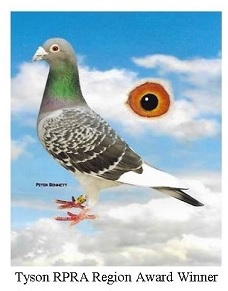
I would like to touch on a couple of the performances of individual pigeons as no one wants to read pages of results which this partnership can offer, so I have just picked two. "Bailey's Choice" won 4th Combine Picauville as a YB, then one race only as a yearling winning 1st Lanc's-York's Club Falaise. As a 2y old 1st Lancashire Nantes Club Sartilly, 1st Eccles 2-Bird Vaines, 1st Eccles 2-Bird Fougeres, then in her final season racing as a 3y old before going to stock won 1st Lancashire Nantes 2-Bird Cholet and 7th NWGN Falaise. "Tyson" RPRA Region Award Winner won 1st Lanc's-York's Saintes and 3rd Sec L NFC Saintes, 7th Lanc's-York's Messac picking up 20th Section with the National, 11th L/Y 53rd Sec L NFC. 4th L/Y 6th Eccles, 24th Sec 316th Open NFC Saintes. 5th L/Y, 4th Eccles, 29th Sec 337th Open Poitiers. 5th Sec 62nd Open Cholet NFC, 1st L/Y, 2nd Eccles, 3rd Sec 78th Open Saintes NFC, 67th Sec 548th Open Messac NFC.
George would like to stress that he likes to keep his whole system as simple as possible and the workload to a minimum, as racing pigeons successfully can turn into a full time job. Alongside good pigeons George is of the firm belief feeding plays a very big part racing a successful team of racing pigeons, and to this end his feeding system is as follows. He breaks them down over the weekend even if the birds have not been to a race and for this he uses his own depurative mix which consists of approximately 50% farm barley 30% farm wheat 10% linseed and 10% rapeseed. Over the weekend he will also add multivitamins to the water for two days, believing that this helps to take out the toxins from the birds' system before he starts to build them up. The sprint team build up would start depending on the distance of the weekend race from Wednesday onwards with the race mixture. The distance pigeons would start their build up from Monday, the mixture used for this was originally mixed by George based on heavy carbohydrates but later got his corn merchant to mix it for him and later still used Beyers, the extreme distance birds he added a handful of farm beans for extra protein. At the backend of the year George feeds a large percentage of farm beans as he feels the birds need protein when moulting. This feeding system is also used for the young birds but he likes to have about 10% Bos Pellets from Bamfords in the young bird mixture, and should he experience any YB sickness he would isolate any bird or birds and feed them on 100% Bos Pellets, which makes them drink more, flushing out their system and has the bonus that should they vomit any food, there is nothing there for the other birds to pick up, which helps to stop the spread of the disease from one bird to another. The build up for the youngsters with the carbohydrate mix again was depending on the distance to be flown, there is no point feeding them for a 200 mile race when the race is only from 100 miles and the time on the wing alongside the weather on the race day would also be taken into consideration.
To achieve these great results the pigeons that were to win the open races were paired on Boxing Day and got ready for these early sprint races. Once these were no longer on the cards the sprint pigeons were paired a month later for the start of the early club races. The middle distance birds were mated the end of January with the distance pigeons at the end of February early March. In their heyday the partnership were ahead of their time using the sprint family of birds to fly up to 400 miles, these quicker flying pigeons were fed to cover that distance in double quick time. As it was found that these pigeons would do over 40mph all day long and the partnership would have a string of pigeons in the clock from these 400 mile race points when many fanciers failed to clock. Many fanciers these days used these type of pigeons for the short Channel races as the time on the wing is the governing factor and not the distance flown, but at the time these two lads were ahead of their time.
As with all good stockmen a keen eye was kept on the health of the pigeons and before the start of the breeding season while the birds were fed on a depurative mixture they were treated with a 4 in 1 for a week. After rearing the race team would be treated for canker and George was very conscious of the fact that respiratory problems greatly affected the performance of the pigeons. To this end a week or so before racing he would treat for this and with keen observation watching how the birds exercised if needed they might be treated again in the racing season. How the pigeons exercised on a daily basis was observed and by Thursday this would determine how well the race would go on the Saturday. Old bird would be vaccinated for Paramyxo well before the breeding season while the youngsters received their jab when they were weaned and went into the young bird loft. A darkness system was practiced with these babies and once taken off the system the lights were on to maintain the length of daylight until the end of the young bird season. The partnership of Barber & Hilson was known all over the country with the many fantastic performances they achieved. But it had always been Roy's idea to call it a day with the pigeons once he got to retirement age, and this came a little sooner than both had expected when Roy was offered early retirement, and after talking this over with his wife Rita decided to take the company up on their offer. At the time the race team were housed at the allotment a short walk away from both their homes while the stock pigeons were kept in Roy's garden in his old racing loft. When the decision was finalised to break up the very successful partnership, a sale was arranged with all the stock pigeons going up for sale, this freed Roy of the task of looking after the stock team and he could enjoy his retirement with the proceeds of the sale. Many of these stock pigeons have gone on to produce scores of winners for their new owners, with many fanciers coming back over a period of time to purchase more of these fabulous distance pigeons.
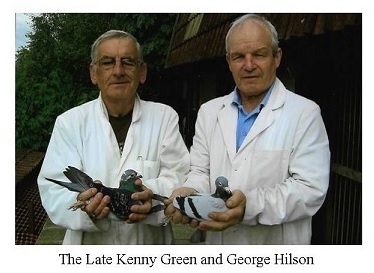
Having had a partner for a good number of years the workload was getting to much for George who at the time was still working. One thing that he missed was coming home from work and all the pigeons basketed for training which George would take, while Roy would clean out, refresh the drinkers and record the trainers home. What he needed was help and this came in the form of a new partner Kenny Green not a great pigeon man but he would help carry some of the workload that Roy did, basketing birds and cleaning out. this worked well at the start and performances were still keeping up until Kenny's health took a turn for the worst and sadly Kenny passed away. Around this time George was now at the point of retirement himself so with a slight change in management things moved on OK for a while. George Kept his team of both stock and racing pigeons on the allotment a short distance from his home, the new stock birds being some choice retiried racers. The 40ft racing loft was built by George before the partnership with Roy Barber has 4 sections, one for sprint pigeons, one for middle distance birds and two for the longer distance race birds, George needed more of these as he wouldn't send them week after week. The loft was built on a staging that makes the set up a double-decker with the pigeons housed on the top level with food store and brew room underneath with all mod cons including TV and fridge. A number of widowhood hens are also housed here with several handpicked young hens that have flown the Channel with the nationals. These are given a year off and used as widow hens before being reintroduced into the race team as two year olds with eight out of ten going on to win major prizes repaying him for his patience. A second 40ft loft that housed the stock birds and youngsters was opposite the racing loft. George, when racing kept a large team of racers but as reported dose race with a number of clubs from over the Channel. His race team at the start of the season consists of 60 widowhood cocks and 40 hens flown on a roundabout system. Unlike some fanciers he will never send a bird over the Channel two weeks in succession. He insists on giving them at least one week at home between Channel races. The young bird team numbers 100 give or take a few and George is always on the lookout for any bird that fall sick or is not up to the standard required. He starts to motivate the youngsters once the big races come along, when he removes the V perches and replaces them with nest boxes from the old bird section, which fit perfectly as both sections are exactly the same. These V perches were all attached to a boards that would be hung on the walls, but not before clear plastic was pinned to the walls making sure when changing these about the walls of the loft were kept clean. Once on V perches the old birds can get on with the moult and the youngsters would then be encouraged to take a nestbox. George likes to send a good team of youngsters over the Channel with the National and come the end of the YB season will retain several good young hens although not always the ones that have won all the prizes. Even so, he will consider the breeding, and these will be used as widow hens the following year. These hens are kept in boxes with wire bottoms and newspaper under for easy cleaning. They receive plenty of grit and water and will be fed once per day, as two year olds these hens will be raced on the roundabout system. He feels following a trying young bird racing season the year off dose them good, and his racing results prove this system is working for him.
Times changed when in 2016 George's wife Mo was diagnosed with cancer, this hit George like a hammer, and following many very happy years of marriage, where like most married couples each takes on certain roles within the relationship. A decision was made to greatly reduce his team to a more manageable number in order to look after Mo. Sadly within only weeks, Mo had passed away and life at the Hilson household would change forever. George had always worked hard to provide for his family and raced his pigeons. Mo had taken care of the house and everything that goes with that along with their son Darren. Following Mo's passing George suffered his own health problems over a period of two years, and then their daughter Kim also had several spells in hospital with her own health issues, with all this going on, meant the pigeons had to take a backseat. Darren has proved a rock these last few years with the management of the birds, numbers have been reduced over this period to help make life a little easier. But with Covid and self isolation affecting many of us including George, has not helped to encourage or motivate any racing these last three years.
With a very much reduced team, George has no intention to competing in the racing for the foreseeable future and is now concentrating on the breeding of winners for his many friends within the sport. As a Honorary Life Member of the Circle he will always have a seat on the top table at our twice yearly Gatherings. The sport has lost not only a great competitor but a fancier who is well respected as an administrator having been President of several racing organisations. George has always been a working official who has never been afraid to get involved with clock setting and checking and more recently with the ETS system. His commitment to the NFC meant he sat on the Management Committee representing section L for many years, where his opinion was always well respected. As President of the Lancashire Combine it was he who encouraged the Combine to present Gold, Silver and Bronze Medals to the winners of every race. The Lancashire Social Circle are also very much in his debt not only as a Committee man but for the many hundreds of photos he has taken at the Gatherings for well over 20 years, that have made my job as a scribe so much easier. As they say a photo is worth a thousand words. The programme of events at each of the Circle functions contain copies of these photos that go a long way to help retain the history of the LSC, all members are pleased even though not racing George will still be in our company for many years to come.
Brian Dearn Tel. 01254 772515.