NORTH ROAD CHAMPIONSHIP CLUB
by George Wheatman
JASON BUCKLE of Stowmarket

Jason Buckle of Stowmarket and his three children, Harvey, Kezia and Rosie
Take a close look at the results of major pigeon races and, beyond the adulation of the winner and its owner, you can often spot a special bird that deserves its moment in the limelight.
Analysis of the North Road Championship Club’s two longest races, from Lerwick and Thurso, will, to the observant with the ability to remember a ring number, throw up such an outstanding pigeon although these two races, on June 22nd and July 12th, tell only two-thirds of the story because there was another club race squeezed in between to enhance the performances.
Tucked safely in its loft and enjoying a well-deserved rest in the charming Suffolk town of Stowmarket is a two-year-old chequer cock bird that many would judge the best performer in NRCC races this summer. Among the 19,000 residents, there is no-one happier or more satisfied than the owner, Jason Buckle.
So let me tell you the story of an outstanding pigeon and a very happy owner.
Jason is a 39-year-old sub-contract roofer, a tough job. He is married to Rachel and they have three lovely young children, Harvey (10), Kezia (8) and Rosie (2). Another tough job providing for, and helping bring up, a family.
For many, there would be no time for a hobby. But Jason manages to squeeze in time for the pigeons he has loved almost since birth. He was born into the sport for his dad, Ray, was and still is a pigeon fancier.
Jason grew up with pigeons and started on his own at the age of 16 in 1991, winning two early young bird races and then experiencing good times and disappointing times, just like all fanciers whatever they might tell you. Days of the doldrums were, however, banished this summer.
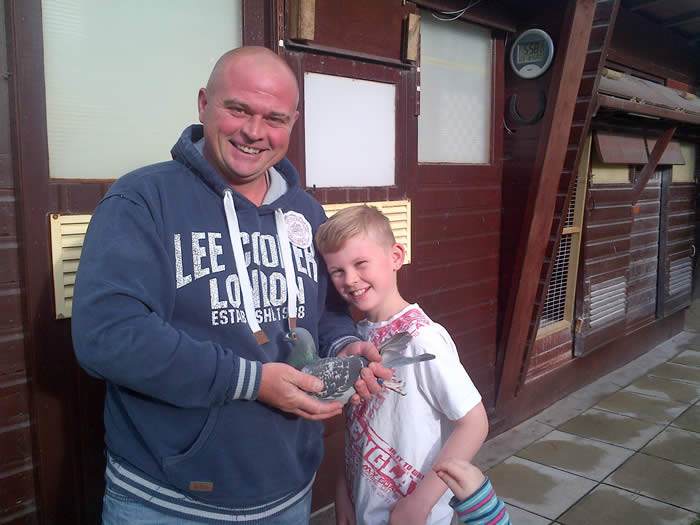
Jason and Harvey
The pigeon that brought such delight, a two-year-old blue chequer, made an inauspicious start to its racing career and, in many lofts, would not have survived. He had one race as a young bird, and then was lost as a yearling from a 100-mile race from Laceby, returning at the end of the season, ring still intact and obviously having been living rough.
By the time the first NRCC race of the season came around, Berwick on May 10th, it had had only three races in his life. He negotiated Berwick safely, as he did the NRCC Perth race two weeks later. Neither race was easy.
He missed the Arbroath race and was sent to the “big one” Lerwick. And he did very well, finishing 21st Section Eight, 180th open on a velocity of 1165 yards per minute, a flying time of 14 hours 27 seconds for the 556 miles.
That was it for the season or at least that was Jason’s plan, well satisfied as he was by the performance. There had been a holdover, and this race was on a Sunday.
There was a 274-mile club race with Saxon Valley from Berwick scheduled for the following weekend, with basketing on Thursday. No thought of sending this bird again so quickly until it began to “talk” to Jason.
“He came home from Lerwick in very good condition, and then blossomed until he was in better condition than he had been when I sent him to Lerwick,” said Jason. “So I sent him to Berwick, even then wondering whether I had done the right thing.”
Result? Second club, second Federation on a velocity of 1331ypm compared to the winner’s 1341.
Phew! Lucky to get away with two races covering a total of 830 miles inside such a short space of time.
Definitely, that was it for the season for this bird, and Jason continued his preparations for the NRCC Thurso race where he planned to send a team of six. The Lerwick cock was not one of them!
But his hen had laid the night before he went to Berwick, and he would be sitting 12 days at basketing for Thurso, the same time as he had been sitting prior to the Lerwick race . . . the stirring of possibilities in Jason’s mind?
And one of the hens earmarked for Thurso really did not look up to the task . . .
“I kept looking at him,” said Jason. “His condition was immense. I was a little bit worried about the two races he had already had, but everything about him was amazing.”
Outcome was that the doubtful hen was dropped from the team, and the chequer cock bird was brought in as a substitute a match-winning substitute as it turned out.
It was a hard race, was Thurso, but this outstanding pigeon made it over the 476 miles to the loft of J Buckle and Son in a flying time of 14 hours 16 minutes and 16 seconds to record a velocity of 979ypm and take 1st Section Eight and a highly commendable 10th open, being the longest flying bird at this stage of the results. Total distance flown in these three races: 1,306 miles.
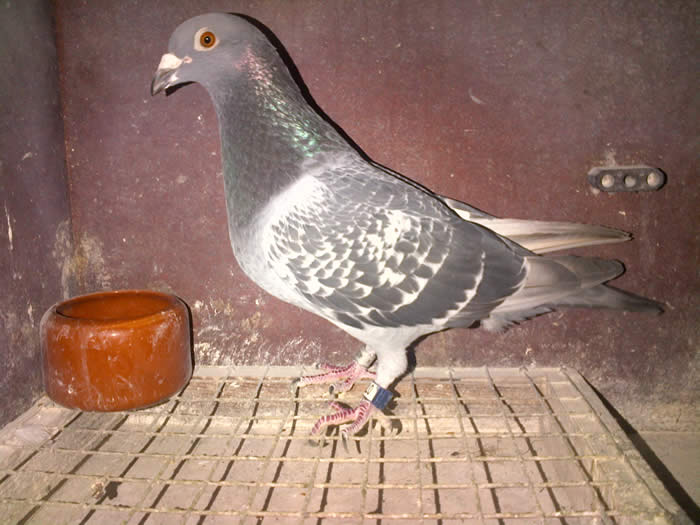
The star bird in the Buckle loft
Because of a work call-out, Jason missed the arrival of his Thurso pigeon. Thank goodness for ETS!
“Someone said I was a hard taskmaster, but this is something I would not normally do,” said Jason. “It makes you feel so humble that a pigeon will do that for you. I think it is an incredible performance, and it has given me such a boost. He was in such good condition, and this is what dictated my decision.
“Having done that, I don’t know what his future will be. I know I shall be careful with him next year.”
Jason comes from a category of fancier where it is not easy to stay in the sport the young family man.
“It is hard and stressful, at times, and life is full on,” he said. “There can be no routine with the birds some times it is a seven-mile training toss, if that is all the time I have, sometimes it can be 20 miles.
“Jobwise, you have to do the work as and when it is there, and you cannot always leave a job at a set time. You get home and you are straight out of the house again to take one of the kids somewhere.
“Rachel is very supportive, but sometimes she thinks I put the pigeons first, which I try not to, but she does need help with the children. Luckily they are all interested in the pigeons. Harvey is the son part of the partnership; perhaps I should include all the family. Little Rosie is my shadow. I will be in the loft and suddenly the door slides open, and there is this little smiling face . . .
“Another thing is the cost of the hobby on top of bringing up a family. There is not much going into the pension pot at the moment. Sometimes I have thought of giving up the sport, but I do love the pigeons and the performances of this bird have been tremendously rewarding.”
Father of the bird is a Flor Engels and the mother a De Klak Janssen.
When he first started on his own, Jason became friends with Tommy Hawes, a top fancier from Kings Lynn, and obtained some Houben-Kirkpatrick birds from him. He won his first two young bird races, but then found that it was not always so easy.
The friendship with Tommy endured, and when another respected fancier, John Pratt, entered partnership with Tommy he, too, became a good friend.
“I have been lucky to have these two fanciers as good friends, and the Flor Engels came from them. The De Klak side of the pedigree came from a good friend in Cornwall. I am very grateful to these friends and for the pigeons I have had from them,” he said.
Jason flies the widowhood system early in the season but he thinks the birds become a bit jaded after a few weeks, so he pairs them up for the longer race, and sitting 12 days seemed to the ideal position for the new star of the loft.
Incidentally, Jason sent six to Thurso and had five home by the end of the second day, a team performance of which many fanciers would have been proud for that particular race.
When he is able, and when he is present around home, he likes his pigeons have the freedom of an open loft.
Jason recalls that, when he first started in the sport on his own, he had a little red Janssen hen which he sent to Sleaford but which did not come back until the season was over, and it had been living rough. Every time she was sent to Sleaford after that, she won and that is one of the reasons why he is prepared to give pigeons a second chance.
Jason says he feels lucky to compete in such a good club where there is friendly banter, as well as keen competition. He also enjoys the good-natured rivalry in competing against his father Ray and brother Dean, who fly a good pigeon as Buckle and Carter only about 500 yards up the road from where Jason lives. They were 11th and 12th section from Lerwick.
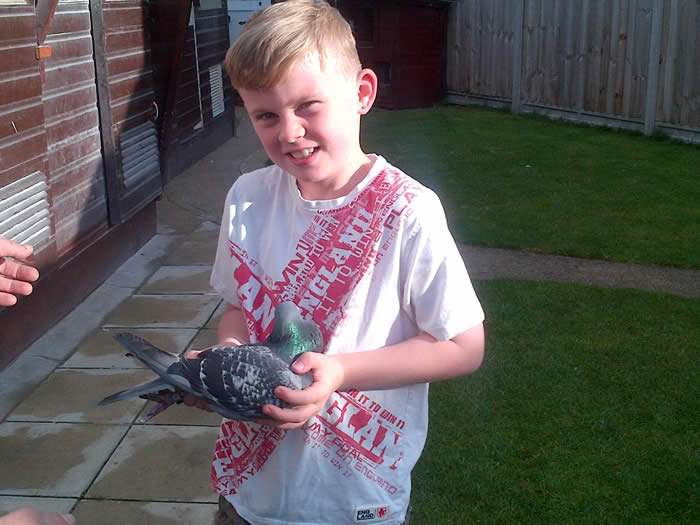
Young Harvey
He only flies north road and looks to concentrate on NRCC racing as much as possible, being the clock officer for Stowmarket.
Jason feeds his birds the same mixture all the year round, and it is one devised and mixed by himself. Basically it consists of Bucktons breed and wean and Titmus breeding mix, and a Diet mix, with straights added, including Dari, Budgie mix, linseed and other small seeds. He is not too keen on beans and peas.
Another good, well respected, pigeon fancier friend is Lee Fuller, along with his daughter Jodie.
Lee is a good listener when things are not going well and, says Jason, always has the ability to put things into perspective. They also swap a couple of pigeons each year.
“I am very grateful to Lee,” said Jason. “He is a good friend, and a valuable help when things are not going right.”
He is also pleased that the children are interested in the birds, although Harvey is now becoming a keen footballer, playing for a Sunday morning boys team.
Rachel, I guess, is like many wives of pigeon fanciers who think their husbands think more of the pigeons than they do of them. But, honestly Rachel, Jason says he is grateful for your tolerance and support. The photographs will show what lovely children make up the family.
Jason says that he likes to keep a variety of pigeons and not put all his eggs into one basket, so to speak.
But, right now, there is one two-year-old blue chequer cock bird that has a special place in his heart.
---