“Superstars Christmas Paper Panel” – Part A
During the early part of the lockdown I sent out a series of questions to fanciers to form a Paper Panel which went down well, the only complaint I had was that “It finished too soon”. With that in mind I decided to follow up with another set of questions for this Christmas Special. This one you can leisurely read of the Christmas break with a drink of your choice on the little table by the side of your chair.
1.Please list your 5 top racing performances since you started racing pigeons, and what is it about those performances that lead you to class them as your best. Is there anything you have not achieved in pigeon racing that you would like to do in the future, is there any particular reason why.
Gordon Bros & Son’s Gary & Niall.
Over the years we have won around 40 x 1st Combines and in recent times we have started to have a little bit more of a dabble in the NIPA. I guess we would list the following as our “best” 5 performances. A. This YB season we took the top 25 positions in the NIPA race from Tullamore (119 miles). That was 277 members sending 6.528 birds. B. In 2019 we took the first 10 positions in the NIPA race from Roscrea (139 miles) and had 29 birds in the top 32 of the Open. That was 271 members sending 4,810 birds. C. In 2018 with the NIPA from Tullamore (119 miles) we had 19 birds in the top 20 of the Open. That was 645 members sending 19,146 birds. D. 1st NIPA from Tullamore against 22,129 birds. There were 832 members competing and we had 32 birds’ home in the top 40 of the Open against 22,129 birds. E. For the last one it has been tough to choose but we will go with a 2019 performance in the EDC from Fermoy (189 miles). In this race 127 members sent 2,573 birds. In this race we had 15 together but only 14 scanned through the ETS to take the first 14 places in the Combine. They were over 90 seconds clear of the Combine that day. The reason we chose this performance over some others is because we have been tinkering with our system to try and get as many of our birds’ home all together as fast as we can. At 100 miles we know what we are doing – but this was 15 together at 189 miles which demonstrates to us that the methods and logic that we are following seem to be getting the desired results. In the future we certainly want to get better at what we are good at. There is no doubt about that. That is what we are good at and that is what we will try to perfect going forwards. There is always the question about “France” and we’ll be trying to fly into France in 2021 with some pigeons that were bred by Mark Gilbert. It will be a big ask for yearlings, but we think if you are good enough, you are old enough.
Les Green

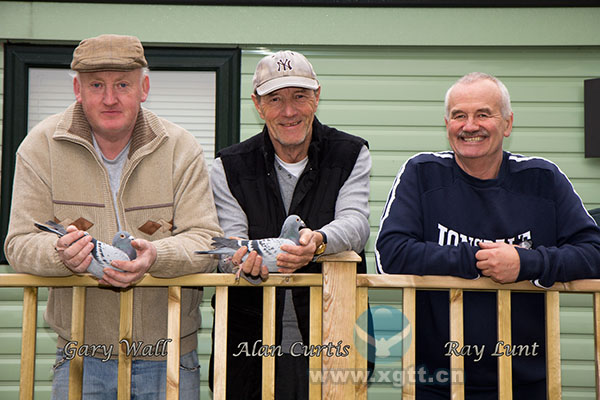
It is difficult to list my best 5 performances, I will try to tell you of the best 5 and why. I was for many years partners with Garry Wall and Ray Lunt and together as Wall Lunt & Green/Curtis Wall & Lunt we achieved many great results of which I was very proud and I think it would be wrong of me not to include some of our performances together as well as others I have achieved on my own since we split the partnership. I race in the Central Lancs Combine, which is one of the biggest combines in the North West and it is always a great feeling to top this combine as it is extremely competitive. I fly in 2 feds, namely Alrtincham federation and Atherton federation. Both are affiliated to the Central Lancashire Combine and Atherton fed is also part of the West Pennine Amalgamation. I have been fortunate to win 1st prizes many times in all of them but the few that really stand out are as follows. Hullavington May 11th 2019, I sent 24 to each fed, it was a strong NW wind with some heavy downpours on route. I got 7 birds drop together to win 1-2-3-4 in both feds and 1-2-4-5 in the combine against 4.509 birds. I am only allowed to have 4 birds on a combine result. One of the reasons why this result stands out is because I really need east in the wind to win it where I live and so to win it that wind on the day and to have so many come on top of each other really was a good performance from the team. Another super result for me was from Frome on the 18th May 2019, I sent 24 to each fed again and this week the wind was North East, it was going to be a harder race than the week before and all the top fanciers in the combine had sent so the pressure was on. Although east winds suite me better, it also suites other good fanciers who are actually west of me. That day I got 6 together and I was locked up in 18 minutes, all home. The first 6 were well in front of the combine and I won 1-2-3-4 in each fed again and 1-2-3-4 in the combine against 4.168 birds, if I was allowed all the birds on the result my first 22 birds home would have been in the first 23 of the combine and I would have won the first 14 positions, what made this race really stand out was the fact that no other fancier timed them in like I did, my rivals all had big gaps in their timings and some only had 4 home after 20 minutes, that was true of almost every other member that day, my team put up an unbelievable performance. As well as those performances other similar results stand out when I would have won the first 14 against 4.409 in a west wind, first 6 in an east wind etc. When I was partners with Garry and Ray we once sent 13 to a race from Portland in the 3 counties combine racing against the best of Manchester, Cheshire and Preston areas, a massive radius really, we won the first 10 positions that day and our 10 were well in front of the next member. The wind was West North West and the distance was 200 miles. The mighty Lancashire combine were also up with us that day and we beat their winner by a clear 4 minutes. To get so far in front of over 3000 birds was a great and memorable result. We also won the NW Grand National a few times and in one race we dominated the result with around 18 in the first 22 including winning it. But if I had to pick one thing that gives me the most pride whilst racing on my own it would be winning the RPRA NW region sprint award 3 years running and in that time also winning the National RPRA sprint award twice. Winning the National award is a first for me, as we never won it whilst we flew in partnership.
Andy Miller
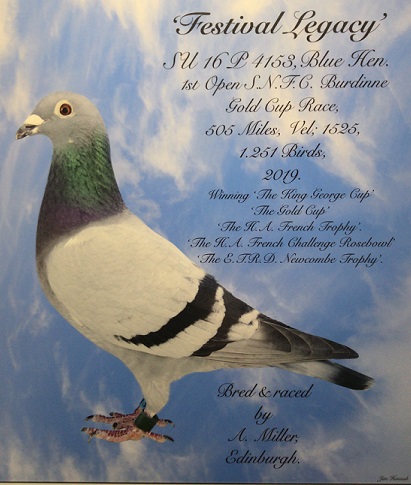
My ultimate performance has to be winning the SNFC Blue Riband race Kings Cup & Gold Cup from Burdinne 505 miles, and winning 3rd, 12th & 32nd Open in the same race, followed by Winning 1st Open SNFC Ypres 434 miles, followed by 2nd Open SNFC Blue Riband race Kings Cup Reims 556 miles. I was also 2nd Open SNFC Roye the same year as I won the Kings Cup from Burdinne. Another 2nd Open SNFC from Ypres in 2013 was extremely pleasing too, as each time I was 2nd Open they were all Section Winners.
John & David Staddon
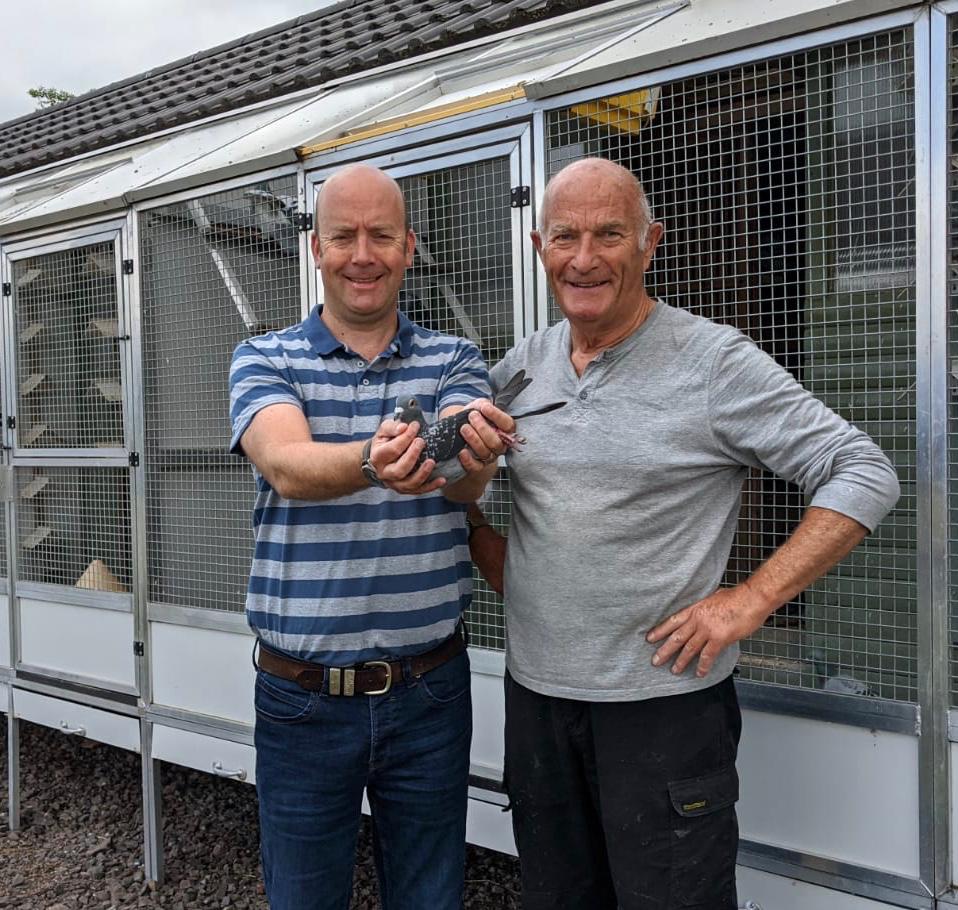
This is quite difficult to answer as we formed our partnership in around 2008 but Dad had flown highly successfully both on his own and with his brother Mike as Staddon Bros previously. For our partnership I would say we got the biggest kick from the 2016 Tarbes NFC Grand National when we timed our yearling hen John’s Joy on the day at 560 miles, 15 hours 20 mins on the wing in virtual darkness, there were only 6 day birds. She won 2nd Section 10th National. Also winning 1st & 2nd National Flying Club Coutances Old Hens race when we only sent 3 birds was a special day with our winning being faster than the whole YB convoy. We have been lucky enough to win 1st National BICC on 5 separate occasions, Carentan, Falaise YB, Tours, Cholet, Fougeres YB. All of these were special days. I would pick out the Cholet win as we won 1st 2nd & 3rd National in the same race 290 miles and the tours win as we only sent 3 birds. The Fougeres YB win was also special as the wind was a strong NW. The next 60 pigeons in the national result were at least 80 miles and more to the east of us and our pigeon really stood out as an exceptional bird in the wind. Finally, this year we timed 8 of our 12 NFC Pau Grand National in the first 10 positions in the section 1st 2nd 5th 6th 7th 8th 9th 10th at 549 miles. The first pigeon Gemstone winning 7th NFC 2nd CSCFC, 3rd BBC and 1st GDSBNFC in the same race.
Ian Stafford
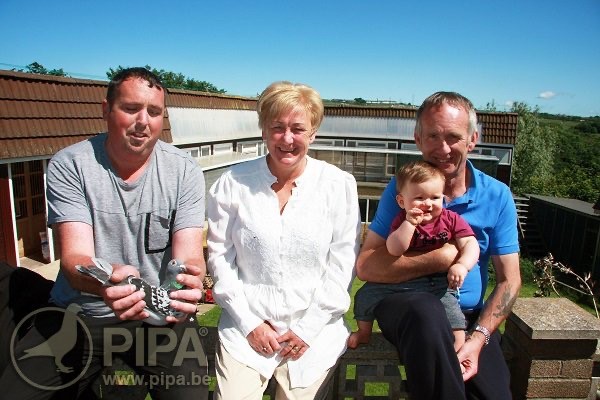
Performance 1. The first time I ever won a National (meaning the West Durham Amalgamation) was from Bourges in 1998 with a check cock called “JR” named in honour of my best friend’s father John Rose as at the time I was partners in the breeding loft with Alan Rose. Incidentally, Alan bred the bird from a grandson of “Peter Pau” from Church View Lofts and a top winning hen from Alan Turnbull of Tantobie. “JR” was my only entry to the most prestigious race of the year. I know it was a big ask sending one bird to 570 miles, but I have every confidence in him as he was the best bird in the loft, scoring previously from the distance. He was flown on widowhood and was timed on the day. Performance 2. My good check and white hen, “Natalie Louise” winning 1st WDA Arras 2006. She was probably one of the most honest pigeons I have ever raced bred on one side, the bloodlines of my good friend Alan Hindhaugh, Busschaert/Van Loon and on the other side the Sumo lines of Jos Thone. Natalie Louise was raced on full widowhood and was one of eight hens I started messing about with on this system as at the time everyone raced predominately widowhood cocks. She gave her all at every single race she flew and always finished like a train. Performance 3. “Beff”, my little blue hen named after my daughter Beth achieved the first of my goals in the mighty Up North Combine. In only my first OB season in Skinningrove (2009), “Beff” came and topped the Combine from Lillers (311 miles) winning me my first gold medal. She was bred from the old original Jos Thone lines. She helped me in that year to go on to win the Pigeon Sport Combined Average in the whole of the UNC (most points all races). Performance 4. “Little Finn”. After a 2-year layoff I went into partnership with Mark Wilson. We didn’t have to wait too long to win our first gold medal for the partnership and to put the icing on the cake we won the most highly coveted trophy in the whole of the NEHU, the Queen’s Cup. This was May 2018 and Little Finn went on to help us win the Fred McClusky Channel Average in the UNC. This average is always our main goal in the UNC calendar as, in our eyes, it is the only fair average when only your first bird clocked from the 5 channel races counts for points. Little Finn is a pure-bred Rudi De Saer bred from 2 children of Rudi’s national winners “Favorit” and “New Tours”. She was flown on full widowhood with her cock always at home. Performance 5. “Gien Jeanie” When I moved to Skinningrove my first goal was to win a gold medal. When I restarted in the sport after a 2 year break my main goal was to try to top the UNC at the 500 mile Classic, wherever it be flown from. However at the time of going to press we cannot say we have won the gold medal as the race is under scrutiny and due to the Co-vid situation no meetings can be carried out at this present time to decide either way. Win, lose or draw “Gien Jeanie” came like a winner flying the 499 miles on the day. She has helped us win the Fred McClusky Channel Av in the UNC for the second time in 3 seasons. She has a pedigree second to none, being bred from the National Flying Club Tarbes winner and UK long distance record holder, “Pennine Heights” when he was paired to a daughter of Big Smithy also a winner of 1st Open NEHU Bourges 585 miles on the day. She was also flown on widowhood with her mate always at home and as you can see by all our performances, all except one are hens flown on widowhood with their mate at home. I now fly with my wife and grandson back in my hometown of Stanley. I no longer race competitively in the club/federation only sending birds as trainers every week. However, my birds will be set up for the 5 channel races in the WDA programme with my goal of trying to win the Shepherd Trophy, Channel Av in the WDA.
L & K Buddle
No 1 must be having the only Two birds’ home on the day of liberation from BICC Pau international in 2009 winning 1st & 2nd Open from 544 miles with Amoy & BC. We are also very proud of the current run of form we have had from the International race point Marseille at a distance of 573 miles, having won 1st Open BICC from this race point for the past 4 season in a row (2017 2018 2019 2020). Winning the BBC Barcelona International race in 2019 with ‘Triple Two’ is also another of our happy achievements in pigeon racing. Winning 9x BICC Certificate of Merit awards. These are awarded to individual pigeons that win 3x top 15 Open positions within the BICC International races. Just another quick proud performance is also winning in 2020 the ‘Europa Trophy’ in the BICC. This is for the best average from ALL 7 International races. The 2020 season was different to other years because all 7 races were within a 5-week period!! That is 7 races of between 500 & 685 miles 5 weeks in a row!! We have also won this award previously in 2014. In the future we would love to clock a pigeon early enough to win a top, top prize in the full International result, especially from Barcelona International.
Geoff & Catherine Cooper


1st International Bordeaux with Farmer George, our first International winner, beating over 10,000 birds by over 60 minutes and the fastest of over 22,000 birds by 47 minutes as a two-year-old. 1st International Pau with Wollongong, beating over 8,000 birds by 32 minutes, as a three-year-old. This was when the Pau International had a limit on the number of birds you could enter. She also won 1st International hens in the same race. 1st International hens, 3rd International St Vincent with Ivy, when she was a yearling, over 10,000 birds.
1st Grand National Tarbes with George over 5,000 birds. George still holds the record for the fastest velocity from Tarbes/Pau. 3rd Grand National Pau with Nicholls, he was the only bird on the day in the U.K. west of Portsmouth. He held his line and his speed in a strong westerly wind. By entering into, and sometimes winning International races, you are competing against the best in Europe. The U.K. International entries may be less than we would like but when you are regularly competing against 10,000 - 20,000 international birds you get an amazing buzz, which for us is lacking in domestic racing. In all the above races our birds had to fly on their own for a large part of the race and maintain their speed. This is something we have worked hard to maintain in our family.
Barry Kinnear
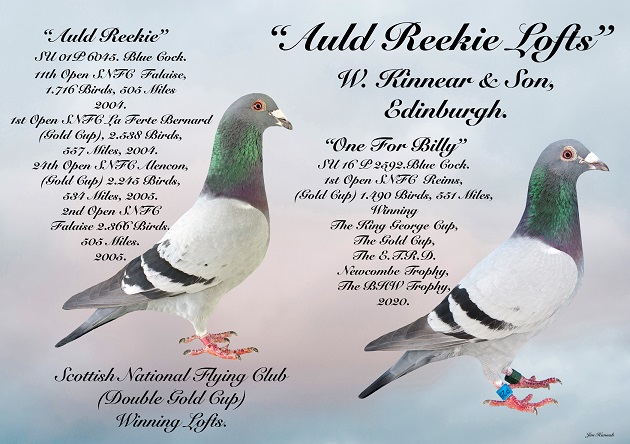
1991. 20th Open SNFC Rennes (Gold Cup), 542Miles 4476 Birds 1022ypm winning £1525, pigeon ‘Stan the Bam’ was basketed for this race 3 days after winning a prominent. Position in the Dorchester federation open race from 365miles. 1996. 2nd Open SNFC Sartilly, 500Miles 1501 Birds 1248ypm winning £1872. Pigeon ‘Back to Basics’ was flying 60miles further than the other 5 South section pigeons that made top 6 open positions. This performance resulted in Back to Basics winning the first of our SNFC Gold Awards. 2004. 1st Open SNFC La Ferte Bernard (Gold Cup), 557Miles 2538 Birds 1153ypm winning £2665, pigeon ‘Auld Reekie’ the greatest pigeon we ever owned, and winning SNFC Gold Cup, a dream come true! Auld Reekie also won 2nd, 11th & 24th Open in other SNFC Channel races. 2009. 1st Open SNFC Ypres, 429Miles 1243 Birds 1368ypm winning £1912, pigeon ‘Young Reekie’ was originally not set up for race, however Dad identified. The outstanding form of the pigeon through observation ahead of basketing and we added to team as our pooled pigeon. Also winning a channel race with a yearling was also very satisfying. 2020. 1st Open SNFC Reims (Gold Cup), 551Miles 1490 Birds 1490ypm winning £760, pigeon ‘One for Billy’ a clear winner by 117ypm 53 Minutes. Was fortunate enough to become only the 5th person in the history (116 years) of the SNFC Gold cup to become a double winner, future ambition would be to become the first person to ever to become a triple winner.
Mark Bulled
1st NFC Tarbes “Legacy” Quite simply for me this is the Number 1 race in the UK. The race most fanciers dream of winning. The ultimate skill test for the Fancier and Stamina test for the Pigeon. If I never win a race again, I know that I’ve got my name on the Kings Cup. It was also the realisation of crafting a very special family of birds over many years with my Dad, Cecil. 1st LSECC Tarbes. Sergeant Cecil - Is special to me as it announced me on the South Road in only my 2nd season after years of flying North. Its particularly special as for years I raced just widowhood Cocks on the North, but I saw something special in this hen that I knew with proper preparation she could accomplish something, so the win was also very satisfying for me as testament to my fancier skills. 1st BBC Fougeres. Eastbourne- My first BBC Fougeres win was so special as it came less than a week after winning the Kings Cup, and 2 weeks after winning the section from Tarbes in the Classic with the only section day bird. Just shows how important loft form is and I’m not just a 600-mile journey man. 1st BBC Fougeres. Rocky – Very special to me as Rocky was an incredibly special pigeon with a prev 1st Section BICC and 2nd NFC. I knew as soon as he arrived, he had won the National. I just could not see anything to beat him. 7 x 1st LNRC. Firstly, the joint special experiences/memories of racing with Dad, and then racing on my own and winning the LNRC in my own name. The LNRC was incredibly special back then with unmatched competition.
Malik & Khan

Obviously out 3 national wins are 3 of our top 5 performances, another top performance is when we were 1st section 3rd open Alencon national 4.797b in a strong NE wind were 1st & 2nd open were in wales and 4th open was also in wales, for us to get her in SW London was exceptional she put up a real good fly that day and we will never forget it, another top performance was when we put 3 in the top 10 of the National from Saintes flying 389 miles recording 7th 8th 10th 3.726b. Our ultimate goal to achieve still lies in the wings, we are after the ultimate performance pigeon with multiple performances, like a double national winner or a pigeon to be x3 in the top 5 of the national etc etc. it will come soon we can just feel it.
Mark Gilbert
I feel my best five performances are. A. 1st eight positions in the BICC 2019 Pau because I was 4th, 5th and 7th international Pau against 12,500 birds and I did not think the UK were in a favourable position that day and I also took the 1st eight positions four hours ahead of the field. B. 1st National Barcelona in 2018 104th international, once again because there was a west wind on the day which favoured the rest of the international convoy and there were 15,000 birds competing that day, the pigeon was over four hours ahead of the next pigeon in the UK. C. 1st National Barcelona in 2020, this was the only pigeon on the 2nd day and beat 2500 pigeons in France, flying 150 miles less than me. Again, it was a strong west wind and a very difficult race, this was the only bird on the 2nd day in the UK. Finishing 154th overall. D. 1st International DAX 17,400 birds, beating the whole of the UK and Europe. E. 1st International yearlings, beating 11,400 pigeons and in the same race being 1st, 2nd and 3rd International hens, 3400 pigeons. F. (Just about to send the article off and I have heard the following news about Mark. LJP). Winner of the Southern Region Loft Performances Old & Young plus the Southern Region Award over 450mls.
2. If you were to restart in the sport in say 5 years’ time what would you do differently that you never did before? What mistakes did you make and how long did it take you to realise that something wasn’t right?
Gordon Bros & Son’s Gary & Niall.
Years ago, we got to a level where we were good enough to maybe win the Combine. That was great and we thought we had cracked it. What used to frustrate us though was we would get 1 pigeon then wait a minute or two before we got another. Why is that? They are all prepared the same way, all fed the same, trained the same, medicated the same. So, we started on a path that led us to where we are now. We were fortunate to meet Rob Fenwick and he showed us a path to follow and since then we have been modifying and tweaking our “Pursuit System” to a point where we are now. Even now we have not cracked it. You can always be better. Always get more home together. Always be another yard clear of the field. This year we fed our birds a completely different mix to what we normally feed. Some would say that was foolish to rip up a system that had given us great results, but we believe in what we are doing. We do not make rash decisions. We try something if it makes perfect sense to us. If it does not, we will never do it. If you do not try to achieve perfection, you will never reach it. If we were to restart in 5 years’ time, we would need to do our homework and find a couple of fanciers that were winning out of turn and learn from them. We have found lots of genuine fanciers who are now close friends who help us no end. We would also look at what were the best pigeons. Our pursuit of the best pigeon out there never ends, and we spend all our best time looking for better. If you do not attempt to strive for perfection, you will never find it
Les Green
If I were to start again from scratch I would not change too much really. I think it is important to have the pigeons for the job. What I mean by that is if you want to sprint, then buy pigeons that are proven in sprint competition and concentrate on that discipline. That is also true for whatever distance you want to race and become successful at. In the very early days I made mistakes with loft design but that was put right quite early on and when I very first started I had pigeons from here there and everywhere, which I think now is a mistake. I would certainly attach myself to the best and most successful fanciers in my area as you will learn so much more from them. It is no use listening to fanciers who rarely win anything, as they will not be able to teach you much. One big mistake some fanciers make is to feed inferior grains, you really must invest in top quality feed as it really makes a difference. Another mistake I made in my early days was relying on medication to much, I have realised that it is far better to give natural products to help performance rather than using antibiotics willy nilly. By all means use the correct antibiotics if your pigeons become sick but not as a weekly pick me up or as a ‘just in case’ kind of practice. I know for sure it does not make them win any more than they would anyway. Good pigeons managed carefully and skilfully will win all year long.
Andy Miller
I could not see myself re starting in the sport as I couldn’t see myself without pigeons, however if the day came then my life would have to take a completely different route. As for mistakes I have made loads and probably still make them however the best fanciers tend to make the fewest and learn from them.
John & David Staddon
I hope to never have to restart in the sport. I cannot imagine life without pigeon racing. If I did, I would buy stock birds as close to big winners for the distances I wanted to win and of course as my pocket would allow. Then breed a large team of youngsters and race them hard, I would be interested in distance racing so as yearlings I would send them all to 500 miles. With whatever I would have left, I would breed from them and their parents and get rid of the rest. Keep testing them at every stage and only the best would survive. We have made many mistakes, being successful means learning from them and trying not to make them again. For example, I made a howler of our first young bird toss in 2020. I took them really early in the morning and liberated them at 05.10am, nothing wrong with that, but it was one of those summer days when the temperature was forecast to rise to 34 degrees by 10.30am. They made a mess of the toss perhaps due to peregrine problems but were then homing in searing heat, the absolute worst situation with babies on their first toss. Lesson learned it will not happen again.
Ian Stafford
If I was to restart in the sport, I would do what I did when I restarted after having two years off due to illness. That would be to not worry about breeds of pigeons, only concentrate on winning genes. Over the years I have made many mistakes listening to people and changing what was already proven systems and loft design, the latter being the most important factor. How many people to you know have flown into old ramshackle lofts to then pull them down and build a totally new set-up and new achieving the past successes?
L & K Buddle
One of the main things I can think of is the way which we would change the layout of our loft sections. At the moment, we have three 6’x6’ sections each with 12 nest boxes in for the widowhood cocks. If we was to start over again and rebuild the loft I would have one big section for the widowhood cocks with nest boxes on each wall so that the cocks are looking across at another cock and their nest boxes. I think that little bit of territory threat and jealously would really help out the cocks with motivation. Another would be to have room for more baby’s each season. With the long distance international races, I think you need to have a big team of young birds, this should hopefully then lead to a fairly big team of yearlings to push about and educate for the future international races. We in the past have found it hard work to build a good team of 2-year olds and over pigeons from only breeding around 40 young birds a season. I think ideally the number of babies would need to be 80 plus each season. We have realised this over the past 2 or 3 seasons, but due to space we are not able to make space for more than 50 to 60 young birds each season.
Geoff & Catherine Cooper
I have made many mistakes since I started racing (at 13) but fortunately I’ve learnt from those mistakes. In the beginning the feed was much too high in protein but now there is a much better choice of mixes.
Barry Kinnear
I would ensure the pigeons I started with were descendants from performance pigeons and ensure that I only bred youngsters from prize winning birds. Two of the biggest mistakes I made in the early days was trying to race pigeons that is feeding was curtailed and also road training pigeons early in the season. One sure way of failing in the longer distance races is by doing both the afore mentioned.
Mark Bulled
When I first started on my own back in 1995 after racing in partnership with my Dad, I had immediate success. In my first season I won the YB fed averages and in my second year North London Flyer of year (with yearlings only). So, I would try and replicate the things I did back then. I was Keen, I was ruthless, and I did not keep as many pigeons. Therefore, the mistakes I am now making are that I am perhaps giving birds that one more chance and thus keeping too many. Too many stock bird’s equal’s overcrowding. Winning the Grand National with Legacy was fantastic, but also comes at a price. My loft has perhaps become a bit one dimensional. Great pigeons at the distance 500/600-mile races but I need to get the balance back between these birds and birds more capable of winning the shorter races. I feel I have got a bit relaxed with my birds and the hunger I had is no longer there. I have had massive life changes in the past few years but feel I am now back in a place where I can go for it again.
Malik & Khan
When we first started, we were so keen that we started installing underfloor heating and thermal temperatures humidity levels etc etc looking at ventilation when all this wasn’t necessary, ventilation can be solved quite quickly by reducing the number of pigeons in a section.
Mark Gilbert
If I were to restart the sport in 5 years’ time with hindsight I would not listen to any theories when buying pigeons and only buy from top performance pigeons and not worry about the family or breed. The biggest mistake I made was to buy pigeons that I liked in the hand rather than worry about performances they had done. It took a long time to rectify this mistake because I had to wait several years to find out the pigeons’ I liked did not breed winners.
3.How do you go about preparing the birds for sprint, long-distance or National races, or do you treat them all the same, if so why. Is there a difference in preparing pigeons for National/International races or do you follow the same system all through?
Gordon Bros & Son’s Gary & Niall.
Up until now we have only sprinted so there is no value in us offering any advice on National and International races. Mark Gilbert is the best at that in the UK in our opinion, so we will leave that one to him. Sprinting we know a little about. During the racing season we live and die by the weather forecasts. For instance, if we think the race is going to be 2000ypm then our preparation (feeding) and work ethic (exercise) would differ than if we were preparing for a 1300ypm day. We would also factor in the distance involved. In Northern Ireland, a 119-mile burn-up is a different race to 250 miles from Skibereen. This is probably where we get things wrong sometimes. We prepare our pigeons to perfection for a certain type of day, and if for some reason the race turns out different to what we expected then I guess we can be caught with our pants down a little. The harder the race we predict the more protein gets banged into the diet in the earlier part of the week. If it is going to be fast, we focus more on the carbohydrates. The harder the race the more oils we add onto the feed too. There is no day in the racing season where our corn has not got “something” added to it, but there is no system that I could write out for you. There are a thousand different permutations depending on the race, speed, distance, temperature, and time of year involved.
Les Green
My preparation is for sprint racing. I would definitely not treat them all the same if I were to race from distance as well. They would not even go out together round home. I was told from an early age that you should teach any animal from an early age and that you should teach them exactly what it is you want them to do and to drum it into them so it becomes second nature. I want them to sprint, so I teach them to sprint. I take them short distances for training, release them in batches of no more than 10s and always have a reward at the home end, which might be feed or their mates. By giving them a reason to get home quick, you will install in them the knack to leave the training point immediately and to fly at a good pace all the way home. I keep the tosses short to build speed in them. I take them often but not far and that way they are never really overtaxed. Of course as the race distance increases you might think they would not have the stamina to compete for let’s say a 5 hour race into a head wind but as long as you have your feeding right, they will keep the fast pace all the way home and that is how they get in front in numbers and leave the rest of the liberation behind them. That is my true belief. I have no interest in long distance National racing and I have no real knowledge of how I would prepare them for this type of racing other than I would again teach them what the job was about. I would train them from longer distances, feed them differently and motivate them differently to try to get the best from them. I would also bring in pigeons that have proven themselves at the distances I wanted to target.
Andy Miller
I like to compete in all races from the first Federation race at 70 miles to nationals at 550 miles. I dislike 2- and 3-day races so 600-700 mile plus which I believe is a different pigeon is not for me. My aim each year is to have sections of my loft ready to compete at certain times of the season, for example sprint and middle distance racers are conditioned for the first 8 or 9 weeks of the season and race most weeks, whereas the longer distance birds usually race 4-5 races before there chosen National at 500 miles towards the end of June and July when there training is increased in the longer and warmer days. There is always the exception to the rule this is when observation plays a part in selection for certain races.
John & David Staddon
These days our main targets races are the 500-700-mile races. However, we send to all races and like to be competitive in them all. So, we slowly build up their exercise time during the season as we build towards their various targets. We like to keep things simple. All birds are paired in mid to late January, we let the best racers and few others we fancy rear a youngster. We have some sprint middle distance pigeons as well as our distance pigeons but they are all treated the same. This is to make life easy for us as I am still working and running my own business. They will all go to the first two or three inland races. Then we will start the channel program with the BICC, CSCFC & NFC. Our distance birds go along to the shorter channel races for experience and fitness. We like to get a 350-mile race into our distance pigeons before they go to a long race. We follow the same system all the way through to Barcelona. We would expect our middle-distance birds to score in these shorter nationals but that is not always the case. The distance birds can also win these races as was proved with our 1st Open CSCFC Guernsey YB winner Miss Tuilagi. She is a distance bred bird but beat 1771b over 115 miles.
Ian Stafford
Our spring and long-distance birds are housed separately. The sprinters are fed a lot lighter mix (i.e. more barley and slightly less quantity) whereas the long distance birds are never broken down, being fed the same widowhood mix all the time with extra feeds of energy mix brought into play the last 3 days before basketing depending on the job at hand. Our hens are always shown their mate before they go to the race however the cocks are the total opposite; they only receive the bowl.
L & K Buddle
In preparation for the BICC long distance international races our birds are sent to a couple of inland races in the early season. These are normally from distances of 100 to 140 miles, this is to get some kind of early season fitness on them. Due to our loft location these inland races are flown from West to East along the south coast. Once we are happy with the bird’s fitness and condition, we them enter them in the BICC National races which are from Falaise 168 miles through to Poitiers which is 318 miles. We do also use the East of England Championship Club (EECC) which also gives us short channel races in preparation for the long-distance international events. Our international race season starts around the 20th June and every weekend thereafter until the first week in August. Ideally, we like our International candidates to have a channel race of between 200 & 320 miles 10-16 days prior to the marking of their selected international race. No private road training is given here, the weekly inland & channel races are the only form of training (except obvious loft exercise) they get. All the race team are treated and fed exactly the same from the first day they are put on widowhood after breeding right up until the last international race in early August. They are also kept on our Widowhood type system all season long also.
Geoff & Catherine Cooper
We follow the same feeding and exercise regime for short, through to long International races, just increasing the fats for the last couple of days before basketing. We like the birds to have a fly a couple of seven-hour races or a ten-hour race before they have a 500 mile plus race.
Barry Kinnear
Pigeons for Federation Racing up to 350 Miles occupy one of the two old bird loft sections and are paired 4 to 6 weeks ahead of the pigeons aimed at the SNFC races, The pigeons making up the Federation Team tend to be a majority of yearlings with any retained inland winners from previous year at races below 250 miles. These winning birds would be retained in this team until they become 5 years old, however I would stress they have to be multiple Prize winners to be retained to 5 years old as I believe you can compete very successfully up to 350 miles with a team of yearlings. The SNFC team are mainly Two year olds and above, with a few selected yearlings, both teams allowed to rear a single youngster (not necessarily their own youngster until they have won a prize) ahead of both teams of Cocks then being put onto traditional widowhood method. The difference between the two teams is that the Federation birds get significantly more road training than the SNFC team.
Mark Bulled
Winning Inland races and National 500/600-mile races are a world apart. It would take a book to outline the differences. To win distance races, or National channel races at least, which is my main interest, the main differences would be bloodline of birds, feeding and patience. You also need a heart of Iron to race the channel strong.
Malik & Khan
Our preparation is our mind set to national racing, we use the first 3 inland races to get the birds fit and used to our ‘ACE SYSTEM’! ready for the big events
Mark Gilbert
I prepare birds for long distance, sprint and or National races in exactly the same way. All birds are fed the same and are let out twice a day. The sprint birds are sent every week and the National birds are sent to the first four races every week and then when they hit the National races, every other week. The International birds follow the same race pattern as the National birds but before the International I will give them 2 weeks fully rest before sending.
4.How much do you rely on your preferred feeding system, what grains do you used, mixed or otherwise. Are there any supplements that you use, also what do you treat your pigeons for and how often do you use any such treatment? If you could only give your pigeons one product of any kind what would it be and why?
Gordon Bros & Son’s Gary & Niall.
As we mentioned earlier, we changed our feeding for 2020. With a shortened season because of COVID it was a chance not to be missed to trial it out. In essence we moved away from the Natural corn that had brought us success and moved instead to the range of corn and supplements provided by the Flanders range. So impressed were with the Flanders range that we travel down to Sheldon Leonard in Arklow and back to acquire it. That is probably the guts of a 5-6 hour round trip. The system must be changed a little because they are not exactly the same type of grain involved; but there’s no denying that our birds are well on it. For 40 weeks of the season our birds get nothing in terms of treatment. We try to encourage our birds own natural immunity to thrive. Racing is another matter. We are on our birds all the time looking for anything that does not sit right with us. We think that because we do not treat for 40 weeks of the year, when we do treat for something in the racing season, we are getting the maximum effect from the treatment. That is the theory anyway. How often we treat is a hard one to answer. It all depends. For instance, if our birds hit rain on a race day, we will treat for Ornithosis on return to clear their heads. If they hit rain the week after and the week after that we would treat them and treat them again for Ornithosis. The head must be right. If there was no rain, then that relieves the need to treat for Ornithosis so we would not feel the need to treat. You must be adaptable with pigeons – different scenario’s present themselves and you must react accordingly. There are a few products that we rely on and use a lot. One is Tollyamin Forte. Another is Gemthepax. Another is Turbo XCell. They are all used to assist in the conditioning of the pigeons. They are all-natural products filled with vitamins, amino acids etc
Les Green
The system I have developed has come from trial and error. What I mean by that is I do not do anything by chance. My system has been moulded over years of racing. I do not deviate from it, as I know it works. The way I feed my race team determines the way they handle and the way they race on race day. I use many different grains in my feed, but I do not mix them myself, I use Beyers Premium Widowhood, Beyers Gaby Vandenabeele, Beyers Premium Breeding, Beyers Diat mix and Beyers Liege. I keep them all separate and feed as I think fit as the week develops. I take into account the weather, temperature, distance they will be racing come the weekend and I am constantly watching the weather forecast to know the wind direction. After all these factors are taken into account I will feed accordingly. The only other mix I use is a fats mix, I make this up myself, or my corn merchant mixes my ingredients for me so I get about 14 bags of it per mix, I also have sunflower hearts separate and I add these to the feed if I think it is going to be a tough kind of race. I use 4 products religiously, Entero for the PH levels, Enegetica to add fuel to the muscle and aids recovery, Optima on the corn twice per week, this is a powdered vitamin B concentrate and I use Tollyamin Forte by Tollisan-Schroeder. This is a fantastic product. I send my droppings and swabs off to a vet at the start of the season, when they are sitting their first round of eggs and only if he says I need to do something I will. I inject for Paramyxovirus, Circo and Adeno, if I have a problem with respiratory during the season I will consult the vet or inject with Engamycin, which is a tip I got from a good friend and fancier from the east coast. If there was only one product I could use it would be Tollyamin Forte, it really helps them reach good form and it really helps the youngsters if they get sick, I put it on the corn and in the drinkers.
Andy Miller
Feeding pigeons when you race in a climate like Scotland which can vary daily some 10 or 12 degrees daily during spring/ summer can be the science between keeping form and condition in your team or finishing them after 3 or 4 races! I do not think I feed my pigeons the same 2 weeks running all season. I tend to have a feel for what they need and how much through exercising, observation, and handling. I tend to feed a basic light mix and a heavier more protein based mix which is combined at different strengths depending on weather and distance to be flown at certain times of season with fats and peanuts added as a tit bit rather just for the distance races. It is a case of a little often but not compulsory. Some manufacturers publish feeding systems to adhere to. Obviously, they have never raced in Scotland!! Regarding supplements I have probably tried most over the years but to answer your question of 1 only it would have to be vita pre/pro combi multivitamin- probiotic.
John & David Staddon
Again, we like to keep things simple. We feed a VL moulting mix during the moult. Treeptops winter mix during winter for maintenance. Our birds go out all through winter on nice days and so do not get too fat. Once we want the birds to fly longer in exercise, we start to feed VL Superstar Plus and they stay on this from the first race until the last race and for young birds too. We add fats to this base if the channel is going to be tough or cold and for races over 350 miles. You must feed to the conditions of the race, the weather and the bird’s appetite, they sometimes know more than we do. I wouldn’t be without VL All In One mix and a salt lick at all times. We regularly test our birds with a vet and only treat when an issue arises. We much prefer not to give any treatment if at all possible as it knocks true form as do most additives in our opinion. We believe in vaccination as it builds your birds immunity to common disease. If we do treat, we prefer a tablet or placing it on the corn. We passionately believe in clean water as much as possible. As soon as you put anything in the water it reduces the pigeon’s intake of water and thus knocks form. We never use electrolytes and the birds always have clean fresh water on return from a race. It’s vital in the bird’s recovery that the first 24 hours they drink as much as they like to rehydrate.
Ian Stafford
We use mainly a basic mix from the Paloma Food Co in Belgium. It is a widowhood/breeding mix with many different grains in the mix. We find the Paloma Energy Mix to be one of the absolute best mixes available at the present time. We have found at the distance the more stuff you put in the water the less the pigeons drink and therefore they eat less food and this is not what you want when trying to get them right for the channel. We now passionately believe that in the 4 days prior to basketing the birds receive nothing but pure water out of the tap and left to stand overnight. If there was one product, I would give my pigeons it would be Avidress Plus as I find this keeps the pigeons right most of the year.
L & K Buddle
We use only Versele-Laga corns all year long, we especially like the IC Plus mixtures, also we use the Versele-Laga Best Allrounder mix added to Plus mixes when we feel the plus mixes alone haven’t quite enough “strength”. During the breeding season we use the Versele-Laga Start Plus with 1/3 best allrounder added. When it comes I the moulting period we use the Versele-Laga Mutine Plus mix and they stay on this with a little barley added until we pair up. During the race season we make up 1 big bin full of our race mix, this consists of 2/3 Versele-Laga Superstar Plus & 1/3 Versele-Laga best allrounder. They receive this mix for every feed 7 days a week, The same for the young birds also. During the 2020 season we started to use the BelgaVet products and was incredibly happy with what the birds looked like and performed like with them. We were asked by Michael Symonds of WillWin Pigeon Products (BelgaVet UK) to try them and I can say we did not regret this decision. We found the BelgaVet Oregano BVP better than the similar product we had used, also the same thing with the BelgaVet Garlic Herbal BVP. BelgaVet Twister Oil will be used to moisten the corn for another of our favourite products Probac-1000 by Brockamp, this is actually the one product I would stick with if we could only ever use 1 product ever again. Our medical programme is also amazingly simple. We Worm 6 weeks before pairing. We then give the birds when they are sitting eggs a 5-7-day treatment for Canker, 5 days if the weather is sunny and warm, 7 days if it’s cold as the birds then drink less. A week before our first chosen race of the early season we will will treat for Ornithosis and upon arrival from the first race they will be given on Sunday, Monday & Tuesday a Treatment for Canker. We then do this same Canker treatment for the same 3 days every 3-4 weeks, this is just the be sure that anything picked up in the race baskets is kept under control.
Geoff & Catherine Cooper
I feed Versela Laga +, but now there are many good mixes available. I used to mix my own but as I have got older, I’ve gone to mixes for the convenience.
We have tried many natural supplements like brewer’s yeast, garlic but they perform as good without them as they do with them. I do like to use cold pressed virgin olive oil on the corn in the lead up to the long races, just enough to make the corn shiny, not wet. We have a microscope and periodically check the droppings for worms etc. If I think there is a problem, I’ll send the droppings off to be thoroughly checked and treat as per the Vets’ advice. I would rather do this than treat blind.
Barry Kinnear
I have not varied my feeding system in many years, immediately after the pigeons have reared a youngster and at the point they are put on widowhood they are Fed 100% depurative mixture the Federation team 4 weeks , SNFC team 2 weeks, after this period the pigeons have access to a super widowhood mixture 24 hours 7 days a week through hopper feeding. Feeding pigeons in this way ensures they only eat small amounts as required are never hungry and you never have pigeons sat in loft with full crops. The feeding of the SNFC team has peanuts & sunflower hearts added after they have flown 250 miles in the build up to main SNFC channel races. The pigeons are annually vaccinated for Paramyxovirus, treated for Coxoid, canker & worms ahead of having samples sent for analysis to confirm their health status ahead of racing commencing and provided nothing is identified will have no further treatment through the racing season. One product I would not be without is a product NOT manufactured for pigeons, it is a natural mineral product advertised for human consumption that the pigeons thrive on.
Mark Bulled
My feeding remains similar although I may try different brands yearly always looking to improve. For the distance events I still prefer a more old-fashioned mixture containing wholegrains rather than the modern pellet-based feed. I still like to see maple peas and maize in my mixture and will supplement with peanuts in the days preceding the big races. Supplements are used, more in the aim of keenness rather than really believing they make a difference. These include Aviform Ultimate on return from races. Sedochol liver cleaner on corn. Naturaline and a B12/Iodine vitamin. These would be perhaps the only 4 supplements used during the race season. As for treatments I shy away from these, if at all possible, especially if the birds are performing well. That said I will treat after the moult for 7/10 days with a general anti to clear any possible ailments, canker before pairing and one more canker and worming treatment whilst racing. I believe that good pigeons will win regardless of the variety of corn/supplements used (in reason of course). And maybe as fanciers we are guilty of overthinking this aspect when really, it is all down to the quality of pigeon and the effort, we as fanciers are prepared to put in.
Malik & Khan
We rely quite a lot on our feeding system as its 1 feed all week and as the national events come up we increase the fat ratio, we feed 3 parts natural finesse breeding 2 part finesse widowhood 1 part popcorn maize and 1 part red maize and basically mix a whole bin up. We do add supplements to the feed of in the water to help the condition of the birds.
Mark Gilbert
I rely on my feeding system 100%. The birds are all fed on superstar plus from Versele Laga, the only difference between sprint, National and International is before National the birds are fed 2 days of 20% fat which is a mixture of peanuts, hemp and oil on the corn. On International races the birds are giving the fat feed for 5 days and for sprint only on the Friday before the race. There are supplements that I use, on return of the race I use probac 1000 (probiotic and electrolyte) and APC90 (a protein product to repair the muscle) for optimum recovery of the pigeons. I also use probiotic energy 5 feeds before the race to help the birds maintain energy during the race. These products are made by Brockamp. We treat our pigeons for canker, worms, and respiratory conditions but only on advice of our vet. If I were only allowed to use one product, it would be the probac 1000 as I really think it helps recover the birds quickly after the race, which I think is particularly important.
5. With attention to your feeding regime how regulated are you? Do you let your eyes be the judge of what the birds need and how much they have, or do you have a regulated feeding programme that you stick to? If so, where did you acquire that programme and why do you follow it
Gordon Bros & Son’s Gary & Niall.
The way that we feed our pigeons in a never-ending process that is under constant review. Like we said earlier we will always adapt our feed every week based on what we think the race is going to offer us at the weekend. Our birds are never hungry, but we will adjust the grains and the oils depending on what work the birds are going to be asked to perform. Think of it like humans – you do not send a labourer to work on a salad. They need more fuel than that in order to perform. We have been modifying our feeding for the last 10-15 years now and we are sure there’s still improvements that can be made. There are things in our regime now that 2-3 seasons ago we could not have foreseen. But at least we are trying. Better to try and fail than stand still. If you stand still others will pass you; and that does not sit well with us.
Les Green
As regards to my feeding policy, I am very regular; I feed the pigeons at the same time each day. I do not measure in weight the amount they get, I just feed them by hand and while watching them I can see when they have had enough. I never leave corn in front of the racers; if a cock or hen leaves any food, I remove it. I acquired my feeding system myself by trial and error, I have an idea how and what I want to feed them according to the coming race and the weather conditions through the week, I follow my instincts, as I know it works on race day. I think it is really important you understand what you are feeding them and why you are feeding it. Understand what each feed gives the pigeons and when you understand this you can make an educated feeding system that helps the pigeons respond to the task ahead of them.
Andy Miller
Yes, my eyes are definitely my judge if you read between the lines as I’ve stated in the previous question. I decided upon this when driving my car home from Blackpool as a teenager many years ago. I had spent and drank most of my money but had a tenner left for petrol to get home on the Sunday (petrol was cheaper back then), however I ran out of petrol a mile from home. Lesson learned!
John & David Staddon
My eyes are definitely my judge. I look at how they are exercising, how they are eating and how they are handling. Sometimes I have been guilty of over feeding in the past but this isn’t a big problem as I just remove any leftover feed and cut back the ration on the next feed until I get them where I want them. I never weigh corn and I do not follow a program. I am not regimented in feed times or exercise times, the birds fit in around me, my family and work, not the other way around. If I am ever unsure on the condition of a bird, I trust Dad’s opinion and go with that.
Ian Stafford
We mainly feed to appetite as where I live now is roughly 5 degrees colder than where I used to live so my birds always get fed handfuls at a time until I think they have had enough but leaving any barley. I have tried many feeding systems and my philosophy is hungry pigeons don’t exercise so with this in mind, by feeding to appetite my birds will always exercise well around home so very little road training is needed.
L & K Buddle
We have a regular feed programme we stick to; we do actually feed a measured amount to the Cocks & Hens during the race season twice daily. This is to ensure that all the grains and pellets that are in the Versele-Laga Plus mixtures are eaten. I feel that if excessive corn is just left in front of them they will then just eat the grains that they favour, Some fanciers believe that pigeons know what grain the pigeon needs to eat, but I’m not a believer in this, I think they would just eat the grains they like. Also, how can they know what to eat if the pigeons have no clue what task and races are ahead of them??
Geoff & Catherine Cooper
I watch what the birds eat and feed according to their needs. If you use your eyes the birds will tell you what they need, more peas when rearing, more maize when racing. I always smile when people tell me they know what the birds need better than the birds do. The birds have evolved over 1,000s of years, surviving by knowing exactly what they need to eat, depending on their life cycle. I always feed to appetite, it is no good sending them to a race with a tank only half full of fuel, nor will they exercise well on short rations.
Barry Kinnear
See previous answer, I strongly believe that pigeons must be fuelled for the middle/long distance races and as such ensure they have feeding available continuously throughout the racing season.
Mark Bulled
100% with my eyes, this will include feeding, loft exercise, when to send, weather etc etc. I have a base system, but it is tweaked accordingly. More so on the south road with channel racing. If I were to fly inland sprints only then yes, a more regulated feeding/exercise regime would be far more important and easier to stick to. My system has been acquired by gut instinct and experience. Prior to a new season starting I often must step back and think of how I am going to do things but once it starts it just comes back naturally. What I have tried to implement as I get older is a healthier Pigeon/Life balance. Pigeons are not my no 1 priority anymore. That does not mean I am not trying, but I am not prepared to train like some guys do just that in order to win. Yes, I want to be competitive, but I want to enjoy the sport and not become a slave to it.
Malik & Khan
Our birds get as much as they can eat twice a day, we don’t believe in holding back food as we believe that is no way to race a pigeon, even when our youngsters go racing we feed them Friday morning as much as they can eat and then again at around 3pm to make sure they have the reserve to get home if a mistake is made, it makes no difference to us about them competing as we have taken the first 20 in the fed feeding this way.
Mark Gilbert
Regarding my feeding regime, during the racing season we try to stick to the same feeding schedule and feed twice a day as much as they can eat. After 30 minutes we take whatever is left out. During the winter, we feed once a day and not so scheduled, once again they get as much as they can eat for 30 minutes and then we take whatever is left out. After the moult, we feed a much lighter corn but continue to feed as much as they can eat for 30 minutes once a day.
6. When you introduce new blood into your loft what is it that is uppermost in your mind? Is it a case of being ruled by performance alone and what homework do you put in prior to introducing new blood? Do they need time to acclimatise or do you expect them to settle as young birds?
Gordon Bros & Son’s Gary & Niall.
We are sprinters so we expect new introductions to come in and hit the ground running. They are under constant review even before the YB season starts we know if they are going to “cut the mustard”. One thing for sure is that if they are not any good the rest of the birds on the garden will expose them. If they do not perform, they are of no use to us. In recent season’s we have sold successful families of pigeons like the Roodhoofts and Wijnants for instance and gone after not only exceptional pigeons but pigeons that are commercially sought after. It is no good having desirable pigeons though if they do not win. We have several friends that we trust to do homework for us and between the bunch of us we will draw up a shortlist of potential options. We will then go and visit that person and assess the pigeons in question. This summer for instance we have been over to Dirk Van Den Bulck and Flanders Collection and seen those pigeons in the hand for ourselves. We did the same when we went after “Best Kittel” and “Golden Prince”. We trust ourselves and we will make the assessment based on what we think are classy.
Les Green
When I want to bring in new pigeons for me it is all to do with performance, this is uppermost in my mind, I do a lot of homework like, do they win for others, not just the fancier I am getting them from. What is the competition like, the loft location does not really interest me as no matter what the loft location is, the fancier and the pigeons still need to perform at a high level no matter what? Ideally, I want them to win straight away, I think this is easier with sprint pigeons as opposed to distance birds. I like to get to know the fancier and I must like the pigeons themselves. I like pigeons with character, and I hate wild pigeons. I normally find that intelligent pigeons are friendly and tame. I spend a lot of time with my pigeons in the lofts and I could not stand it if I could not go and pick them up without chasing them all over the lofts. The best pigeons I have raced over the last 8 years have been the ones that were most friendly in the lofts, they create a special bond with you and I believe they race back with more intent as they love their home and they love the fancier who takes care of them.
Andy Miller
Pedigree and performance with multiple winners as close to the fountain as you can afford and it has to come out sooner or later, although most of my best or most consistent birds have come from friends through gifts or exchanges. Two years of breeding with a different partner should decide if they have got it or not.
John & David Staddon
When we introduce new blood, it is principally on performance at the chosen distance. Secondly it is about the fancier himself. Thirdly it is about the pigeon and their type. I think 2 years is enough to know if they are going to cut it. We have traditionally only bought from UK fanciers who have proven the pigeons over the channel and at the distances we are looking for. Just recently we have introduced some new Dutch long-distance birds from Frank Zweirs direct. His results are fantastic, he flies a similar distance to us in the internationals and races to loft of a similar size to ourselves. Only time will tell if they suit our racing and our systems.
Ian Stafford
When introducing new blood into my breeding loft I now try always to obtain top winning pigeons and if I cannot buy the winner then I would buy direct children off a top winner. I would also have done my homework on what the bird actually won and in what strength of competition as every club has a winner, but no one knows just how good the opposition is. I expect any sprint birds I introduce to breed winners straight away, i.e. within 2 years however distance racing, you must be more patient and breed more birds from fewer pairs thus giving the pair a better chance to breed the one special bird we are looking for.
L & K Buddle
When new birds are introduced, they are chosen by the pedigree, basically by the performance of the parents or grandparents. We personally would not go any further away than a grandchild of the performance pigeon(s). We have recently introduced birds from the lines of New Laureaat, The Special One, Golden Barcelona, Kannibaal Barcelona, Iron Man, The Proof, Verweij - De Haan, Perpignan-06 & Marseille-09. etc. These will gradually & slowly be put into our own family and also some will be tried uncrossed into our family as we want to be careful as not to lose the base of our own bloodlines by crossing to many, too quick into them.
Geoff & Catherine Cooper
When making new introductions I look for top performances at the races I want to compete in. I prefer the loft I am looking to introduce from to have lots of related winners, rather than just one top performer, but there are always exceptions. I have never had a problem settling birds, they are nearly always introduced as young birds for going into the breeding loft when adult, I never buy young birds to race.
Barry Kinnear
The thoughts most uppermost in my mind when introducing new stock is, are they capable of winning, and from a line of winning pigeons. My homework on this would be Knowing all about the fanciers results and birds where purchasing from. In saying that like to purchase from a reasonably close to home fancier flying the same course as my own team. The fancier would need to have many successful years of flying a family of birds at the chosen distance of purchase as I passionately believe in ‘Horses for courses. I would prefer to buy squeakers for racing the same year, they would be raced along with my own through to the YBN. If they made it that far, the remaining youngsters Would be evaluated then raced as yearlings to the 429-mile mark. Again, if still there selected for national racing as mature 2-year olds. If happy with results would then Consider breeding from them the following year. Any purchased youngsters would be vaccinated ahead of entry into the loft then treated for Coxi, Canker & worms, followed by A few days on vitamins.
Mark Bulled
First and foremost, I am only interested in performance. They must be winning the type of races I want to win. Names and pedigrees mean little to me. I then try and view the birds and fancier. They must fit to my type and I want them from a fancier that I believe I can trust, does not send 100s to win, and does not rely on heavy training schedules and medication. I am a keen fancier but not a fanatic belting down the road everyday so I want birds that can compete on my methods. Good birds will show me something straight away and I would expect sprint birds to win from the off. Cost is also important. I do not believe you need to spend a fortune and if they are out of my price bracket I kindly walk away.
Malik & Khan
We are very fortunate on the continental scene and have made good relationships up with many top fanciers and get to know when a good pigeon is about, we also check the live weekly results in Holland and Belgium and access to good pigeon is possible, so the first thing we look at is the result of the pigeon and its pedigree, the pigeon must come from a long line of winners, we don’t believe in any theories of wings eyes tails feathers etc etc the basket and the pedigree is the judge in our loft and must breed from the off, it has 3 breeding seasons to prove them self if they don’t then there eliminated no matter how much they cost.
Mark Gilbert
When introducing new blood into the loft, my main concern is performances. The homework I do prior to introducing the new blood is decide what races I am focussed on and which pigeons are appropriate to aid me in winning those races. I also check to make sure they have multiple performances and not just one. I would also like to see other winning pigeons in the pedigree.
7. Decades ago, it was the same pigeons that used to fly the whole programme – short, middle, and long distance. Do you think we have gone away from this now? Can pigeons still win races from one end of the programme to the other end and if not why not? Have we created an inferior pigeon if it can only perform excellently in one certain arena?
Gordon Bros & Son’s Gary & Niall.
100% we have moved away from that. We can prove it too. We have fairly nippy pigeons on the garden. Breakneck sprinters that we expect to go eyeballs out for a good 5-6 hours. On the other hand, we have some pigeons from Mark Gilbert whose sole intention is to cover large distances at a competitive speed. When we train our YB’s from 20 miles we know that the sprinters will take a good 3 minutes out of the distance pigeons. They do it every time. That is not a weakness of Mark’s pigeons. We would be worried if they were mixing it with the sprinters. They are built differently, have different wings. When they exercise the Gilbert YB’s will fly willingly for around 2 hours. Our sprinters do not do that. If one of us comes to the garden and a team of YB’s are exercising 100 yards away, we can tell instantly which group it is just by the wingbeat of the birds flying. The sprinters are covering the ground faster. The distance pigeons at a lesser speed but they will fly and fly and fly and this year we were even having to pull them down with droppers! Different pigeons designed for a different job – simple as that.
Les Green
I do not think we have created inferior pigeon; we have created specialist pigeons that perform at such a higher level at a certain discipline. There are still many fanciers who send the same pigeons to the early races, the middle distance races and then across the channel and some win well, but I believe the top prize winners in big competition are the ones who have specialised in their chosen fields. Certain lofts compete well at all competition but with different teams and that is different, they pair some later than others, train them differently and feed them differently, to do that you need a lot of time on your hands and the normal working man cannot do that, especially early in the season when the daylight hours are shorter. For me it’s all about setting your pigeons up to do the best they can from every race they are entered into. There are many examples of this all over the country and on the Continent.
Andy Miller
Majority of the time it’s horses for courses. In horse racing the Derby winner is not going to win/ compete in the Gold Cup at Cheltenham however there has been some went from flat to fences and succeeded so there is an exception to the rule as in pigeons. Regarding an inferior pigeon, presently there are many supplements and different feeding that has improved the speed of pigeons since the birds of yesteryear and specialising in certain racing distances has changed the type of pigeon of each fanciers preferred discipline.
John & David Staddon
Pigeons will still win from the first to the last race. This year our own cock Fahrenheit flew from two international races Pau where he was 23rd National at 549 miles and then Rieux Minervois 592 miles where he was 2nd National. This cock was 1st club from Littlehampton as a young bird at 89 miles, so it can and does happen. Truthfully, I think most lofts now specialise, sprint on land, sprint on the channel, middle distance, or long distance. Not everyone has the stomach for the long distance. They fill their loft with birds that specialise in that discipline and do not try for an all-round set up or family of birds. Each to their own I say. We ourselves love distance racing but keep around 10 or 15 middle distance birds to keep us competitive in the shorter races.
Ian Stafford
Times have changed. If you fly in a sprint hotbed you need top sprint birds and the same applies to distance racing. To give you an example every time we train our birds by road we train from the same spot (22 miles). On every toss our Stefan Lambrecht sprint birds beat our distance birds by 2.5 minutes 99 times out of 100. With this in mind, we never educate or train our birds together always keeping the sprint birds separate. I think by doing it this way you get faster sprint birds and better long-distance performing birds (i.e. better orientating).
L & K Buddle
I think pigeon racing has now become more specialist at certain distances. There really are not fanciers anymore that have the same bloodlines or family of pigeons that win or do well from 60 to 700 miles week after week. I do not feel this has created an inferior breed of pigeon if anything it has made specific types of pigeons stronger for their intended events. Obviously, you always get exceptions to these rules like a long-distance pigeon winning a sprint race early in the season or a last chance sprint middle bird being sent to 500 miles and scoring.
Geoff & Catherine Cooper
My family of birds win from the first race (about 45 miles to us) through to the 500 mile plus races. Wollongong was 2nd Fed from Exeter (68 miles) and won at 560 miles, as do many others. They excel at distances between 200-600 miles, these are all channel races.
Barry Kinnear
I’m not sure it is true that decades ago ‘the same pigeons flew the whole programme’ !, many of the wise fanciers years ago conditioned birds for sprint ( up to 300 mile races) OR longer distance races (300-600 miles). I do believe this still applies today although we do have selective bred pigeons for various distances. The birds of yester year, I believe are every bit as good as todays birds, again I believe it is all to do with conditioning them. There are many different types of pigeons just as there are many different types of races and weathers (especially in Scotland), so I would try and send birds to cater for all these issues.
Mark Bulled
Back in the 80s we had the Busschaerts that won from 100 to 500. These types are rare now, perhaps the Vandenabeele one of the only day modern breeds that can compete at all distances. Rather than create inferior pigeons I believe top fanciers concentrating on short/long or young bird racing have created superior pigeons and it’s getting to the point that if you want to compete at a certain distance the fancier needs to specialise himself. So, yes there are not many birds that can win both sprint and distance races, but there are still many talented fanciers that excel at both but with different birds.
Malik & Khan
We believe most pigeons including fly up to 450mile but to fly 500+ is a certain type of pigeon.
Mark Gilbert
I do not believe there is a pigeon that can win at top competitions in short, middle, and long distance. As in all walks of life, no animal or human can be the best at all distances. The makeup of a sprint pigeon is different to a middle-distance pigeon and a long-distance pigeon. My general belief is a sprint pigeon is larger, with more power at the front whereas a middle-distance pigeon is small to medium, still with power in the front. A long-distance pigeon is normally smaller and much lighter, and this is the reason why they can fly further. However, there are exceptions to all rules.