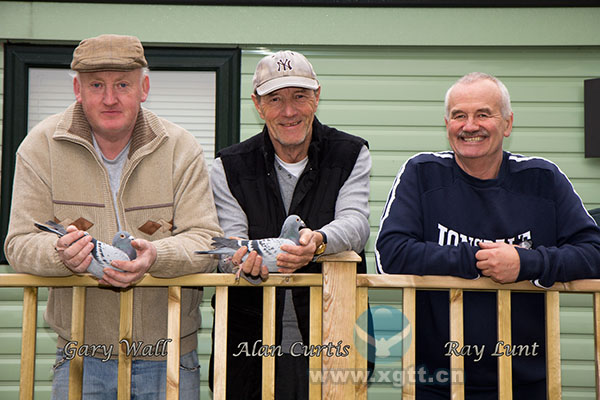
PARKINSON
I have had a good response to the article on the late George Stubbs who raced his pigeons with the Sandbach club. George had many good National performances over the years but there is no doubt that his race point with the NFC was Nantes flying nearly 410mls. The results I have were from 1970 to 1992 during with time he was 62/97/84/137/106/45/59/140/96/64/71/74/13/20/112/190/70 and that was just at Nantes. Other open positions included 48/84/17/26 and there were many top section positions. It is also worth pointing out that during this spell the National would be sending as many as 11,000 plus birds per race and in the section as many as 1800 birds per race. In those 22yrs racing George was in the first 100 of the NFC no few than 15 times flying up into Cheshire and only sending a handful of pigeons. In those days you would see 9/10/11000 birds per race and that shows just how good a fancier he was to compete against the best flying as much as 200mls on many in the races. I have always believed that a lot of those performances were down to the great competition that there was in Sandbach at that time with well over 30 flying members and on a percentage basis that was high there were some really good competitive fanciers.
Training
As expected we had our first training toss over the Easter break and the first toss saw them somewhat strung out with the first arriving on 30mins while the last was some 6hrs later. I don’t know why but it a point noticed by Craig and that is when we toss the pigeons whether old or young at Nantwich a 5ml toss they do not home as expected. There has to be a reason but I have no idea what that is and no matter from which angle I look at it there is still no real explanation why they are so erratic from such a short distance. In amongst these were pigeons from yearlings to 4yr olds that are experienced but after that they are fine and they return in good time. They then went to a 15ml toss and faired much better and another two from that point set them up for their regular training schedule. My training then moves on to the trainer with Anthony Evans who is a godsend with the training as he goes three times each week to 35mls so that suits me. After that we had some real good weather for training and it has set most up for the season. I mentioned the Nantwich toss to Janet Hull and she was saying that they have the same problem when tossing their pigeons at Parbold. Strange how these things happen but they do and we can never work it out.
Birds of prey
I have very often been asked about the birds of prey in our area, well they are increasing and I like most other fanciers do not like it. There are several Buzzards but they only make the pigeons more alert when they are roaming the sky above the loft. It is the other birds of prey that are increasing that are the problem. We do not see anywhere near as many wild birds as we sued to a few years ago. These people who want to protect the birds of prey should think about what their increase in numbers is doing to the rest of the bird population. There is an old saying “Everyone has a right to protect their property” my pigeons are my property.
Racers
I have been very amused at times with the race team that should have been settled in the normal way that we would expect of a couple. There are two cocks paired together and no matter what they will not have hens. They have been separated into sections where they cannot see each other and put with hens. They have been locked in boxes with hens and still no luck so they are now left to their own devices. There are two spare hens in the old bird loft and there is no chance of a relationship, no problem everyone to their own as long as they are happy. On the other hand I have two hens paired to one cock and they are sitting 4 eggs. Yes it does get amusing at times seeing them have their own individual ways especially when it is time to see which one is going to take the next few hours on the nest. What I have noticed is the chequer hen is the one who is more often than not the unlucky one but appears to stand guard over the one that is sitting at any given time. Once again as long as they are happy they should race to the lofts and who knows what incentive they have.
Disease
Mycoplasmosis Catarrh. The chronical form of catarrh in pigeons often is called Mycoplasmosis". It is caused by a multiple infection with pathogens: bacteria (e.g. Cocci), viruses (e.g. Herpes) and pathogens which belong to the group of mycoplasma organisms. It is assumed that mycoplasma causes severe conditions only in the presence of other infections. Pathogen/Cause: Outside the animal body, mycoplasma organisms are viable only for a short period (approx. 17 days at 20°C, but only 20 minutes at 50°C). Low temperatures favour their survival. Mycoplasma organisms are killed by almost all commonly used disinfectans, e.g. desinfectans. Transmission takes place through the faeces, the drinking-water, feed, equipment and by droplet infection from pigeon to pigeon.
Symptoms of the disease: Mucopurolent discharge from the nose, reduced flying performance, unwillingness to fly, flying awkwardly, throat inflammation, rattling and wheezing sound of respiration particularly noticeable by night. Air sac inflammation. Recognition of the disease:
Cadaver examination: air sac inflammation Serological blood test Treatment: In air sac inflammation: see treatment plan for the application of aviosan. In rattling sounds of respiration: Injection (s.c.) of 0.5 ml aviosan injectable per pigeon and day, for 3 days, subsequently chevimulin-t for 5 days at a dosis of 1 sachet per 3 litres of drinking water. Disinfection by using desinfectans. Prevention: Elimination of possible factors that reduce the bird's resistance to infection. Such factors may be: overcrowding in the loft, lack of cleanliness, latent infections (e.g. ectoparasites, worm infestations, coccidial infection), excessive stress in breeding, deficient feed, poor water supply, stress during the racing season. There is also Ornithosis that is an infectious disease that affects many bird species worldwide. It can also be transmitted to humans and other mammals. In Germany, ornithosis is a notifiable disease in pigeons. Pathogen: Chlamydia psittaci. Chlamydia are small, non-motile micro-organisms that invade cells parasitically. Infection occurs via inhalation of stirred-up dust containing the pathogen, uptake of faecally contaminated feed or water, or else billing or feeding of squabs. Symptoms of the disease: Ornithosis occurs in 2 forms:
The acute form can be recognised in young pigeons from: wheezing noises, uni- or bilateral conjunctivitis and muco-aqueous enteritis with diarrhoea . The chronic form is more often found in adult birds, which, however, show few or no signs of the disease. Pigeons that have recovered are a dangerous source of infection for young pigeons and for humans due to their latent shedding of the pathogen. Recognition of the disease: The disease can be demonstrated in dead pigeons by microscopic examination of a smear or impression ("klatsch") preparation of spleen, liver, conjunctiva or air sac that has first been stained using the method according to Stamp. In live birds, the pathogen is demonstrated in faeces, via a sink dab from the cloaca, or alternatively by serological identification of specific antibodies. Similar conditions: Infectious catarrh, salmonellosis, paramyxovirus infection. Treatment: Flocks are treated with chlortetracyclin+, which has been successfully used for many years to control ornithosis. In order to maintain effective blood levels, administration of chlortetracyclin+ must not be interrupted during the 25-day treatment period. Notes: Do not give the pigeons any feedstuffs containing calcium (e.g. grit) during treatment, since calcium binds chlortetracycline and thus reduces its efficacy. No free flight for affected pigeons. Remove bath water. We included the other disease that can affect breathing last week and that was Salmonellosis that has one of the highest mortality rates of any infectious bacterial disease of pigeons. (see last weeks notes) With bereathing difficulties you could also include Aspergillosis is a fungus disease of birds, animals and humans. It is usually characterized in the pigeon as a chronic infection of the lungs and air sacs. Another name for this disease is pneumomycosis. Pathogen/Cause: Aspergillus fungi. They grow as multicellular, fluffy mold colonies, free-living in the soil, on vegetation or parasitic living in or on birds, animals, and humans. Symptoms of the disease: Respiratory form: difficulty in breathing; greenish deposits on tongue and palate. Skin form: skin scaling off with breaking of feathers. Recognition of the disease: Cadaver examination: Fungal lawn in lungs. Microscopic examination of deposits and skin scrapings. Treatment: Elimination of source of infection (e.g. mouldy feed), separation of affected birds. No treatment is recommended for Aspergillus respiratory infections in pigeons. Skin infections can be successfully treated e.g. with copper sulfate (1:2000 dilution) or a solution of mercuric chloride (1:500 dilution). Prevention: Dry, well ventilated loft, good quality feed, administration of vitamins. This disease section by courtesy of Plosoft)
Can you help?
We have an interest in an article so can anyone help with the required information. “Morning Les, Just a quick email to say how much I enjoyed your recent article about Reg Churchill from Weymouth, another blast from the past was Jock Reid from Stenhousemuir. There was also a partnership called F Churchill & Son of Stroud who flew very well at the distance. They had a big Mealy cock called Palomas Pride who raced well at the distance (Stan Biss tried to buy this pigeon but it was not for sale). They flew around the same time as Reg and featured many times in the same results in the British Barcelona Races. There was once an article in the Gazette about F Churchill & Son but it was actually titled R Churchill Weymouth. I don’t recall if there was any other articles printed about this partnership but it would be of interest to read if any scribe did one. I no longer keep pigeons I packed up with them in the eighties when I got married, I have always kept in contact with the sport and have been the sec of Kirkham & Wesham Homing society for the last ten years. Yours In Sport. Brian Lawrenson”
Albert Tarleton of Knotty Ash
Hear is another article from the past, one that took me to Liverpool for the first time that is to write about a winning fancier. “Ken Dodd put Knotty Ash on the map through his wit on TV, but this part of Liverpool is better known through out the pigeon world for Albert Tarleton. Albert is an insurance man who loves to spend any available time with his pigeons to keep them at the top of the list where they are so often found. The Liverpool Amal saw the full force of this likable fancier in 1980 when he really went to town to take 1st,2nd,3rd,4th.5th,6th when 684 members sent 6886 birds to Gloucester On this great performance Bob Moffett from the Amal had to say off the other side of the result “The Gloucester old bird race high lighted stupendous performance, one in which has never before been achieved and one which has never likely to occur again. To take the first six positions in any competition is no mean feet, but to take them in one which is regarded as one of the most difficult in the country to win, and against 684 members competing 6860 birds is par excellence. Such results as this can only be gained through personnel effort coupled with dedication and expertise and who can say that Albert Tarleton can be found lacking in any of these requirements is his pigeon interest. I feel that the entire membership of the Liverpool Amal will wish to join me in wishing Albert there heartiest congratulations on the magnificent result”. Just one week later I didn’t know whether Albert slipped up or what had happened as a result of the amal with 693 members sending 6,783 birds went as follows 1st,2nd,3rd,4th,6th,12th with again Bob Moffett making his feelings known to Albert “Further congratulations are extended to Albert for following up his first six positions in the amal from Gloucester with the first four this week from Wincanton, once again highlighting is a complete mastery of the art of pigeon racing. The members of Liverpool Amal have witnessed over the last few years the emergency of a competitor who’s amazing performances even dwarf those of the great continental flyers and while it is most difficult for the majority members to compete with any degree of success in such company, there must be a few indeed who fail to appreciate such talent.
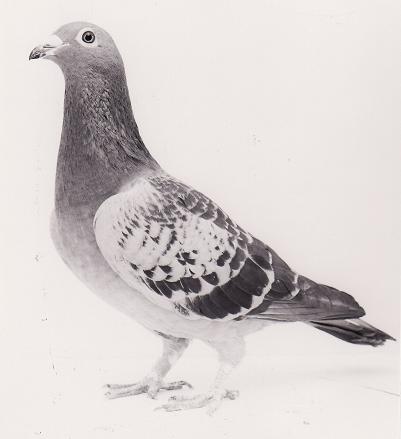
La Merveilleuse 75
These results achieved by Albert over the last two weeks are truly phenomenal and must surely be remembered by the racing pigeon fraternity for many years to come.” How better could these performances of Albert be described? Other first class performances put up by Albert are being 1st Liverpool Amal 3 weeks in succession 1st in West Derby 1979 seven times in twelve races competed, to follow up in 1980 with 6x1sts from 11 races. In 78/79/80 from 38 races Albert won 18x1sts 19x2nds 12xc3rds 7x4th and in the Roby FC for the same period from 28 races won 14x1sts 7x2nds 10x3rds 7x4ths making Albert the highest prize winner over this period. Some of these positions won many 1st class prizes such as 1978 Ludlow 641/5696 birds 24th 32nd Hereford 643/6204 birds 3rd 26th 50th Gloucester 646/6295 1st 2nd 13th 14th 28th 31st, Wincanton 634/6089 1st 2nd 5th 30th, Dorchester 627/5673 5th 7th 9th 21st, Dorchester 1st 5th 1979 saw Albert without a first but still had a very good season winning Hereford (1) 634/6126 7th 9th 10th 13th, Hereford (2) 667/6903 5th 11th, Gloucester 660/6812 3rd 14th 44th, Wincanton 659/6633 3rd 25th 26th, Dorchester(1) 6th,12th,30th, Dorchester(2) 5th, 7th, 16th,1980 saw Hereford(1) 600/6569 birds 7th, 8th, 11th, 13th, 29th 33rd 36th Hereford(2) 693/6808 48th Gloucester 684/6860 birds 1st,2nd,3rd,4th,5th Wincanton 693/6783 birds 1st 2nd 3rd 4th 6th 12th Dorchester(1) 669/6226 birds 9th 16th 36th 39th Dorchester(2) 646/5894 birds 12th and 39th. A pleasing point with Albert was when he presented ten youngsters to Saint Edwards College in Liverpool in 1976. One of these pigeons in the first year for the college won 1st West Derby FC from Ludlow and also 1st Liverpool amal over 6000 birds this was a blue hen. Now that I have told you how well Albert races his pigeons I had better give a few details as to how it all came about in the first place Albert was not born into a family of pigeon fanciers but caught the fever from the lads at school, of how he first got started Albert said “in 1951 I caught a Cheq pied hen I reported to the RHNU and was informed that it belonged to a Mr Jackson of Brompton Cumberland. Having no loft of my own I put it in the loft of a school friend who I later learnt he had it flying out. When I told my mother of this she was furious and made me go and get it back and using a tea chest I constructed a temporary home for it, subsequently Mr Jackson sent for it and I railed it off”. Of course I had a small loft and no pigeons. But the late Alf Eales came to the rescue with two grizzles, so I became a pigeon fancier in my own right. “In 1952 I left school and started work with British Road Services but after only six months I was very badly injured in an accident and was in hospital for several months. On release from hospital I was unable to work for quite some time, so I spent a lot of time with the pigeons, as I was unable to work much. In 1953 Alf Eales offered me a 6ft loft, so I got two friends of mine Bobby Hollis, and Ken McDonald to borrow a builders hand cart and we made two four mile trips to bring the loft down to my mothers house in Old Swan.
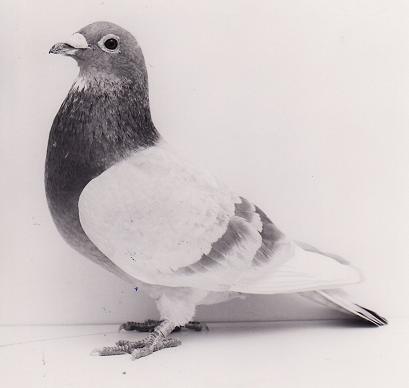
The Golden Ball
Bobby now races in the Garston area of Liverpool and I think Ken maintains interest in his birds. In 1956 I was called up for national service in the royal army Pay Corps serving at Waverly nr Kidderminster, we us to get a lot of strays walking around the camp, subsequently I became the unpaid and unofficial camp stray catcher. If the strays were stamped I used to get one of the lads going home for the weekend to toss them in there own territory with a note on there leg. One owner sent me a pound note to buy all the lads a pint in the NAAFI hen was from Queensbury or similar name in Yorkshire”. Alf Eales was always a big help to Albert and supplied some Gits -Barker, he didn’t win anything with them, no reflection on the birds as they were good pigeons but at the age of 15 Albert was a hopeless fancier, Alf was a very special help in those earlier days. Later birds were obtained from Jack Bergh of West Derby of the Gits barker and sons some of which are still in the loft today. Albert’s good pigeon good pigeon “Golden Visa” is a g/son of the original. Other birds in the present day team consist of Fred Woods Dordin’s which are used for channel racing and are crossed with the Jack Barges Gits and Barker Sion family for races up to the East approx 190 miles Albert just races the Janssen’s of Arendonk which for this fancier are virtually unbeatable. These birds are only raced on the widowhood system as this method suits both Albert and the birds of which the results prove as for Albert natural pigeons cannot consistently live withy the widow cocks. Albert has some 12 pairs of stock, which are paired in January, and 32 cocks that are raced on the widowhood system these are paired at the beginning of February. Albert keeps approx 40 y/birds these are housed in the loft that measured 50ft a loft that was built by several local fanciers namely Joe Rimmer John Mcgreavy and Jimmy Haffman. An important factor in the loft design is adequate ventilation but Albert does not believe in open fronts with wind and rain blowing, as the loft must be dry. The old birds and yearlings are given about 4 x 20 mile tosses before the first race after which there is no more training for them at all, the y/birds are trained 3 times per week at 30 miles. Corn for the birds is a mix of beans maize, peas, milo, linseed; all are bought separately and mixed to Albert’s specification. For the moult the diet is changed to 50% peas or beans and 50% mixed corn.
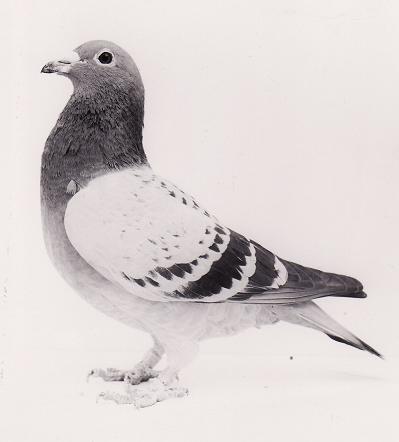
Millers Gold
A few tips from Albert for anyone who is not winning are to join all available clubs now because if you start winning and then try to join they will not have you. To get into a winning position in the first place you must go to a top fancier for late-breds to start six will suffice, do not fill your loft with lots of cheap birds spend wisely. Good pigeons of good origin and possibly most important of all they must be healthy. These you must have if you are to go to the top. Any new starter must remember a lot of mistakes are made because fanciers plan what they intend to do in the pub in stead of in the loft consequently they suffer from “froth on the brain” which results to the resorting to crack pot ideas which never work, there is no short cuts. “All my birds are tame which are fine which I find is the way to have them if one expects them to perform well, they are also contented around home. Visitors here are amazed at the way my birds fly to them when they are standing in the garden; this is why they perform so well. “With y/birds never place them on the landing board in the hope they will look around for themselves. Let them find their own way out. A very important thing that one must do on the way to success is get the birds as tame as possible and happy around home it goes along way to helping one to the top of the tree. The games about 100% effort, it may be 50% man 50% pigeon the losers expect 100% pigeon, so they put nothing in and get nothing out”. Albert is president of the West Derby FC and is also a member of the committee of the Western Region so it takes a lot of interest in the other side of pigeon racing and said of the management of the sport “There is nothing that I do not agree with but the sport seems to have being infiltrated by cast off shop stewards quoting and making rules and also prefer meetings rather that the actual racing of pigeons”. All invitation clubs should be banned as this would be a benefit to the sport and there should be a rule to force clubs to except all fanciers who are within the radius, stock clubs drawing in a radius to keep fanciers out which will also be a benefit to the sport. I was rather disappointed to be denied membership of local clubs even a club with a one-bird limit refused me. On eye-sign Albert said “I do believe in eye-sign the problem is with eye-sign is that it attracts novices looking for a short cut to success unfortunately they start giving advice to the older fanciers who win twice as they do, this gives the eye-sign theory a bad name”. Albert was saying that in 1975 he was thrilled when he had a dream that he was 1st 2nd 3rd NW Combine on the Saturday, he did in fact finish 1st NW Combine Avranches, the following Tuesday he was 1st Nantes in Liverpool 2 bird specialist club. As to the top fancier in his area he said “I am that’s why I am writing the answers in stead of some one else, the man that gives me the most competition is my friend Leslie Kilshaw he and I dominate the results of the Liverpool Amal”. As to late-breds “I do breed some, I keep one or two hens for stock purposes only, I do not keep late bred cocks with the intention of racing them as I do not think a late-bred yearling would ever beat a well trained and raced yearling.
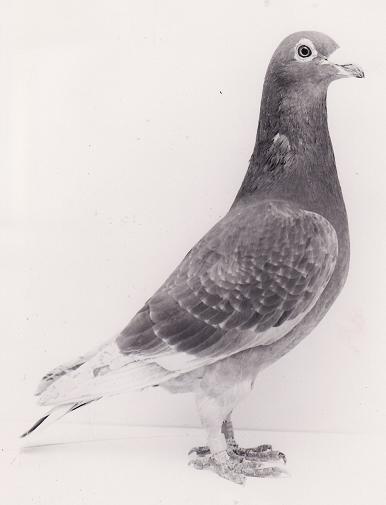
De Vos sire of The Young Fox
Albert’s wife assists with the clocking in on race days and has clocked quite a few winners and his two daughters and their friends often feed the pigeons in the garden as this helps to make them tame. A final sum up from Albert on himself and birds and what he does or does not win, “I never go out to win averages that’s why I never send in all the races, I can make highest prize winner in just a couple of races. I prefer to win the races; there is little joy in winning the averages if you never win a race. 1st prize is everything 2nd is hard luck 3rd and 4th then you just have to try harder. Those so called fanciers who huddle in those dark corners of the bar were to put a little of there efforts into there lofts instead of denigrating the winners they might figure a little higher in the result”. The rumourmongers tell each other of me doping them to win, having a magic bottle and of giving then the needle on marking nights. One idiot even had the audacity to phone my friend Tom Rigg of Parbald to ask him if they could be doped When I go on holiday usually to Cornwall the pigeon grapevine get the news in a knot and I am supposedly in Belgium gather a few more stock birds, they certainly have a great imagination. One rumor mocks the other, after all why go to Belgium for pigeons when all you have to do is give them the needle on marking night. “I broke the record for cash winnings in West Derby FC in 1975 1976 1978 1979. In 1980 pooling dropped dramatically due to some members running unofficial pools in the bar, excluding me of course. Actually I never used to pool much but one or two said that I couldn’t pick them, so I showed them how to do it though money won does not always reflect the true position won. Fanciers today seem to treat their birds with contempt really, they expect each weekend to obtain glorious results, yet there own contribution encompassing to the birds efforts are nil. My birds are very tame due to the affection given them by not only myself but my wife and children.
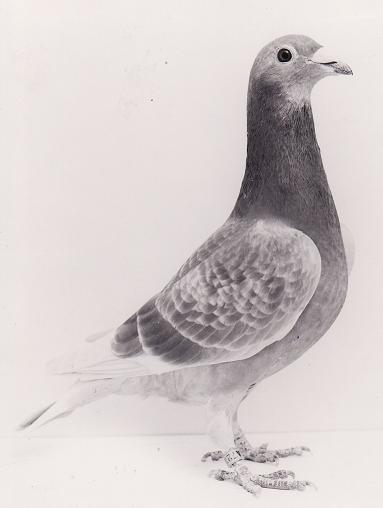
The Young Fox - Meritorious Award winner
They have no fear of any of us nor for that matter do they have any fear of visitors here as they readily will fly on to them and sit on there hands as they would one me. I openly admit to being in love with my pigeons and they with me that most certainly contribute to the success that I enjoy. In my loft the welfare of the pigeon is paramount that is one of the reasons I never chase after averages. If both club and Amalgamation it is unlikely that I will ever win any averages, but one thing is certain no one will win more winning positions than I will despite the fact I miss several races. Fanciers coming into the sport today expect immediate success, they don’t want tom serve an apprentice in the sport as I did. In local clubs there is more trophies and prizes for novices than there in for the winners. How will the fancies ever recapture the golden days of fanciers like Logans Northrop Barker, Fred Shaw or some of the great locals Bill Kilshaw Charlie Howell Reuben Eastham etc. they would turn in there graves if they new of the going on today with clubs refusing fanciers, membership just because they may win. I laugh when I hear some fanciers talk of there own pigeons as Barkers or Logans I just say it’s a good job they are not around today because you lot wouldn’t let them in the club. “I have had some great times with fanciers throughout the country in the past few years, one of my favorite areas is the North East. There is not too many widowhood fanciers up there, but they are all mad keen to learn, I really do enjoy their company. Having served on so many panels/moots” I have noticed the order you receive when answering questions they are very attentive. At one moot I was on the panel with Jed Jackson and what a fantastic fanciers he is, he is a one-man show if ever there was one. No panel could possibly be complete without Jed. I can honestly say that one of the highlights of my life was the day I sat next to Jed Jackson at Haswell that was when he disclosed to me the secret of his success was to be found in the oak tree at the bottom of his garden. Albert made a comment which is quite true and I think this fancier is one who has taken notice and learnt which is “I do not believe you make mistakes you just gather experience”. May be this is why Albert is at the top of the pile in Liverpool.