LES J. PARKINSON'S
NEWS-REPORTS-ARTICLES
This year we are bringing in a few young birds to try, which is something I have very often done in the past. With having a team of stock birds consisting of around 30 direct children of 1st National winners I am always looking for something special. I am bringing in a few this time and I shall include them as we go along. The first ones were 11 from Frans Rigole that came over about 5 weeks earlier than I wanted but with being in Belgium it was a case of circumstances at the time. I then had a call from Ann Smith who had 6 rings from me but again we ended up with an additional one. We had wanted to make this visit to Ann for quite some time but the chance never arrived until now. She only lives in a small village even so it took us a while to find her; we asked 4 people before we were directed to the correct house. The man who told us said that they don’t very often see Ann out and about so we now know that she spends all her time with the pigeons and that is probably why she wins so well. What I did smile at was when Elizabeth asked if she had always had pigeons. Ann went on to say that she had them for the last 32yrs and at first not by choice. Ann’s husband came from a pigeon family and one day he was building a playhouse for the girls. At the time Ann not being impressed let them out the following day and they cleared off so he went to bring them back. The next day it was the same procedure, Ann let them out and he toddled off to bring them back. So Ann saw no sense in doing it again and gave up on the girl’s playhouse having now realised that it was going to be a pigeon loft and not the expected playhouse. That was the start in pigeon racing for Ann and since then she has always gone out of her way to get top class pigeons for the stock loft. I must say that as soon as I saw the pigeons I could see something different about them. When she went into the loft you could see that she spends time with them and that is why she wins so well. The pigeons were happy to have Ann in the loft and were also quite happy as she went to pick them up. The old bird widowhood section is not very big and shaped so that the nest boxes do not come together in the traditional way and it takes that empty corner space away. You can see that these boxes are well worn because they were made many years ago and Ann said that she does not want to change them. I saw boxes in this format a few years ago at Luc Sioen’s loft in Moorslade and he was saying that they are set that way to keep them under control as compared to square corners that gives them that bit more space. This is what more fanciers should do, and that is why change for the sake of changing especially when things are going well and they certainly are in this loft. The stock loft is split and they are in an area that keeps them well under control and this is obviously how the whole lofts are set. Whichever section you go in you can stand in the middle and pick up any pigeons. It was a real pleasure to visit this loft and surroundings that you could have the pleasure of sitting at a garden table with a nice bottle of red wine to go with cheese and biscuits, as long as the sun was out. Behind the house are the hills for the local estate and someone cannot come along to build houses, the hill behind is a bit steep for that and Ann was saying that it is not the easiest of hills to walk up, at least for the first 20 times. Perhaps we should make another visit to see Ann and compile a full loft report after all she does a lot of winning. Come to think of it we have been invited by Ann for a barbeque in the summer so who knows, I can feel a loft report coming on. In fact I think I will send Ann a questionnaire or perhaps fill it in while we are having a glass of wine and Elizabeth taking the photos as usual, have to take the photographer wherever I go.
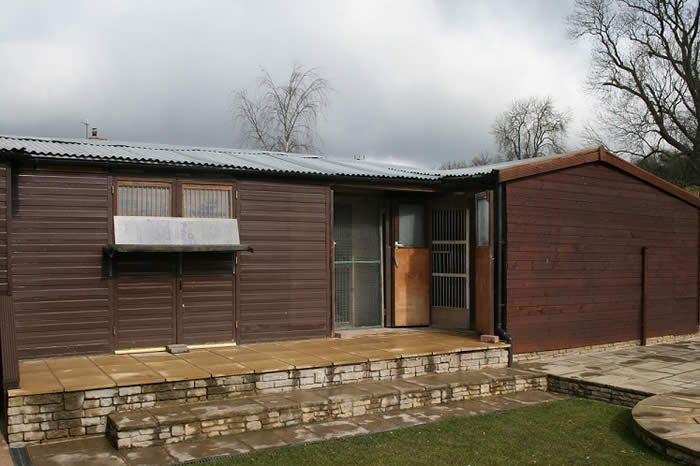
Ann Smith's race loft
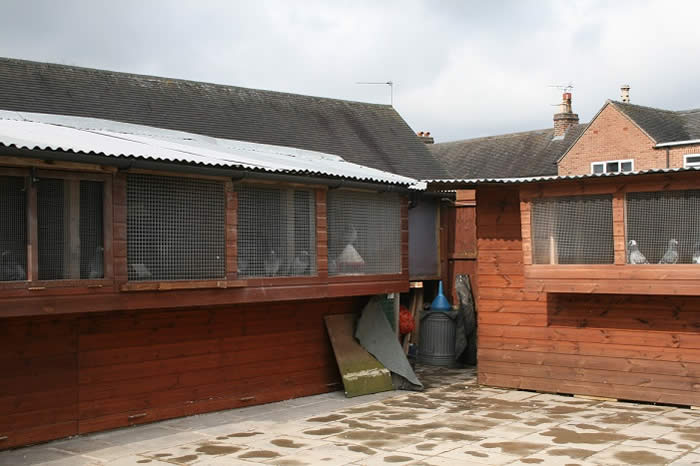
Stock loft
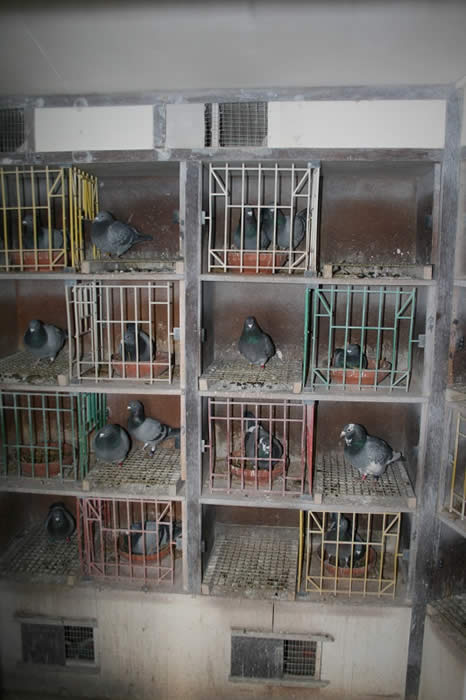
Widowhood loft
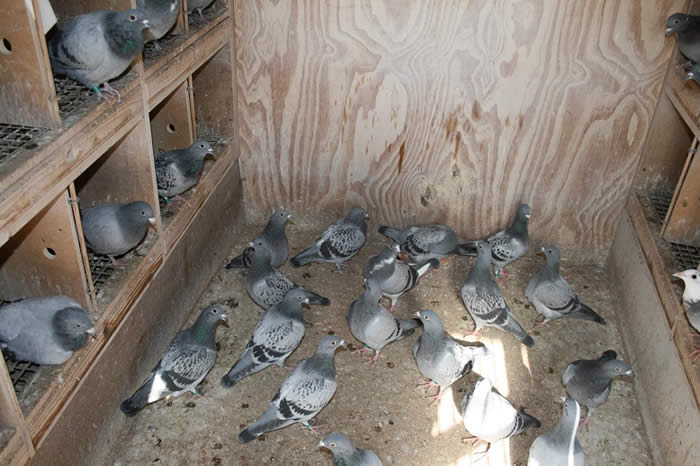
Anne's youngsters
Attack
Had an email from Chris Herbert about a recent attack on his pigeons. “Hi Les, My best young cock was killed while exercising round home last night, another was attacked but escaped on Sunday. Each year I lose pigeons at this time to the same pair of hawks. Ian Cooper and Phil Buckton have both lost birds in the last couple of weeks. Regards, Chris”. This is an ever increasing problem in the pigeon world and where these attacks were mostly happening to lofts in the countryside but now it doesn’t matter where the loft is nowadays because it happens all over the country. Worst part about it the best ones are very often taken.
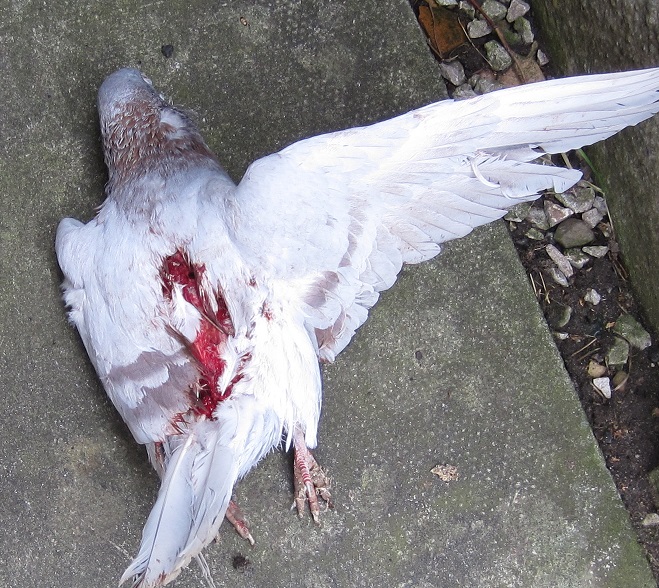
Hawk attack
Virkon S
Like a few items we have in these notes the story continues, or it might even be good advice continues. “Hi Les, My name is Terry and I race pigeons in the UNC. Reading your article in the Homing World of the 15th March 2013 regarding Virkon S, I’ve got to say I’ve started to use it, as I was told to its benefits. Is it OK to ask how many times a week do you give Virkon S before clean water, vitamins, probiotic? Les could I ask if you have a medication programme for the racing season and could I ask if and when you treat your youngsters. Thanks. Yours in Sport. Terry”. With Chris Knowles giving the run down and so many asking the question here is the system he uses to protect his pigeons. “Hi Les. I give the Virkon S on Sunday (all day) and Monday a.m. following a Saturday race but with non racers it doesn't matter and I usually give it for 2 consecutive days. Best Regards, Chris".
Pieds
The pieds are still creating a few mails etc and it is still interesting to see that they are more than a one off in wildlife. “Hi Les. Re interest in the pied crows, blackbirds etc. Obviously there is always some chance of some joker winding you up, but I would like to pass on my findings over many years. I first began to notice pieds in otherwise self coloured birds when in my early teens (now in my 72nd year). So it was a long time ago. I was living in Eastbourne in Sussex where I was born and used to take notice of anything to do with nature. I used to cycle past the works yard of a roofing firm called Russell Asphalt and regularly saw a pied blackbird perched on the roof singing his head off. He had a lot of white on his head, neck and shoulders and a very yellow beak. I was working on a farm when I left school, and one day I was attracted to a lot of noise in a next-door field. On investigation I witnessed what I thought was a crow and a magpie fighting. Some weeks later due to what I found, I realised they were mating. I found one after another, the results of this union. They were birds of crow size, black and white but the shorter wings of a magpie and therefore could not sustain their body in flight. They would hop into the hedge up into a tree and launch themselves into the air, and even though beating their wings frantically they would descend to earth probably at a gradient of about 30 degress. I caught these birds over the space of a few days and put them down thinking they would not survive for long. When I caught the last one I thought somebody might be interested in it, as I had never heard of such a union before. So I put it in a cage while trying to find out who might like it. Unfortunately as often happens when wild birds are caged it refused to eat and sadly died. Over the years I have seen many mismarked birds and a few animals, including other blackbirds, crows, jackdaws, greenfinches, a white buzzard, and a white starling (which always flew in the centre of the flock possibly for protection), a white badger that was stuffed as proof the pelt of the red badger that had been preserved professionally (it was absolutely beautiful) and a white mole. The photo of the pied blackbird in your article BHW March 22nd 2013 was very interesting to me, because of having a dark coloured beak instead of a yellow one; because of this fact maybe it was a juvenile whose beak had not yet changed. I do hope this is of some interest to you. Peter G Wood, Powys”. This latest photo from Peter shows a blackbird with even more white on that any other that I have seen. Just remembered I have also got another photo from Roy Gregory of Derby so they are well split. I have had quite a few calls about these pied blackbirds and Simon from Middlesex phoned to say that he sees a white one on his walks. Anyway thanks for your interest on this one it has certainly been an eye opener for some readers including myself.
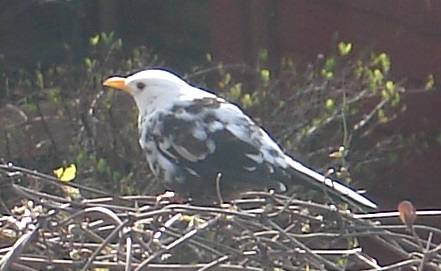
Pied blackbird with a white head
Barbers
I recently went down to get my monthly haircut; I know there is not much but it still needs doing. Tim who has cut my hair for quite a number of years knows that I have pigeons and was telling me that he had heard about how racing pigeons was a cruel sport and this had been on the radio. He went on to ask was it true that we lose 75% from the channel races. I looked up at him through the mirror and suggested that he had got the percentage wrong to which he said he had not. I did say to him that if I was losing 75% each year I would have packed up long ago. Anyway when I got home there were a couple of mails with just web site address’s on, usually I do not look at them but for some reason I looked at this particular one. It was then that I found out what Tim was saying was correct. There is no doubt that pigeon racing is always going to be the target of someone in the modern days of pigeons racing. What I cannot understand is why it has been sensationalized because racing pigeons are highly trained athletes of the sky and they are better prepared than most of our human athletes for the Olympics. In general they are fed on the very best food, vitamins, etc that are available, mostly they are super fit and healthy. Yes there are going to be the odd fanciers who go against the norm for the sport and that will never change. The sport loses more to birds of prey than anything else and that will never change, we have had two taken from out loft in the last two weeks. These are highly trained athletes who are killed by birds of prey more than they are lost from a race. They are in immaculate condition.
Club/fed news
The latest breeder/buyer was held on the 24th March at the Boards Head Hotel, Middlewich for the local club's own special race towards the end of the young bird season. Mr & Mrs Albert Austin were once again helping club secretary Alan Groom out by taking control and they would like to thank all those who took part. The result is that those participating will be racing for the following prizes for both breeder and buyer. 1st £180. 2nd £140. 3rd £110. 4th £80. 5th £48 making a total of £1,116 prize money. There are always some good races to be held at the end of the season but I wonder how many push their young birds a bit too far to compete in these races especially at that time of the year. Young bird racing has become a priority with some fanciers who don’t really take a great deal of interest with the old bird racing.
Les.J.Parkinson, Elimar, 11 Rushton Drive, Middlewich, Cheshire, CW10 ONJ. Tel/Fax; 01606 836036. Mobile 07871 701585