Joop Koch in Holland
with Les J Parkinson
(from the Elimar archives.)
I have brought this one out because there are some real good pigeons that have come down from Joop’s pigeons that have won big and you can see where many of today’s winners come from including the hen to the late Derek Woodward’s Golden Pair. One thing about knowing Hans Verschueren is that I get to meet the top Continental fanciers. On our last trip, Elizabeth and I had the pleasure of meeting one of the best in Europe, Joop Koch, 1999 winner of two National Championships in Holland, as well as being the Versele-Laga World Champion. On our arrival I was amazed, because I expected the usual Continental lofts but saw a British back-garden set-up. These are no fancy lofts but lofts that the pigeons race very well to and win from against the best. Joop’s house was like many in Britain with a front and a back garden, which is the pattern of most lofts that we visit. Here is an every-day fancier come good at the highest levels of competition, with a loft that we all like to see because it belongs to a working man. It proves that you don’t need elaborate, expensive lofts to win quality races; all you need are common sense and good pigeons. On top of that, Joop is a real down-to-earth fancier who met us, talked a great deal about his pigeons and showed us the top-recorded pigeons in Europe for 1999. Joop started up like many more members of the sport, a stray was the reason. That stray was an injured hen picked up in the street. Joop treated her, found her a mate and the 1999 master started on his way to the Dutch National Championships plus the World Championship that have made him a household name in the sport.
Along the way there have been many more achievements, including some by Joop’s well-known pigeon, The President, which in 1995 was the fastest pigeon of Oost-Brabant on 4 occasions over 8 weeks, competing against 20,000 birds in each race. The stock is class. A team of 15 pairs. with a racing team consisting of 40 widowhood cocks and 6 hens, specially prepared for the long-distance events. The origin of the pigeons goes back to 1973, with the first stock coming from Jan Zoontjes, then after that some young birds were brought in to keep the lines going. After a few years, Joop brought in further stock from Wal Zoontjes, who has a top-class team of pigeons that I have reported on over several weeks in my ‘Cheshire Scene’ notes in the British Homing World. (There is also a very good report on the lofts of Wal Zoontjes & Son in the Ernst Nebel Book of Champions.) Then in 1993 he brought in further additions that had the pigeons of Jan van Steensel of Arendonk in their pedigrees, with the origin being Houben x William Geerts. He also had a few pigeons from Stan Raemaecker, which are the Chanel x Jose lines of Jan van de Water of Eindhoven and Heesters Bros of Reusel stock. For the very long-distance races, Joop has brought in the Frans van Welbakel lines, which are more for the 2-day races. With these lines the loft is now made up of 60% Jan & Wal Zoontjes, 30% Houben x Geerts from the Jan van Steensel loft, 5% Stan Raemaecker lines and 5% Heesters Bros. The long-distance birds of Frans van Welbakel of Holland are kept pure. For his future stock, he likes to put the best racers to stock as soon as their career on the road is finished. He also makes a point of giving the cocks a different hen each year.
The pigeons are line-bred but in the second or third generation he does like to put a cross in. This family is now well established, winning around 35 x 1sts per year and, rearing the season’s youngsters, amounting to about 80. The birds are housed in an L-shaped loft measuring 11m in length, with the widowhood loft facing the house and the youngsters to the left as you walk towards the lofts. There is one section housing 16 cocks for the middle-distance widowhood team and one section of 12 for the widowhood 500 to 700km long-distance team. This is where Joop gets it right. All his pigeons are housed separately for a set distance. Thus, the 12 pigeons for the very long distance are also housed in a section on their own. Using the hens, Joop has all 6 paired to stock cocks from mid-May through to the end of August.
The young bird section is open all the time so that the residents get used to Joop being around the lofts, which also keeps them quiet. There is a deep-litter system used during the winter months but as soon as his birds are being prepared for the races they are cleaned out twice each day. To rear those youngsters, his breeders are paired up on January 7th, when a good selection of tobacco stalks is put in for nesting purposes.
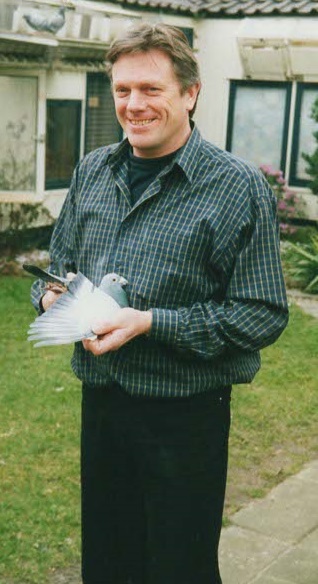
Joop Koch
The 80 youngsters reared are moved when they are 24 days old. The actual breeding is very selective, with the stallion method used. That is, there are 2 cocks selected and each has 3 hens; their eggs are transferred, as are the old bird team’s eggs, which are put under the yearlings. When they are rearing, Joop always gives them a good breeding mixture. He has a new ATX-Flachtherm under-floor heating system installed and, to date is very pleased with it. I asked him why the sudden change to the
heating system and what were the advantages. Joop replied: ‘The system is very easy to install and gets up to full heat within 2 minutes. A big benefit is that it uses only 50% of the fuel, compared to normal
heating. This is not an oxygen-burning system and works as the sun does, warming up man and animal and not the air. This system was developed for the space industry so is not bulky. Each plate is only 15mm thick.’ It was interesting to note that prior to the season starting, part of the preparation for the season and the long-distance events that the birds are expected to compete in later is a medication that cures paratyphus. Joop believes that this cure should be given before each racing season, as part of the preparation, and at this time he also likes to keep them in a quiet, restful atmosphere. To get them ready and make sure that they are right for the season ahead, Joop gives his birds the complete health programme supplied by the Interlabo company of Germany. This has helped him to achieve his
high standards of racing into Holland and has been made easier because Joop is a good friend of Heinrich Renz, one of the masterminds behind this range of products. The system starts prior to the season commencing and goes right through to the end. If Joop has a problem with the birds, he always talks to Heinrich and gets the problem resolved. If the right products are used, it is easier to get the pigeons into form and maintain a high level of performance throughout the season.
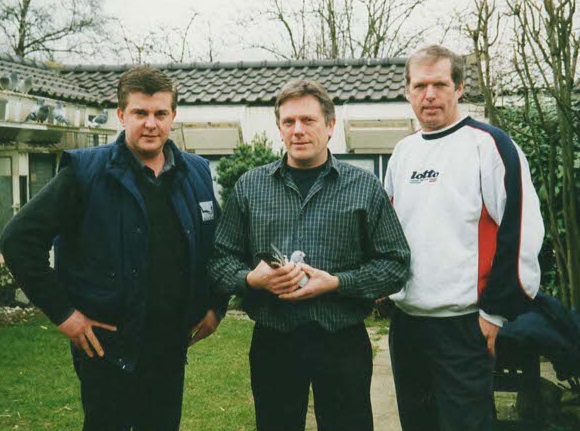
Hans, Joop and Les
However, if there is a lapse along the way, Joop lets a few hens out with the young cocks and, by doing this, the birds soon get their appetite back to race home in the way that is expected,
keeping the standard of performance high. For the majority of the racing season the lofts are darkened to keep the widowhood cocks quiet, unless there is a lack of form (as above), when they need their level of interest raised. While on the subject of form, when the wet weather arrives towards the end of the season, Joop’s heating system comes into use to maintain form. When the cocks are fully on the widowhood system they don’t see their hens prior to the race, until they get to the long-distance races, at which point the system changes slightly. They are then together for 2 half days prior to going into the basket, with the bowl put into the box. Then, when they return from the races, the pairs are left together for a few hours so that they can relax around the loft, after which the cocks are locked up and not exercised again until Monday.
Up to and including the middle-distance races, the cocks can have as many as 18 races, while those prepared for the middle distance receive 5 and the long-distance team only 3. Even though the distance birds have only 3 races, during their preparation period they go to 130, 170, 220, 270 and 330km, then they are expected to go to the races for which they have been chosen. Let’s take a further look at how his pigeons are initially prepared for the racing season ahead. When the youngsters are about 16 days old they are moved. Then the racers are separated for a month, re-paired again for 5 days and then separated again so that they are still in their own sections for the first race of 80km. When they return from the first race they are left together so that by the second race they have had each other’s company for a week, which means that the third race sees them on eggs for 3 days. After the third race they are separated again, at which time they will be on 4-day-old eggs. This system is continued throughout the season. It may sound a bit complicated but if you sit down and set it out on a calendar (it’s much easier than trying to work it out in your head) you’ll see the sense. Training starts during the month prior to the race with tosses from 5, 10, 25, 40, 40 and 40km, then they are trained on the first 4 Wednesdays when the racing season begins at the 40km stage and no more after that. During March they are exercised around home at 4pm only but when we get into April they go onto the normal morning and evening 1-hour sessions. Interestingly, when it is raining the cocks don’t go out of the loft at all. Now, how does Joop select his good pigeons? Not only do they have to perform well but the weather conditions are also taken into account, something many fanciers don’t consider because, to the vast majority, a winner is a winner. However, some pigeons need help and, when the going gets tough and they are expected to work, some pigeons just cannot cope and fall by the wayside. That is why Joop is careful in his selections and why he is one of the top modern-day Continental fanciers. Remember, just because a pigeon wins doesn’t mean that it is a good one. Joop’s racers have to win when the conditions are ideal. By the way, the cocks have just the nest bowl prior to being put into the basket for the races, seeing the hens only on their return. One thing that did surprise me and a point that is not very often raised is how the pigeon handles. Some time after our initial visit we met up again with Joop at the lofts of Taveirne-Rigole and after a few drinks (soft in Joop’s case) and food we discussed the way a pigeon comes to hand. I was taken back when Joop pointed out that it does not matter if the tail comes up when the pigeon is in the hand, this has always been termed as a poor pigeon. Even so what he said is right because they do come in all shapes and sizes and many do handle different to how you would prefer, but a winner is a winner no matter what. The racing season lasts 18 weeks and, during that time, Joop tries to make sure that the pigeons have a full wing right through to the last race. To keep them happy and get them back into a restful, relaxed atmosphere around home for the cold months, they are allowed to rear a nest of youngsters. During this time there is no fancy feeding because Joop puts them on a normal Bosmolen mix for the winter and they have an open loft for a few hours each day. Feeding is done communally in troughs and is made up of the following: Diät and Zoontjes (Koch/Bosmolen) with 25% maize. The feeding system starts on the Saturday when they return from the race. Joop’s feed contains 20% sunflower seed, 20% hemp, 40% Diät. On a Sunday morning they have Diät; evening 50% Diät, 50% Koch/Bosmolen. Monday morning’s feed is made up of Sunday’s mix added to 25% maize and 5% hemp seed. This is then fed until Wednesday evening. On Thursday morning a blend of 50% of the previous mixture is put with Bosmolen PLX Super race mixture and fed until the racers go into the basket on Friday evening. This system is for the short races up to 300km but for the 300 to 500km races the mixture introduced on Thursday will be brought forward and started on Wednesday and so on. For the longer races (between 600 and 1,000km) the Thursday mix is given on Tuesday. During racing, the shorter-distance racers also receive a spoonful of hemp and sunflower seed on Thursday and Friday. Interlabo vitamin products are put on the corn, as planned out by Joop’s good friend, Heinrich Renz.
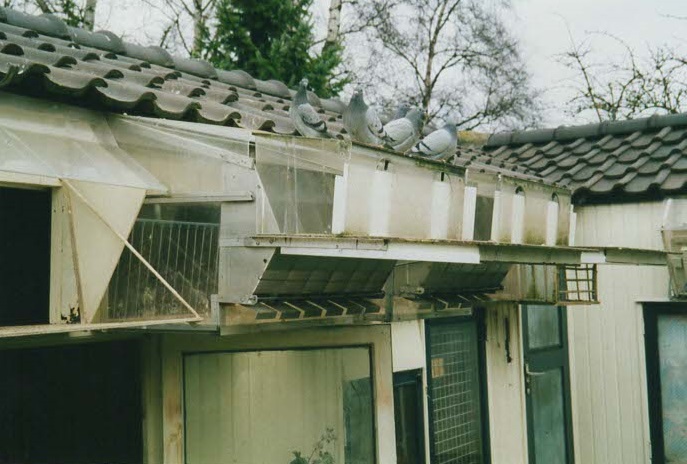
Old trapping system of Joop Koch
The widowhood hens are housed in an open loft during the week and are fed a very light feed daily but aren’t fed on the day after a race. To stop them pairing, there are V perches in the loft, as Joop feels that there is no real need for them to be housed in separate boxes. The widow hens aren’t shown to the cocks prior to the race and the only time during the racing season that they are exercised is when their cocks are away at the race.
My next step is to look at the young bird system and how they are reared, trained and raced. The youngsters are moved at 24 days and are left on the open hole, which helps them to settle around the loft while they are at that early learning stage. Then, until they are 4 to 5 months old, they are fed a good breeding mix? up to 2 weeks prior to the start of the racing season ? and they then have a light mix twice a day. The youngsters are also put on the darkness system from 7 to 15 weeks of age. It is hoped that all of them will be raced to 520km. Different ideas are tried, including having them sitting at about 10 days for the more important races, a method that has brought some very good results. If they are in this condition, they must perform well, otherwise their future is considered carefully, because from the 80 youngsters reared, Joop will be looking to house about 20 over the winter months. When the time comes to make those selections, he takes into account the best results from the 13 races, including the individual distances at which they have performed; the most important races are those at the 300km stage. Also considered is the pedigree, because his birds must be bred right to maintain the standard of the loft. I was looking at the incredible results that Joop has achieved over the years and thinking to myself, how do I list them without taking up too much space?
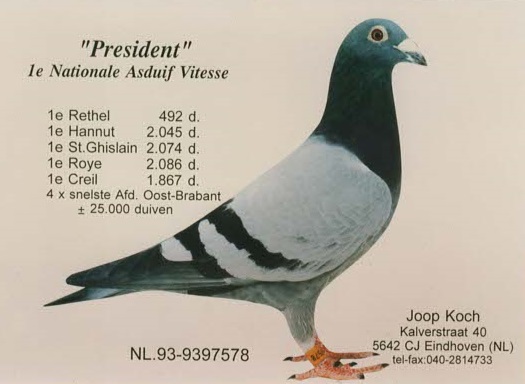
I came to the conclusion that the best way would be to mention a few from 1998 and 1999. In 1998 he was 3rd Overall World Champion WK Versele-Laga, 1st and 2nd Ace Young, 1st Champon Young, 1st General Champion, 1st Aang 2, all with the Mid-Fond Club, 4,000 members, Oost Brabant. In 1999 he was 1st National Mid-Fond Champion Holland, 1st National Sprint Champion Holland, 1st Overall World Champion WK Versele-Laga, 1st National Ace Sprint Holland, 3rd National Ace Mid-Fond Holland, 1st Champion One-Day Long-Distance FC Zuiderkempen Aang 2 and 1st Golden AFD Champion, 4,000 members, Oost Brabant. We shall leave it at that, even though there are many more national and international awards credited to this excellent fancier. However, I must mention that in the last 14 years Joop has won 12 x 1sts General Championship of the CC Eindhoven, 550 members. Joop is also winner of 2nd General Championship Versele-Laga 1997 and 1st National Champion of Holland 1995. In fact, he has won 3 National Championships, done only once before, by Bert Camphuis. This is no flash-in-the-pan loft, as you can see. There is an excellent pigeon worth a few lines and that is Blauwe Favoriet, which in 1999 won 1st National Sprint Holland, 3rd Ace Pigeon National Mid-Fond Holland and 3rd As Doffer WHZB Holland. 1998 was also a good year for this cock with 1st Ace Pigeon Youngsters of CC Eindhoven, 550 members. A full brother of Blauwe Favoriet won 9th National Ace Mid-Fond. If any fancier is going to have continued success, then he has to ensure that the breeding is right, with a good line of pigeons but Joop did say that you have to have a bit of luck.
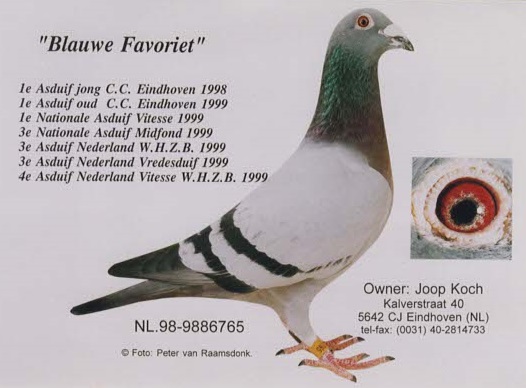
Blauwe Favoriet a top class pigeon, there are many winners down from this pigeon in the UK
The new starter must get some pigeons off a fancier he knows and listen to his advice, whoever it may be, the novice must be able to trust him. Enjoy having pigeons, even if success does not come, because the fanciers he admires most are the ones who keep going, even when they do not achieve success year after year but go down to the club to play their part in keeping pigeon racing going. This was a very pleasant trip, made possible by Hans Verschueren, who we have to thank for giving up his time to show us that the ordinary back-garden loft is still the place to race pigeons from, whether in the UK or on the Continent. Also, many thanks to the Joop Koch household for putting up with us as we seek out and write about the best fanciers. I am going to finish with words from Joop on his ambitions, which are: ‘To continue achieving the results and, at the same time, have a good family life, because there is more to life than pigeons.’