Parkinson. L. J.
We all have our theories about racing pigeons, what we think they need or how their make up should be, this will always vary from one group of fanciers to another. Over 20yrs ago I spent quite a lot of time with Bill Carney who has always had a good knowledge of racing pigeons no matter what part of the pigeon but I must add his speciality is eye sign and he was good at selections in this area. Over a few years I wrote a lot about his theories, I suppose theories is the wrong word because he could certainly select a pigeon better than anyone I knew at the time, so you could say they were fact, a question mark maybe. The reason I have brought this article out is because I am always getting asked about such things and based on where I originally learnt a lot of what I consider to be the best on the wing theory that I write about I am using the original article that was done with Bill, this is one such article.
When I was talking to Bill he said on more than one occasion that the problem with a lot of pigeon fancies is they are “Bar fliers” they spend time in the pub talking about their pigeons under the influence instead of spending more time with their pigeons where they could learn more about them. Spend that time in the loft and study the pigeons that you have and compare them with these photographs and maybe if you look hard enough you will answer some of your own questions that have eluded you for so long. The most important thing that you must remember which should be your golden rule is, 'You can run your hand down the pigeon's wing with your fingers pointed to the ground and your hand should carry on in a continuous curve along the wing and across its back. I am not talking about forcing your hand but more of a leisurely slide so that you are not forcing the wing to the body as illustrated in photo 6 and if you remember that you are on your way to knowing the ins and outs of the pigeon’s wing. Obviously we cannot put down on paper everything that you need to know which is why we are using a series’ of photographs to help make it easy.

No 1 photo you can see the length and strength of the wing, its aerodynamics. In all good pigeons you will find that they have got a gap in the eighth, ninth and tenth flights that you can drop a pea through, you want a long front wing of primary flights and a short back wing, this is where all the aerodynamics come into use. On this number one photo with the pigeon showing you the wing across its back this type of wing is of a pigeon that can fly from 50ml to 500ml quite easily. This is what is termed as a dual purpose pigeon.
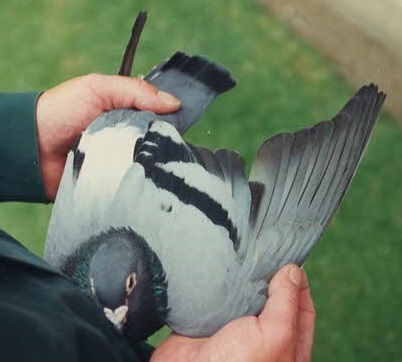
No 2 is of a cock that has won 14 x 1sts up to 200mls this is a sprint wing and therefore should be treated as such if you are to build up a team of top winning pigeons. You will notice with this wing how the last four primary flights are all together, also with this wing you will notice that its wing does not come across the back but runs more or less straight down the side of the pigeon’s body so this is a sprint pigeon and not a pigeon that will perform from 50 to 500mls. On this wing you will still see that it is a delta wing pigeon, aerodynamics. A small back wing but you will notice on the particular pigeon on film that it is also a short front wing and that makes the pigeon to be basically a sprinter.
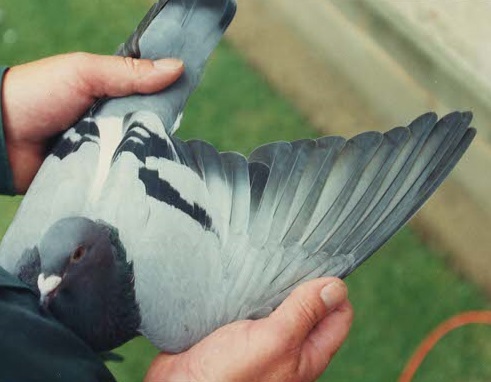
No 3 is a hen that has bred a lot of very good pigeons you will notice how short the back wing is and I mean by the back wing the secondaries which you want to be as close to the body as possible. This short back wing restricts wind from stopping the pigeon from flying fast. The shorter and closer the back wing to the body or the secondaries the faster the pigeon. Pigeons that you want to plod on over 500mls are basically big back winged pigeons.
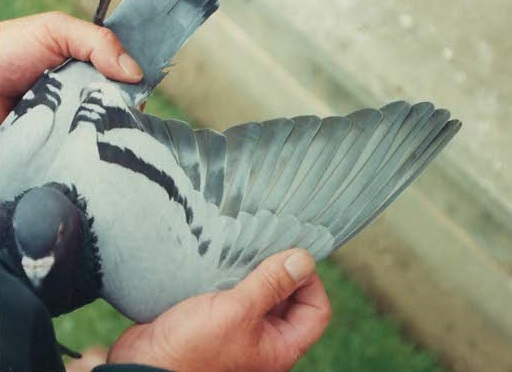
No 4 This pencil blue cock has flown 14hrs 43mins on the wing and you will notice how wide the flights are on the front wing or the primaries. This particular pigeon has been timed in from each National that he has been sent to.
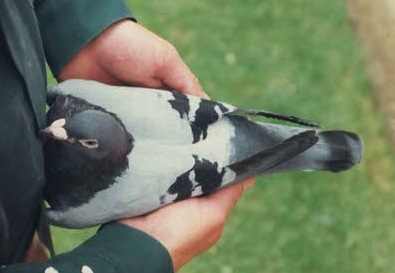
No 5 How a dual purpose pigeon should sit in the hand with the flights nearly touching across the back. This type of wing goes with numbers 1, 3 and 4.
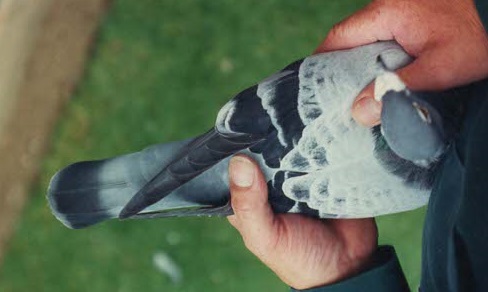
No 6 You should be able to hold a pigeon in the hand and draw your other hand down its side with your fingers at an angle pointing to the ground. The pigeon should taper off straight down the wing which will then go over its back. Pigeons with such wings that do touch across the back will perform at all distances. Therefore you should always try to select a pigeon which has the same width as depth, i.e. the depth from its back to its keel is the same as the width from the outside of the wings. You should be able to hold the pigeon in the hand to taper like a pear. The pigeon should also have a good broad rump.
Fanciers say about a weak backed pigeon but the back is only as strong or as long as the vertebras in its back. The rump is entirely different to the backbone. Therefore, when you get pigeons that when touched on the back and their tails shoot up in the air, it is not weak backed it is only the length of the body structure in its back. When you talk about the back across the rump this is where you get the power for the pigeon to fly from 50 to 500mls. In greyhounds, race horses and human beings their legs are their speed but with a pigeon it is their wings. Always try to get aerodynamics like a swallow in your pigeon's wings basically they are delta winged. A big front wing or primary flights and a small back wing the secondary flights are short in depth, that is from the top of the flight to the butt of the wing and as short from the body to the primary flight, if you can get about two inches gap or two inches of flights in the ten secondaries as short as possible and as close to the body as possible, this particular wing lessens the drag on the pigeon when it is flying. As most pigeon men will know the pigeon only flies with its 7th, 8th, 9th and 10th primary flights. These are the workhorses of the wing. So if you have (like the old English pigeon used to be) through trial and error pigeons to fly 500mls upside down they would do it but not at such a fast speed as the birds cover today from 400mls or 500mls. So by restricting the flights the length of the back wing and shortening the back wing, this then determines your pigeon so it can fly far faster and less drag in the air for the pigeon to move. Basically the pigeon is cutting through the air with a smaller flick on its front wing Instead to having to beat like the old English pigeons used to, like a seagull just batting up and down you will notice that the more modern day pigeon flicks its wings or a jerk and can therefore cut the air far faster and far quicker. You will get big backed wing pigeons in sprinters from 50ml to 200mls because it is a far shorter wing than a pigeon that I will call a dual purpose pigeon that will fly from 50mls to 500mls at velocities of 800ypm to 2000ypm, it is all to do with aerodynamics, where the sprint pigeon is best at about 1350ypm to about 1170ypm up to 200mls. The wing is far shorter and has no gaps in its primary flights so it cuts the air like a bat. This is alright if you just want to compete in races up to 200mls but pigeons that will perform well at 50mls to 500mls it is aerodynamics with a short back wing and a long front wing and if you can in the particular pigeon can drop a pea through the last four flights when its wing is stretched and I do not mean fictitiously and manmade but when you pull the wing out and let it rest on your hand so that you can see this on the last four flights. Always try to pair pigeons up with this type of wing, it is no good putting big back winged pigeon to a short back winged pigeon because you will get so many of one and so many of the other. When breeding you are breeding to a type that will do a job and not just pairing up in the hope that you might get the pigeon that you are after. On the subject of breeding I have never liked the breeding season, don’t know why but I was always glad when it was over. I didn’t realise until this year that there are also many more that look at the breeding season in the same way and bring youngsters in each year.
Les J Parkinson. 11 Rushton Drive, Middlewich, Cheshire, CW10 0NJ.
Tel 01606836036 Mobile 07871701585.
Email;