Parkinson L.J.
Pigeon Fanciers Lung is a common problem in the pigeon world, I for one know because I have suffered with it and spoken to many more that are also in the same position over many years. I am mentioning this now after seeing a very good article by Keith Mott on this very same subject a few weeks ago. I found that even walking in front of the loft I was affected by them so even the hutches that Keith had would be no different to having them in a loft without all the coverage so I may as well have a traditional loft. However I did find that wearing a mask, hat and loft coat which came off when I had finished with the birds all helped. I was told by my Doctor that the hat is one of the most important item that I can use in protecting myself because the dust settles on your head and finds the easiest way into your blood system. Even now without going into a loft but near pigeons I still get affected and the flu symptoms come back again but with the protective clothing I am OK and for many years the pigeons did not affect me as they had done in previous years. When I was in my teens I would go to all lengths to catch pigeons including going into the roofs of old buildings to catch strays. I suppose the way I transported them home was not helpful because I would put them under my jumper and I can tell you walking home cause a few odd looks from people walking by. That would do me no good at all because even though they were strays they still had bloom on them and that was under my nose and rising as I walked home. These are the things we did when we young, they soon disappeared when I let them out so I went back for more. I am always talking to pigeon fanciers to see what is going on and how they race their pigeons, anything that can keep me up to date with what is going on in the pigeon world. I was talking to Ray Lunt recently about one thing and another and I asked about his partnership of Curtiss-Wall-Lunt and why they had stayed together so long. He went on to say that he started collecting pigeons with Alan Curtiss when he was 9yrs and Alan was 11yrs. Alan did leave when he got married but they kept in contact and eventually Alan came back to the partnership. Gary joined when they Ray was about 16yrs and Gary 2yrs younger. These were lads after my own heart who would catch pigeons on old buildings and that was what got them started. This is how many started in those days because there was always a supply of pigeons on the local town square. These lads have been friends ever since and apart from a spell when Les green joined the team they have always flown pigeons together. They have a good understanding of what they all need to do to keep the pigeons in the right condition and more importantly at the right time to win the races. I was corresponding with fanciers in Australia about how we start in pigeon racing and there were quite a few who started in the same way as I did, through feral pigeons in towns Etc. I think it is a case of if you want to stay in pigeon racing it was those early days that keep your interest going. I had no member of my pigeons in the sport prior to myself but my father did get hold of some pigeons for me, they were from his sister’s who were involved in farming. I remember one particular pigeon that John Mellor picked out and because there were so many I let him take her with him. John tried to settle her but as we watched her circling above for quite some time she didn’t look as if she was going to come down as she went higher. All of a sudden she struck a line and out of site never to be seen again. The only other member of my family to take an interest in pigeons is Wayne but he has always had health issues so he is out of the equation. I am surprised at the number of fanciers whose children do not take an active part in the pigeons but they don’t and you will never change them. I was on the subject of the wings in my notes and I recently reproduced an article with details taken from an article done in the 80’s for a magazine no longer being produced. I was asked by a member of the staff at the BHW if this was the famous “Wings in flight” article that I had written many years ago and thought nothing more about it until the Thursday it appeared when I had a few calls on the subject the same day so I quickly got the old article out to refresh memories, by the way the 28yrs mentioned is now just short of 40yrs. This was that original article and I might add that I had emails from publishers of other pigeon magazines asking if they could use it and none were in the UK but much further afield, I should have charged them instead of getting a free copy when it was published. This was the article as it appeared and on reflection I probably should have brought out before instead of the other one because of the in depth information included. “Over the last 28yrs I have written many articles under various names about different aspects of racing pigeons and the sport in general, I think that now is the time to re-evaluate those ideas on what I have seen over the years during many loft visits. In my last article of Cheshire News I touched on the wing and the theories that surround it and as promised I am going into more detail mainly for the comparative new starters of the last 10 to 15yrs. There is no doubt about it the flight of a bird has come a long way since the first known bird in flight which was the Archaeopteryx whose fossils were found in limestone in the Southern part of Germany in 1861. The fossil is thought to be from 140 million years ago, how they come to that conclusion I have no idea however this fossil did give the ornithologist an insight into the first birds of flight because the fossil did have both reptile and avian characteristics. Even so the new breed of animal (the bird) did not develop a great deal over the next 25 million years but then when it did change different species began to evolve. The evolution of birds and their survival rate has made them one of the outstanding forms of life in the world; they see everything from the air and survive in all sorts of conditions on all continents. Over the years different birds have developed and their wings became suited to the requirements of that particular line. The racing pigeon is no different it has changed considerably over the years and has become suited to the distances it is expected to cover. What suites one fancier in the breeding for a distance may not suit another, which is why every fancier cannot have a team of birds to cover all eventualities? If they did there would be no real challenge to racing pigeons. The wing of the racing pigeon is no different from any other part of this racing machine, which is generally developed to perfection. There have been many theories over the years and through extensive breeding to near perfection of the distance that the pigeon is required to fly. Experienced fancier's have bred pigeon's for their preference in racing i.e. the wing for the sprinter or which in the modern day of racing can be anything up to 250mls. Years ago such a distance was classed as middle distance but with the improved knowledge gained by the observant fancier the sprint distance has been increased. This also applies to the middle distance of 250 to 400mls; these races have been covered by more and more pigeon's yearly. In fact if you do not clock on the day from 400mls then something is wrong. The long distance races are upwards of 500mls where the numbers clocked are considerably reduced unless you get favourable conditions, even so there are fancier's who clock from such distances with a greater degree of regularity. After 600mls we are practically always looking at second day birds. We know that the Central Southern have this idea of "At dawn we go". However, in reality there are very few pigeon's that will do that kind of distance on the day from such places as Pau even to the South Coast where they are covering a band of 500 to 525mls to the shorter flying members. I have very often thought of how many pigeons try to make it across the water late at night and fail to reach their destination. Most of the racing done in Britain is on land based on the fact that for the majority of fancier's there are good races without crossing the water. Obviously depending on where your loft is situated you can get a couple of hundred miles plus on either North or South road points. For those fanciers living in the central part of the Country the racing is good because they can get a good land race before crossing the channel which they then get in the last two thirds of the race. Now for the Southern fanciers who want to race the Nationals it is unfortunate that they have to get their birds across the water early in their races if they are to succeed in the big races. We were down at a Blandford lofts a couple of years ago for a Guernsey race and could not believe the problems that the Southern fanciers have from such a short race. What we must remember is that the velocity of a particular race will also have a bearing on the winners as will the wind which is why so much must be taken into account when you are preparing pigeons for sprint, middle or long distance races. Why should this be, well on a hard day with the vel's dropping to 1000ypm we generally find that the fanciers who do well in the longer events are higher up the result sheet? That makes a big difference to the way we pair the pigeons and that is why we should be very selective with our choice. We must never make the mistake of rating a pigeon as an all rounder on the strength of one win in the longer events if it has a proven track record on land but never raced across. If you do class a pigeon as an all rounder then you must take into account the vels on the day as well as the distance. It is a fact that some fanciers will not put a pigeon into a channel race that has a good track record in the land races; this is wise because the pigeon is only built for sprint races in the first place and the wing theory will tell you that this pigeon is not going to make the distance. So what have we picked up so far with the wing theory, the main point being consideration to the conditions of the day? I remember winning a 120ml race when I was working at Foden Trucks at Sandbach and every lunchtime we would sit around and have an inquiry about all sorts of things. One Monday in the early days I went in as pleased as punch because I had won the race on the Saturday that was until the late George Stubbs pulled me up saying that you cannot class a pigeon as being good after winning in a tail wind. Which brings us back to the wing theory and which wing suits which distance? Because no matter how much the comment hurt at the time he was right and it makes you wonder just how much some of the top fanciers actually know and keep it to themselves.
|
|
|
Picture one Picture 1. Dark Hen winner of prizes to nearly 500mls and has been twice 2nd Niort. This is a full wing to race the middle distance where the strength of both the full wing and the strong flights easily propel the bird forward. Take note of the full back wing and also the width of the flights right through the wing. The end flights become slightly shorter for the middle distance pigeon. |
|
Picture two Picture. 2. Is a sprint wing and when the pigeon was tested at 300mls he took rather longer to come home and has not seen a channel race since. However when you send a pigeon across the water it that is not suited to ant distance it does take it out of the bird for future sprint events. But for the sprint races this cock gained positions incl 2nd Fed. On my travels I have found that this is generally the type of wing that picks up speed. If you look at the wing of the Sparrow Hawk you will notice that the back wing is very small and even the primary flights taper off much more quickly that most other members of the bird family. Take note that the primary flights become proportionally longer for the sprint pigeon compared to the middle and long distance birds. |
|
|
|
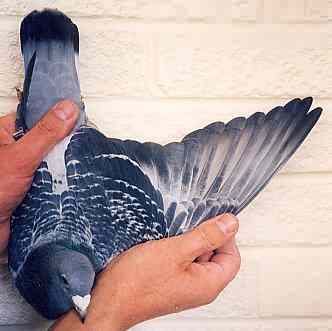
Picture three Picture 3, This is a wing that will put any bird up amongst the winners up to 400 to 450mls but will then drop away, this cock has won prizes in club, fed and Classic up to 410mls. It has a good back wing that is slightly bigger than the out and out sprinters and will race in any velocity. Notice the step up from primary seven to eight and also the slight gaps between the end four flights, this can be found in the sprint and middle distance pigeons. |
|
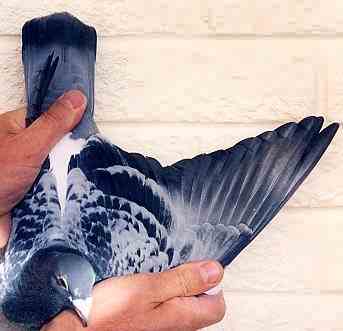
Picture four Picture 4. The wing of the out and out distance pigeon which has a complete full back wing to make flight that much easier for the bird to stay in the air for long periods of time. This type of pigeon does not have to put in the same number of wing beats to cover the distance when they have a long journey.
|
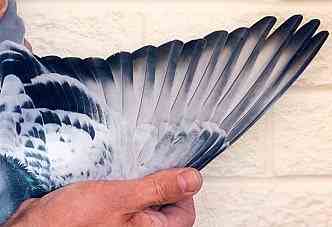
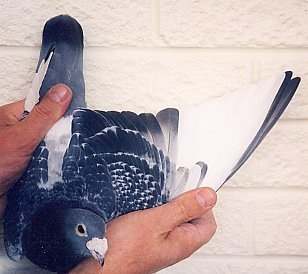
If you look at the birds that soar high above in search of food such as the eagles, vultures, and buzzards etc they all have big back wings which effectively keeps their use of energy to a minimum. When you look at the birds that fly long distances in migration they all have big back wings in comparison to their body. In the pigeon world we have fanciers who have a preference to distance racing and they breed for that purpose which leads to this type of full wing. Pigeons, like birds that are migrating know that geologically they have a big task ahead of them with the distance that they have to cover and therefore they do not put all the energy into the faster wing beat. The problem that the pigeon has with flight is that it is a high cost of energy, which is why the sprinter who puts in the faster wing beats cannot cover the longer distance races. I was once in conversation with a local fancier about one of his pigeons and the wing theory and the term came up "Chicken Wing" and that proved to be his best 500ml pigeon, again the full back wing that a pigeon needs to cover greater distances. There are many fanciers who would like to race from the longer race points but very rarely get the birds home. The reason for that is, they are racing their birds in the shorter events and breeding off those that get amongst the prize winners but for the longer races you have to be after more patient if you are going to get into the big league. Now what happens with the fanciers who successfully race the distance is they are selective with their breeding and only breed from the pigeons who have set a standard of racing which will lead to success in the longer events. The steady pigeon that has the breeding will always come through. There are odd occasion's when the distance pigeon will produce a sprint to middle distance pigeon and when this arises and you look back through the breeding you will see that this has happened before and therefore a throwback. These throwback pigeons will not necessarily produce the distance pigeon even though they have come from the distance pigeon in the first place. This is where you get the all distance loft coming into its own. One thing always infuriates me when you go to the pigeon shows and there is a competition on selection of wings for what distance. In the first place I have no idea who takes the pigeons picture of the wings but they should learn how a bird uses it's wing before they take the next one, then take the photo and ask the question. Taking a photo of a wing that is being stretched out to put it in its full context is about as useful as a chocolate fireguard in a nursery, if you are going to do it get it right and there is no danger of misinterpretation. Always remember that at the end of the day the fanciers must know what they are doing or else you will not get anywhere. Knowledge is helpful but not what we need to win the race. What does matter is how you put that knowledge into use” Brought back memories of some good birds I used to race especially photo 4 he was a real good cock who flew some races for me that I most enjoyed from the distance in the National. I have always that if this cock had been in the hands of a fancier who knew the distance inside out he would have been in the books as one of the all time great pigeon ever to grace the sky. When you look back at racing and the pigeons you have had there are always those who stand out. Mine would be a pigeon I called “Elimar Joe 90” he was a Chequer Krauth cock bred in 82 and named by Kenny Latham. The other is wing number 4 in this article, a cock who found distance racing so easy, I am talking near 700mls in the NFC. Before finishing I would like to thank all the people who have phoned, texted or emailed me about the pages from the past articles and how they have enjoyed them. I must say that we used to go all over the place writing about fanciers at one time but the costs kept rising so I reduced my trips which was a shame because both Elizabeth and I used to enjoy the trips out to meet fanciers. I have done the odd ones over the phone but it is not like going out to the lofts.
Les J Parkinson. 11 Rushton Drive, Middlewich, Cheshire, CW10 0NJ.
Tel 01606836036 Mobile 07871701585. Email;