ANDY PARSONS
of Salisbury
talking to Les J. Parkinson
My first contact with Andrew was when he once again achieved such good results in the San Sebastian National in 2001 winning 1st section 8th open. We of course did the race report and then as always I took a good look at the winners and started select a few names to compile a question and answers series on. This is how the interview went and as always there are is some good information available.
Q. Please introduce yourselves. Where do you live, how long have you been racing pigeons, how did you start?
A. My name is Andy Parsons, I live 3mls north of Salisbury and I have kept pigeons since I was 10yrs old. I acquired my first pigeons from the local market. I entered my first Fed race when I was 15yrs and was lucky enough to win it, but it did take me ten years to repeat that performance.
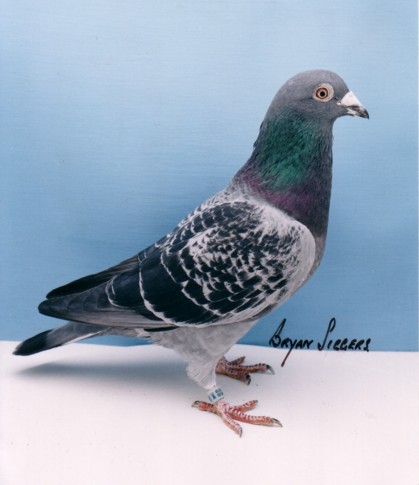
1st Section, 8th Open San Sebastian.
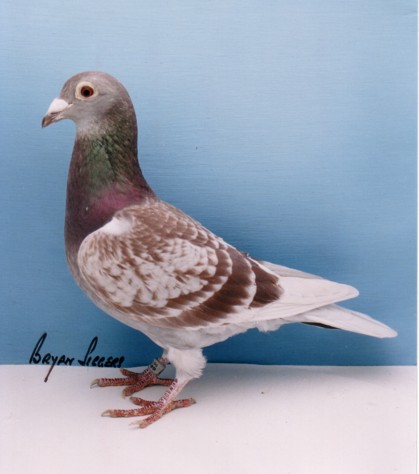
Bred by M. Gower and of Jim Biss lines
Q. Give the readers the basic results that you have achieved as a partnership/own?
A. Up to 1991 I raced mainly club, achieving some good results including highest prize winner 3 years in succession against 35/40 members. Since 1991, I have concentrated on distance racing in the Classic and National Clubs.
Q. Amongst those results what are the real highlights?
A. I sent 4 birds to the N.F.C. Bordeaux race and clocked 3 on the day, winning 38th, 89th Open. I have also been 5th, 10th Pau C.S.C.F.C. and gaining numerous positions in the first 30 over the last ten years. I have been 4th C.S.C.F.C. one other race worth mentioning was a Bordeaux race with the B.B.C. where I clocked 4 birds to win 31st, 48th, 54th and 101st Open. This year my birds have won 1st Section 4th Open Palamos B.B.C., 2nd in the Single Bird N.F.C, 1st section 8th Open San Sebastian N.F.C. with 5 other day birds winning 38th 69th 72nd 152nd 170th open.
Q. What organisations do you race with. Do you have any preference, if so why?
A. The N.F.C., B.B.C., C.S.C.F.C. and Salisbury F.C. I use my club for training purposes, I have no preference at the moment regarding the other clubs as a consider that they are being run equally effectively.
Q. Do you ever think about competing for averages?
A. No, but I did win the 2 & 3 bird average from Pau in the C.S.C.F.C. in 1998. My Pau birds were very rarely raced in the same club more than once per year, which rules out qualifying for averages.
Q. How do you race your pigeons and how many. Do you have any systems, or the condition of how you like to race them?
A. Natural, I keep 80 - 100 birds, 30 - 35 birds of 2 years or over all of which will go to 540 miles and beyond. They are sent on 5-18 day eggs although I find good birds do well at any time of their natural cycle.
Q. What are your lofts made of and how big are they?
A. I have a block built loft of 30ft long and a 12ft long loft for young birds. I also have an aviary on the end of the young bird loft and a small stock loft. The main loft is divided into small sections but usually the birds have access to the whole loft.
Q. Do you attach any importance to having a tiled roof on a loft, if so are there any benefits?
A. I do have a tiled roof, this I feel helps with ventilation.
Q. How many stock birds do you keep and do you breed off your race team also how many pigeons do you think that you need to breed off any individual stock pair each year to see if they are quality producers?
A. I have 10 pairs of stock, I take at least 2 rounds off each, I often change the pairings later in the year and breed the odd late bred. If I like the look of any of these I will keep that pair together the following year. I breed very few from the race team.
Q. When do you pair your pigeons. Have you tried early youngsters if so how did they perform or have you raced late breds and do you pair for any races in mind?
A. Any time between February and the end of March. I let my young birds have a natural life, some may pair later in the season but the ones I seem to do well with in the longer races are April/May bred. This may be because they are still full of flying in September, I won a good Nantes race with one of these birds.
Q. What criteria do you set down for the pigeons you winter with your thoughts on the following seasons racing and breeding?
A. All my birds 2 years and over have to fly 540 - 675 miles in good time, very few survive if they fail to arrive within the first and second day, although I do not judge the 2 year olds on their first performance. The stock birds stand or fall on the performances of their children at the distance.
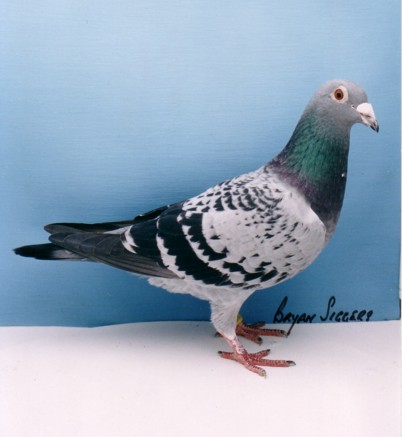
Flown Pau 5 times, winning 10th, 21st, 98th & 99th Open CSCFC.
Bloodlines are Mike Rumbold x Len Painter
Q. What do you think about the vaccination programme for the pigeons and do you think it affects the pigeons long term?
A. I think the vaccination programme should have been phased out long ago, I would rather sort my ill birds out, but I feel it could ruin our birds constitution.
Q. Do you attach any importance to grits and minerals or can the pigeons get what they want they are out of the loft. Do we get any help to solve this problem or is there anything that can be done?
A. Yes, I use both. If I let my birds field I run the risk of Hawk attacks, I lost 12 birds that way in 2000 and 5 in 2001. I don't think we get much help regarding the hawks problem, we should emphasise on the loss of song birds to the general public, we could get more sympathy and understanding from this line.
Q. Do you use any floor dressing or do you clean the pigeons out daily?
A. I use lime, the stock and youngsters are on deep litter as I have little time with the birds.
Q. Do you like to have plenty of room for the pigeons?
A. The more room the better, I have decided to erect an aviary to the front of my lofts, this will allow the birds to have more room and take advantage of fresh air and sunlight.
Q. How do you feed the cocks and what do you feed them on. Are all your pigeons fed the same?
A. All my cocks have high protein food in the breeding and racing season. I add maize and oil seeds for the distance races.
Q. Do you measure the amount that you give to each pigeon, or are they fed according to the individual pigeon?
A. They get as much food as they want.
Q. You have quoted your position on being Easterly or Westerly do you set any stall by the position and if so why?
A. I am in the centre of the country some 25 miles from the South coast. It seems to me if the wind blows East or West someone will get an advantage. If the wind blows South or North everyone has a chance, although we never get a total advantage. In saying that it doesn't worry me where the wind is.
Q. To term a phrase are you a professional team of pigeon fanciers and do your circumstances make a big difference?
A. I'm certainly not and because of work commitments in the week I spend very little time with the birds. If it wasn't for a friend taking the birds to the marking, I would find it hard to race. If the Classic and Nationals could find a way to mark in the evenings I'm sure more working men would send.
Q. Whenever I have visited a loft fanciers always look at the pigeons eye. Do you consider that the eye has any importance in (a) the breeding, (b) distance races (c) sprint races. (d) the pigeons health. Or do you steer clear of the subject and if so why?
A. Like many pigeon fanciers I do look at the eyes, although I don't have an eye sign glass. The last one I had ended up on the railway line next to my house. I do think health is reflected in the eye, it is also useful as a guide within a family of birds. Some years ago I had an expert visit, he said my birds were a mediocre lot. I was highest prize winner in our club for the following 3 years. 2 cocks selected for racing only! The first one bred a bird 8th Open Palamos B.B.C. for a friend, the other bird bred 3 1st prize winners. Most of the birds in our lofts are what they call breeder racers, if an eye sign man could pick the best from these that would be something but in my experience they can't. So it seems to me, it would be better to use our energies testing our birds in the basket which certainly does find our best birds.
1st Section, 4th Open BBC Palamos
Q. Do you use any preventative medication?
A. I treat for canker before breeding and again in June. If I found a major problem with the birds I would get them tested by the vet.
Q. How many weeks do you think a pigeon can maintain it's form on the natural system for both cocks and hens?
A. About 3 - 4 weeks on my system which suits me because I am trying to get my birds into top form for one or two specific weekends.
Q. Do you think a pigeon has the capabilities of racing both short and long distance races. Also what distance can a pigeon actually still "RACE" as opposed to homing from any race point?
A. I think you can win with any strain up to around 450 miles, after that the shorter distance birds become more inconsistent. I only rate birds which are clocked on the day or the winning day, remember Pau is 540 miles tome and Palamos 675 miles. After the second day in any race I consider the birds are working their way back rather than racing. My birds only seem to perform after 300 miles.
Q. What proportion of you pigeons get better on subsequent trips to the long distance races and what do you call distance?
A. I call distance any distance a bird can achieve in two days, after that I consider it an endurance race. I find the birds which have an easy life up to 2 year old return and are clocked time and time again, in fact I like 3 - 6 year olds best but of course the 2 year olds can and do win and learn a lot from their experience.
Q. Which is the more difficult, establishing a team of sprinter's or distance pigeons and why?
A. I would say a distance family, my reason for this is you can judge sprint birds as yearlings, whereas distance birds obviously need longer. I would also say the only way to test and establish distance family is to send as many as you can, I would always forgo pooling to allow me to send and extra one or two birds. The only birds you are testing are the ones you send, and not their loft mates. At first my returns were disappointing, but as I weed out my stock birds I find the returns improve.
Q. Sprinter or distance, there is no difference, it is all in the feeding?
A. No, I don't think so, not for me anyway. I feed high protein, beans or peas and horse beans if I can get them. Feeding my way would win very little in short sprint races.
Q. Taking into account distance, which is more difficult racing to your area, is it a case of a 600ml race is a 600ml race regardless of competition or route?
A. In a 600 mile race our birds in the South encounter the Channel after flying about 450 miles, if they flew the water earlier, when they were fresher I think we would have more day birds. A 600 mile race in Combine or Classic racing, is much different than flying in the National and International races. I also believe if our birds were trained privately from the distance race point, they would not have the pull of other birds and I think we would be surprised with their performances.
Q. What families of pigeons do you keep?
A. I have George Burgess and Eric Cannon bloodlines and a few Len Painter`s. I also swap occasionally with my friends Mark Gower, Mike Rumbold and Pete Lovell. Mark bred my first bird out of San Sebastian, Mike bred my good Pau hen.
Q. How do you go about bringing in a new family and what do you look for. Does strain matter, why or why not?
A. I bring in birds which regularly beat me in the National events. I don't consider that strain matters as long as the birds are doing well at the distance that I am racing at the time. If I see someone doing well I try and visit and if I like the set up and the fancier I would introduce the odd bird and try it with mime.
Q. Early in the article we discussed the wind direction, do you consider that good pigeons will win in any position?
A. Yes I do but of course the wind gives and advantage.
Q. Some fanciers go out and purchase good quality winning pigeons but never appear to make the grade, why do you consider that this happens?
A. I think many are leaving the sport because after paying big money for birds, lofts, feeds and all the potions you can buy they still fail, because they have not learned the basics in conditioning birds. Limiting prizes in Club racing might help. Top fliers in Clubs should consider clocking fewer birds allowing new members a little success to encourage them.
Q. Do you give any special treatments when the pigeons return from the race as a precaution against anything that they may have picked up in the basket?
A. No, but I watch them closely, my winner from Palamos this year did not leave the loft for 2 weeks after returning home. Did you find the reason why or just let it get right by itself. I consider the long rest my birds had helped to rebuild her strength, in fact in the past I have had birds after returning from Pau and kept in the loft for a week or so do well again at one of the later distance races. Incidentally my Palamos hen laid eight days after her return from the race, this of course told me that she was right.
Q. Which of the two sexes do you consider is the most important when it comes to breeding?
A. I am always looking for a good hen, I think if you have got good hens in your stock loft you can't go far wrong. If I do well, I will take a late bred from him/her and use the young hen at stock. I always seem to have more hens in my loft than cocks. Ideally, I would pair a good racing cock which has been clocked from Pau 4 or 5 times, to one of the young hens mentioned before.
Q. Some fanciers like big hens for breeding does the size of the hen make any difference to the quality of youngsters that she breeds in your past experience?
A. No, I have found small hens just as good, most big hens I have had breed big cocks, I like medium to small birds for the races I enter.
Q. Is there anything that you have not won in the sport that you would like to achieve?
A. I would like to win a National race but I would much rather be consistent over the years.
Q. Who do you consider to be the best fanciers in the Country and for what reasons?
A. Because of my interest in long distance races I would have to say Jim Biss, George Burgess and the late Eric Cannon.
Q. What do you think can be done to take the sport forward. What are your thoughts on going International?
A. I would like to see, the Classic Clubs and National Clubs working together, transporting and possibly liberating, in some cases together. I applaud the Welsh for making their Nationals Open races. I would like to fly International races ideally with the National FC or with the BICC. I would only be interested in this type of racing if the British could send large birdage, this would allow the quality birds to break in numbers and race home, I am not interested in birds working their way home over a period of days.
Q. Are there any special treatments that you give your birds once the season has finished what do you recommend the readers to do with the birds?
A. My birds are fed on high protein and linseed up to December, they are then on barley and linseed up to 3 weeks before pairing up. I work on the basis that this helps them to reduce internal fat.
Q. When it comes to breeding do you line-breed or use a first cross or just pair winners to winners?
A. I try all methods. If you get a good bird you have to breed around him/her. Some good birds seem to come from 1st crosses returning back into your own family.
Q. Do you breed off the top widowhood cocks after the racing has finished, do you breed late bred youngsters and what do you think of those later bred youngsters?
A. Because I fly natural, I save the eggs from my birds which are sent to the distance races and foster them under yearlings. I will hatch the eggs from the ones that are successful and use them as mentioned before.
Q. If your race team went off form during the season what action would you take to restore their condition?
A. I would rest the birds which are off form, but with my system where my birds always seem to be in need of a race, you might say they are off form until the distance race which they were prepared for.
Q. Do you use the darkness system for the young birds, if so for how long and do you think it affects them later in life. What do you think about the system where it is used?
A. I personally do not use the system but I have a friend who does and he is a very consistent flyer with his young birds. I feel, if their races are mapped out for them and the birds are not sent week in week out they certainly fly well later in life.
Q. Are there any feeding methods for the young birds i.e. do you break them down, do you keep them hungry for control purposes, do you give them a trapping seed mix?
A. I feed my young birds a high protein mix and as much as they want both morning and evening. Unfortunately my system will cause me to have the odd bad trap but I would rather the birds grow and developed well to stand them in good stead for their work in later life.
Q. What percentage do you consider it takes to win with racing pigeons for Management and pigeons and why?
A. I would say 50/50, if the condition of your birds is poor you will win very little, there are some brilliant fliers about but they could not win with mediocre birds. Most of my birds, because of the way I train them as youngsters, make the odd mistake and the good ones learn from their time out. If allowed to recover they will repay you at a later date, this is where good management comes in by the fancier, it does not matter how good the bird is, if you send a bird time and time again you will lose it or burn it out. That is why I say 50% management and 50% bird.
Q. What is the farthest distance that you would train your old birds or young birds?
A. My young birds start training in late June/July, I give them one or two 15 mile tosses any direction. I then take them 40/50 miles again any direction, this generally depends on where I am working, some might have a night out but my losses are few. I then rest them for about a week then resume training again wherever I am working. My late breds have about 5/6 trainers usually around 10/15 miles, this is completed around Christmas time. My yearlings and old birds start their training at about 20 miles and then go wherever I am working. I then give my 2 year olds, which some are still waiting for their first race, one or two short races of about 80/120 miles. They will then join the older birds and go to one of the intermediate Classic races. On the run up to basketing for Pau, I train regularly from the South or East. This year because there were no races from France, I trained more often than normal, unfortunately I very rarely see my birds return from training.
Q. If random drugs tests were carried out on your pigeons, would it reveal any substance, illegal or otherwise. Do you have any other views on them?
A. No but illegal drugs could finish our sport. I would like to see as many winning birds tested as possible, I know very little about the subject but with the distance birds being in the basket for three days or more I feel that illegal drugs would give little advantage in the races I enter.
Q. How do you consider that the British sport is going compared to the continentals and do they have any ideas that you think would benefit the sport in the UK?
A. Nationals and Classics are doing well but the club racing is suffering, in our area the youngest member that we have in our club is 40yrs of age. I think the reason for the lack of young members is the costs and there are so many other activities for them to choose from. I don't know much about the sport on the continent but going by the large numbers of birds sold in this Country from the Continent I would suggest it is big business over there. Some of the birds that come into this Country are of course top quality but most are rubbish and of course are not helping us regarding young bird losses.
Q. Is pigeon racing as a hobby going beyond the average working man. Is it becoming too technical and complicated or can you keep everything simple and still win with the pigeons?
A. It's as simple or technical as you want to make it. With distance racing it is mainly love of home that wins the day, coupled with supreme fitness and condition. I can achieve this to a certain degree but I feel a type of roundabout or widowhood system would enable me to achieve my ambitions. Would this be more technical? I do not know.
Q. You are successful fanciers, there are far too many leaving the sport, to encourage fanciers to either join or stay in the sport what do you think about limiting prizes to two per race per loft. If not Why. If yes Why?
A. I don't know what is to be done regarding this problem. New members either leave within a year or two, possibly because of cost of being unsuccessful. Some stick it out and these should be encouraged in every way. I think novice trophies and running competitions within club's can be helpful.
Q. Do you think winning fanciers should move on from club racing once they have reached a certain level of consistency. Are club performances paramount for personal satisfaction or sales purposes?
A. It's entirely up to individuals to race wherever and whatever races they want. When I flew Club only I had some good years but found weekly racing too time consuming and I would only put the real work in when we got to the Channel races.
Q. Do you attach any real importance to the pigeons wing i.e. back wing, end four flights and do you look at the wing to see if they have cast before a race. Any other comments on the wing?
A. No. If I have nurtured a bird for 2 years and it is fit, it goes, in fact because the majority of my birds have not reared any young before Pau, they often drop 2 flights just before basketing or in the race pannier.
Q. Do you use any form of heating system in any of your lofts. Do you think it would be advantages for the birds?
A. No not for my type of racing, I want condition in July not April.
Q. Do the pigeons need any special treatment on their return from the race to help them relax. Is any such treatment needed for the short or long distance races or the hard races compared to the easy races?
A. All they get is a light feed and rest.
Q. Irrespective of how your pigeons have flown, what are your views on the past season whether good or bad or the management of the sport in general?
A. I think it was a brave decision for the National and B.B.C. to race from Spain without any intermediate races into France, this season proved what I always believed, a big jump will not hurt the birds if they are prepared right.
LJP. That is it for another article on a National winning loft where competition is all that matters, competition that is at the highest level. Thanks for your time Andrew and it was a pleasure to be in your company at the National FC weekend.