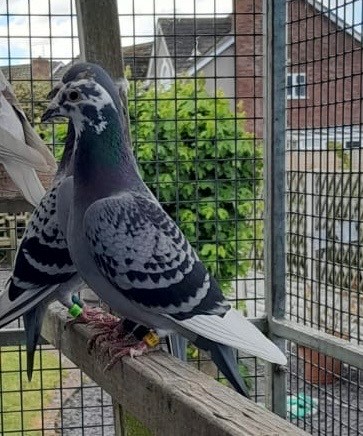
GABY VANDENABEELE
talking to Les J. Parkinson
From time to time the emphasis on winners changes and a new line comes to the fore and their pigeons are in great demand. One of the premier lofts for winning stock at the present moment is that of Gaby Vandenabeele whose pigeons are winning well around the world. This was a loft that I had not visited so when I had the chance on a trip last September arrangements were made for us to call in and see what was so different about the Vandenabeele lofts. The visit was good but the only problem with Gaby is that there is always someone on the phone after him; even so we did get some time with the present master of pigeon racing and breeding. The lofts are spacious and the stock are not confined to a small area where they have limited room for exercise, they have a rather large loft and a very good aviary which is the key to good breeding over a long period.
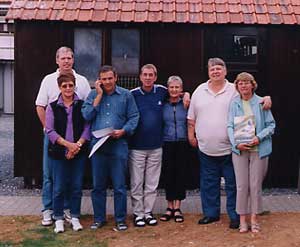
Gaby Vandenabeele on the phone
Q. Please introduce yourself and tell us how you got started in the sport.
A. My name is Gaby Vandenabeele, I'm 53 years old and I live in Dentergem, Belgium. I got started in pigeon racing with my father Gentil who was a very successful fancier in his own right. In 1976 I started racing pigeons in my new built lofts in the Wontergemstraat 72 where I still live and keep my pigeons. My father’s loft of pigeons was built around pigeons from Valere Desmet-Matthijs of Nokere, Pol Bostyn from Moorslade and Lucien Verstraete of Deinze.
Q. Give the readers the basic results that you have achieved.
A. I have won many prizes that include 5 x 1st Nationals and over 60 x 1st provincials since 1988, I was very pleased with 1995 when I won 3 Nationals and 12 provincials. In 2002 I won 24 x 1sts 21 x 2nds 15 x 3rds etc. I was in the first ten 156 times in 2002.
Q. Amongst those results what are the real highlights?
A. 1st National Bourges 13,154 birds with “Rambo”. 1st National Brive 4,719 birds with “Blauwe Fideel” 1st National Brive Derby 3,970 birds with “Blauwe Fideel”. 1st National Limoges 8883 birds with “Ronker” 1st National Bourges 13,116 birds with “James Bond”.
Q. What organisations do you race with?
A. I race mostly provincial and National races. I can't race in regional races because I'm excluded in nearly every regional club because of my good results. It's very difficult for me to live with that but I can't do anything against this way of working of the local clubs. In excluding me they try to keep up their number of members.
Q. Do you hold any official position and if so do you take an active part, if no what are your reasons?
A. No none at I am very busy and I don't have the time for this.
Q. Do you ever think about competing for averages, if not why?
A. I don’t race in the clubs so cannot compete.
Q. How do you race your pigeons and how many?
A. In old birds and yearlings I only race the cocks as widowers. I have about 55 widowers and they race every 14 days on middle and long distance flights. They are on 2 times two lofts that means that every week two lofts go in the basket for a race. Youngsters (about 80 birds) are kept separate males and females. On the day of basketing they are let together for a few hours. That's their motivation for speeding home.
Q. What are your lofts made of and how big are they?
A. All the lofts are made of wood. I have 4 lofts for widowers 2within each 12 birds and 2 within each 16 birds. One loft is about 2.40 m on 1.80 m. I have three lofts for young birds and the size is about 3.00 m on 2.40. Then I have my breeding loft and on loft for the couples that raise the youngsters of the breeding couples. The breeding lofts also have extensive aviaries where the birds can have more than enough freedom to help keep them in good condition. The widows and spare hens are in separate outside lofts. There are also open aviaries where I can house pigeons that are not being used at any particular time.
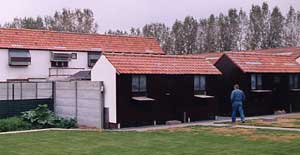
Vandenabeele Lofts
Q. Do you attach any importance to having a tiled roof on a loft, if so are there any benefits?
A. All my lofts have tiled roofs because I think it's better for ventilation. In my widowers lofts I have also ventilators to bring in as much fresh air as possible.
Q. How many stock birds do you keep and do you breed off your race team also how many pigeons do you think that you need to breed off any individual stock pair each year to see if they are quality producers?
A. I have about 30 couples of stock birds. I must point out that before a pigeon is selected as a stock bird he must have proven that he is a very good racing bird. A good racing bird gets his chance and mostly it turns out to be the good way of working.
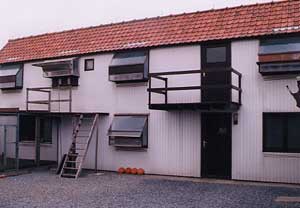
Vandenabeele Stock Lofts (lower floor)
Y.B. Loft (top floor)
Q. When do you pair your pigeons and why then?
A. The pigeons are paired at the end of November; this gives me the opportunity to have early youngsters that are ready for racing when the season starts. Here in Belgium nearly every fancier pairs his pigeons at that time of the year and all for the same reason.
Q. Do you move the hens with the young birds?
A. No. Youngsters are weaned when they are 21 days old.
Q. Young bird sickness is a problem; have you had this in your loft and if so what have you treated them with?
A. I think this disease is a problem for many fanciers but nowadays we have better medication to threat this sickness, so in fact it shouldn't be such a big problem. The only problem is when the young birds get sick in the basket. It may be that the losses on this flight are enormous. A treatment against canker together with electrolytes is good when the sickness occurs.
Q. Do you race your young birds, if so how many races, if not why, do you think they are better off in the longer events if they are only raced lightly?
Young birds need to be raced in order to get experience. They race the full season if their health is good. Healthy young birds don't suffer even if they are raced intensively. Young birds race 2 races of 120 miles, 2 of 200 miles and about 6 races of 300 miles.
Q. What criteria do you set down for the pigeons you winter with your thoughts on the following seasons racing and breeding?
A. Only the one's that have raced well can stay in the lofts. A severe selection is needed to keep the quality up. Especially the youngsters that do well in hard weather are kept.
Q. Do you have any grills fitted in the floor or in the boxes, are there any advantages to using them?
A. I don't have grills in my lofts.
Q. What do you think about the vaccination programme for the pigeons and do you think it affects the pigeon’s long term?
A. I vaccinate my birds against paramyxo. In Belgium it’s obliged. Every fancier all over the world should do so. Only Then we can overcome the disease. Young birds are also vaccinated against pocks and diphtheria.
Q. Do you attach any importance to grits and minerals or can the pigeons get what they want they are out of the loft?
A. There is always grit in the lofts so the pigeons are free to get it. I also put some minerals on the lofts but my pigeons don't seem to like them very much.
Q. Do you use any floor dressing or do you clean the pigeons out daily?
A. Pigeons are cleaned out every day. Every year all my lofts are completely disinfected.
Q. Do you like to have plenty of room for the pigeons?
A. No. I think the lofts mustn't be too big. Pigeons are more in hand as they are in smaller lofts where they are always close to the fancier. Pigeons must have a good relationship with the fancier so they love to be in their lofts.
Q. How do you feed the cocks and what do you feed them on, a branded mix or do you buy separate corns and mix your own?
A. I supply Vandenabeele mixture every day. Only the last two days before the race some maize is added.
Q. Do you measure the amount that you give to each pigeon, or are they fed according to the individual pigeon?
A. The widowers are fed separately. They become a spoon of mix in the morning after training and also a spoon of mix in the evening after training. The youngsters are fed generously twice a day as much as thy can eat.
Q. Easterly or Westerly do you set any stall by the position and if so why?
A. All my lofts are oriented to the south. This gives the advantage that the lofts are very dry so diseases make lesser chances.
Q. Do you consider there to be any advantage having a racing partnership?
A. I race and maintain my pigeons by my own. I don't have experience with a racing partnership but I can imagine that partnerships can have some advantages (dividing the work a.o.) but also disadvantages can occur such as taking decisions on what pigeons to race and how to race them…
Q. Are there any points that you disagree on and if so how do you compromise a situation where there is a different viewpoint?
A. As mentioned I have no partners I race my own birds.
Q. To term a phrase are you a professional team of pigeon fanciers and do your circumstances make a big difference?
A. You can say I'm a professional fancier. The difference is that I put nearly all my time in maintaining, breeding and racing my pigeons. People who do have to go to work can't put as much effort in their sport. As you know pigeons to need a lot of attention and the more they get, the better they fly.
Q. Whenever I have visited a loft fanciers always look at the pigeon’s eye. Do you consider that the eye has any importance in (a) the breeding, (b) distance races (c) sprint races. (d) the pigeons health. Or do you steer clear of the subject and if so why?
A. I attach some attention to the eye but I don't go too far is this matter. Pigeons with different eyes can be good breeders or racers so I think you mustn't set the eye as a final criteria.
Q. Do you use any preventative medication? If a pigeon goes ill do you try to put it right or does the bird have to go?
A I try to use as less medication as possible but if my pigeons don't seem to be well I don't hesitate to go to the vet. Than I follow his advise. I try not to play the vet myself. In youngsters I handle a severe selection on health. The ones that can't stay healthy are moved out.
Q. How many weeks do you think a pigeon can maintain its form on the widowhood system for both cocks and hens?
A. It is my opinion that widowers can maintain their form for 13 to 15 weeks if they are maintained well. After a race they need to recover very fast. They must be fed in a good way i.e. not too heavy.
Q. Do you treat pigeons differently with their preparation if they are to go to the bigger races whether National, Classic, Specialist club or open?
A. No, all pigeons are prepared in the same way, they are all expected to do their share of the racing during any season.
Q. Do you think a pigeon has the capabilities of racing both short and long distance races. Also what distance can a pigeon actually still “RACE” as opposed to homing from any race point?
A. My pigeons can fly first prices from distances of 60 miles up to 550 miles. It has always been my intention to breed all round racers.
Q. What proportion of you pigeons get better on subsequent trips to the long distance races and what do you call distance?
A. My favourite races are between 300 and 500miles. That’s what we call middle distance and distance.
Q. Which is the more difficult, establishing a team of sprinter’s or distance pigeons and why?
A. I have always looked for pigeons that could fly top prices as well on races from 60 miles as on races from 500 miles. They must do well as youngster and as widower.
Q. What happens when you are racing either widowhood or the roundabout when you have a bad race and lose a few from one sex, how do you continue with those pigeons who have lost their mate?
A. I only race widowers so I don't have the problem.
Q. Sprinter or distance, there is no difference; it is all in the feeding?
A. I think it's more in the pigeon. Sprinters have difficulties in racing successfully on long distance flights because they get tired too soon or their orientation is too week. How further the distance the more corn they get because of the sugar contend.
Q. Taking into account distance, which is more difficult racing to your area, is it a case of a 600ml race is a 600ml race regardless of competition or route?
A. Long distance flights are always more difficult. The weather can change during the flight. More other dangers can come up and last but not least the pigeons that take part in the race are severely selected which makes the competition very hard.
Q. What families of pigeons do you keep?
A With the years I built my own 'family' out of super breeder “Kleinen” (1981) he is the base pigeon and my number one breeder and he was never raced. I bred him myself and everything about him came about by chance. The sire of “Kleinen” is “Zitterke” who was on loan to my loft from Jozef Delodder of Zulte, my problem was that all my best hens were coupled so I did not have a hen for him. “Zitterke” was only at my loft for a short time so I went to my friend Gilbert Van Parijs who used to race the young birds very hard. Gilbert offered me his best hen “Ameyke” who had already bred good young bird racers. The “Kleinen” got his name because he was so small but later matured into a good medium sized pigeon. He was paired to the “Goed Jong 76” of my father and they immediately became super breeders when they produced the “Picanol” who won the title of Ace Provincial Champion as a yearling. His descendents were also very good pigeons including “Sissi” who became the base hen for Ad Shaerlaeckens. “Sissi” is a half sister to the father of my Limoges National winner “Ronker” Another good racer was “Fideel” a son of “Zitterke” & “Ameyke” who won 2nd National Limoges against 6,911 birds. A son of “Fideel” the “Schone Fiddel” was 1st National Brive 661km against 4719 old birds and 3,70 2yo’s. The “Kleinen” produced a line of top winners including “Stier” “Turbo” “Dokus” “Bambino” “Wolfgang” “Parel” plus many more. One of the very best I have bred from the “Kleinen” is “Wittenbuik” whose racing in 1989/90/91 was truly outstanding and more importantly there are many winners around the world from this top winner and breeder. The winning line continues with “Bliksem” who missed out on the chance of being National Ace Pigeon because I did not send him to Bourges. “Turbo” another son of Kleinen” has bred some very good pigeons as both racers and breeders such as “Bourges” and “Het Provinciaalke”. It is this type of selection that makes a good pigeon fancier.
Q. How do you go about bringing in a new family and what do you look for?
A. I 'm very careful in this matter. New blood is tested to the edge. Only if racing and especially breeding results are excellent a new sold pigeon can come into the breeding lofts. Mostly I buy back my own breed (min. 50% Vandenabeele) when they made good results in the lofts of my friends. . I am always looking for good pigeons to extend the breeding in my loft so I have introduced several good pigeons but if they do not come up to the standard that I require they are not left in my loft. I also have descendents of “De Vital” 1st National Ace pigeon long distance. Just before finishing on the breeding I must mention “Turbo” who was 1st Ace Pigeon West Flanders long distance in 1993 and in 1994 was 2nd Ace Pigeon in the same category.
Q. When you bring in that new family do you think that they need time to acclimatise, if so how long?
A. A short period of acclimatisation must be allowed in order to set the new pigeons at ease but this period mustn’t be too long because good pigeons adapt fast.
Q. Do you think that fanciers change for the sake of changing or do you think a loft can breed a winning team out and lose track of the winners?
A. If all stock birds are family of one and other than it's really the time to look out for new blood. Otherwise you come into a vicious circle of inbreeding and the quality of the pigeons can go down. I really don't like inbreeding.
Q. When looking for new pigeons do you look for a particular family, one for specialist races or club races or just be name?
A I this case I only look for the best pigeons over all distances regardless of the name..
Q. Early in the article we discussed the wind direction, do you consider that good pigeons will win in any position?
A. Yes. But in races with tailwind a lesser pigeon can also win. That's impossible in races with low speeds.
Q. Some fanciers go out and purchase good quality winning pigeons but never appear to make the grade, why do you consider that this happens?
A. I think a fancier is 'born' as a fancier. Some people do really have the talent to breed and race pigeons. They have a wonderful relationship with their pigeons. These are the real champions.
Q. Do you give any special treatments when the pigeons return from the race as a precaution against anything that they may have picked up in the basket?
A. Not really because I only give electrolytes after a hard flight to help them recover faster.
Q. Do you race your pigeons every week or do you prefer to condition them for a specific race?
A. My youngsters are raced every week. The widowers get rest one weekend between two races because they are raced on distance flights.
Q. Is there any specific condition that your pigeons perform best at, or any particular time of the year?
A. My pigeons perform best if the weather is good and the wind blows in their faces. So in hard weather they do best.
Q. In your view do you think that a loft needs different pigeons for different distances?
A. No, good pigeons do well on all distances that is why they are good pigeons in the first place.
Q. Which of the two sexes do you consider is the most important when it comes to breeding?
A. Both sexes are very important.
Q. Some fanciers like big hens for breeding does the size of the hen make any difference to the quality of youngsters that she breeds in your past experience?
A. I don't think the size is so important. What count's is the ability to breed and to race well. This ability you find as well in big hens as small hens. That's why I don't take the size as a parameter.
Q. Is there anything that you have not won in the sport that you would like to achieve?
A. To win a National flight is the highest you can obtain in our sport. I already have 5 of these victories but I would like some more if possible, you have to keep looking to improve.
Q. Who do you consider to be the best fanciers in the Country and for what reasons?
A. Eric Limbourg. He performs outstanding on all distances.
Q. What do you think can be done to take the sport forward?
A. Support for the starting fanciers is most important.
Q. Do you read many magazines/Articles, if so which type of article do you find interesting and why?
A. I'm not so much of a reader because I don't have so much time for it but articles on top fanciers are always interesting because many times you can learn out of it.
Q. Are there any special treatments that you give your birds once the season ha finished what do you recommend the readers to do with the birds?
A. You should give them as much rest and joy as possible. Take care they are well and in good condition for moulding which is very important for the next season. They need much fresh air in the after season period.
Q. When it comes to breeding do you line-breed or use a first cross or just pair winners to winners?
A. You can find my breeding strategy in my catalogue by carefully studying the pedigrees. I try to pair up good x good.
Q . Do you breed off the top widowhood cocks after the racing has finished, do you breed late bred youngsters and what do you think of those later bred youngsters?
A. Only the widowers that were very successful on the races are allowed to the breeding lofts. The selected widowers all breeds after the season.
Q. If your race team went off form during the season what action would you take to restore their condition?
A. I would not race them anymore and go to the vet. Only after a serious investigation I would take action. Getting out of condition can have many causes so the first thing to do is find the right cause. Only then you can decide what to do. Three days Blitz-Form from Röhnfried is always good to bring the birds back in form.
Q. Is a favourable loft location the single biggest factor in sprint racing?
A. A favourable location can be interesting but the skills of the fancier and the quality of his pigeons will also have a lot of importance in order to get good results.
Q. Do you use the darkness system for the young birds, if so for how long and do you think it affects them later in life?
A. Yes. I start darkening half march until begin of June and this from 17. 00 pm until 7.00 am. I think as a yearling all effects of darkening have disappeared.
Q. Are there any feeding methods for the young birds i.e. do you break them down, do you keep them hungry for control purposes, do you give them a trapping seed mix?
A. Vandenabeele mix as much as they want twice a day.
Q. What is the farthest distance that you would train your old birds or young birds?
A. Old bird fly up to 550 miles, young birds up to 300 miles.
Q. If random drugs tests were carried out on your pigeons, would it reveal any substance, illegal or otherwise?
A. I have had many controls and never an illegal or other substance was found.
Q. Is pigeon racing as a hobby going beyond the average working man? Is it becoming too technical and complicated or can you keep everything simple and still win with the pigeons?
A. You have to set your goals. You can keep small and beautiful and win many prices.
Q. You are successful fanciers, there are far too many leaving the sport, to encourage fanciers to either join or stay in the sport what do you think about limiting prizes to two per race per loft? If not Why? If yes Why?
A. No, that would be to radical. Also successful fanciers have to restart every season. It may well be that one season is better than the other so what criteria do you set for a 'successful fancier'.
Q. Do you think winning fanciers should move on from club racing once they have reached a certain level of consistency? Are club performances paramount for personal satisfaction or sales purposes?
A. See above. In Belgium they can exclude you from your club if you’re too successful and that's what happens to me. I'm not glad with it but I can't do anything against it.
Q. Do you attach any real importance to the pigeon’s wing i.e. back wing, end four flights and do you look at the wing to see if they have cast before a race. Any other comments on the wing?
A. The end four flights must be long and not too wide. They mustn't deform after a long flight. They are strong and bendable. The pigeons must feel very soft.
Q. Do you use any form of heating system in any of your lofts. Do you think it would be advantages for the birds?
A. I don’t use such systems as I prefer to keep them as natural in the elements as I can..
Q. Do the pigeons need any special treatment on their return from the race to help them relax? Is any such treatment needed for the short or long distance races or the hard races compared to the easy races?
A. A good bath can do wonders and help settle the birds down when they have returned from any race, they need to relax and feel happy to be at home.
Q. Irrespective of how your pigeons have flown, what are your views on the past season whether good or bad or the management of the sport in general?
A. 2002 was one of my best seasons but all fanciers must look to maintain a standard or even improve no matter how good the results have been.
Q. With your pigeon work do you have a silent partner i.e. wife, partner or friend, if so what part do they play?
A. My wife is a great help for me. I also have good friends who are willing to help me where needed.
Q. Is there anything that you do not like about the sport, something that you feel needs changing for the good of the sport?
A. Like in all sports there are always things to improve but in general I'm pleased and I enjoy racing my pigeons and the people that I meet.
Q. Do you compete in the National events, if not why not? Or are you happy to race in the club?
A. I compete in National and Provincial events. In the club I'm excluded because of my results.
Q. Do you have any further comments about anything that we may have missed in any area of the sport?
A. I attach very much attention to earth radiation. If bad radiation surrounds your lofts your pigeons will not fly very good.
Footnote. I would like to thank Gaby for the time he gave us on our trip and also the help in compiling this report that I hope the Vandenabeele enthusiasts will enjoy. It is always nice to report on the winning lofts of the day from the continent where many of the winners are being bred from.