Elimar is inviting successful fanciers to tell us a little about themselves, as we feel sure that this will create plenty of interest for our readers in the UK and around the World. Roger Lowe kicked off the series, followed by Jason Ross, Mike Mitchell and Mel & Sue King. Next up is John Halstead.
JOHN HALSTEAD
Although never sending many birds, in the last 4 racing seasons alone John Halstead has won: 3 x 1st Nationals at 429, 682 and 696 miles and 3 x 2nd Nationals at 161, 696 and 697 miles plus 6 x 1st Section in The National Flying Club; 3 x 1st Federation; 3 x 1st Section BICC; 20 x 1st Club; 3 x 1st Section BBC; 6 x 1st in Gold Ring races.
Todmorden, a town between Burnley and Halifax in the Pennines, was the place I first started in pigeons in 1966, in partnership with my brother. It was in 1967 our first season racing young birds that in the final race we won 1st Club and 2nd South East Lancashire Federation - I was 8 years old at the time. My brother soon found other distractions and left the partnership, but I continued with regular help all the time in the background from my father – who had no previous involvement with pigeons. Living in a farm cottage we could not have the usual pets, so one day the farm feed merchant presented us with 2 pairs of racing pigeons; and so began a lifetime with pigeons.
In 1969 my father took me to Cheshire to visit Bill Hammond of the famous Hammond & Whittaker and we went home with some ‘Grooters’, the ‘in vogue’ family of that era. We also visited Allan Bullen of Croston, famous for Croston Barkers and added another couple of birds and some sensible information.
Between 1967 and 1970 I gathered as much pigeon knowledge as possible – listening to all the top local fanciers, visiting every fancier that would allow me into their lofts and looking at and handling hundreds of pigeons, some good, some bad and some indifferent. On a snowy winter's day in 1970 at the age of 12 my father and I went to an auction sale near Burnley and I proceeded to look through all of the birds that were in the sale room, marking down what I thought were the best ones. Probably because of the bad weather there were very few buyers at the sale and I managed to buy the 5 I had marked down. The cheapest, a blood red black splashed cock, was 30 shillings and the most expensive, a lovely small mealy hen, was 75 shillings. All 5 birds made a notable contribution to the loft; the red cock won from Rennes 388 miles and the mealy hen bred our first Lancs & Yorks Border Championship club winner from Nantes, 450 miles, when she was paired with a Grooter cock from Bill Hammond. Another red chequer cock costing £2 sired our Pennine 2 bird club 500 mile winner, so I think my instinct and ability to choose and select ‘the best’ pigeons showed in my youth and hopefully has stayed with me to the present day, and this now is known as stock sense.
I have kept pigeons almost continuously since 1966 and have been fortunate to win a first prize every season since then. These days my main interest lies in the longest National races – the Blue Riband races which the premier flying clubs in the country organise annually. Having twice won the British Barcelona Club’s longest race, I suppose that my next target should be Tarbes with the National Flying Club but these are all prestigious races and I feel are now firmly in my sights along with the chance to take on not only the best UK flyers but also the best in Europe in the International races. In the last 3 seasons I have had a couple of excellent International results (264th from Barcelona 27,627 birds and 17th Agen 22066 birds) and it is very pleasing to read down the international list and see my name appearing above some famous Dutch and Belgian fanciers that we used to regard as ‘pigeon gods’ a few years ago. Obviously in any pigeon race the wind plays an enormous part, but more so in the International races but the growing list of excellent British fanciers who have achieved 1st International proves that with favourable winds we Brits can take on and beat the very best in Europe – but of course you have to be ‘in it to win it’ – so we must support the British International Championship Club and thank them for offering British fanciers the opportunity to be able to compete in the Internationals.
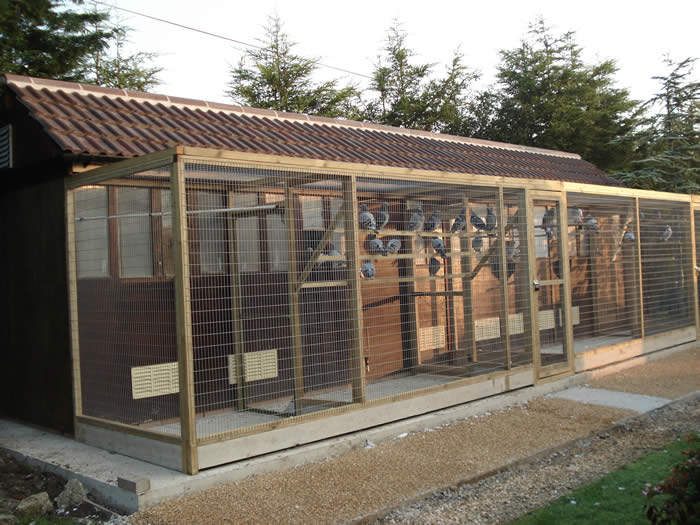
My stock loft
My present day families of pigeons should allow me to be competitive at most races but the majority at stock would come under the heading of Long Distance and Endurance birds. I have learnt over the years that how a pigeon is prepared and fed can also be a factor in just which distance category you can place it. For example my 2009 Barcelona winner (696 miles) is from the Janssen Van Den Bosche/Grondelaar family – not a family you would normally associate with 700 mile races but as with several other good pigeons I have owned, he put up good performances in races of 200 miles then 330, then 500 and then 700 so he should be in the Middle Distance to Long Distance category, and the same would apply to my Jim Biss x Norman Southwell family. I have also obtained close relatives of recent Barcelona and Palamos race winners and intend blending these individual pigeons into the previously mentioned families. This way, I should be able to maintain the original families and trial some crosses with the same long distance and endurance overall characteristics. I also have a few pairs of Gaby Vandenabeeles which excel in the shorter races, most young bird events and up to but not beyond 500 miles. Other Janssen based birds are kept for the shorter faster type races, because I want to be competitive whatever the racing distance and conditions.
In my stock loft, the number 1 breeding cock is ‘Nyland Ashley’ who is of the Biss x Southwell bloodlines, being a son of Jim Biss’ Turban which was 2nd Open NFC Pau at 650 miles paired to an Ernie Deacon Southwell. Ashley put up a string of top National performances ending with 2nd Open BICC Barcelona (696 miles). As a widowhood cock he bred a hen to win 1st Section BBC as a youngster and another to be 15th Open National, so he had shown he could breed top performers. Put to stock at the end of the 2008 season, he is now grandsire to 1st Open Palamos (682 miles) and to 1st Section NFC Tarbes (548 miles) and a host of other excellent pigeons. His half brother, from the same sire (son of Turban), named Cassius was 1st Section 2nd Open BICC Barcelona and 1st Section 13th Open Perpignan (618 miles) in 2011. I have around 20 grandsons or sons of Ashley in my 2012 race team.
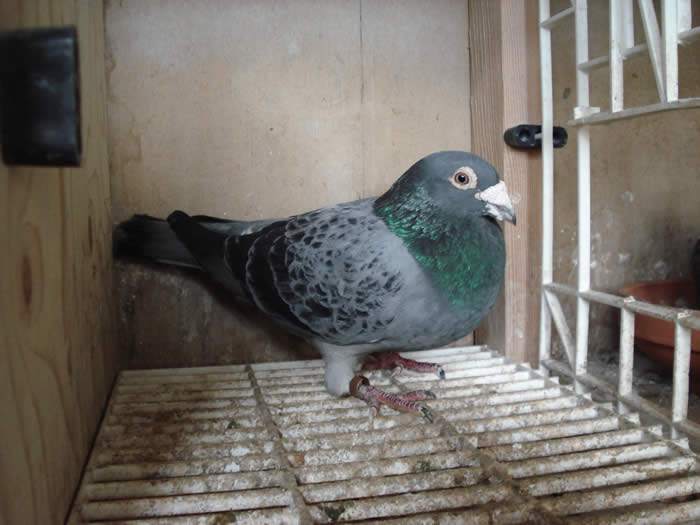
Son of Turban. Sire of Cassius - 2nd Barcelona. Also sire of Ashley - 2nd Barcelona.
This leads me into the accommodation for my race team, because along with the 20 cocks all closely related to Ashley I intend racing a further 27 cocks making a race team for 2012 of 47 widowhood cocks. These will be housed in 4 different compartments – each containing 12 widowhood nest boxes. It is unlikely that I will race any hens other than in late August and September when hens can race with the young birds in the Old Hens National and Classic races. I believe that my widowhood cocks can compete anytime, any place, anywhere and in 2011 my racing hens were always more than 15 minutes behind my cocks in every race. The 2 hens that I prepared for the September Old Hens races did manage to take one 1st, two x 3rds and a 5th Section in 2011 though. The key to racing old hens at this time of the year is the state of the moult and I deliberately mated these 2, very late (May) and raced them with babies in the nest to hold back the moult. Four top 5 Section prizes from 2 birds was very satisfactory.
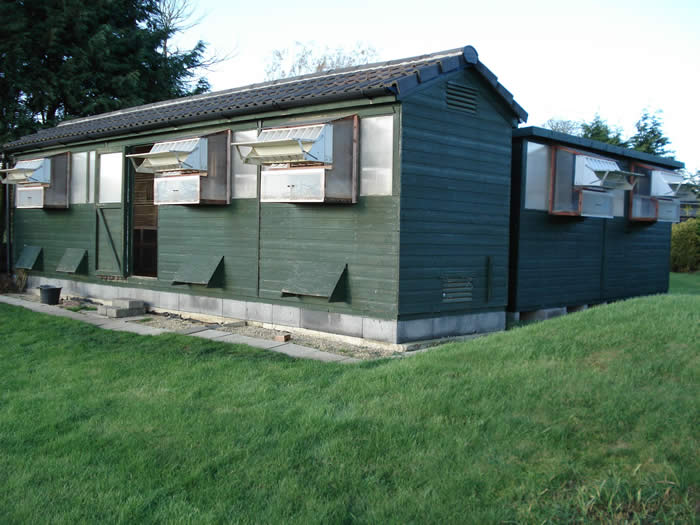
My racing lofts
For 2012, I have replaced a 9’ x 6’ apex felt roof shed which I brought down from the Midlands with a brand new 10’9” x 6’ plywood loft with a tiled roof. It is quite high at 7’ and contains 16 ‘Hermes’ self cleaning, conveyer belted, widowhood nest boxes. My intention is to put 2012 young birds in this loft and use plywood shutters to darken as required for my standard young bird darkness system. The widowhood boxes will be used as deep box perches allowing perching for 32 birds although it will probably house 24 youngsters. At the end of the season the young cocks that remain will stay in the loft and revert to widowhood for 2013.
I am very much against overcrowding and have 4 different racing lofts measuring in total 70’ x 6’. The stock loft which also houses the widowhood hens and has an aviary running the full length is 32’ x 6’. I also have a 13’ x 8’ purpose built loft to house developing youngsters. The main racing loft faces South as does the stock loft but the other 3 racing lofts face East. All have housed winners, but my 3 National winners all had nestboxes in the South facing tiled roof loft. This winter I will house in total 152 pigeons.
The raptor problem, which in my area (South West of England) is at its worst in March and April, has made me reconsider my breeding and pairing dates. I do not intend pairing any birds before the Blackpool Show, and I will mate my main race birds on St Valentine’s day. I see no advantage to breeding early because the Darkness System helps youngsters to mature quickly anyway, so they are always ready for my target races which are the Nationals and Classics late in August / early September. Flying out young birds in March and April whilst the raptors are hunting and the female sparrowhawk is building herself up for nesting, would result in carnage and a team of frightened young birds which would not want to venture outside the loft and exercise. My youngsters rarely go out now before the first of May the time when most sparrowhawks have gone to nest.
My old birds, unfortunately have to ‘run the gauntlet’ in early April with loft exercise although I am usually close by to guard my flock as best I can. Only the race cocks are exercised and the aim is to improve general fitness before training starts. Generally a first toss at 9 miles and then a further 4 more up to 25 or 30 miles is the only training my birds get before an 80 mile club race. Conditioning is then achieved by home exercise and Saturday racing.
I use very little medication for my birds. I vaccinate every bird in the loft the last week in December for paramyxovirus. Every bird receives a worming solution for 24 hours in mid January and when each compartment is sitting the 1st round of eggs for 8 days, they receive a 5 day course of canker treatment. The race birds may have a 3 day canker treatment again towards the end of May and usually that is all.
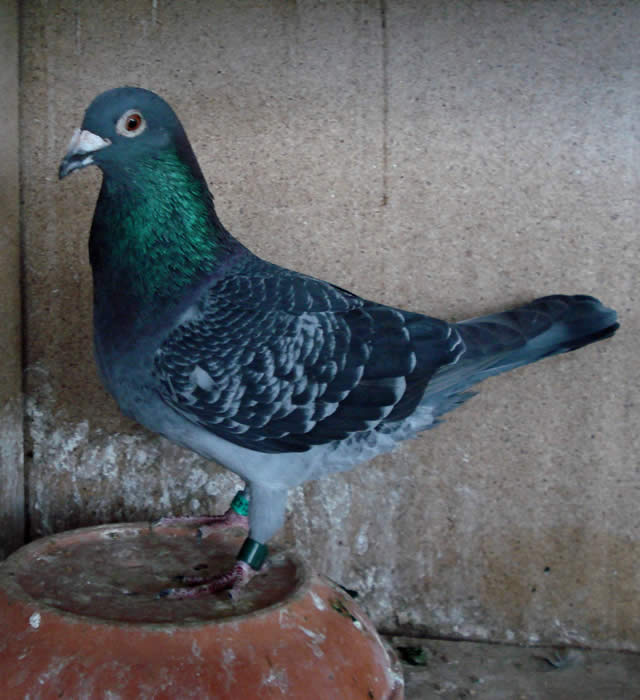
Cassius - 2nd Open Barcelona 2011
My breeding mixture is purchased from A E James of Barrow Gurney, near Bristol and I mix 2 bags of their Ponderosa Special breeder with 1 bag of Concord – which is mainly maple peas, to give me a good general breeding mixture containing a good variety of grains and in particular maple peas. They also supply my racing feeds which are Versele Laga Depurative, Gerry Plus and Super Widowhood. I also like their Countrywide Young Bird no maize, or Breed and Wean for my developing youngsters.
I believe that the best supplement to aid with breeding and rearing healthy, robust youngsters is Harkers Hormoform. This, introduced before the evening feed each day, provides added vitamins and really makes a difference to young birds receiving it. I also use Old Hands Golden Boost, which is fortified calcium concentrate powder, and I follow the recipe instructions on each tub to mix it with pinhead oatmeal (groats), sugar, water and cod liver oil to give when dry to most of my birds. They receive just under a level teaspoon per bird, daily from February to September. I have found that Gemthepax from Gem Supplements is also a good supplement for breeding and I use it every other day in the water, when there are youngsters in the nest. Grit plus redstone and clay pickstone blocks are also used on a daily basis during the breeding and racing season.
In old bird racing over the last 10 years I have developed and improved my own widowhood system and find that it motivates my birds to win from 80 miles to700 miles – so I am happy to continue to use this system with only a little ‘fine tuning’. Of course I only race the cocks, and the hens are at home all the time, to welcome back the cocks from any races. Observation is always important in pigeon keeping and I keep a very close eye on all aspects of my race team from exercise to feeding and just general behaviour. This can lead to me using motivational techniques inspired by this behaviour. I am always looking to use different tactics. Keeping the widowhood hens in tip top condition for their mates is also vitally important, and they must play their part in encouraging the cocks to race not just home.
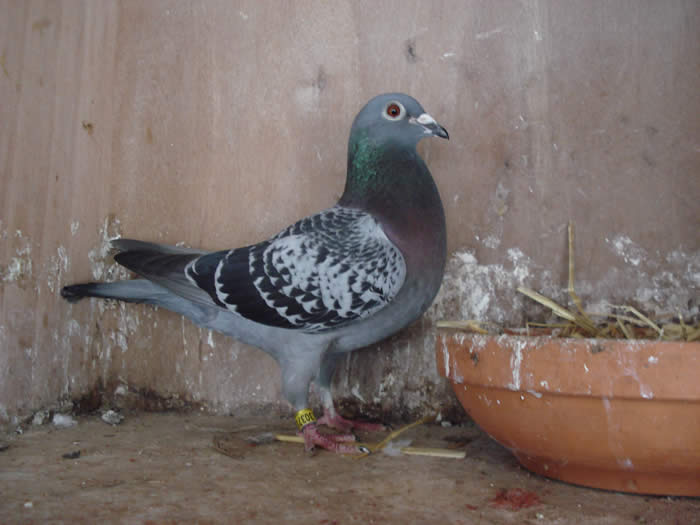
Dam of Cassius - 2nd Barcelona. Jimmy Sheppard Southwell lines.
I still have a few ambitions in the sport. Certainly to win the BBC Blue Riband race for a third time would be special because I believe it’s not been done before. The National Flying Club's Blue Riband Tarbes National would be another target, and now that more fanciers are interested in the International races it would be an ambition to improve on this year’s 17th International from Agen.
I have never really been influenced by individual pigeon fanciers – though I have in the past asked Geoff Kirkland the odd question and of course Geoff being the gentleman he is, has always answered informatively. Of course over the 45 years I have been involved in the sport I have listened to many fanciers and read many articles about the methods of successful fanciers and have tried to incorporate the best ideas into my own management. In my early years my father would regularly send me off to the pigeon club with the words ‘Listen and say nowt’. Good advice for someone eager to learn. In more recent times I have tried many different things and some have worked well and others have failed, but I can certainly say that I have learnt from my mistakes and perhaps now don’t make quite so many. In most sports the team or man that makes the fewest mistakes ends up the winner. Couple that with good healthy pigeons housed in well ventilated dry accommodation and a good management routine and you have a good chance to achieve some notable performances with pigeons.
Our thanks to John for taking the time to compile his thoughts. Next up in the Elimar Invites series, R & B Smith.
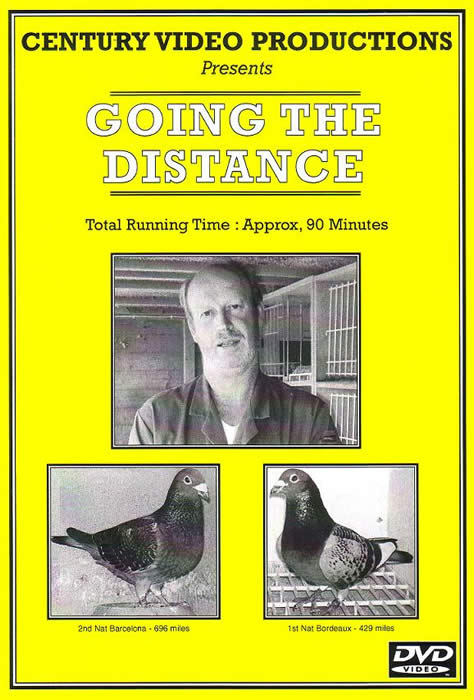
Going the Distance is one of 9 John Halstead DVDs available via Elimar (click on the Pigeon Racing DVDs logo towards the top left hand side of this home page). John's pigeons have won THREE firsts and THREE second Nationals in the past four seasons up to and including 2011 in races from 162 to 696 miles, and in his 45 years in the sport John has won literally hundreds of first prizes. This 90 minute DVD covers widowhood and natural systems and explains all aspects of preparing pigeons for long distance races, particularly the feeding. It includes information on: the racing and widowhood hen lofts; preparation for the new season, pairing dates; canker treatment; exercise, training and improving fitness in early season; the widowhood routine; the pigeon food and water additives; using the natural system from June; preparing birds for longer races; feeding for the long distance. Going the Distance is priced at £20 inclusive of postage.