Elimar is inviting successful fanciers to tell us a little about themselves, as we feel sure that this will create plenty of interest for our readers in the UK and around the World. Roger Lowe kicked off the series, followed by Jason Ross, Mike Mitchell, Mel & Sue King and John Halstead. Next up are North-West legends Bob & Brian Smith.
R & B SMITH
OF BURTONWOOD
We race as R&B Smith at Burtonwood near Warrington. Bob started racing with Dad in the fifties, this being on an allotment at the rear of the family home; the lofts had to be moved to the small back yard of the house in 1962. Brian was always involved with the birds and became a partner after the death of Dad in 1971 when the above partnership was formed. Dad’s family have been involved with pigeons since just after the First World War; they were also all good stock men keeping any and every kind of livestock. As kids (there were 7 of us) we were involved with the upkeep of the livestock on our allotment, all having jobs to do before and after school.
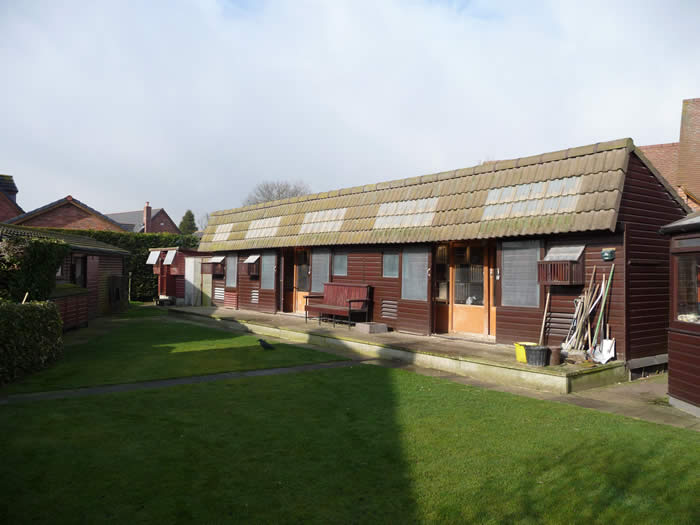
The main racing lofts.
We have always been channel orientated, with the national races and the 2 bird specialist clubs taking priority. Here in the North-West of England we are lucky to have an abundance of 2 bird clubs. These in the main are the type where you take your two entries to be marked and basketed with the other members and not double banked out of the normal Saturday clubs. We are members of The N.F.C., M.N.F.C., North West Grand National, North West Classic, North West Nantes 2bird, North Ashton 2bird, Wigan 2bird, Warrington 2bird, St Helens 3bird and Eccles 2bird, this latter one being doubled banked out of Section L with the N.F.C. Our Saturday clubs are Burtonwood with the Merseyside Fed and Earlestown with the Two Counties Combine.
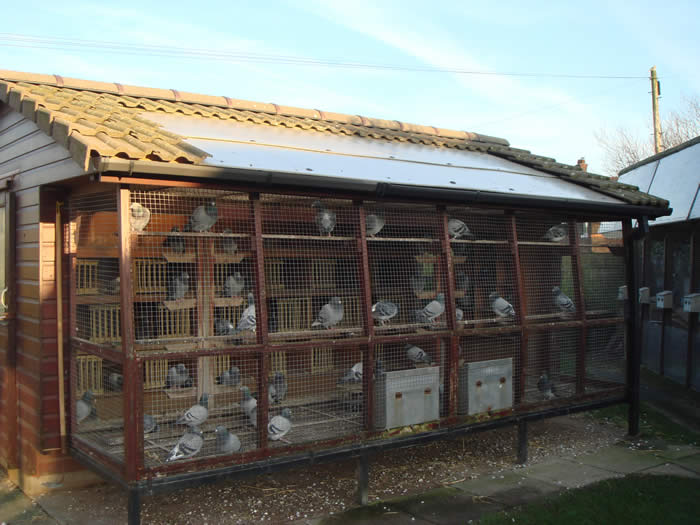
Main stock loft.
Over the last 30 years we have tried numerous families of pigeons, starting with the birds raced by Dad and Bob, these being a mixed bag. The first introductions were the Pickavance birds, these being, in Jim Pickavance’s words, loosely based on Soffle, Hansenne and Barker. These won for us but were out and out distance birds and with pigeon racing getting more competitive, if you couldn’t compete from the first race to the last you were an also ran. With this in mind we introduced the Dordins from D&E Sixsmith, and Stichelbauts from them and T J Lofts were brought in. Let me add all these fanciers were in the clubs we raced in so we knew the calibre of both fanciers and birds. Crosses were tried with all these, with some of the best distance birds we have ever raced coming from Dordin, Stichelbaut, Pickavance crosses. In the late Seventies the Busschaert birds were making a big impact in the North West. At this time we were planning a move to Burtonwood so put off trying these birds until Alun Reed from Blackwood in Gwent was having a sale at Garswood. We had some Dordins off Alun so knew the quality of birds that he kept. We brought in just 2 pairs of his Busschaerts, these breeding winners from day one so a few more pairs were sourced from him, these also breeding winners from the off. The Busschaerts would win up to 370 miles but we struggled to get them past this; even when we crossed them they were not getting the longer races. In 1986 Bob was on a quiz panel with Dave Allen and Dave told him about the Van Reets he had just introduced. Dave was good enough to sell us 8 young birds in 1987 - 3 cocks and 5 hens. We sent for 2 young cocks off Ian Axe, one turning out to be a hen, this in turn being the best Van Reet hen we have ever had. We brought in more Van Reets from various sources. Three of these were bred by Tony Mardon, one being off Record, the nest mate to Toey. When the Allen, Mardon and Axe birds were crossed they churned out winners for us and anyone who had them from us. The Van Reets were also crossed as regardless of what the breed they all have to fly the channel. We always stay clear of racing the pedigrees. We have had birds that have won out of turn on the land but they still have to fly the channel, the thought being we can’t tell a bird it’s not a distance bird, the bird has to tell us.
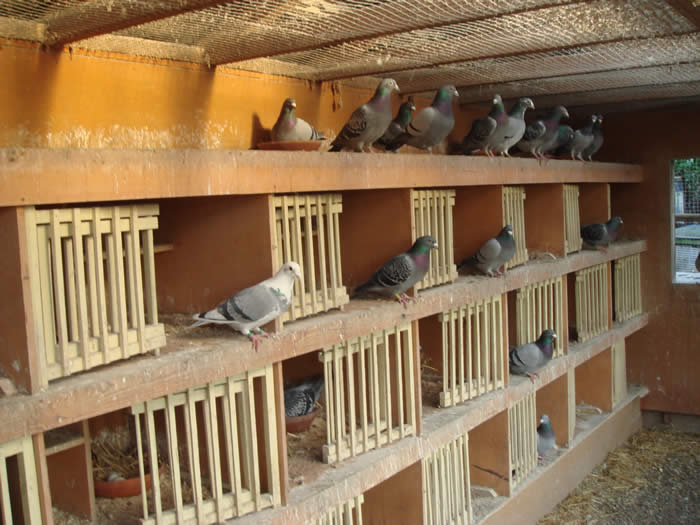
Inside of the stock loft.
We have been very lucky with regards to having good breeders. As I said earlier, the hen we had off Ian Axe was the best Van Reet hen we ever had. She was responsible for generations of winners from 60 miles to 540 miles. At the same time we had her at stock, we had a son of Record that was breeding outstanding birds from all distances.
The next great breeder was the “Dearns Cock”, he being a breeder exchange bird in the Lancashire Social Circle, this coming from Brian Dearn of Darwin hence his name. We have never known his breeding but when you look at his racing results this matters not one bit.
"Dearns Cock". His main wins include:
1st Northwest Nantes 2 bird Sennen Cove. (No channel)
1st Eccles 2 bird Specialist Club open Fougeres.
1st St Helens 3 bird Championship Club Nantes.
3rd Warrington 2 bird Sennen Cove. (No channel)
More importantly when he was retired to stock he produced a dynasty of winners and breeders with the racing and stock lofts being full of his progeny.
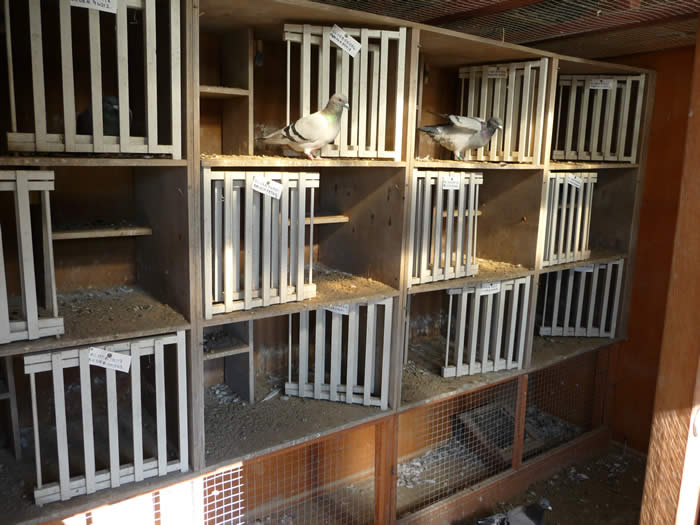
Boxes per ten foot section.
The bird that is making the biggest impact at present is another Lancashire Social Circle exchange bird, this being "Hughie". In 2006 we were asked by Hugh Higgins if we would race a pair of young birds on his behalf in the Lancashire Social Circle centenary young bird guest race. We agreed to this and Hugh sent us a Blue Pied Cock who went on to win the race. He was bred from Hugh’s Turner and Ryder Red Daniel stock. We raced him until 2008 and then put him to stock for the 2009 season. On entering the stock loft “Hughie” came into his own. He selected a box and a Dark Cheq Hen, breeding winners in his first year at stock. The year after he paired to the same hen then decided one hen was not enough and paired to a Blue Hen in the next box, keeping both hens happy and breeding winners with both.
“Hughie”. Winner of 1st Lancashire Social Circle guest race, 2nd club 2nd fed Frome, 6th club 14th fed Lessay, and 1st club 1st fed Cheltenham. "Hughie" is the sire of the birds listed below:
Blue Pied Cock 07 A 00961, winner of 1st Taylors Choice 2bird Fareham, only 8 birds on the day.
Cheq Pied Hen GB 08 B 00345 (nest mate to 00344 sale bird). 3rd Eccles 2 bird St Malo. 3rd West section yearlings 80th open and 19th West section any age M.N.F.C Lessay. 1st St Helens 3 bird open Lessay. 4th club Mangotsfield. 2nd club Mangotsfield. 1st club 1st fed Lulworth.
Dark Cheq Cock GB 09 B 22009, “009”. 1st section 1st open North West Grand National Littlehampton. 1st club Mangotsfield. 2nd club 4th fed Mangotsfield. 1st club Kempsey. 2nd club 10th fed Lulworth.
“009” is the sire of GB 10 N 20543 4th open Merseyside fed open Carentan. 11th sect 276th open MNFC Fougeres. 3rd club 4th fed Swainswick, and GB 11 A 46009, 1st club 1st Combine Mangotsfield, 2nd open North West Nantes 2 bird Seaton.
Cheq Hen GB 09 B 22008, 3rd open Bamfords Channel Challenge and nest mate to “009”.
Cheq Hen GB 10 B 31536, 2nd section 13th open Bamfords Gold Ring Poole, 1st club 2nd fed Swainswick.
Blue Hen GB 10 N 20518, 1st Wigan 2 bird open Poole.
Dark Cheq Pied Cock GB 10 T 28982, 1st club 10th fed Cheltenham.
Dark Cheq Cock GB 10 T 28981, 3rd club 3rd combine Mangotsfield and sire of GB 11 N 62688 1st club Seaton.
Blue Hen GB 07 S 48507 (full sister to 00344 sale bird). Bred by R & B Smith owned by Des Taylor of Willenhall. 48507 when paired to GB 07 S 48526 (also bred by R&B Smith) are responsible for GB 09 Z 72153/54. 54 won 3x1st 2x2nd 2x3rds., 53 won 1st club Carentan 14th fed, 1st club Fougeres 3rd fed, and 1st mid week club. GB 10 Z 60102 winner of 2x1st.
Dark Cheq Cock GB 11 B 46007, 1st open North West Nantes 2 bird Seaton.
Blue Hen GB 11 B 46013, 3rd club 16th fed Cheltenham, 14th section 81st open Bamfords gold ring Poole. 7th Eccles 2bird Fougeres 358 miles.
Blue Cock GB 08 R 56401, who is the sire of GB 11 N 62631, 1st North West Nantes 2 bird open Carentan 291 miles,28th section 490th open NFC Fougeres 358 miles.
Blue Cock GB 10 N 20518, who is the dam of GB 11 Z 68353, 11th section 339th open MNFC Chale.
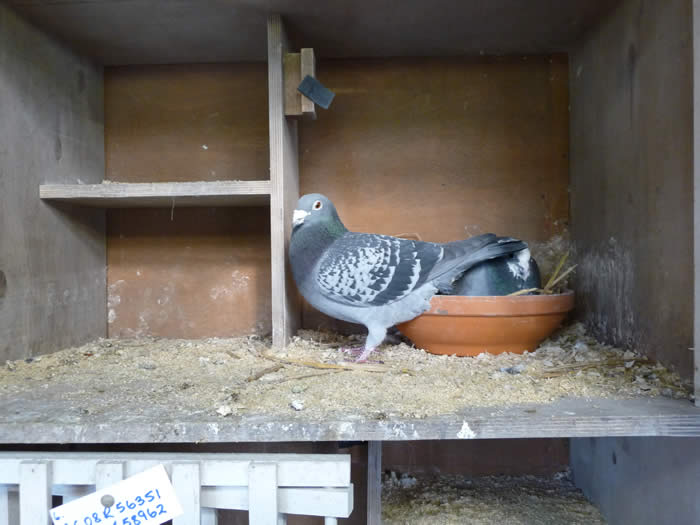
Note the large nest box size.
Our lofts were all designed and built by us. All the lofts are of wooden construction with tiled roofs. These consist of a 48 x 8 foot old bird, a 16 x 8 young bird, a 16 x 12 with aviary stock loft and a 21 x 6 aviary type stock loft that we can split into four sections. We have just added a 6 foot x 6 foot aviary on the end of this loft which makes it easier for them to have a bath and relax in the sun/rain. Both stock lofts have flagged floors. We also still have the last loft Dad built in the late fifties - the only thing different is a new front.
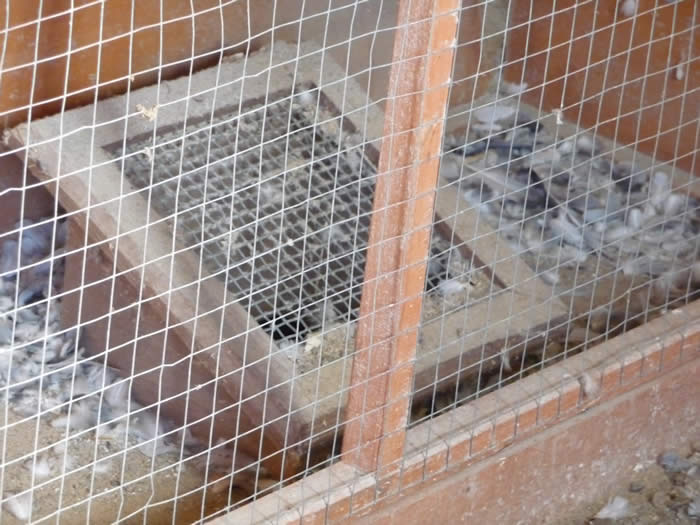
The ventilation beneath the nest boxes.
The old bird loft is split into 5 sections with a corridor running down the front of the four sections we use for old bird racing. Each of these has twelve large nest boxes, these being about 18 inches off the floor to allow for the chimney type vents underneath. Each box is fitted with a shelf which enables the hen to get out of the way when being driven and makes a good perch for the widowhood cocks. The fifth section is 8x8 and we use this for a few young birds we let mature naturally; this section also connects to the widowhood hens’ aviary and dad’s old loft. We have just moved the young bird loft and replaced the roof with an offset apex type roof like the old bird loft and we have also added an 8x5 aviary to front, with access to this through a roller shutter door; this is also used to darken them down. The trapping to this loft was by means of two sputniks but this has been altered several times, this time to accommodate the ETS. The racing loft has room for 48 widowhood cocks. The main stock loft has 21 boxes in but quite a number nest on the floor and on top of the boxes so there is ample room for 30 pairs of stock.
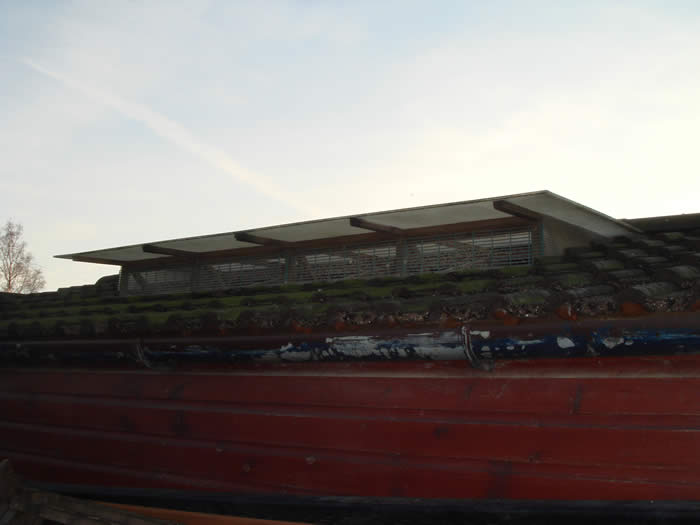
Roof vent.
The other stock loft has 4 boxes per section. We use this loft for specific pairings, with the other stock loft being what we call Butlins, where they can pair to what they want. We have always been of the opinion the lofts have to be as well ventilated as possible. With this in mind the stock lofts are wide open at the front and they have roof ventilation to create an air flow. The racing loft has louvers in the front, the eaves are open all round and we have chimney type vents under the boxes. The young bird loft has louvers along the back, one at each side and two at the front. Since going on darkness we have put an extractor fan in. This comes on for twenty minutes every hour during the darkness hours.

The small stock loft.
Our birds have never been good at exercising at home. They will fly at most half an hour morning and evening, so we have always trained them, trying to get two tosses a week. We try to make these so they have to fly at least 1 hour. When the channel races come around we will tailor the training around the weather. We will take them in any direction i.e. North in a South wind or East in a West wind and we will increase the distance if we think they have had too many easy races. We normally train the birds ourselves so we can liberate them how we want. This can be single ups but mainly a basket at a time, this being 12 birds.
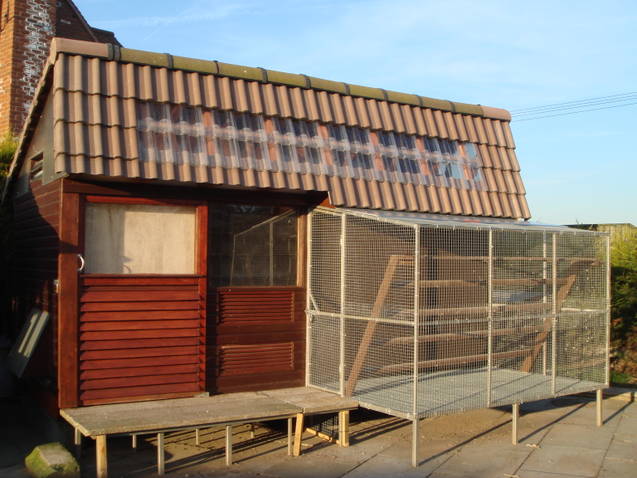
The young bird loft.
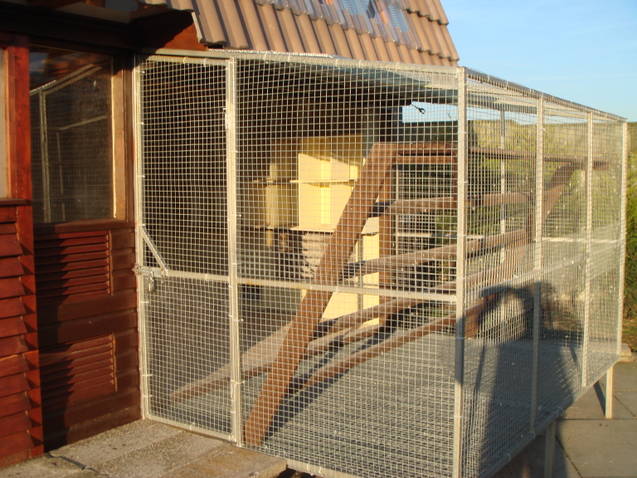
The large aviary on the front of the young bird loft.
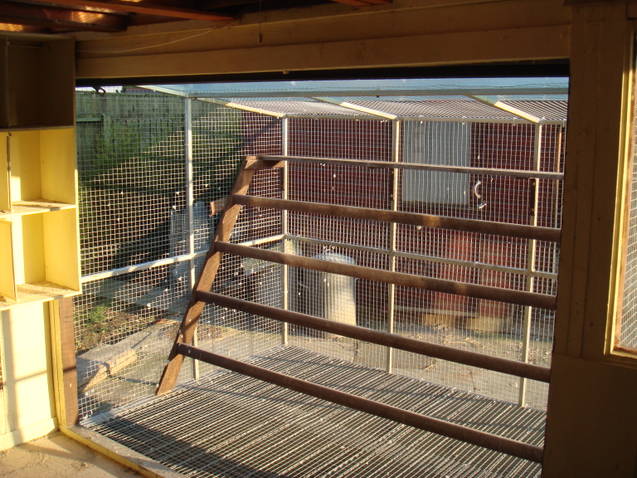
Inside the young bird loft.
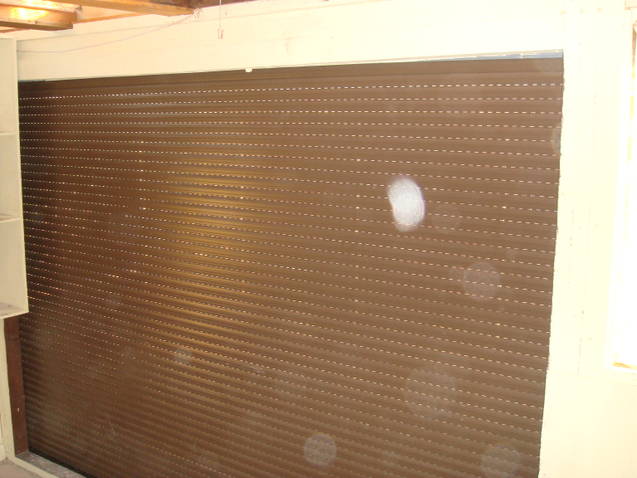
The roller shutters which block off the young bird aviary.
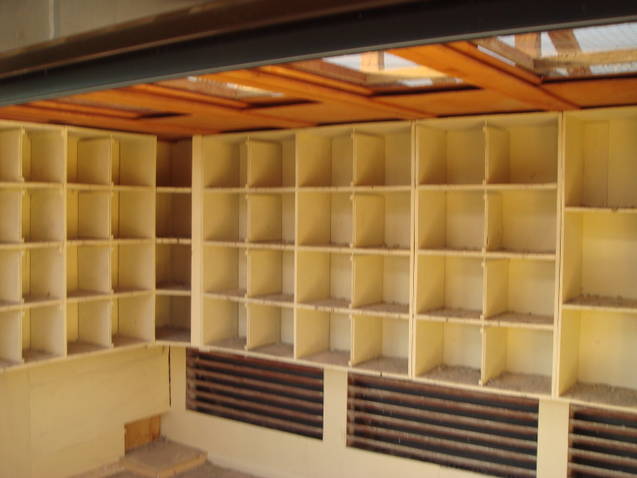
Note the ventilation below these box perches in the young bird loft.
Medication
We have a great friend in Joe Xuereb from Malta. If we do have any problems, it’s a phone call or email to him. We steer clear of indiscriminate usage of any medication but we do use Ivermectin once a year.
Feed
The first thing with food is we never measure food or put the birds under food stress. When breeding we use a standard breeding mix and add 30% turkey pellets. We have used these for many years, and our theory is, it gives the young birds the best start so helps build a strong immune system. and with us never having young bird sickness we will carry on with this. When racing we use a good widowhood mix along with a diat mix and when we get to the longer races we introduce a fats mix. When racing is over we use a standard moulting mix and add farm sourced barley/wheat and beans. In the last few seasons we have added about 10% turkey pellets.
Supplements
On return from races we use electrolytes. The only other things we use on a regular basis are grit and black minerals.
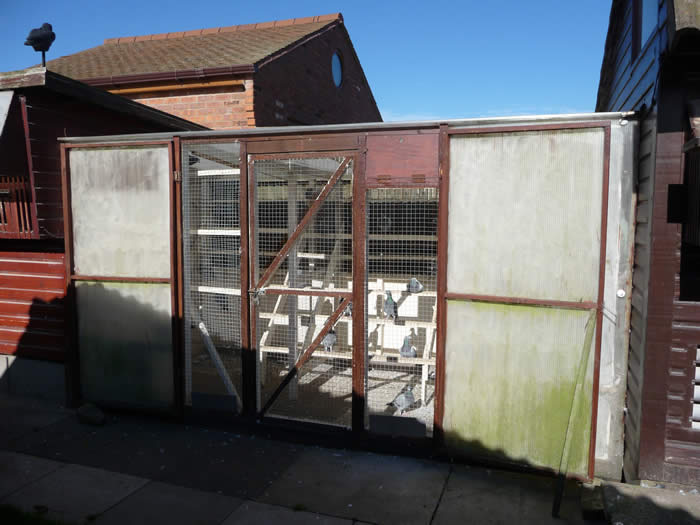
Widowhood hens' aviary.
Motivational techniques
We race the cocks on widowhood. They are paired up at the end of January and bring up a round of young. They are split after sitting the second round of eggs for a week to 10 days. When racing, the cocks see the hens on basketing night and again on return from the race. We race the hens paired to the widowhood cocks on a type of roundabout system. They are kept in the end section with access to an aviary. They are exercised once a day from the end section, only seeing the cocks and boxes on basketing night. On race days they trap to either the end section with access to the widowhood loft by bob holes at floor level, or they trap straight to the widowhood loft. We usually race the first 3 to 4 weeks of the channel on the same system. For the longer races we will pair them up over an approximate 2 week period so they are not all on the same nest condition. At this time a good fats corn is added to the normal widowhood mix.
We have been lucky enough in 2011 to achieve one of our ambitions by winning the Midlands National F.C. Further ambitions would be to win the N.F.C but really just to carry on racing with the consistency and enjoyment we have had over the years would suffice.
As for influences, we consider ourselves very lucky because our Dad was one of the best stock men and conditioners of pigeons we have ever seen. We also had uncles that where good pigeon men. This along with racing in the same clubs as men like the Pickavances - old Sam, young Sam and Jim, the Sixsmiths - Danny and Eddie, then in specialist clubs alongside the likes of Jack Cropper. Then there is probably the best secretary we have ever come across this being Lol Whittle, and present day John Schofield not only races a good bird but has made our fed the envy of the area, this being achieved by himself with a lot of hard work.