THE ELIMAR INTERVIEW
PETER JONKER
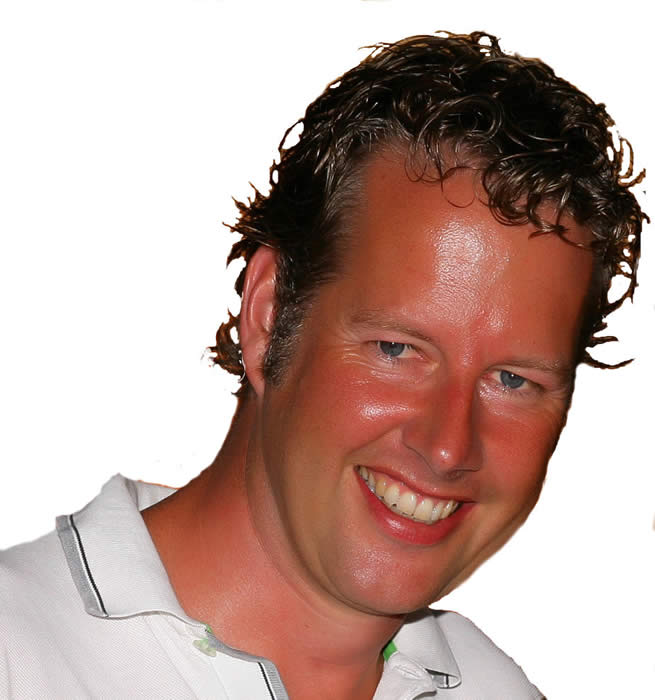
Peter Jonker
Please introduce yourself and tell us how you got started in the sport.
My name is Peter Jonker and I live in Uitgeest, Holland. I started as a little kid, taking over the passion for racing pigeons from my grandfather. I restarted in 2003 at my new address in Uitgeest. My ambition was to start racing on a semi-professional level.
Give the readers the most memorable results that you have achieved.
In recent years, I have won a number of national titles in championships, especially short-middle distance:
2012: 1st Loft Champion Short and Middle Distance Federation
2008: 1st Nat. WHZB Short Distance. (Blauwe Hertog 115)
2008: 3th Nat. Champion Short Distance NPO
2007: 7th Nat.WHZB Short Distance (Pre Olympic 064)
2007: 2nd Nat. Champion Short Distance NPO
2007: 4th Nat. Birdchamp Short Distance NPO
2006: 3th Nat. Champion Youngbirds NPO
2006: 6th Nat. Champion Short Distance NPO
2005: 6th Nat. Champion Youngbirds NPO
Is there anything that you have not won in the sport that you would like to achieve?
The highest possible, is to self breed and race top pigeons that will end up in the top 3 on national level championships like WHZB and NPO ranking, and even better would be to represent the Netherlands in the Olympiads.
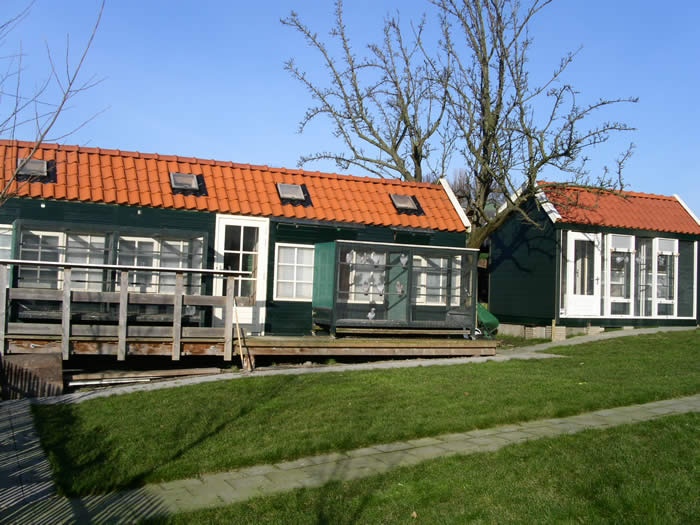
Peter's racing lofts
Which races to you target?
I target races from 200-500 miles, especially NPO races.
What are your lofts made of and how big are they?
My racing loft is 9 metres x 2 metres, built from wood on a wooden frame. My breeding loft is 3.5 metres x 2.5 metres long, wood also. Every section of the loft has its own aviary, so all birds are able to go outside at any time. I use ATX heating to minimise temperature differences between day and night in the racing season. The system is also used to manage humidity (fixed around 65-70% max).
What families of pigeons do you keep?
My main bloodline is from Blauwe Hertog (50% Koopman) acquired at Eijerkamp, Brummen. Also Pre Olympic (a Vandenabeele) descendants and Grandson Che (Eijerkamp) dominate my breeding loft. Recently I acquired a number of pigeons from Arie Dijkstra, Oudwoude, Netherlands who specialises in longday racing in tough conditions. This to add perseverance into my base, looking at my ambition to race up to 400-500 miles in the coming years. I look for strong muscles, a good thick forearm, well closed from behind and most importantly a fine character in the loft: they need to be confident enough to defend their territory without fighting. I have never had ace birds which lose their energy in fighting. In my experience, new birds need a good year to acclimatise. The first round(s) in the first year can be good, but in general breeding results improve after a year or so. When looking at new pigeons, in every generation top performance on a regional level should be present and visible, this as an indication of the genetic value of the strain.
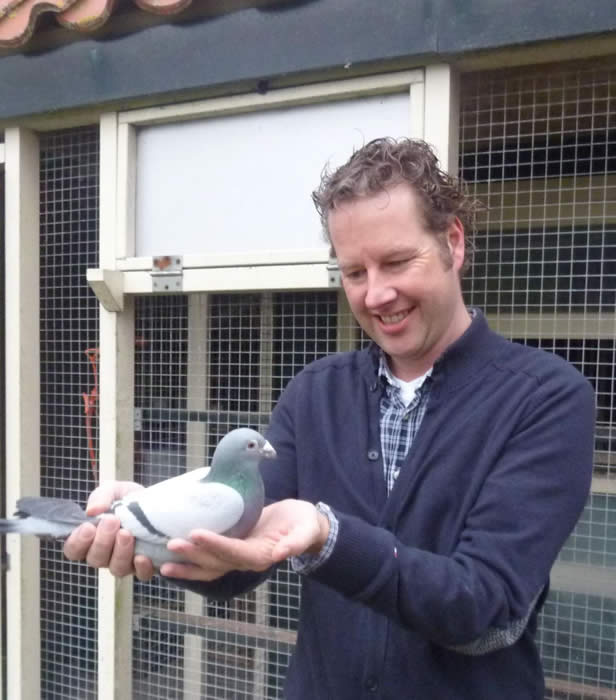
Peter in front of the breeding loft holding Grandson Che, himself champion Young Bird and one of Peter's best breeders delivering multiple 1st prize winners in the first and second generations.
What method do you use to select your breeders?
My main criteria is high performance in racing. Newly acquired breeders need to deliver quality in the first 2-3 years. Quality to be defined simply as descendants able to beat the competition more than just once.
How many stock birds do you keep?
I keep 16 pairs of racers and 10-12 pairs of breeders. From the best racers one round of youngsters is bred before the season starts. From the breeders 3 rounds are bred; that should be enough to get an idea about the combination set. I pair them up during the Christmas holiday. Working in education, I am able to guide the pairing/breeding process best in that period. I bred late youngsters last year from my best racers. Quality is above average, but to be honest late bred youngsters are difficult to keep between the others as they are not old enough for breeding and are too young/inexperienced for racing. So I will only keep the best young hens from my best birds for breeding purposes as from the winter of 2013 and further on.
How do you race your pigeons and how many?
I race 16 pairs on total widowhood; both cocks and hens are raced. Last year I started on nest position for the first 4-5 weeks and the results were very good then as well.
Do you race your pigeons every week or do you prefer to condition them for a specific race?
I race them every week, if their condition is OK of course. If needed, I keep birds behind for recovery or to avoid risk due to poor weather forecasts, reserving them for more important races the week after.
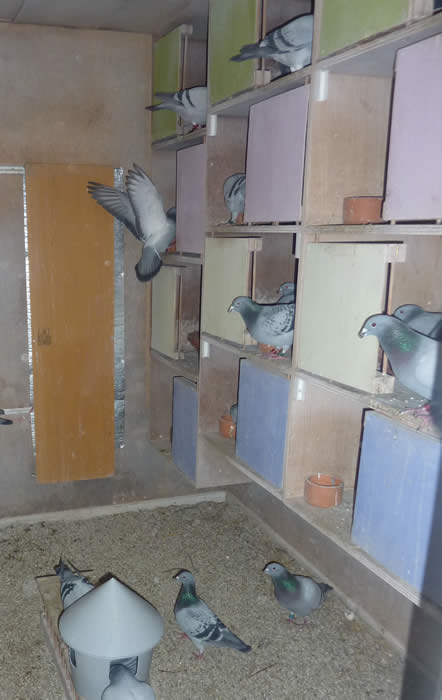
A picture of the racing cocks' section. ATX heating is installed and used when necessary.
How do you feed the cocks?
I feed them a branded mix called Ovator (from Germany). I use Top Relax as a base, adding Non Stop (high fat) or Winter Perle (light feed) looking at the weather and race ahead. I apply a multigrit from DHP, also Volamin is used in the water as a vitamin/mineral supplement during the season. My pigeons train outside the loft; after training they are called in again.
Do the pigeons need any special treatment on their return from the race to help them relax?
Special treatment is not applied, other than total disinfection of the water for 1-2 feeding shifts. In hot weather, I apply an electrolyte supplement as well. I use brewer’s yeast on the feed, attaching it with vegetable oil.
If your race team went off form during the season what action would you take to restore their condition?
That depends on the problem. I would seek medical assistance, and then move on. What also helps is to take them back 2-3 weeks, and apply as much rest as possible (light feeding system, and very easy going on the training). Sometimes you can let the birds together for 1-2 days to get them 'happy' again.
What happens when you are racing either widowhood or the roundabout when you have a bad race and lose a few from one sex, how do you continue with those pigeons who have lost their mate?
I have a couple of late bred youngsters for this purpose. The birds need to sort that out themselves.
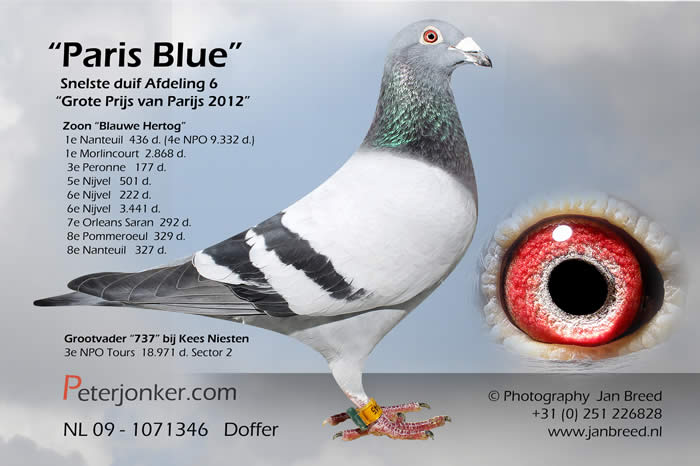
Paris Blue is my best racer. He's a direct son to 1st national ace WHZB 2008 Blauwe Hertog, when paired to daughter Messi from Jelger Klinkenberg (2nd WHZB in the same year).
If you could pass on one piece of advice what would it be?
Set your goals clearly, stay focused on them and stick to the plan. The most common mistake is to change your plans too often, listening to too many advisors along the road to success.
How far do you race your yearlings?
Up to 400 miles (but this distance, just 1-2 times max). I am careful racing yearlings. In my opinion a lot of yearlings are destroyed by racing too much and too far before they are fully grown.
Young bird sickness is a problem; have you had this in your loft and if so what have you treated them with?
It's a returning problem in this region, sometimes also in my loft. I use a medical system (4x1, or Amco) as soon as I suspect trouble is on the way. In most cases, the problem is resolved in 2-3 days. My advice would be to apply a light feeding system, and small amounts. Don't let them train at that time either!
Do you use any preventative medication?
I use a total disinfectant and a preventative cure on paratyphus. If one goes ill, it gets recovery time for a couple of days or else it has to go.
Do you use the darkness system for the young birds?
I darken the birds from weaning up to 4-6 weeks before the racing season starts (approx. beginning of June). I darken them for about 14 hours, from 6pm to 8am.
What are your feeding methods for young birds?
I do not like hungry youngsters, and feel they need good feeding to develop well. They are fed with Ovator ZMP for the first 6 weeks after weaning, then I change it to Top Relax gradually. A small amount of seed mix is applied as well.
Do you attach any real importance to the pigeon’s wing ?
I pay no special attention on the wing other than looking at generally known characteristics. I do like widowers to cast the first as a sign of health and condition! The old birds are not darkened by the way.
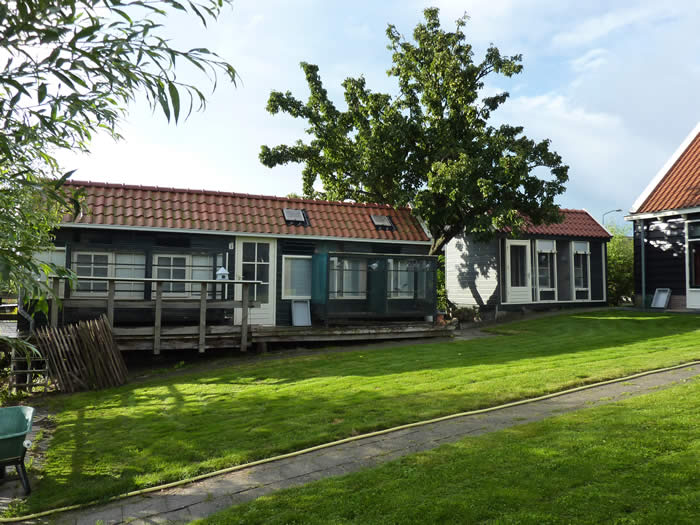
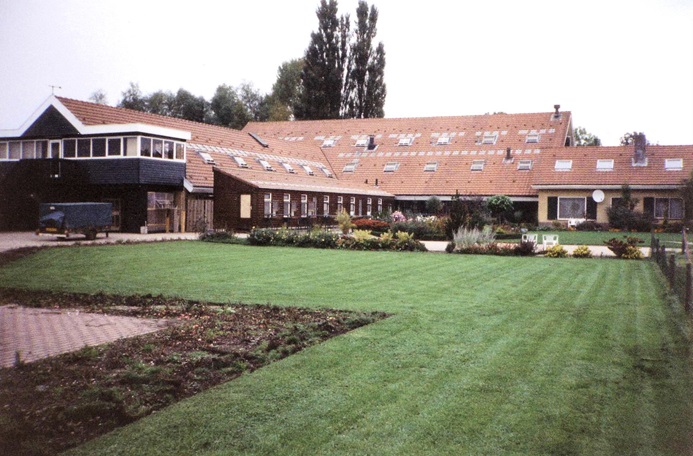
Peter's set-up pictured in summer time
If you could only give your pigeons one supplement what would it be?
It would be brewer’s yeast and vegetable oil (i.e. Forzoil Oropharma).
Which fancier has influenced you most?
That would be Evert Jan Eijerkamp I guess. He taught me a simple rule: training = eating = improved metabolic system = top codition & results. So balancing your training and feeding system, taking present condition and upcoming races into account, is an important key success factor.
What do you think can be done to take the sport forward?
Every fancier in the UK and abroad should be proud to be a pigeon fancier, and act as such and be an ambassador to the outside world! Work on fair play: let fanciers race for championships with similar amounts of birds (apart from bird championships) and take measures to make the sport more family friendly. In 2020 we will get the sport we deserve, it all depends on the efforts we all make (or not).
How do you consider that the British sport is going compared to the continentals?
As a Dutch fancier it is difficult to make a comparison as such. I can see a lot of UK fanciers investing in top quality in recent years (i.e. through PIPA) which tells me the quality level in the UK should be comparable with the continentals.
Do you have any further comments about anything that we may have missed?
No, my intention it to share ideas to help others forward, as well as getting feedback for me in order to improve my system as well. I am convinced we need each other in pigeon racing to keep the sport healthy and improve its position in society as a whole. Thanks for your attention and I wish you good luck next season!
February 2013