
The Elimar Interview
TONY & SIMON HUGHES
of ROCHDALE
Answer questions from Les J Parkinson
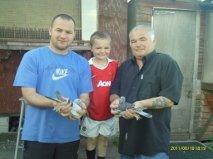
Simon, Zak and Tony
Please introduce yourself and tell us how you got started in the sport.
We are father and son, Tony and Simon of the A&S Hughes partnership, in Rochdale. We have had pigeons most of our lives and have been flying as a partnership since 1999. There is just us in the partnership and we both have full time jobs. We share all the loft duties, cleaning, basketing, training etc, but the breeding, feeding and racing is left to me (Simon), and this has worked effectively over the last 10 years. There are many advantages racing in a partnership, sharing the cost, sharing the workload and sharing each other’s ideas. This partnership certainly wouldn’t be as successful as it is if it wasn’t one, i.e. training cocks and hens and darkening the ybs etc.
Are there any points that you disagree on and if so how do you compromise?
99% of the time Dad leaves me to the running of the lofts, pairing of the stock, racing and feeding etc. Most of the loft maintenance is left to Tony and this is where the only disagreements occur.
Give the readers the most memorable results that you have achieved.
The best result I probably had when I flew on my own would have to be 1st club, only bird on the day, 1st fed, 2nd Amal, 2nd Lancs Combine, 2nd 3 Counties Combine, 2nd North West Region, 16th open Nantes Centenary Race 66000 birds. Since we've flown together Dad and have had many great results. The 2006 season was a good one. In the Lancashire Combine’s 5 races that season, 4 old bird channel and one young bird inland, we never finished outside of the first 4, winning 1x1st, 1x2nd, 2x3rds and a 4th. Then there was the 2007 season when we won 1st, 3rd and 18th Bamfords Gold Ring Poole, 1st, 2nd and 3rd Denton Open Portland, 1st and 4th Lancs Nantes 2 bird Open Portland, 1st Lancs Combine Lessay, 11x1st feds and 4x1st Amals. In 2008 we won the 3 Counties Combine from Lessay over 5000 birds; the birds were liberated in a N.E. wind and finished in a N.W. wind so that was a great result. But the best result of that season was in the NWCC. The birds were liberated at Portland in a N.E. wind and finished in a N.W. wind just like the Lessay race. We had over 20 birds drop together to take 1, 2, 3, 4, 5, 6, 7, 8, 10, 11 and 12 section and open. The 2011 season was also a decent one for us winning 1st sect, 5th open MNFC Vire; 1st, 4th, 6th, 7th & 11th sect, 2nd, 14th, 16th, 17th and 34th open MNFC Carentan; 1st sect L, 80th open NFC Messac; 8th, 10th and 12th Sect L, 113th open NFC YB Fougeres; 3rd open 3 Counties Combine Falaise over 5000 pigeons, and 3rd, 4th, 5th and 6th Lancs Combine Carentan YBs on a very hard day after 4 nights on the transporter, plus 8x1st in the club.
Is there anything that you have not won in the sport that you would like to achieve?
Yes, without doubt we would love to win both the NFC and the MNFC some day, a big ask we know, but that’s our aim now. We would also like to win the famous "Dusty Bin" in the Lancs Combine's Niort race.
What organisations do you race with?
We fly in our local club Rochdale & District H.S. which is a member of the South East Lancs Fed and Border Amal, and also we are members of the NFC, MNFC, NWCC, Lancs & Yorks 4 Bird and Lancs Nantes 2 Bird club.
Do you hold any official position?
I used to be the fed, amal, Lancs Combine and 3 Counties Combine delegate but for reasons out of my control I am no longer. I am now just the club press officer and help out with anything I can in the club such as arranging the breeder/buyer and doing the result for the club on a Saturday night. I also enjoy helping out at the marking of the MNFC whenever I can.
What are your lofts made of and how big are they.
All our lofts are made of wood and have been built by ourselves. The old bird racing loft is 28x10 foot and consists of 2 sections of 16 widow boxes and a section for the hens. The youngsters’ loft is 32x10 foot and has 4 sections in it, and the stock lofts are 16x8 and 18x8 with large aviaries attached to the fronts. There is no heating in our lofts, and to be honest I think it makes the birds soft. There's no heating in the wild... is there? It would definitely be of an advantage in the winter when the temps are down to stop the water freezing over and in the early part of the season to bring a bit of form. The ventilation in our lofts is through the front and out through the back, at the top. We don't have any grills on the floor as I think this would make us lazy and attract rodents to any spilt food. Same applies to the boxes and perches.
What families of pigeons do you keep?
The main family of pigeons currently housed are of one which we have built up ourselves over the last 6 or 7 years. It is made up of Braspenning (De Felle line), Piet Valk (Galaxy), Van Loon and De Klak. We also have some Vandenabeeles through Mark & Dick Evans and Clive Lister. We have recently introduced some direct Danny van Dykes and some De Rauw Sablon pigeons through our very good friend and top flyer John Crehan of Crehan & O'Conner of Salford, which wouldn’t have been possible without his help and we are extremely grateful
How do you go about bringing in a new family and what do you look for.
We look for a loft that is flying consistently well season after season. We then ask to buy or swap some youngsters and these are raced heavily and compared to our own. Good pigeons don't need time to acclimatise, they either win or they don't. If they are any good then they will show signs of their quality.
When looking for new pigeons do you look for a particular family?
We do tend to go for the Janssen type pigeon, and those that perform at the middle distance consistently well.
Which of the two sexes do you consider is the most important when it comes to breeding?
Both sexes play an important part in breeding and for that reason I don't consider any to be as important as the other. It is up to us to get the best out of them.
Some fanciers like big hens for breeding. Does the size of the hen make any difference to the quality of youngsters that she breeds in your experience?
I'm no expert, but we've never had a good racing hen on the big side, but we have had some excellent breeding hens that have been on the big side
When it comes to breeding do you line-breed or use a first cross or just pair winners to winners? Does luck come into breeding winners?
We just pair winning lines to each other, and inbreed to keep the line. When selecting breeders we mainly use performance and bloodlines. Our current best breeding hen is the sister of one of our ex-best racing cock. She was bred by us for George Appleton. When we retired the cock I checked the breeding books to see if there was any other the same way bred given out. A phone call to George was made and he kindly gave the pigeon back to us some 3 years after us giving her to him. So I’d say a bit of judgment and a whole lot of luck.
What materials do you use for nesting
We like to give a pile of straw and a pile of tobacco stalks and let the birds choose; they tend to use a bit of each. I do put a handful of sawdust and sand mixed in the nest pan upon pairing up.
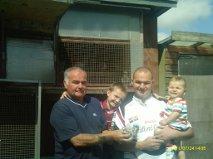
Tony, Zak, Simon and Max at the pen
When do you pair your pigeons and why then?
We normally pair our stock up in December and then pair our racers up to coincide with the stock birds’ second round to allow us to float some eggs of our top stock pairs.
How many stock birds do you keep?
This year there are around 40 pairs of stock. This is more than the norm as we have some new ones to try out. You need to take at least 2 rounds off any new introductions to test them out. We do take young birds off our racers but these are normally sold on to help with the cost of racing etc.
Please explain the method used from pairing up until the first race.
Once the racers are paired, they are fed twice a day and let out on good days for a bath and a stretch of the wings; once they are sitting they don't go out normally until the youngsters start feathering up. We try not to let the hens go down again and split them up before they do. The hens go with one YB into the YB loft and the cock finishes off the other. Four weeks before the first race both sexes are flown out once a day until they are flying for 45 minutes. Once up to this time for a week they are then trained as much as possible up to the first race, and then up to the second race when training stops. Once rearing is done the birds are treated for all the usual suspects. We normally train from 30 miles both old and young, but will go to 55 miles as and when necessary. This is normally when the birds haven’t had a race for a week or two and need a bit more.
Do you breed off the top widowhood cocks after the racing has finished?
We don't always breed late-breds off our race team but would if we got asked to so as to help pay for the winter feed.
For every 50 pigeons that you breed realistically how many of them would win at 500mls, based on your past records.
Over the last 10 years we have only sent to 500 miles 3 times, so I couldn’t really give you an idea, however we plan to send more in the future. We did send in 2011 and were 1st club, 1st fed, 7th combine with other day birds also, so we know our birds can do this distance in the future.
How do you race your pigeons and how many?
Our old birds are raced on our own roundabout system. This allows us more options to send to multiple races by having a bigger team to choose from. Our old bird team consists of 32 cocks and hens for the coming season, of which 75% will be yearlings.
Do you ever think of competing for averages?
Never. I think many good birds are ruined or lost chasing averages.
Do you race your pigeons every week or do you prefer to condition them for a specific race?
We used to race week in week out, but now we are sending to the Nationals we are trying to condition them the best we can for these races. This means plenty of rest in between Channel events.
Do you think that a loft needs different pigeons for different distances?
Yes, for sure. I think shape and size play a huge part.
Is there any specific condition that your pigeons perform best at, or any particular time of the year?
No not really, we are fortunate to have a family of pigeons that race consistently well all season long.
When do you allow your racers to take a bath?
Usually our birds are allowed to laze around and bath on Sunday mornings, depending on the weather conditions.
Do you use any floor dressing or do you clean the pigeons out daily.
All our stock lofts and young bird lofts are on deep litter. This helps keep the work load down. The old bird lofts are cleaned once a day in the winter and twice a day during the race season, with loft white now and again.
Do you like to have plenty of room for the pigeons?
Yes, I think it’s a must as they have to have a love of home, but not too much room as they will lose their natural motivation to defend their own space.
How do you feed the racers?
All our old bird racers are fed by hand on the floor, but we do give the cocks tit bits in their boxes. We tend to feed to appetite, without over feeding.
Do you attach any importance to grits and minerals?
Fresh grit is always given to the birds, with a pick pot and clay block given once a week.
Is there a way that your pigeons let you know when they are in form?
Different pigeons act in different ways when in form. One sure sign is good uninterrupted spells of exercise followed by the usual showboating around the sky and lofts.
Do you have any secrets about what you do with your pigeons and how you get them right?
A good alarm clock!
Do the pigeons need any special treatment on their return from the race?
On return from all races our birds receive first and for most clean water, then electrolytes with the evening feed. Once a month they will be give a product to treat against all the usual nasties.
If your race team went off form during the season what action would you take to restore their condition?
Find out what the cause is first and foremost. If it’s a health issue then we would treat accordingly, if not, then rest for a week or even re-pair them, which we did this year with good results that followed.
How do you proceed with those pigeons who have lost their mate?
If this happens then we would probably use the stock birds as replacements to motivate the spare birds.
Is a favourable loft location the single biggest factor in sprint racing?
It is, but in the same scenario there are a lot of fanciers that fly in favourable location and don't win out of turn so the fancier still has to be a good one as well.
Do you treat pigeons differently with their preparation if they are to go to the bigger races whether National, Classic, Specialist club or open?
Why should we? A channel race with the club is the same as one with a national; you would still need to feed them for the job in hand.
Do you think a pigeon has the capabilities of racing both short and long distance races? Also what distance can a pigeon actually still “RACE” as opposed to homing from any race point?
I think there are pigeons capable of racing and winning at all distances although they are thin on the ground. I think pigeons are capable of racing up to 450 miles on the day in a head wind. Over this distance in the same wind then I think it becomes more of an endurance test than a race. That is just my opinion and I know the extreme distance guys will disagree.
What proportion of you pigeons get better on subsequent trips to the long distance races and what do you call distance?
To me there are two types of distance, middle 300 to 450 miles, and long 450 plus. Over this and there not many of our present team good enough, but at 300 to 400 then that is where they seem to best.
Which is the more difficult, establishing a team of sprinters or distance pigeons and why?
I suppose it is hard to build a good team of both sprinters and distance birds, but if I had to choose it would be distance as more birds are lost at the longer events.
Sprinter or distance, there is no difference, it is all in the feeding. Do you think this is true?
Definitely.
If you could pass on one piece of advice or tip to fanciers old and young, what would it be?
Keep things simple and race your birds on a system that suits your lifestyle and time.
What problems do you think are most detrimental to race condition in modern day racing, both Old Bird and Young Bird?
Peregrine falcons for sure, also the ever rising cost of this hobby, corn and fuel being the main ones.
How far do you race your yearlings?
All our yearlings usually have to go to 400 miles, but if one was to put up a couple of good performances at the two shorter channel race points then we would have to consider putting that one away until the following season.
Where do you house your hens?
Our hens are in a section next door to the cocks. These are on v-perches and a wire floor to help prevent them pairing to each other.
What is your routine for preparing pigeons for the longer races?
We really look forward to the channel races, especially the ones of around 3 to 400 miles. We give our team as many races in the club as possible before the first North West Classic race, which is normally May bank holiday from 212 miles, then one more club race, usually around the 150 mile mark, then that would be it before going to their first channel race, which should be Carentan 300 miles with the MNFC or Fougeres 368 mile with the NFC. A team would normally be sent to both.
Young bird sickness is a problem; have you had this in your loft and if so what have you treated them with?
Yes we have, and I don't think there are many that haven’t. We've tried many different potions over the years but Nifuramycin is one of the best to treat them with.
Do you race your young birds?
Young bird racing is very important. In my opinion it’s important to give them as much experience as you can in their year of birth. We enjoy young bird racing, especially the Bamfords Gold Ring and the Young Bird channel race, which is normally with the Lancs Combine, but we are hoping to send good teams to the NFC and MNFC next season.
What do you think the sport should do to change things for the better?
The idea of giving free entry to schools into the RPRA one loft is a great start. Whole schools getting involved in pigeon racing, doing projects on it. Better late than never. We need to get youngsters into the sport or there will be no pigeon racing. The RPRA also need to do more in the fight against the RSPB and their beloved B.O.P.
Do you use any preventative medication?
We do use preventatives. I think it is a must. All our birds get cared for but if they regularly get ill then they have to go.
Earlier in the article we discussed the wind direction. Do you consider that good pigeons will win in any position?
The wind plays a massive part in this sport. I know some pigeons do win against the wind but it isn’t common and it’s hard to do even for good pigeons, especially in races up to 200 miles.
Some fanciers go out and purchase good quality winning pigeons but never appear to make the grade. Why do you consider that this happens?
Many reasons really, but it the old saying "you can't buy the man" springs to mind!
Do you give any special treatments when the pigeons return from the race as a precaution against anything that they may have picked up in the basket?
Not with the old birds but we do with youngsters in the first couple of outings.
Do you use the darkness system?
Yes, we think it is a must for young bird racing in this day and age especially if you want to compete in the longer races. We have found it not to have any adverse effect on them in later life and with the correct care and attention why should it?
How do you feed your young bird race team?
The young birds are never broken down, and keeping them hungry is a dangerous game; if a young bird makes a mistake and has to fly for long periods then it needs all the help it can get so having an empty tummy isn’t a good idea.
Do you attach any real importance to the pigeon’s wing?
I used to, but not any more as the basket tells you everything. We always check the wing for damage or thrown flights before sending a bird however.
If random drugs tests were carried out on your pigeons, would it reveal any substance, illegal or otherwise?
Definitely not!!!!!!
What criteria do you set down for the pigeons you winter with your thoughts on the following seasons racing and breeding?
All birds must have a good problem free moult. The birds we take forward to the coming season must have performed to our standards; birds that haven’t will have to go and we will only breed off winners and proven breeders.
Are there any special treatments that you give your birds once the season has finished?
We don't give anything special in the water other than we fill a drum of water up and in the drum is one full garlic bulb cut up, one full lemon cut up and one full onion also cut up. The drinkers are topped up Monday to Friday with this water only, then on the weekends the drinkers are cleaned and fresh water is given.
What were the last four things that you put in your drinking water, when and why and did you notice any benefits?
See my last answer. The benefits are good clean skin, clean wattles and problem free, health wise. It must do some good as Dad goes to the odd show and wins an odd prize.
If you could only give your pigeons one supplement what would it be?
Gemthepax from GEM. We've used this for the last 10 years and I think the birds really benefit from it.
Which fancier has influenced you most, in the way in which you fly your pigeons?
Nobody, we've made my own mistakes and learned from them, but it has helped having good fanciers as friends, Frank Noon in the early days and more recently John Crehan. Our present system and ways are all our own doing.
Do you look at the eye?
I have been to many top lofts that win at all distances and one thing that stands out is that all the champions have different coloured eyes, so no I don't believe there is anything in the theory. However, the eyes do give an indication on the health of the pigeon. The only way to find out whether it’s a good racer/breeder is to race it and breed from it.
Who do you consider being the best fanciers in the Country and for what reasons?
At this moment in time, in my opinion, Mark Gilbert is the best fancier in U.K and one of the best in Europe; his results over the last couple of season have been consistently brilliant. There are many good fanciers all over the country and it would be unfair to mention names and disrespectful if I was to miss any out.
What do you think can be done to take the sport forward?
I think something is already being done. Getting schools involved in the one loft races for free is a good start. Another thing that could be done is to get lofts on school grounds and get these young kids involved physically by looking after their own birds and competing for free.
What percentage do you consider it takes to win with racing pigeons for management and pigeons?
A lot has to do with the management as good fanciers will win with mediocre pigeons, yet some fanciers spend thousands on the best pigeons and win nothing. I can't really put a % on it.
What past mistakes have you learned from?
Not listening and not keeping an eye on the forecast as well as I should have.
Who or what motivates you to remain successful?
Passion and the will to win I suppose.
What qualities do you think must be present for a fancier to be classed as a top fancier and at what level must he/she have achieved results to be rightfully so-called a “Champion”?
One of the most important factors in my opinion is the art of breeding; a fancier must be a good stockman and be able to produce their own champions. A champion is a fancier which wins regularly at the level they choose to compete at.
Do you think winning fanciers should move on from club racing once they have reached a certain level of consistency?
Some fanciers do not have the resources to compete at all levels, so they have to stick to what they can afford, so no fanciers don't have to move on just because they consistently win out of turn. A fancier should want to win for their own satisfaction and if this is their livelihood then winning would help create an income.
Are you professional pigeon fanciers?
In no uncertain terms we are not professional fanciers, we both work full time and both have families. I suppose this helps with the routine as we only have limited time with the birds.
What do you think about limiting prizes to two per race per loft?
Limits do encourage the less successful flyer, but on the flipside it gives false results and this leads to fanciers breeding off inferior pigeons thus leading to losses. Also I feel its punishing the fancier that works hard, gets out of bed at all times and gets home late and misses out on family time to be successful.
Is pigeon racing as a hobby going beyond the average working man?
It is, but you can win by keeping things simple.
What are your views on pigeon moots?
They are a good way of getting fanciers together in the off season and I think there should be more of them.
What do you think about the vaccination programme?
I think pigeons should be vaccinated in their year of birth and that is all. Do we vaccinate our own kids every year?
What do you think of vets in the UK?
I have never ever used one.
How do you consider that the British sport is going compared to the continentals?
Only China and Poland are thriving, everywhere else is struggling and numbers are dwindling. Maybe the RPRA should visit these places to see why they are on the up so much.
What is your view on pigeon shows?
Shows are ok and are a good way of keeping the fancy in touch through the off season. If I had my way we wouldn’t enter any but Dad seems to enjoy them. One thing I have noticed about the shows is that it seems to be the ones that win the shows don't win on the road but that is just my opinion.
Do you read much about the sport?
I used to get all the magazines, but these days just the one, the BHW. I find in depth loft reports a good read as it’s nice to hear what other fanciers do.
What aspect of the sport interests you the most?
Racing and breeding.
Is there anything that you do not like about the sport?
Jealousy is the worst thing in this sport and back stabbing.
If you went into another fancier’s loft and were given the opportunity to leave with a pair of pigeons, how confident would you be that you had selected the best pair?
Without trying to sound big headed, I think I am a good judge, as I have picked out many fanciers’ top birds when visiting lofts.
Is your loft of pigeons as strong as it was 5 years ago?
It is stronger, I hope!