The Joe Murphy Column
Firstly may I wish everyone who reads my column and their families a Very Merry Christmas and hope they have an enjoyable day with their families. This is one of my favourite times of the year as everyone is relaxed and you can enjoy each other’s company in a happy peaceful environment. Well that is until one of the toys is broken and all hell breaks loose ha ha. Enjoy this special time with your family.
This week’s photo
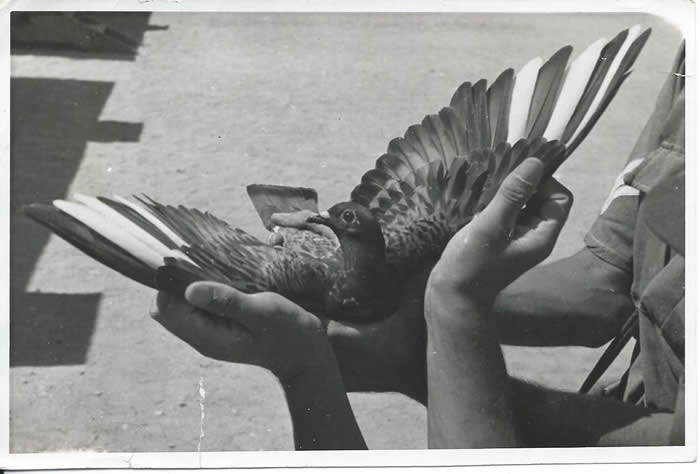
This is of the wing of a yearling hen that flew from El Alamein to AHQ Cairo a distance of 150 miles. She was liberated north of Quattra depression during the tanks and artillery battle in a sand storm and made it home in 3 ½ hours. This picture was from the Middle East Pigeon Service in October 1942 by Wing Commander G Russell. When I was first given this photograph I was quite intrigued to find out more about the bird and about the battle at El Alamein so did some research into this historical situation.
The First Battle of El Alamein (127 July 1942) was a battle of the western desert campaign of the 2nd world war; fought IN Egypt between the Axis forces (Germany and Italy) of the Panzer Army Africa which included the Afrika Korps (Field Marshal (General Marschall Erwin Rommel) and Allied (British Imperial and Commonwealth) forces (Britain, British India, Australia, South Africa and New Zealand) of the 8th Army (General Claude Auchinleck)
The British prevented a second advance by the Axis forces into Egypt. Axis positions near El Alamein, only 66 mi (106 km) from Alexandria, were dangerously close to the ports and cities of Egypt, the base facilities of the Commonwealth forces and the Suez Canal. However, the Axis forces were too far from their base at Tripoli in Libya to remain at El Alamein indefinitely, which led both sides to accumulate supplies for more offensives, against the constraints of time and distance.
On 25 June, General Claude Auchinleck Commander-in-Chief of the Middle East Command relieved Ritchie and assumed direct command of the Eighth Army himself. He decided not to seek a decisive confrontation at the Mersa Matruh position. He concluded that his inferiority in armour after the Gazala defeat; meant he would be unable to prevent Rommel either breaking through his centre or enveloping his open left flank to the south in the same way he had at Gazala. He decided instead to employ delaying tactics while withdrawing a further 100 mi (160 km) or more east to a more defensible position near El Alamein on the Mediterranean coast. Only 40 mi (64 km) to the south of El Alamein, the steep slopes of the Quattra Depression ruled out the possibility of Axis armour moving around the southern flank of his defences and limited the width of the front he had to defend.
Battle of Mersa Matruh
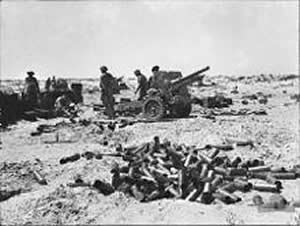
While preparing the Alamein positions, Auchinleck fought strong delaying actions, first at Mersa Matruh on 2627 June and then Fuka on 28 June. The late change of orders resulted in some confusion in the forward formations (X Corps and XIII Corps) between the desire to inflict damage on the enemy and the intention not to get trapped in the Matruh position but retreat in good order. The result was poor co-ordination between the two forward Corps and units within them. Late on 26 June, the 90th Light and the 21st Panzer Division managed to find their way through the minefields in the centre of the front. Early on 27 June, resuming its advance, the 90th Light was checked by British 50th Division's artillery. Meanwhile, the 15th and 21st Panzer Divisions advanced east above and below the escarpment. The 15th Panzer was blocked by 4th Armoured and 7th Motor Brigades, but the 21st Panzer was ordered on to attack Minqar Qaim. Rommel ordered the 90th Light to resume its advance, requiring it to cut the coast road behind 50th Division by the evening. As the 21st Panzer moved on Minqar Qaim, the 2nd New Zealand Division found itself surrounded. It succeeded in breaking out on the night of 27th June without serious losses and withdraw east. Auchinleck had planned a 2nd delaying position at Fuka, some 30 miles (48 km) east of Matruh, and at 21-20 he issued the orders for a withdrawal to Fuka. Confusion in communication led the division withdrawing immediately to the El Alamein position.
Rommel in North Africa (June 1942)
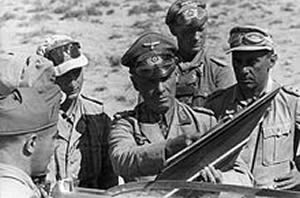
X Corps, having made an unsuccessful attempt to secure a position on the escarpment, were out of touch with the Eighth Army from 19:30 until 04:30 the next morning. Only then did they discover that the withdrawal order had been given. The withdrawal of XIII Corps had left the southern flank of X Corps on the coast at Matruh exposed and their line of retreat compromised by the cutting of the coastal road 17 mile (27 km) east of Matruh. They were ordered to break out southwards into the desert and then make their way east. Auchinleck ordered XIII Corps to provide support but they were in no position to do so. At 21-00 on 28th June, X Corps?organised into brigade groups?headed south. In the darkness, there was considerable confusion as they came across enemy units laagered for the night. In the process, the 5th Indian Division in particular sustained heavy casualties, including the destruction of the 29th Indian Infantry Brigade at Fuka. Axis forces captured more than 6,000 prisoners in addition to 40 tanks and an enormous quantity of supplies.
Defences at El Alamein
The Western Desert Battle Area, July 1942
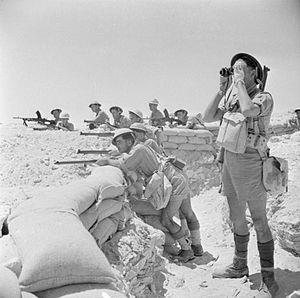
Alamein itself was an inconsequential railway station on the coast. Some 10 mile (16 km) to the south lay the Ruweisat Bridge, a low stony ridge that nonetheless gave excellent observation for many miles over the surrounding desert. 20 mile (32 km) to the south of that lay the Qattara Depression. The line the British chose to defend stretched between the sea and the Qattara Depression, which meant that Rommel could outflank it only by taking a significant detour to the south and crossing the Sahar Desert. The British Army in Egypt recognised this before the war and had the Eighth Army begin construction of several "boxes" (localities with dug-outs and surrounded by minefields and barbed wire), the most developed being around the railway station at Alamein. Most of the "line", however, was just open, empty desert. Lieutenant-General William Norrie (GOC XXX Corps) organised the position and started to construct three defended "boxes". The first and strongest, at El Alamein on the coast, had been partly wired and mined by 1st South African Division. The Bab el Qattara box?some 20 miles (32 km) from the coast and 8 miles (13 km) south-west of the Ruweisat Ridge; this had been dug but had not been wired or mined, while at the Naq Abu Dweis box (on the edge of the Qattara Depression), 34 miles (55 km) from the coast, very little work had been done. The British position in Egypt was desperate; the route from Mersa Matruh had created a panic in the British headquarters at Cairo, something later called "The Flap". On what came to be referred to as "Ash Wednesday", at British headquarters, rear echelon units, and the British Embassy, the British frantically burned confidential papers in anticipation of the fall of the city. Auchinleck?although believing he could stop Rommel at Alamein?felt he could not ignore the possibility that he might once more be outmanoeuvred or outfought. He therefore believed that, to maintain his army, plans must be made for the possibility of a further retreat whilst maintaining morale and retaining the support and co-operation of the Egyptians. Defensive positions were constructed west of Alexandria and on the approaches to Cairo while considerable areas in the Nile delta were flooded. The Axis, too, believed that the capture of Egypt was imminent; Italian leader Benito Mussolini sensing an historic moment?flew to Libya to prepare for his triumphal entry into Cairo. The 24 guns of the 28th Field Regiment Royal Artillery at El Alamein 12 July 1942; The scattering of X Corps at Mersa Matruh disrupted Auchinleck plan for occupying the Alamein defences. On 29th June, he ordered XXX Corps?the 1st South African, 5th and 10th Indian divisions?to take the coastal sector on the right of the front and XIII Corps?the 2nd New Zealand Division and 4th Indian divisions?to be on the left. The remains of the 1st Armoured Division and the 7th Armoured Division were to be held as a mobile army reserve. His intention was for the fixed defensive positions to channel and disorganise the enemy's advance while mobile units would attack their flanks and rear.
On 30 June, Rommel's Panzerarmee Afrika approached the Alamein position. The Axis forces were exhausted and understrength. Rommel had driven them forward ruthlessly, being confident that, provided he struck quickly before the Eighth Army had time to settle, his momentum would take him through to the Alamein position and he could then advance to the Nile with little further opposition. Supplies remained a problem because the Axis staff had originally expected a pause of six weeks after the capture of Tobruk. German air units were also exhausted and providing little help against the RAF’s all-out attack on the Axis supply lines which, with the arrival of United States Army Air Forces (USAAF) heavy bombers, could reach as far as Benghazi. Although captured supplies proved useful, water and ammunition were constantly in short supply, while a shortage of transport impeded the distribution of the supplies that the Axis forces did have.
Axis plan of attack
Rommel's plan was for the 90th Light Division and the 15th and 21st Panzer divisions of the Afrika Korps -to penetrate the Eighth Army lines between the Alamein box and Deir el Abyad (which he believed was defended). The 90th Light Division was then to veer north to cut the coastal road and trap the defenders of the Alamein box (which Rommel thought was occupied by the remains of the 50th Infantry Division) and the Afrika Korps would veer right to attack the rear of XIII Corps. An Italian division was to attack the Alamein box from the west and another was to follow the 90th Light Division. The Italian XX Corps was to follow the Afrika Korps and deal with the Qattara box while the 133rd Armoured Division Lillorio and German reconnaissance units would protect the right flank. Rommel had planned to attack on 30th of June but supply and transport difficulties had resulted in a day's delay, vital to the defending forces reorganising on the Alamein line. On 30th June, the 90th Light Division was still 15 miles (24 km) short of its start line, 21st Panzer Division was immobilised through lack of fuel and the promised air support had yet to move into its advanced airfields.
Rommel was later to blame the failure to break through to the Nile on how the sources of supply to his army had dried up and how: then the power of resistance of many Italian formations collapsed. The duties of comradeship, for me particularly as their Commander-in-Chief, compel me to state unequivocally that the defeats which the Italian formations suffered at Alamein in early July were not the fault of the Italian soldier. The Italian was willing, unselfish and a good comrade, and, considering the conditions under which he served, had always given better than average. There is no doubt that the achievement of every Italian unit, especially of the motorised forces, far surpassed anything that the Italian Army had done for a hundred years. Many Italian generals and officers won our admiration both as men and as soldiers. The cause of the Italian defeat had its roots in the whole Italian military state and system, in their poor armament and in the general lack of interest in the war by many Italians, both officers and statesmen. This Italian failure frequently prevented the realisation of my plans.
Rommel complained bitterly about the failure of important Italian convoys to get through to him desperately needed tanks and supplies, always blaming the Italian Supreme Command, never suspecting British code breaking.
Aftermath
The battle was a stalemate, but it had halted the Axis advance on Alexandria (and then Cairo and ultimately the Suez Canal). The Eighth Army had suffered over 13,000 casualties in July, including 4,000 in the 2nd New Zealand Division, 3,000 in the 5th Indian Infantry Division and 2,552 battle casualties in the 9th Australian Division but had taken 7,000 prisoners and inflicted heavy damage on Axis men and machines. In his appreciation of 27th July, Auchinleck wrote that the Eighth Army would not be ready to attack again until mid-September at the earliest. He believed that because Rommel understood that with the passage of time the Allied situation would only improve, he was compelled to attack as soon as possible and before the end of August when he would have superiority in armour. Auchinleck therefore made plans for a defensive battle.
In early August, Winston Churchill and General Sir Alan Brooke the Chief of the Imperial General Staff -visited Cairo on their way to meet Joseph Stalin in Moscow. They decided to replace Auchinleck, appointing the XIII Corps commander, William Gott, to the Eighth Army command and General Sir Harold Alexander as C-in-C Middle East Command. Persia and Iraq were to be split from Middle East Command as a separate Persia and Iraq Command and Auchinleck was offered the post of C-in-C (which he refused). Gott was killed on the way to take up his command when his aircraft was shot down. Lieutenant-General Bernard Montgomery was appointed in his place and took command on 13th August.
The above all happened before I was even born however I found it quite fascinating to read about the battle of El Alamein and how our feathered friend helped save many lives.
Joe’s Joke
Here is a nice joke to put a smile on your face, A man doing market research for the Vaseline Company knocked at the door and was greeted by a young woman with three small children running around at her feet. ‘I'm doing some research for Vaseline. Have you ever used the product?' She said, 'Yes, my husband and I use it all the time.' 'If you don't mind my asking,' he said, 'What do you use it for?' 'We use it for sex,' she said. The researcher was a little taken aback. 'Usually people lie to me and say they use it on a child's bicycle chain or to help with a gate hinge. But in fact, I know that most people do use it for sex. I admire you for your honesty. Since you've been so frank so far, can you tell me exactly HOW you use it for sex?'. The woman said, 'I don't mind telling you at all. My husband and I put it on the doorknob and it keeps the kids out.
Merry Christmas
From Joe