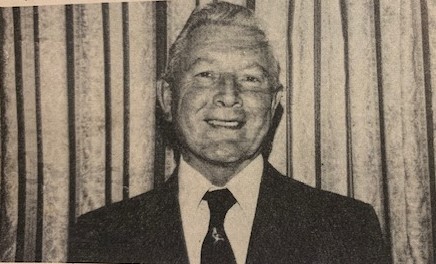
The Joe Murphy Column

Continuing with Part 3 of Major Hutton’s story;
The racing pigeon unions of most countries where pigeon racing is carried on are members of the International Federation. This International organisation has carried out a number of surveys and experiments in connection with the sport and have issued their reports. The space at my disposal will only allow me to make a few observations on their findings which I hope will be interesting and informative to the reader. While to most fanciers the fact that pigeons can be trained to fly at night is not a new, one or two conclusions reached from the Federations experiments are very significant. The conclusions reached were that pigeons do not guide themselves by the East, nor by the Sun or for that matter from visual memory as propounded by some theories. This nocturnal orientation which permits pigeons to blindly direct themselves towards the area of their lofts is in complete accord with the hypotheses that they are guided by waves set up by the district (zone) in which the pigeons concerned have their habitat. My experience has been both in normal civilian racing and in the variety of conditions met with the Army, I believe that the further pigeons are away from their loft, the less time do they take to clear off in the right direction for home. Yet when liberated close the will clear off and then come back again perhaps several times before finally disappearing for good. This pattern of behaviour is in keeping with the idea that pigeons become attuned to whatever it is being given off from the zone when it is only habitat and when taken away from it, they are capable picking up the signals from this zone and flying towards it. A long distance away these signals and the zone emitting them is a small spot, but as the distance decreases the zone increases in size until the voyaging pigeon is completely surrounded by the signals thus being deprived of this means of orientation and from then on has to depend on visual memory. This mean of course that pigeons liberated close to their loft have to have to depend on their visual memory built up from past experience in training and racing. I have worked on this idea for a long number of years now but do not think that we have the complete picture as yet. It is encouraging to me to know that the international experimenters from two different experiments carried out by different people have provided confirmation of my own conclusions regarding the probable means by which pigeons navigate themselves to their home zone. Whatever it is that creates the attraction I have the notion that its strength varies from time to time and day to day. Have you ever noticed in our Scottish National raced that one-year fanciers in one district do exceedingly well yet at another time not one of them are in the hunt or at least well up. We know that certain weather conditions may and certainly do favour one section at the expense of another, but this phenomenon of which I write operates irrespective of which section has the advantage or disadvantage on any particular day. Furthermore, if you care to study SNFC race results over several years you will observe it not unusual to find birds belonging to an area of club being timed very close to one another, while a club or area close at hand draws a blank. As an example of this I could not help noticing the success of the members of Coalburn Club in the SNFC races from Rennes 1967. There are no less than 10 birds timed between 4-04 and 4-37pm, this being exactly half an hour, and they had 14 birds all told in the money. The positions taken by these first 10 birds were 4th section/22nd open;7th section/27th open; 10th/31st; 24th/59th; 26th/63rd; 29th/ 67th; 30th/68th; 35th/79th;38th/84th and 41st/87th. During these vital 30 minutes the neighbouring clubs Douglas Water and Lesmahagow who usually do very well only have one bird each; the Lesmahagow bird winning 9th section 30th open and the Douglas Water bird winning 23rd section 58th open. Another feature of the Coalburn club members success was the age of their winning pigeons. There were 4 x 2-year-olds; 3 x 3-year-olds; 2 x 4-year-olds and 1 x 5-year-old. One of the experiments was to follow a convoy of racers from a plane trying to keep them in sight from start to finish. Here I was rather disappointed that the distances flown were not given. They found that pigeons did not fly as many migrant birds do, some in an inverted V formation with an obvious leader or in a line one behind the other. Pigeons on liberation rise and circle as they gather into a compact group. There being no leader, they all seem to want to be ahead of each other forming a large front in a crescent moon formation. The observers have never seen a single pigeon forge ahead of the other members of its group and go off on its own, but have found birds breaking away from the extremities of the crescent and others loitering behind apparently unable to keep up with the others. They found that pigeons under normal conditions fly at between 100 and 150 feet and will not rise to fly over an obstacle if they can fly round it. I can vouch for the fact that they do not like flying high, having liberated scores of pigeons from many different types of planes and using several different methods to get them clear of the plane. Once clear of the slipstream and into what we might term undisturbed air they drop rapidly to house or tree top level. As a race progresses the original large crescent shaped flock starts to break up into smaller groups. This process is helped by the divisions created during the negotiation of obstacles met on route. In a tail wind pigeons fly much higher than usual, so they do not meet so many obstacles to divide them. In consequence they tend to remain in much larger flocks and reach their home zone in large numbers, whereas in a head wind they fly close to the ground making use of all the shelter they can from the wind and if their journey is a long one, every obstacle they meet with tends to divide them and single birds become isolated with the result they arrive home one by one. Cross winds have much the same effect and in addition they tend to drift the pigeons off their true course. On such day’s pigeons arrive from the direction into which they have been pushed by the wind. Regarding the effects of Radar, Radio, and large centres producing electrical power, no evidence was observed of any hesitation or deviation from their course by the travelling pigeons while passing over or near such centres. Disasters are usually the result of human error plus the unforeseeable deterioration of the atmospheric conditions en route. Meteorology is making steady progress and may very soon be able to warn pigeon organisations early enough of sudden changes to avoid these disasters. There is another type of disaster; what it is and what brings it about is a mystery. Experienced convoyer’s and controllers will all have had some experienced of this mysterious phenomenon. The sky is clear and visibility good with favourable forecast – the race controllers and convoyer’s have no hesitation in deciding to liberate their charges. The pigeons clear alright and in fact the next convoy for release has already taken to the air when the first birds liberated come back and circle round while the second lot appear to have cleared, but soon over the race point are a host of pigeons flying to and fro in all direction. Gradually their number’s decrease as small batches are seen clearing in all directions. I believe that in one of the early young bird races this season the birds were coming back after appearing to have cleared. A friend of mine during the war was stationed at one of the popular race points in the Midlands and one morning witnessed the liberation of several Scottish Federation’s birds. The birds cleared normally but over an hour later they came back and kept circling the race point. By this time the convoyer’s were on the train on their way home totally unaware of what had happened. In fact, there were birds still flying around as darkness fell. The reason which so upsets the pigeons’ normal powers of orientation with such disastrous effect is a mystery. The report’s conclusions are that trial liberations should be made before general release of the race birds is decided and if these control releases are unsatisfactory, then some method of warning other convoys in the vicinity should be made. Personally, I feel that when a disaster happens the details should be sent to the Met office immediately. Data collected from these disasters and of finding means to avoid them is the future, not to mention increasing our knowledge of another angle to this ever-fascinating sport. I would like to thank all the fanciers whom I have spoken too, that have enjoyed Major Hutton’s comments re-printed in my column these past few weeks.
----------------------------------------------
Received a phone call from my old friend John Murray of the UNC area. John was saying how much he enjoys my short write up’s and also seeing the photographs of the winning pigeons. We discussed how looking at these old photographs brought back some wonderful memories of these great pigeons from the past. John informed me about his book blue cock that won 3 times in the UNC from Litters and I asked him if he could send me a photo of the cock which he has done. Rung NHU93NW1199; in 1995 he won 1st club 2nd Newcastle West federation 5th section 30th Up North Combine Lillers with 18,473 birds competing. In 1997 he won 1st club 6th Tyne to Tweed Championship club; 78th Up North Combine Lillers 19, 074 birds. 1st club 8th Newcastle West Federation, 198th Up North Combine Lillers 18,610 birds. Owned and raced by J G & Karen Murry – Coxlodge HS photo taken by Jeff Walton. A truly outstanding pigeon and when you look at the birdage in the Up North Combine from these 3 races the convoy amounted to 56,157 birds and only 303 birds beat John’s blue cock. No wonder the man is so proud of his pigeon – Everyone of us would feel the same, well-done John and it was lovely taking to you.
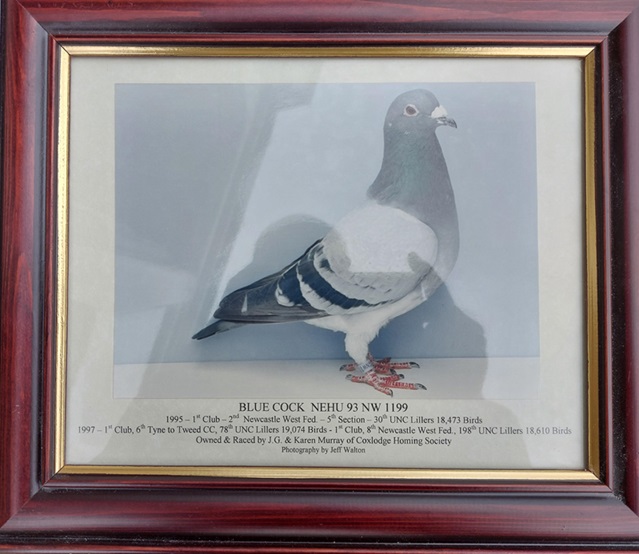
John Murray's Blue Cock see text
SNFC Grevillers Race
After a two-day holdover the SNFC race from Grevillers was flown on 14th July with the convoy of 391 birds liberated at 07-00am into a light south wind. Only 3 birds gallant pigeons made it home on the day with the winner past SNFC 2016 Roye winner Jocky Scott of Kennoway in Fife. Jocky timed in a yearling chequer cock at 20-51pm for the 486 miles doing a velocity of 1029. There was no word on the national lib line and I had a couple of fanciers asking me if this was true there was a bird in Fife and I told them that I didn’t know. However, I’m happy for Jocky as he won the Dewar Trophy in 2019 with his chequer cock ‘Whisky’ (which you can read about in my book ‘The Dewar Trophy the First 50 Year) The winner of 1st south section 2nd open is John Hodgson of Annan who was the winner of the Dewar Trophy in 2022; John Hodgson needs no introduction to the pigeon sport as he has a very impressive history in the SNFC national having won 7 x 1st open National winners. Starting away back in 1986 winning Sartilly (2) the following year he won Sartilly (1) and in 1990 he won a double winning Rennes Gold Cup and Sartilly (2) the following year he won Sartilly (1). Then in the 2000’s he moved house to Kirpatrick Fleming and won Falaise in 2008 and Clermont 2 years later; John is now back in Annan living. J Ferguson of Eastriggs timed at 21-02pm and he won 2nd region A 3rd open with these being the only 3 gallant birds timed on the day. Winning 1st section B 4th open is Brian Kelly of Chirnside with my dear friends Charlie & Glen Cameron of Arbroath winning 2nd 3rd & 5th section B 5th 7th & 16th open. 1st region E 1st west section 6th open is D Gillespie of Blantyre. 1st region F 8th open is Andrew McKenna of Irvine; 1st region D 13th open is Tom & Mary Paterson of Plean; 1st region G no open place is won by Mike Main of Portlethen. Congratulations to all the fanciers who timed in pigeons from this 400/500 miles for the furthest flying fanciers.
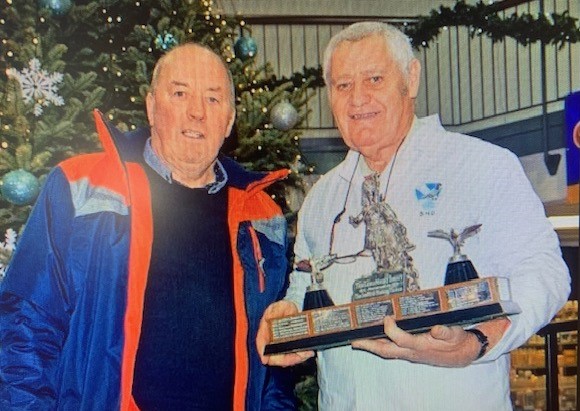

Jock Scott see text John Hodgson see text
27 Day Space Weather Outlook Table.
Issued 15th July at 02.02
UTC Radio Flux Planetary Largest
Date 10.7 cm A Index Kp Index
2024 Jul 15 230 5 2
2024 Jul 16 230 5 2
2024 Jul 17 230 5 2
2024 Jul 18 210 8 4
2024 Jul 19 200 8 3
2024 Jul 20 200 8 3
2024 Jul 21 200 5 2
2024 Jul 22 195 5 2
2024 Jul 23 190 5 2
2024 Jul 24 185 5 2
2024 Jul 25 180 5 2
2024 Jul 26 180 5 2
2024 Jul 27 180 5 2
2024 Jul 28 175 5 2
2024 Jul 29 170 5 2
2024 Jul 30 170 5 2
2024 Jul 31 170 5 2
2024 Aug 01 165 5 2
2024 Aug 02 165 5 2
2024 Aug 03 170 5 2
2024 Aug 04 170 5 2
2024 Aug 05 180 5 2
2024 Aug 06 190 5 2
2024 Aug 07 200 5 2
2024 Aug 08 200 5 2
2024 Aug 09 200 5 2
2024 Aug 10 200 5 2
Please continue to keep the news flowing; to Joe Murphy Mystical Rose Cottage 2 Flutorum Avenue Thornton by Kirkcaldy KY1 4BD or phone 01592 770331 or Email to
© Compiled by Joe Murphy