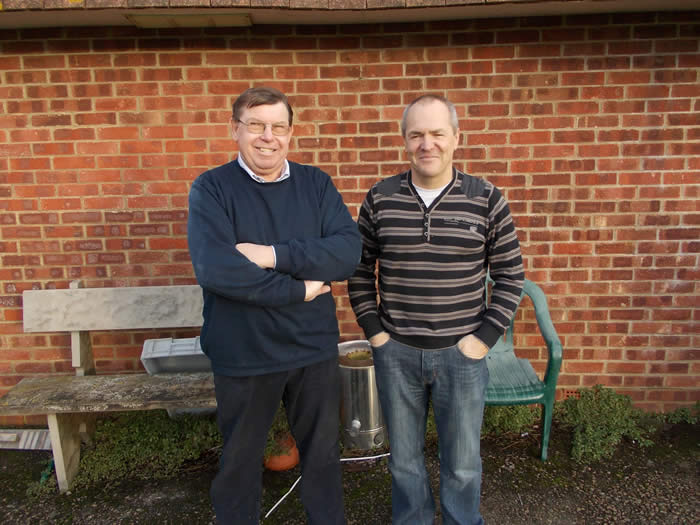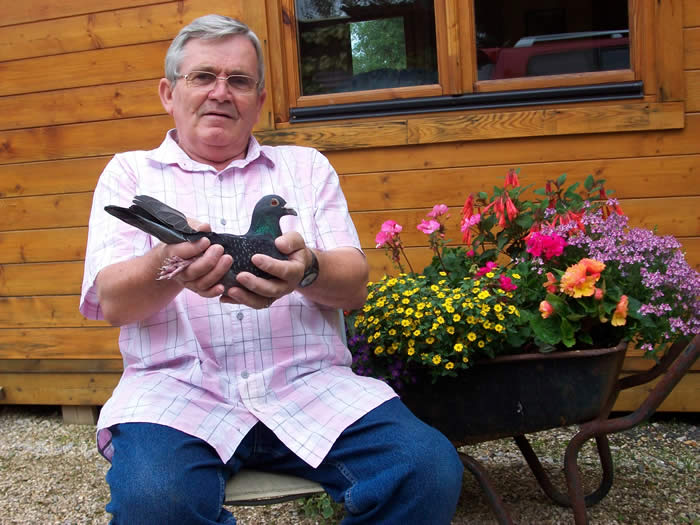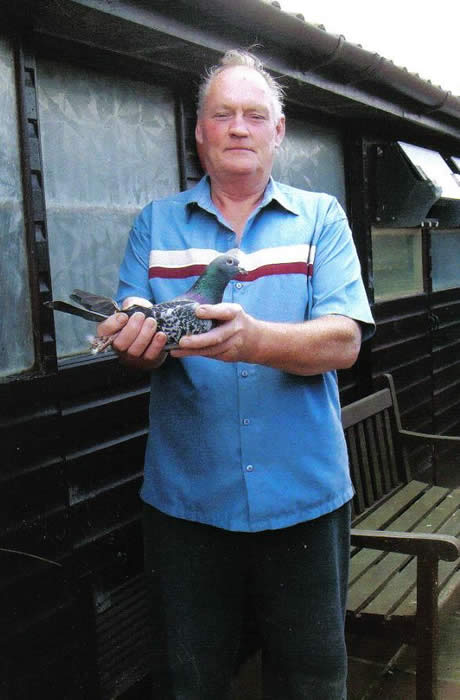
Gareth Watkins chats to
DAVID HALES
of Hockley
MULTIPLE WINNER AT THE DISTANCE
The subject of this loft report is one of the most successful and consistent performers on the International racing scene with the BICC. So much so that if I have to phone him much more for details of his winning pigeons in BICC International races then one of two things will happen - either David will pick up my Welsh accent or I will adopt his Essex one! The following is an interview I had with David following his most recent success of 1st Open BICC Marseille, a performance that followed on from David's 3rd Open Barcelona and 9th Open Pau International earlier in the season.
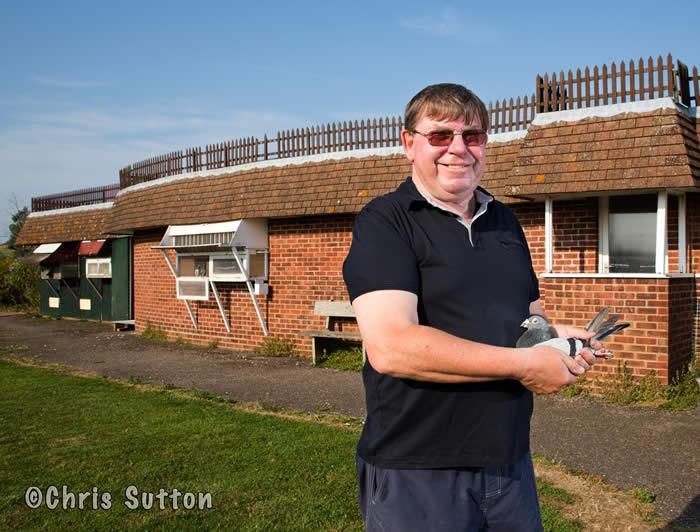
David Hales
When did you start in the sport?
I started in the sport at the end of 1961 by catching a stray.
Who was your first major influence?
A combination of being told by my dad Harry that, had I been home and not been in the pub, I could have won on several occasions and the other fanciers thinking that I was a soft touch. This made me a bit more determined to succeed.
Can you give brief details of your first loft, birds, management etc?
My first loft was 2 rabbit hutches on top of each other before eventually moving onto a more conventional construction. Being a chippy by trade it was designed to my own requirements. The early days it was a case of feeding beans and lots of training but I held my own out to 500 miles.
How long have you raced to your present location?
I moved to my present location in 1988 and started racing in 1990. The early years were spent chasing sprinters around on the north route up to 500 miles. I won more than my fair share but a new challenge was required so the decision was made to turn south and have a go at the long distance International races with the BICC.
Can you give details of your present loft set up i.e. overall dimensions, orientation, number of sections etc?
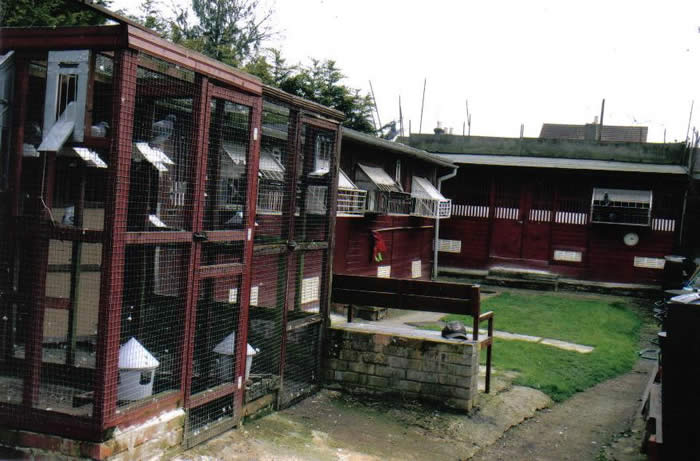
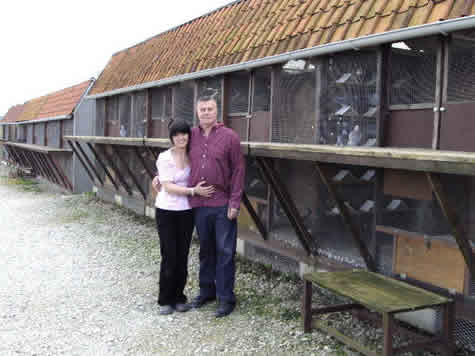
I have approx 200 feet of lofts divided into around 14 sections, this includes my stock loft which has 2 sections both with aviaries on the front. The birds have plenty of room. I will never overcrowd - for me it’s a no no. The racing loft faces west and this gives me protection from the cold east winds early on in the year.
Do you use deep litter, grids or clean daily/regularly?
I use deep litter in the stock loft. The racing loft has conveyors in the nest boxes, and some of the loft also has pits with grills.
How many birds do you keep?
I keep 12 pairs of stock now, mainly retired racers and children of them. I started the current season with 34 widowhood cocks and 16 widow hens to race. I have a team of 50 youngsters.
What system do you use to race the birds e.g. widowhood, roundabout, natural etc?
Only widowhood is flown, both cocks and hens.
When do you mate your stock birds and racers?
This year the stock were mated in early January, the widowhood hens in February and the widowhood cocks were paired in March. I am constantly tweaking pairing dates to try and maximise the length of time the birds hold their flights as I race old birds into early August.
Do you mate the birds you intend for the longer races at a different time to the other racers?
The whole loft is paired for long distance racing. The hens I try to get ready for the earlier races then the cocks come into their own later in the season in June, July and August.
What is the preparation of the racers prior to the first old bird race?
I increase the flying time around the loft to an hour twice a day then a couple of training spins out to 40 miles. The hens may have a little more training if weather and time allows.
Do you force fly your birds during exercise or are they left to do as they please?
The birds are encouraged to fly the time that I feel is required for the time of the year.
How often do you exercise the race birds?
The cocks will go out twice a day for an hour. This will change as the longer races approach going up to 100 minutes in the morning and open hole in the evening supplemented with a toss as required between races. The hens go out once a day in the evening for 120 minutes, again supplemented by the odd toss as and when required between races.
How often do you train the race birds before and during racing?
I train little before racing and as and when I feel required between racing. It’s a fine line between giving enough early on and not over doing it before the big races come around.
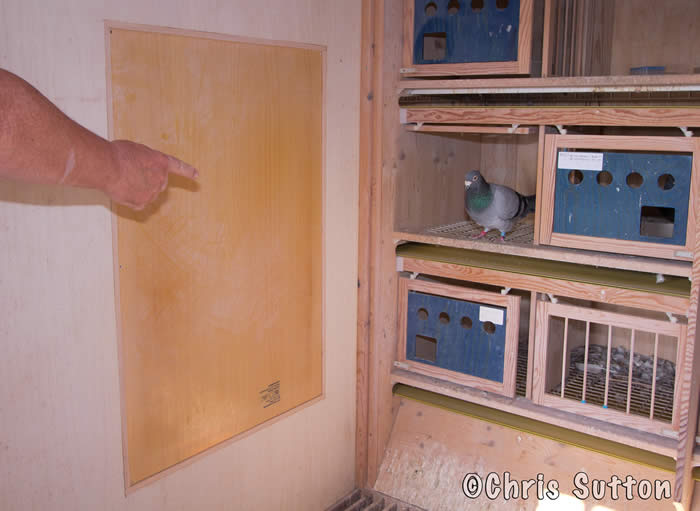
The Marseille winner in his box
How far do you usually train?
I start at 25 miles go out to around 60.
Is there any specific preparation for the birds before National races?
This year they had 2 inland races and one channel race before the first International. Luckily the early channel racing this year put some much valuable time under the birds' wings. The rest of the old bird team had the 2 inland and 2 or 3 channel races before heading off on their European adventures.
How much racing do your young birds receive and how many training tosses do they have in the year of their birth?
I have found that it makes vey little difference to long distance pigeons how much work they have as youngsters. Believe me, I have done both, hard trained and hard raced, also just trained not raced and I have good bids in the loft treated both ways.
Do you race your young birds on the Natural system or darkness/light system?
If I intend racing the young birds then they are put on the darkness system.
How do you feed the racers, stock birds, young birds hopper/by hand. How do you gauge how much they need at each feed?
My birds have food in front of them 24/7. If I feel they are wasting too much then occasionally I will make them clear the hoppers.
What mixtures do you feed?
I mix a combination of V/L mixtures. I don’t like feeding too many heavy/large grains.
Do you feed any differently in the build up to National races?
No, they get the same basic mix but I will add fats to the mix in the last 5 days for the Internationals.
What are the main bloodlines that you house now and which lines have proved the most successful?
I fly a combination of Jim Biss, Alan Parker with a sprinkling of Bruggeman, Hagen, Fauche and Jan Aarden. The Parker birds have proved to be a very good base but they all hold their own or they would not be entertained here. The older birds are expected to fly 2 International races a year over 500 miles. More recent introductions have been from our friends in Kent and an inbred cock from Richard Green's [Crowley & Green] Barcelona pair. These are unproven but looking encouraging so far.
Do you line breed, in breed outcross when breeding. Which method has been most successful for you?
I inbreed the odd ones for stock, otherwise I cross breed hoping to inject some extra vigour into their obvious toughness and tenacity.
Is there any fancier who has helped you more than any other?
Two fanciers have given me the right attitude to be a successful fancier, both now deceased. My friend Stuart Elvin from Chelmsford and Sid Rowe from Rochford - thank you guys, you're no doubt smiling up there watching how things are progressing!
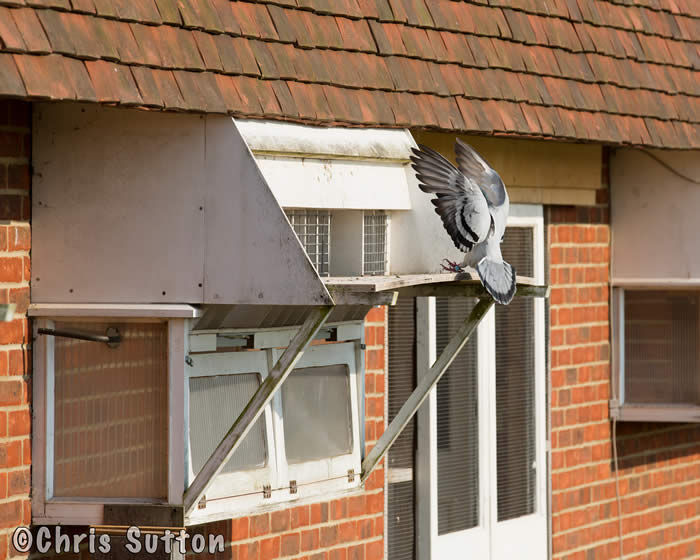
David's 1st open Marseille winner alighting on the loft
Can you give an outline of your many top class performances and those that have given you most pleasure?
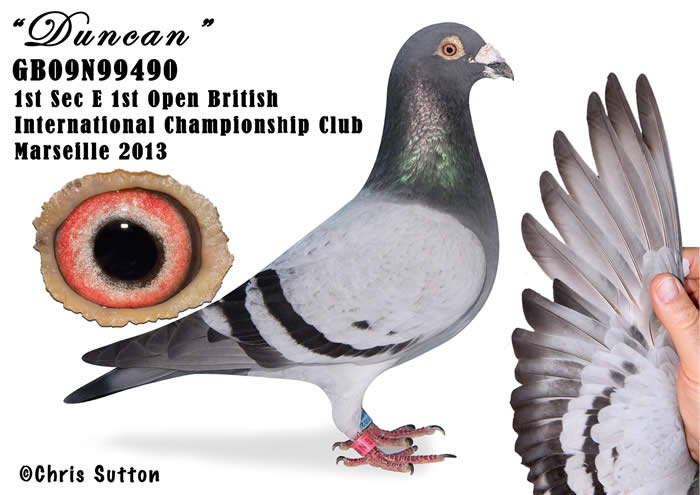
1st Open NFC Sartilly Y/B, 1st BICC Falaise, 1st BICC Falaise. 1st Open BICC Dax, 1st Open BICC Perpignan, 1st Open BICC Marseille, 3rd & 15th Open BICC Barcelona (sent 3), 4th & 18th Open BICC Barcelona (sent 3), 7th & 16th Open BICC Barcelona (sent 2). Clocking “Tubby” 2 years running on the day from International Pau at 575 miles and my most recent performance at Marseille not only winning but clocking “Tubby” for 8th Open and “Glynie’s Girl” for 13th Open (she was also on the day from the Pau International this year). Three from three all on the winning day at 637 miles will stick in my mind for a very long while.
Can you give details of some of the top pigeons that you have raced?
My best pigeon at present is “Tubby”. He just seems to have something that bit special. 3rd Open BICC Marseille 637 miles, 7th Open BICC Pau 575 miles on the day, 8th Open BICC Marseille, 9th Open BICC Pau on the day, 110th Open International and 35th Open BICC Tarbes 580 miles. He was also here to have a decent position from Agen 517 miles. Tubby is half brother to"80" who won 1st and 4th Open BICC Perpignan 617 miles and 38th Open NFC Tarbes 580 miles. The year he won Perpignan he had 580, 580 and 617 miles in around 6 weeks and he came home fresh from Perpignan. I have also clocked the same 2 cocks "07" and the “Fantail” from Barcelona 2 years running.
Do you have any views on how the sport can be improved and how we can attract new members into the sport?
That’s I question I would love to have the perfect answer to. Where to start? Where are new fanciers coming from? I guess we should concentrate at the grass roots in the schools and then as much encouragement as we can give around our own lofts. Show them all aspects of the hobby and make racing cheaper if we can. There is so much for youngsters to do nowadays that involves them having to do next to nothing physically!
Do you have a specific programme of medication?
I vaccinate annually but other than that I have no specific program of medication, although I will treat for canker after the first channel race.
Do you use any supplements such as vitamins etc?
I like to give fresh grit daily usually in the form of Matrix.
Do you feed any supplements in the build up to long distance / National races?
I will occasionally put electrolytes in the water.
How does your ideal pigeon look/handle?
How my ideal pigeon looks and handles doesn’t alas always reflect on how they perform at the distance. I like medium hens that are nice and round. Cocks I like with a bit more size, on the large size of medium if you like, but they must also be round but light like paper bags, never heavy. I like to feel silky feathering - that's important to me.
If you could only use one product / supplement what would it be?
Vineherb Strong guard.
There you have it then, the thoughts of one of the top long distance fanciers currently plying his trade on the International stage in the British Isles.
---
Elimar November 2013