PAGES FROM THE PAST FEATURING
JIM BISS
THE MAESTRO OF THE MARATHON
2 x 1st LNRC
4 x 1sts MNFC
20 x 1sts BICC
1st NFC Pau plus 12 x 1st section NFC
by Gareth Watkins
Where does one start in attempting to do justice to a fancier who was winning long distance races and the most prized trophies in the LNRC into the East end of London in the 1950s and then went on to win 20 x 1sts when racing with the BICC after his move to Norfolk in the mid 1960s? Add to the above successes with the London North Road Combine and BICC the fact that S. G. [Jim] Biss also won a veritable mountain of certificates with the NFC including the King’s Cup from Pau and 12 x 1st section in NFC races, plus 4 x 1sts Open MNFC and you have the CV of possibly the greatest fancier ever to have raced pigeons to these shores.
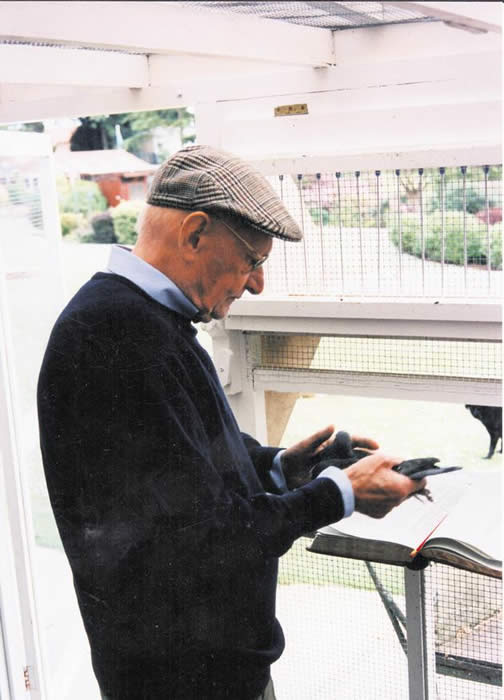
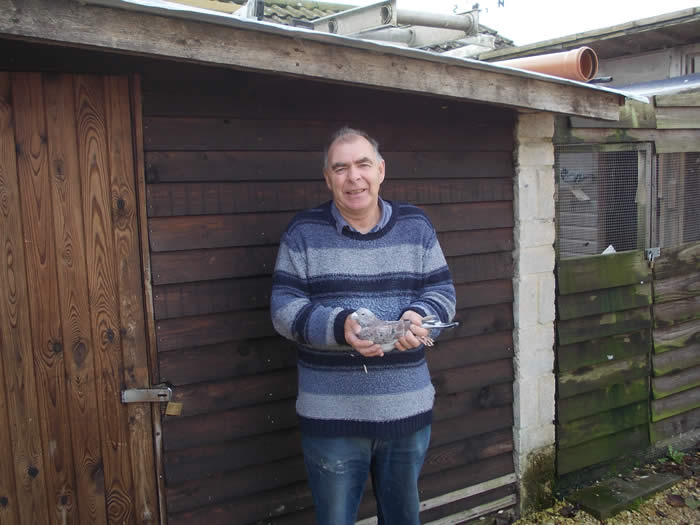
Jim Biss studying one of his race candidates
THE BEGINNING
The Biss “Gold Medal” strain that Jim Biss raced into the East End of London was founded on the Old English families of Lulhams, Savage Barkers and Thoroughgoods and when racing into London on the north road from Berwick, Fraserburgh, Thurso and Lerwick won no less than 10 NHU [RPRA] Meritorious Awards plus three times winner of the Tommy Long Trophy for best average in the three longest Scottish races with the then 2,500 member strong London North Road Combine. Incidentally, the Tommy Long Trophy was won in three consecutive seasons racing from the Scottish race points. Pigeons such as Champions Agnes, What’s Wanted, The Limit, Rogersday, Jose and The Big Hen all won top prizes at combine level in races from 300 600 miles.
On moving to Norfolk in the mid 60s, Stan [Jim] Biss set about founding a new family at the new location, Hillside Lofts at Brundall and went abroad to France to purchase the cream of the all conquering Dordin strain. Many of the Dordin winners were purchased at great expense, including the immortal Scout, Spahi, Sombrero, Sosie, Romulus, Remuant and Turbulent plus sons and daughters of Pierre Dordin’s main breeder Indemne.
The lofts built at Hillside to house these champions were nothing less than spectacular for that time, as they incorporated running water and insulation in all walls and ceilings and a revolutionary type of flooring. The floor was made up entirely of sections of plastic diamond shaped grills so that any droppings could fall through into a seven foot deep pit beneath. This pit was cleaned out and disinfected at regular intervals to ensure the perfect health of the inmates.
The Dordins were, in the main, kept pure but some were crossed with the Gold Medal family to good effect. The Gold Medal family had previously been raced on the natural system but after the move to Norfolk the birds at Hillside once established, were raced on the widowhood system with devastating results at club, Federation and National level.
Witness the result of the Midlands National Flying Club race from Rennes in 1976 when the Biss widowhood team won 1st, 2nd, 3rd, 4th, 5th, 8th, 10th & 11th Open at 342 miles against a field of 2,556 birds entered by some of the best sprint /middle distance fanciers in the UK.
In the BICC race from the Scilly Isles which took place in 1983 the Biss team took 1st, 2nd & 3rd Open at 384 miles. Add to this the result in the MNFC Nantes race in 1984 where the Hillside widowers took 1st, 2nd, 3rd, 4th, 5th, 6th etc Open and you can easily appreciate the skill which this man possessed in getting a team to perform at the highest levels.
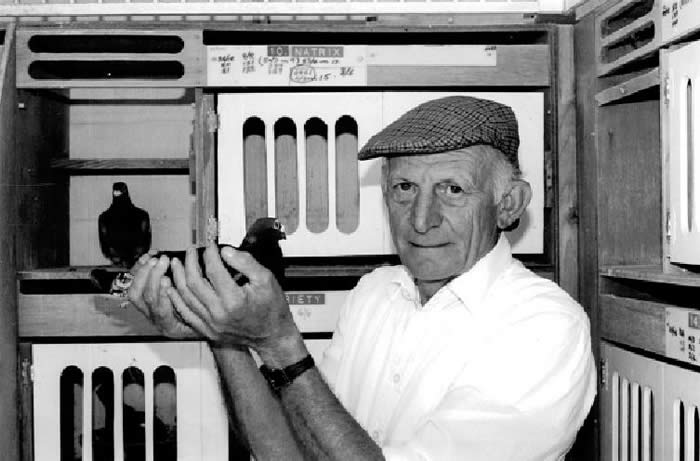
Jim Biss holding triple BICC Marseille winner Natrix
Stan [Jim] Biss could be described as a “meticulous perfectionist” and having cracked sprint and middle distance racing on the widowhood system set out to develop a team of widowers that could perform at the extreme distance, racing against the best in the UK and Europe in International races from Pau, Perpignan, Marseille, Barcelona and all points south.
With this goal in mind he scoured the UK in his search for top extreme distance performers and introduced birds from Trueman Dicken, Cyril Galyer, EJ Woodsford, Reg Churchill, Fear Brothers and others including a number of extreme distance winners from across the border in Scotland that had flown over 1,000 miles from Barcelona to the land of the heather. All these introductions were actual performers at the extreme distance for their breeders and these were moulded together by the master alchemist to produce the Biss “Greater Distance Strain”.
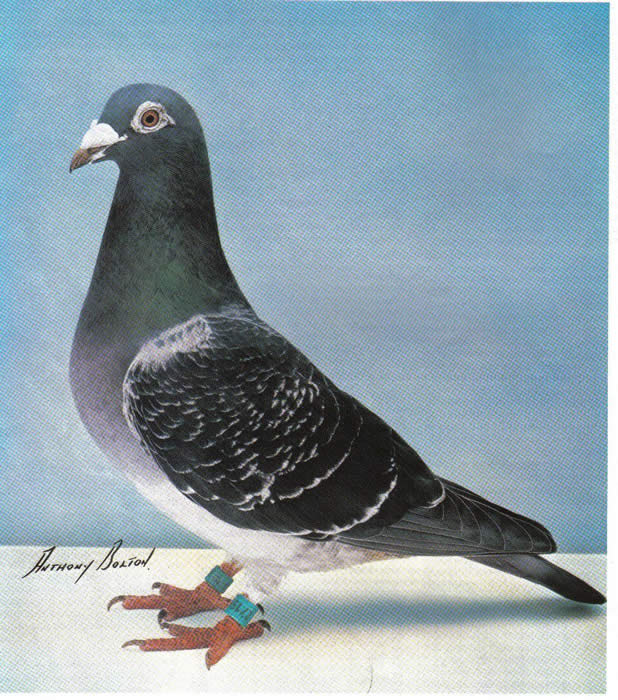
Hillside Fellow - 1st Open BICC Perpignan
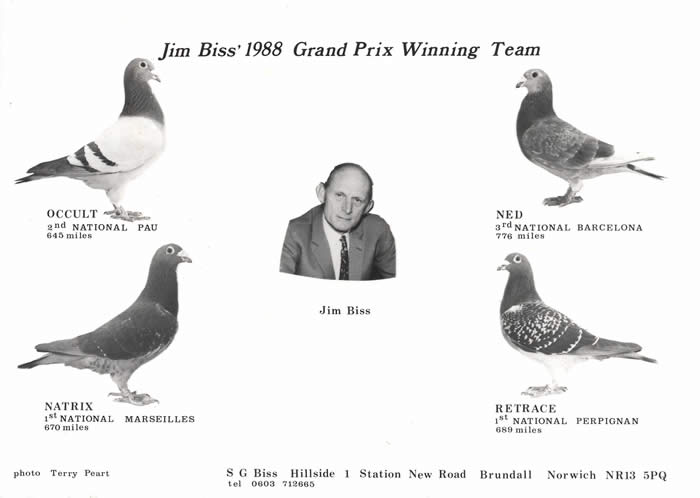
Possibly the most influential of the “Old English” long distance introductions was the bloodline of John Woodsford’s Perpignan winner “Black Velvet”. Jim Biss bought Black Velvet at the Woodsford clearance sale in 1979. He also bought his son “The International”, so named because he was bred from Black Velvet when mated to “La Oscura”, Cyril Galyer’s Barcelona winning hen. This line resulted in the production of numerous long distance performers including the red cock “Ned” winner of 2nd & 3rd Open Barcelona and also the great long distance racer “Natrix” who went on to win 3 x 1st Open BICC from Marseille.
Dave Pirie of Aberdeen won 1st Open SNFC Andrezel 626 miles on the day with Marlene’s Girl. This great hen was bred down from a grand daughter of Hillside Moon who in turn came down through the bloodlines of Black Velvet x La Oscura through “The International”. A golden seam of breeders.
The Bartholomew and his half brother Amigo bloodline from Tueman Dicken was also very influential as were the bloodlines from Fear Brothers. It should also be noted that the “Knightsdale Lady” bloodline from Reg Churchill of Weymouth also played a significant role in the development of the “Greater Distance” family as Jim Biss actually purchased the great long distance hen [6 times Palamos and always on the prize list including 1st Open] from Reg Churchill.
The greater distance family went on to win out of turn at the extreme distance with the BICC, amassing a phenomenal 20 x 1sts Open in races from Marseille[15 x 1st Open]; Perpignan [2 x 1st Open]; Dax and Barcelona.
The 2 Bird Average was won from Marseille in 1999, 2000, 2002, 2003 and 2004 as was the 2Bird Ave from Barcelona in 1999. These wins are never likely to be equalled and they adequately demonstrate the outstanding ability of Stan Biss, the maestro of the marathon.
Pigeons of the quality of “Natrix” 3 x 1st Open Marseille in 1986/87/88 and “Lama” 1st Open Marseille in 1984/85, “Fortune” 1st Open Perpignan 689 miles, “Retrace” 1st Open Perpignan and “Paddy” 1st Open Dax 625 miles amongst many others, all raced successfully from the South of France to their Norfolk home.
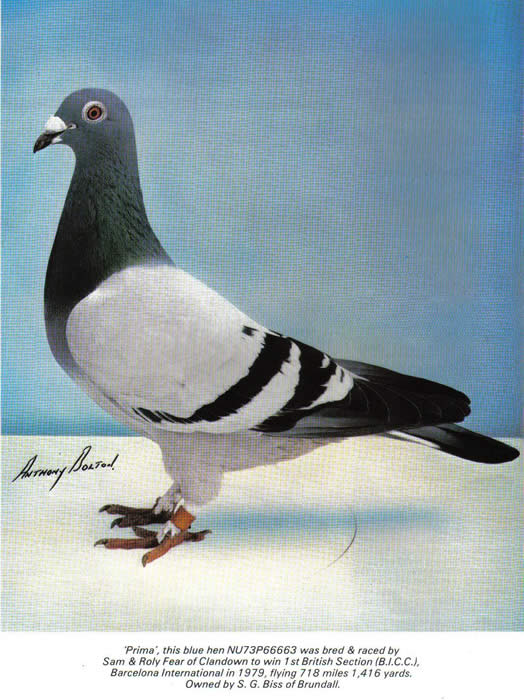
THE PIGEONS
Not satisfied with these outstanding performances at the extreme distance, the perfectionist in Stan Biss drove him to search the continent of Europe for something even better birds that could improve on even those great long distance performers already housed at Hillside. As a result, sons and daughters of the immortal “Supercrack” winner of 3 x 1st National at St Vincent, Barcelona and Narbonne were brought in as well as “Favori” a winner himself of 3 x 1st National at the distance. Jim Biss then set about breeding around these lines by mating daughters of Supercrack with Favori and daughters of Favori with sons of Supercrack. It should be noted that Favori was related to Supercrack through his grand sire which was a full brother to Supercrack. These continental lines were than added to the old base bloodlines to produce long distance “racers” with that extra ingredient of guts and reliability.
Later on, successful introductions were made from Julian Matthys which went on to produce the next generation of long distance performers when integrated with the already established lines.
The Biss method was to line breed within different lines for stock purposes and then cross these different line bred lines to produce each generation of race birds.
Unfortunately I never had the pleasure of visiting Hillside lofts but one man who did make the journey and who has a deep love of long distance racing is Cameron Stansfield who had the pleasure of handling many of the big winners at Hillside in the late 90s. I’ll let Cameron relate his impressions on handling these extreme distance winners.
“I visited Jim’s in company with my father and the Bush brothers Neil and Keith in the late 1990s and to be honest the pigeons were a bit of an eye-opener regards type. I was used either to the humped-backed Lancashire Barker that prevailed across the channel when I was growing up, and also that longer caste narrow type which formed my idea of pigeons with greater capacity for longer distances than the Barkers. I thought this difference was perhaps the biggest factor when it came to 500 milers as opposed to 700 milers. But Biss' racing cocks were, in the main, like neither of these. They were more wedged shape being shorter caste and pretty flat across the back, with a feeling of power up front. I likened them at the time to long distance 'sprinters'. We then went into his stock loft and I handled Favori who was aged 19 but handled like a 2y and was perfect in every way - he was not wedge shaped, humped back or anything else, just everything in proportion. Basically however, Favori was a 550 miler, and what Biss had created with the combination of the Favori and Supercrack type 'racing' pigeons was a bird that could 'race' 660 miles once nicked with the old English/Welsh/Scottish base-metal type that produced birds like Natrix which had more bone, more frame, more feather and bigger skulls. Years later having looked at the Biss line which won for him and others, I've noticed that when conditions are 'raceable' it is more often than not the Favori/Supercrack cross which prevails and when you get deep into the south of France for the Internationals the Natrix type come to the fore - and I believe it is these latter types that are the key pigeons taking a family or line forward because they are the supreme navigators/survivors. I thought it was interesting to look at how the later cross worked of Red Perpignan and Crack Perpignan. There seems little doubt from what I have read and seen that, given the number of birds which carried this cross towards the end of Biss' career, Crack and Red Perpignan crossed birds were not as stamina laden as what went before. Glazer and one or two others aside, they were not great Pau pigeons into Norwich. Conversely I spoke to Tony Waite, Biss' partner in Hampshire, and he told me that this cross was very effective for him, which I took to mean they were essentially 550 milers (also that they were not as willing or able to fly solo over greater distances). Jim told me that the Dordins were basically 'found out' at the Pau distance so when he resolved to concentrate on the Pau National and the Internationals he needed different pigeons. He went to various sources including Scotland where he bought some of the Palamos birds, all flying circa 1000 miles, and one or two of these left a lasting impression. Now, these Palamos pigeons took a good while to get home so I asked him what it was that made him value them and he said something I have never forgotten, and that is that they had the most elusive quality of all - 'survivability'. He said thousands and thousands of pigeons could fly 500 miles (and many more still would fail in the attempt, of course) but a pigeon flying 1000 miles had to be able to get up and do a bit more day after day, after day, foraging for food and water and not cracking or giving up. This is what he wanted and I think fanciers in general make a great mistake in dismissing pigeons with low velocities from the extreme distance races. In my final call with Biss he told me which were the two key breeding hens in his loft but that’s a story for another day.”
There you have the opinion of a man who has handled more long distance winners than most.
THE LOFT
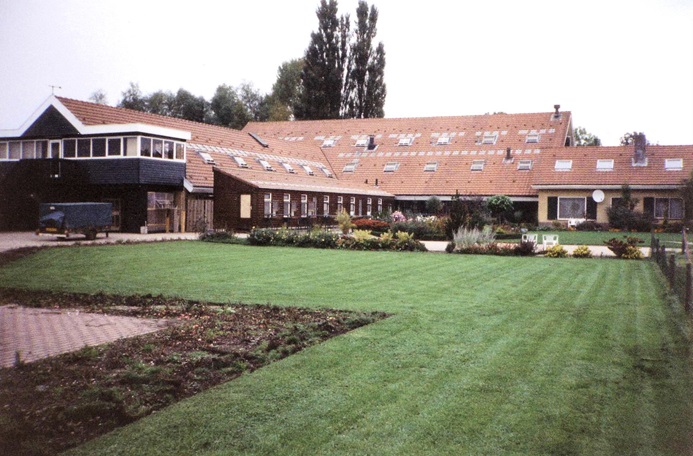
The first loft built at Hillside was “state of the art” for the time, the early 1960s. However even this wasn’t good enough for the perfectionist in Stan Biss and after only a few years Hillside Lofts Mark 1 was superseded by Hillside Lofts Mark 2. The photos which accompany this article clearly show what a magnificent structure this was. It incorporated six 10ft x 7ft sections to house the 100 widowhood cocks raced each year. Once again the revolutionary grid flooring was used to cut down on management and ensure a healthy internal environment. A false ceiling beneath the tiled roof ensured that stale air passed out above the pigeons roosting places through a fine mesh and out through vents in the tiled roof. The fine mesh ensured that flies and gnats were excluded from the loft. Each cock enjoyed nearly 40 cubic feet of air space so there was certainly no overcrowding here.
The 75 pairs of stock birds were housed in a separate loft as was the young bird team.
The lofts and all fittings were disinfected prior to mating and smoke bombs were also used to exterminate any nasties that might be lurking in the nooks and crannies. All nest boxes were removable making for ease of cleaning and disinfection.
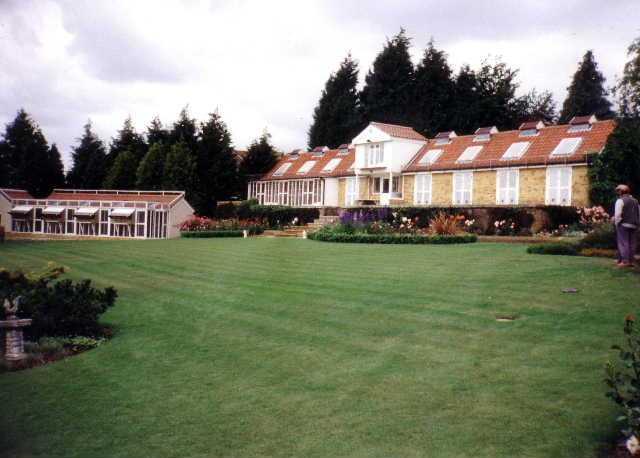
The lofts of the late Jim Biss
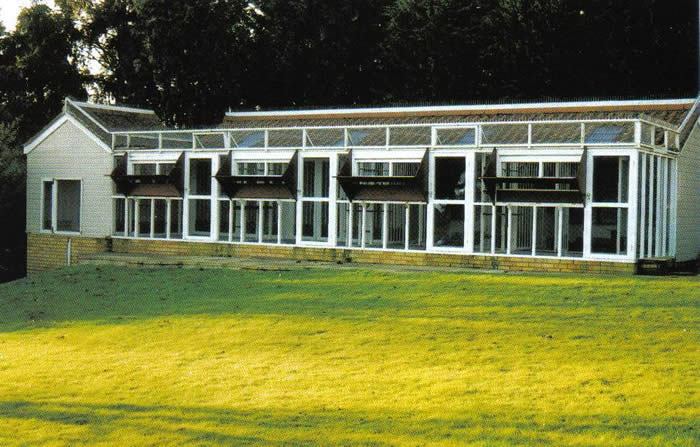
The YB loft
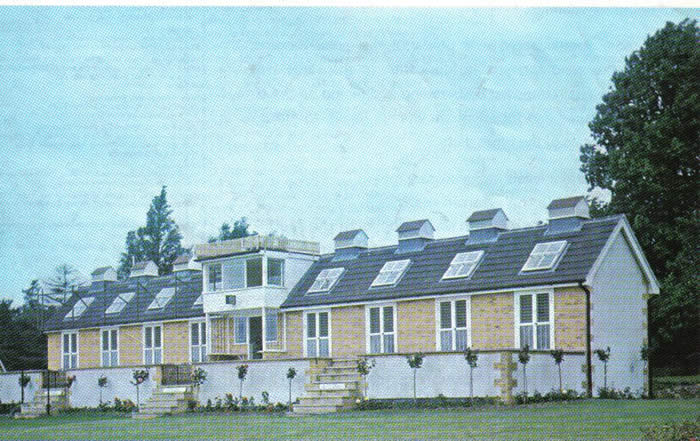
The widowhood loft in 1977
MANAGEMENT
All birds were mated at the same time which was usually around the middle of February each year. The widowhood cocks were allowed to rear a pair of youngsters and then when these were weaned allowed a week’s rest before their training regime began.
The cocks were exercised twice daily for one hour on each occasion with no forcing, just allowed to come and go as they pleased. Once Jim was happy with their exercise the cocks were given just four training tosses at 40 miles before going to their first race of the season. Once racing began the cocks were raced every other week or every three weeks in preparation for the long distance International race programme.
I give you here the actual race preparation of Natrix prior to going to Marseille:- Following his initial pre season training Natrix was entered in his first race at 173 miles followed by a 320 mile cross channel race, a 395 mile race and a second 320 mile race before being basketted for Marseille.
The Biss King’s Cup winner from Pau “Vend” was treated in a similar manner having two 90 mile inland races followed by a 220 mile channel race and then a race at 260 miles followed by one at 390 miles before going on to win the king’s Cup from Pau with the NFC.
The widowers did not see their hens before the race but were allowed to remain with them for at least an hour on their return.
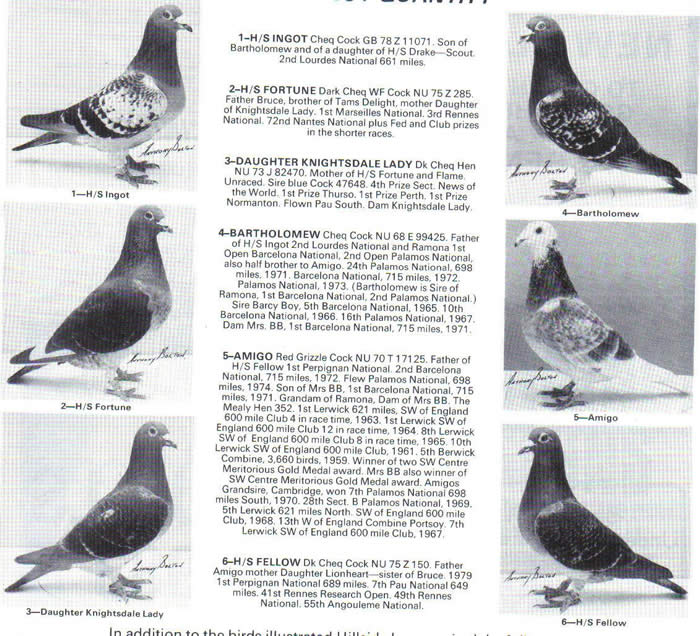
The Biss Greater Distance Family
FEEDING
The birds at Hillside were hopper fed during the winter months and no vitamins were ever added to the food or in the drinkers as Jim Biss was firmly of the opinion that if the grain fed to the birds was of the right quality it would contain all the vitamins that the birds would need. The only time that this rule was broken was after their twice yearly treatment against cocci and canker. The cocks, when racing, were fed a very light “super diet” type feed after morning exercise. This mixture consisted of white dari, safflower, wheat, rice, pearl barley and other high carbohydrate grains. A good home made widowhood mixture was fed after evening exercise. This contained at least 16 different grains including three types of peas, three types of maize, wheat, white dari, safflower, groats, pearl barley, rice etc. Feeding stopped once one or two birds went to the drinkers.
Medication was kept to an absolute minimum with just two courses of treatment each year for cocci and canker and that was it.
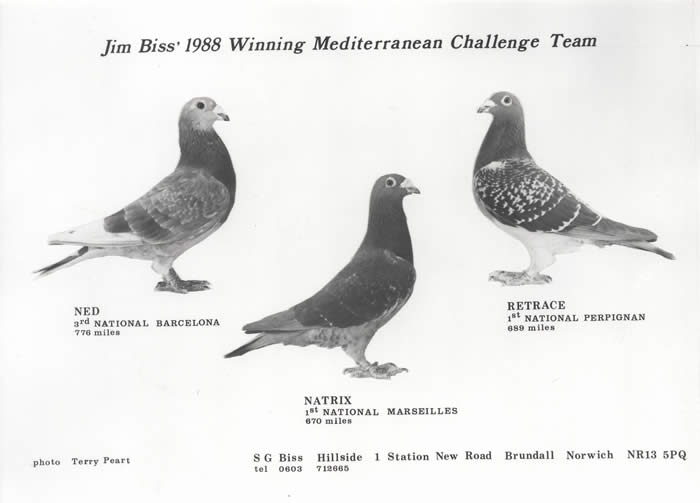
YOUNGSTERS
Jim Biss believed that youngsters should be brought along gently in their first year and not over stretched. His ideal race programme for the babies was a few races at 80/90 miles followed by one or two at 120 miles before being set aside for the yearling stage of their development. He believed that by taking this softly, softly approach with the babies their subsequent racing careers could be extended to 6 or 7 years racing as old birds.
He didn’t mind if the babies made a mistake so long as they showed him they had learned from the mistake. In fact one of the loft’s best performers later in life, was picked up by a non fancier as a young bird completely flown out, huddled under a car in a super market car park.
Jim Biss had learned from experience that long distance pigeons take longer to develop their homing ability when compared to the faster developing sprint pigeons.
Pre-season training for the babies consisted of three or four tosses at 8 miles followed by a similar number at 20 miles before moving on to 30 and 40 miles from which point he liked to get as many tosses as possible before the first race. He always insisted that the first toss at each stage took place in good weather in order to boost the babies’ confidence.
If a bad toss was experienced during the youngsters’ training programme then they would be rested for 5 or 6 days to get over the experience before training resumed.
The young bird team were fed on the same mixtures as the old birds with ½ ounce per bird being fed after morning exercise followed by as much as they required in the evening with feeding ceased when one or two birds went to the drinker.
Jim Biss also raced in partnership with Tony Waite to a loft in Hampshire and enjoyed great success to this location, including 1st Open Palamos with a pigeon named “Zimbiss”, but that’s a story for another time.
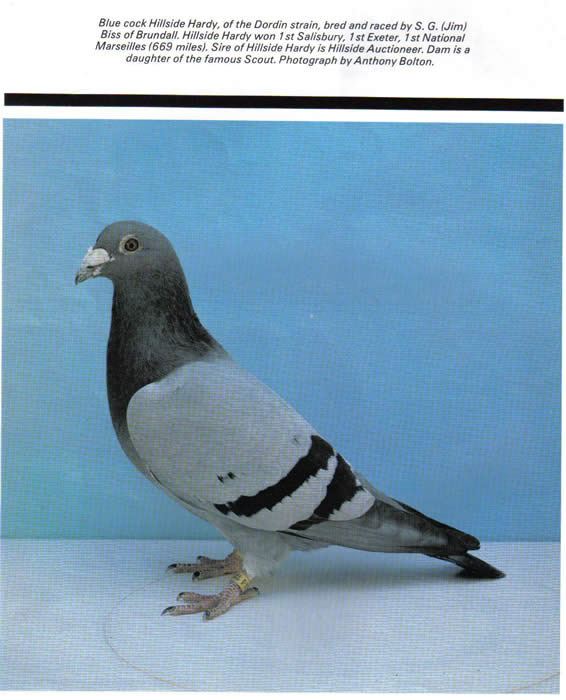
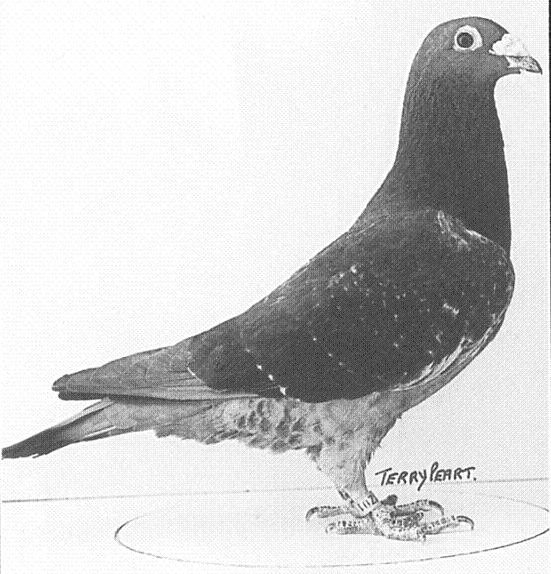
Natrix - 3 x 1st Open BICC Marseille. GG son of Black Velvet x La Oscura.
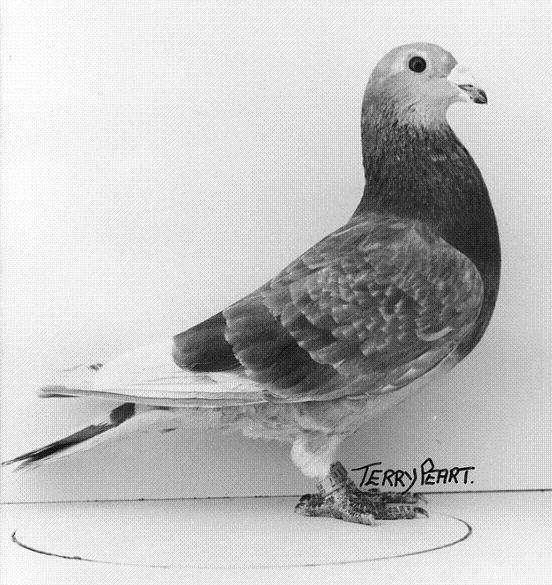
Ned - 2nd & 3rd Open BICC Barcelona
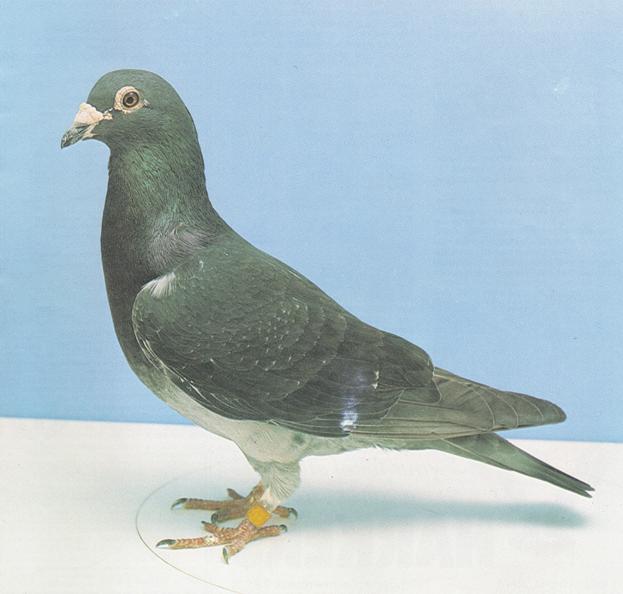
Black Velvet. 1st Open BICC Perpignan for John Woodsford and later bought by Jim Biss for whom he was responsible for many winners.
The International, a son of Black Velvet & La Oscura. Top stock cock for Jim Biss.
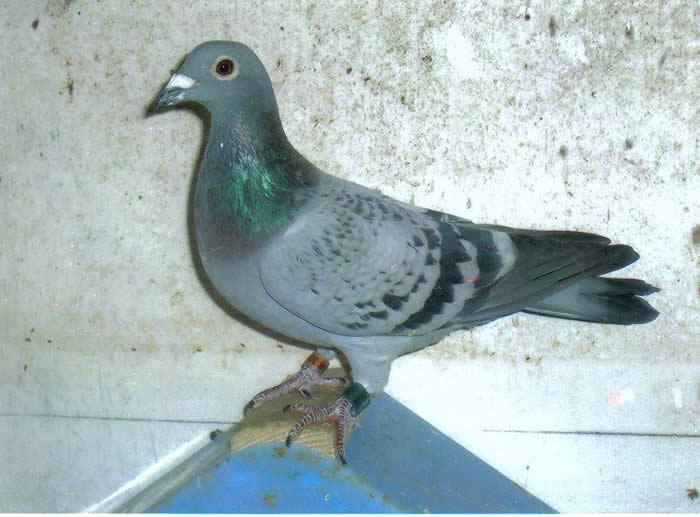
Dave Pirie's Marlene's Girl - 1st SNFC 626 miles on the day
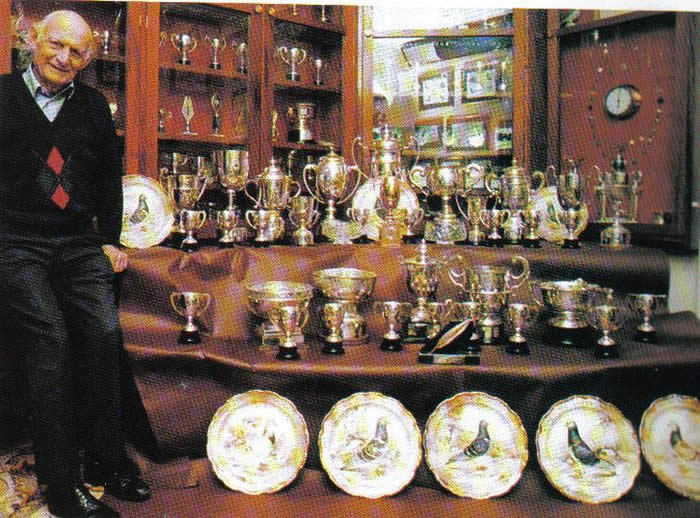
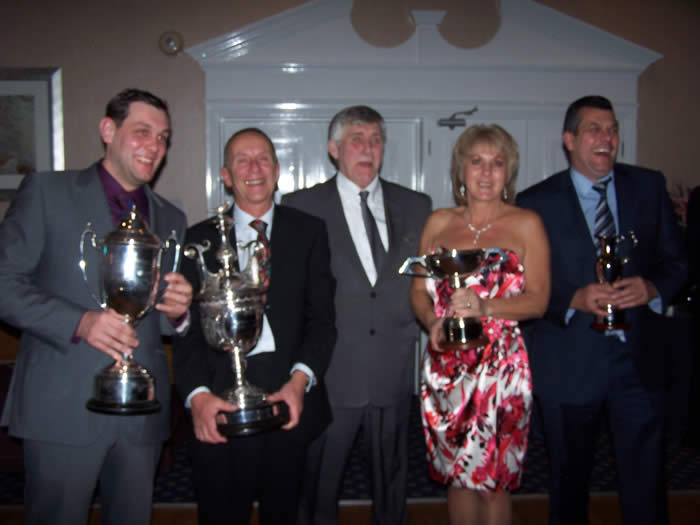
Jim Biss with his trophies
That then is a pencil portrait of one of, if not THE most successful fancier ever to lift a scraper in these Isles. I hope the reader has enjoyed this article and the others in the series. I must thank all at the Racing Pigeon especially Steven Ricketts and Mike Shepherd for all their help and also Cameron Stansfield for his input on this, the final article in the series.
Copyright 2013 Gareth Watkins
---