IN THE FLIGHT PATHS OF HEROES, The pigeons and the pathfinders on the road to victory 75 years ago.
By Chris Williams
As a writer my mind is a strange thing , some days I can sit at my desk with every intention of tapping out an article and nothing happens and another time I can see or hear something which piques my interest and the next thing I know I am busy thrashing out “pigeon prose “ on my laptop.
This was most definitely the case, when a friend of mine posted a photograph of one of their training spots which happens to be a disused air strip which in the dark period that we now know as the second world war was used by the heroic pathfinders who’s unenviable task it was to parachute behind enemy lines and ahead of the main Allied landing forces Their tasks were to mark the drop zones or landing zones and set up radio beacons as a guide for the aircraft carrying the main force and to clear and protect the area as the main force arrived. As one would expect such missions were highly dangerous. Such as operation Tonga” this was an essential element to the success of D-day. The operations objective included the capture of two key bridges over the Caen Canal and Orne River which were to be used by Allied ground forces to advance once the seaborne landings had taken place . The pathfinders also had to destroy several other bridges to deny their use to the German troops and secure several important villages. The division was also assigned the task of assaulting and destroying the Merville Gun Battery, an artillery battery that Allied intelligence believed housed a number of heavy artillery pieces, which could bombard Sword beach and possibly inflict heavy casualties on the Allied troops landing there . The offensive on the Merville Gun Battery is a an event which pigeon fanciers who are proud of the role our winged warriors played during this turning point in world history should be aware of Allied paratroopers from the 21st Army Group were dropped behind enemy lines days before, along with a pigeon in a small basket. Their mission was to ensure the guns were out of action and relay that information back to Allied Command. The mission ran into numerous problems, with many of the troops failing to make the rendezvous and critically, radios going missing. Despite this, around 150 paratroopers launched an assault and managed to disable the battery. Without radio equipment, their only way to get a message back was to release the pigeon with a message containing news of the operation's success. The gallant bird flew through a storm of bullets, bombs and driving rain and as result was awarded the Dicken medal and given the name “The Duke of Normandy “.
As I sit here marveling over this heroic feat , the fancier in me asks the question if the birds of the pigeon service could make it home in such conditions, are we not perhaps a little too soft on the pigeons of today, but that is a discussion for another time.
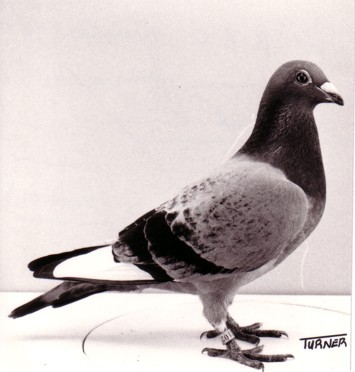
Looking into both the pathfinders and the Dicken medal also showed another link not only the county of Dorset but also the late great Jack Adams a fancier and writer whom I have hero worshiped since reading “A lifetime with racing pigeons “, which I borrowed from my Dad at the age of twelve and is still on my side of the pigeon bookshelf today! Jack writes with striking clarity an amazing account of the historic day of June 6th 1944 : D-day will always be manifest in my mind , it was the day RAF Hurn(now Bournemouth airport ) became a bee hive of activity with fortress bombers commuting all day long in support of the Normandy landings , the three lofts supplied almost 50 pigeons two to each aircraft . Attached to each pigeons leg was a plastic tube container which contained a message slip . Jack goes on to explain how of all the pigeons that were on active service that day a blue checkered pied cock with the ring number NPS.43.9451 , which he describes as his favorite pigeon that handled beautifully and was a well-balanced long casted intelligent specimen would win the Dicken medal and thereafter would be forever known as “Paddy”
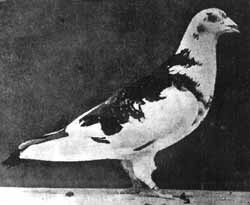
Paddy
Pigeon NPS.43.9451
Bred by A S Hughes, Northern Ireland
Date of Award: 1 September 1944
“For the best recorded time with a message from the Normandy Operations, while serving with the RAF in June 1944
Prior to the D-Day Normandy landings on June 6, 1944, Paddy was delivered to Hurn and two days later, he was among thirty pigeons taken to France by a unit of the First US Army. Paddy was released at 8.15 a.m. on June 12th, 1944, carrying coded information on the Allied advance, and returned back to his home loft at RAF Hurn in a record-breaking 4 hours and 50 minutes. This was the fastest time recorded by a message carrying pigeon and, in recognition of his remarkable contribution; Paddy was awarded the Dickin Medal, the animal equivalent of the Victoria Cross.
Reading the exploits of the extraordinary pigeons and people of world war two has only deepened my interest and admiration for the humble racing pigeon but it has also enabled me to understand that pigeons are far more capable of feats that even we fanciers cannot comprehend and this to me is what makes the enigma of pigeon racing such a powerful puzzle to solve. Making it the most attractive sport on the planet ,long may this legendry sport continue and may its incredible legacy be remembered because as a great man once said “Never was so much owed by so many to so few"
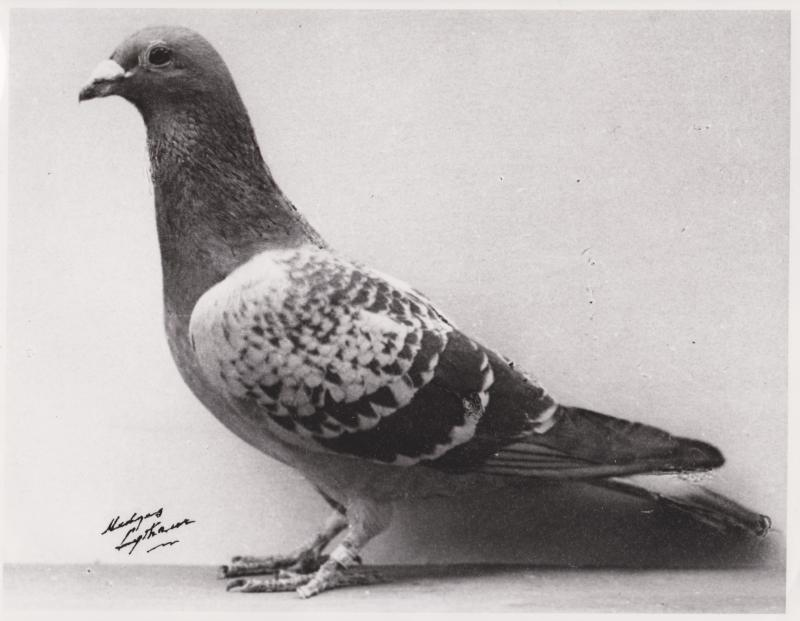
The Duke of Normandy

An example of a badge from the national pigeon service

Head of the pigeon service Wing commander Lea Raynor.