British International Championship Club

Trevor Robinson, an 800-mile Fancier
A dream? No!, Dedication? Yes!
There are several fanciers, albeit few and far between, who relish the challenge of extreme distance racing, this is usually over 800 miles. The BICC International races allow fanciers to compete at these extreme distances with races over 700 and 800 miles. The fancier Jim Emerton, himself an 800-mile virtuoso, thought that reporting on extreme distance fanciers would offer an insight into the mind set of these fanciers and encourage others to think about taking up the challenge. For many years now, Jim has sponsored three fantastic BICC trophies, to reward those fanciers who have excelled at the distance. They are awarded to the winner of the highest velocity over 750 miles, the best two bird average from Barcelona and the ACE International pigeon award, recorded in two International races in the same year.
This report is part of a short series on one of those fanciers, Trevor Robinson, who has been a member of the BICC for nearly 20 years. Trevor lives in Patrington, which is a mere 854 miles from Barcelona. It is a village in the East Riding of Yorkshire, in an area known as Holderness, 9 miles south-east of Hedon and 16 miles south-east of Kingston upon Hull. It is situated north of the river Humber and the Prime Meridian passes just to the east of Patrington. The Prime Meridian is the line of longitude in the geographic coordinate system and is defined to be 00.00°. This line divides the Earth, into two hemispheres: the Eastern Hemisphere and the Western Hemisphere. So, what does this mean for the BICC and Trevor? For the BICC, it is the line that divides the east sections from the centre sections. For Trevor it means that his loft is situated just 200 yards into the North Centre Section inside the Eastern Hemisphere of planet Earth.
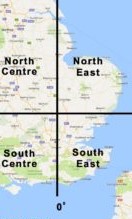
BICC Section Map
And so, from Patrington, in the north of England to Barcelona, on the north-eastern coast of Spain, let’s hear how Trevor gets his birds home from 854 miles.
I have been asked to write a report on my birds’ performances at 854 miles. People ask me how do you do it? To me it is the pleasure of preparing the birds over the years ready for the ultimate test Barcelona. I will give you an insight on my way of thinking and preparing my birds. I stress, this is my way, each person must select his own path on distance racing, and if a small loft team, do not be diverted trying to keep up with the big team members. In a big team set up with three or more lofts, one loft can be dedicated to the distance, and apply the same method as the small one loft.
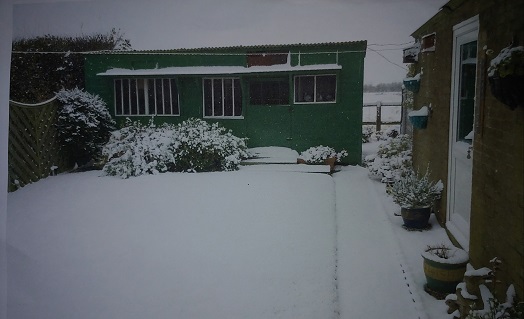
Trevor's loft in the snow
I have always enjoyed channel racing with the club, and still do, but limited to under the 500-mile distance. On joining the National Flying Club this increased the distance to over 700 miles. Then the BICC gave me 854 miles distance, a target to go for. People who fly the distance in the North over 800 miles are a breed of their own, and friendships and respect for each other is formed. People like Mick McGreavey, Chris Gordon, Brian Denney, Dave Fussey, and Alwyn Hill do not boast about their performance, just a nod and, ‘well done’ in appreciation of a good position in a distance race, they know what it takes.
Jim Emerton of York, who I met about 20 years ago at Sycamore Cottage, with his mother, has promoted distance racing in the North, donating cups in the BICC for members flying over 750 miles. Full credit to Jim for his dedication to the cause. The NFC and BICC are wonderful clubs to compete in, Carol Francis of the BICC and Kevin Healey and Mick McGreavey of the NFC are always ready to help you with any problems. Helping other fanciers getting their birds to marking stations is another bond between the distance members. I did a 500-mile round trip on one occasion.
For races over 700 miles, I have had birds taken awards from Pau 714 miles, being 1st North East 700 mile club, 1st Section K and 9th Open. Palamos 790 miles, Tarbes 722 miles. Marseilles International 748 miles, taking 1st Section, 1st Open BICC and the ‘Pascal Smet’ International trophy for the longest recorded bird in the International race with 13,500 birds competing. Barcelona 854 miles winning the Section trophy four times. I have birds that have flown Barcelona three times, one after only three 100-mile races then into Barcelona 854 miles taking 2nd Section, beaten by her nest mate by one and a half hours that took 1st Section. A hen flew Tarbes 722 miles as a 2, 3 and 4-year-old taking section awards in the first eight, then as a five-year-old onto Barcelona, 854 miles taking 1st Section. The personal pleasure of seeing them arrive home is my reward.

Trevor with his Tarbes hen


1st Section Barcelona 854 miles & 3 x Tarbes 722miles & 3 x Barcelona 854 miles in her retirement.
To start you must decide the strain or strains you are going to fly. Mine are Jan Aarden based, with a blend from Van Hee Kirkpatrick, and others that could be any strain.
I keep four pair of stock birds and breed about 40 young birds, if I breed more, I will lose birds training until I get down to the forty mark. I do breed some late-breds, but I do not count on these to perform the following year, most of them will look great but take up space, fill their crops, then disappear first or second race, I still breed them though.
I pair the birds in second week of February, I used to mate at the end of March, but the birds were feeding young when I wanted to get them into the racing mode. I also feed a heavy mix when breeding. Have your own plan, do not chop and change each month, there are plenty of armchair winners, and big team commercial winners, all telling you to do this, buy this bird etc. You are at the sharp end, i.e., the loft, with your own personal life and environment affecting your racing plans. Keep it simple, do not get upset if you do not win each race. Think of the end goal, listen to advice, but take only what you think can improve your performances.
I wean at 25 to 30 days and do not keep any birds that show signs of weakness, make sure you do not eliminate ones just because they look small, you could end up with all cock birds. Training starts with a few short 5-to-10-mile tosses. Due to being north of the Humber, a 30-mile line of flight would involve a 100-mile round trip. I therefore train thirty miles west and may take them over the Humber for one or two tosses or give them first race fifty miles and let them come over with the 3 to 4 thousand federation birds. They usually go past for 10-30 miles but it’s good experience for those that return.
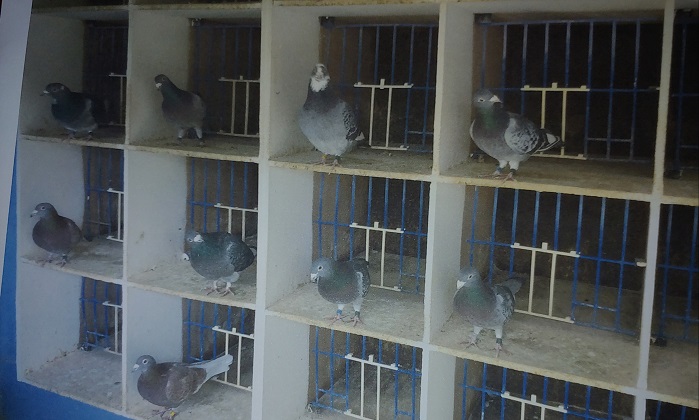
Some of Trevor's cocks
After three or four races I will stop half the team at 100-150 miles. The rest will go onto 200 miles, with four or five across the Channel with the NFC. As yearlings, due to them racing as young birds, they can get a couple of training tosses then into the races between 50 and 100 miles mark. With being in the NFC, BICC and our own YMRF there are plenty of Channel races to select from. I like them to have at least 2 to 3, 350- mile mark races. One or two may do the 4-500-mile mark. As two-year-olds you can send them to your desired race points. You will know by now which birds you can rely on. You will also have three, four, and maybe five-year-olds that have come through your racing system the previous years. You must also remember that your birds could be 5 to 6 days in the basket prior to release, so your feeding, motivation of the birds should be considered. I have had pigeons home from Barcelona on a relaxed widowhood system, sitting on eggs or feeding young.
You will get setbacks, and distance racing is not for the faint-hearted. At National and International racing getting to marking stations and clock checking can be a problem but help and advice can be found by talking to the officials of the clubs. And so, all the best to all fanciers, especially the club’s, federation’s, and national’s officials who do their best so we can enjoy our racing. I’m looking forward to trying the distance in 2023 and hope that fanciers find my report interesting.
And that concludes Trevor’s account of his methods and achievements over 800-mile races. If this has encouraged anyone to try racing from the distance in the Internationals, then the BICC will be staging 5 International races in the 2023 season. These will be from Pau, Agen, St Vincent, Barcelona, and Perpignan.
Anyone interested in racing with the BICC to compete in these races, against the best in Britain and Europe, can join the BICC for £40 membership with £9.50 birdage for each International race. The BICC are always keen to welcome new members and Jim would love to see a new name lift one of his trophies. So, why not give it some thought over the winter?
Mike Jackson
BICC Press Officer
Email:
Tel:07964448291